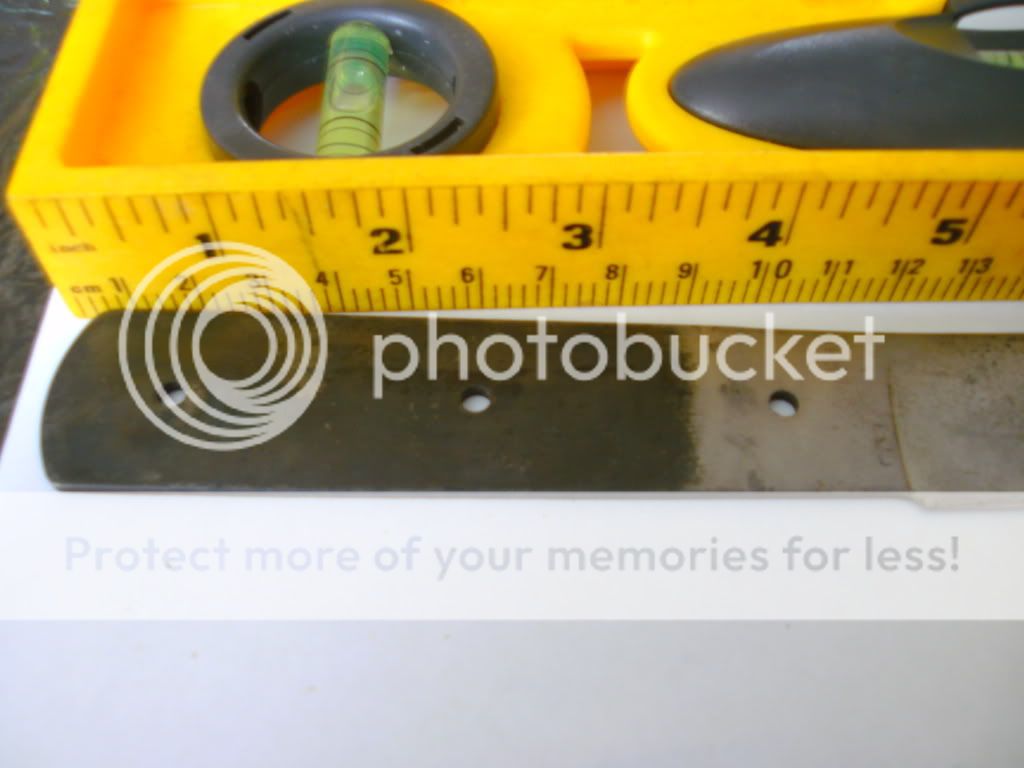
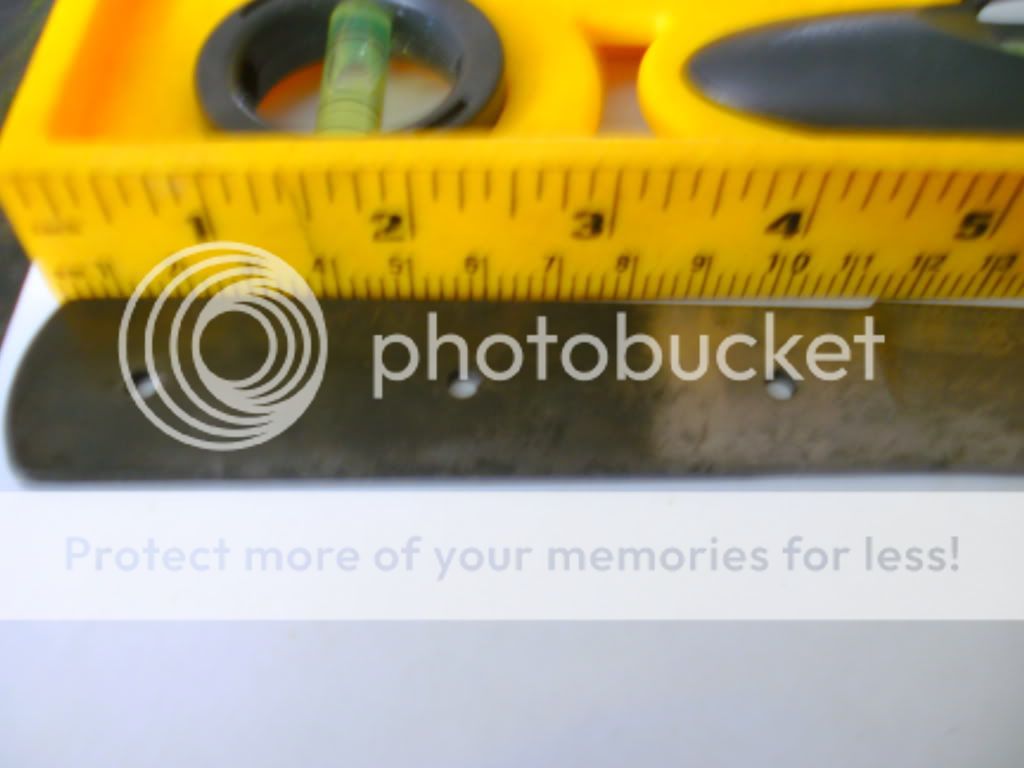
Trying to 'rebuild' a blade I found.

Joined
Feb 16, 2012
Messages
1,641
Hi all, I have a question pertaining to tinkering with a knife.

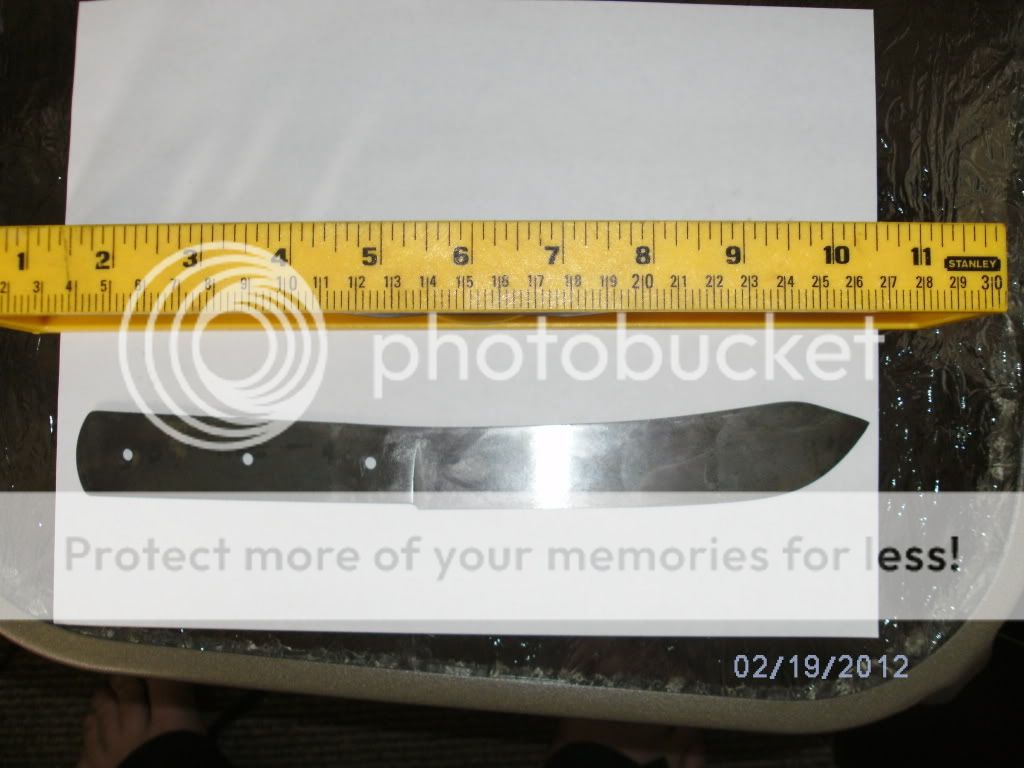
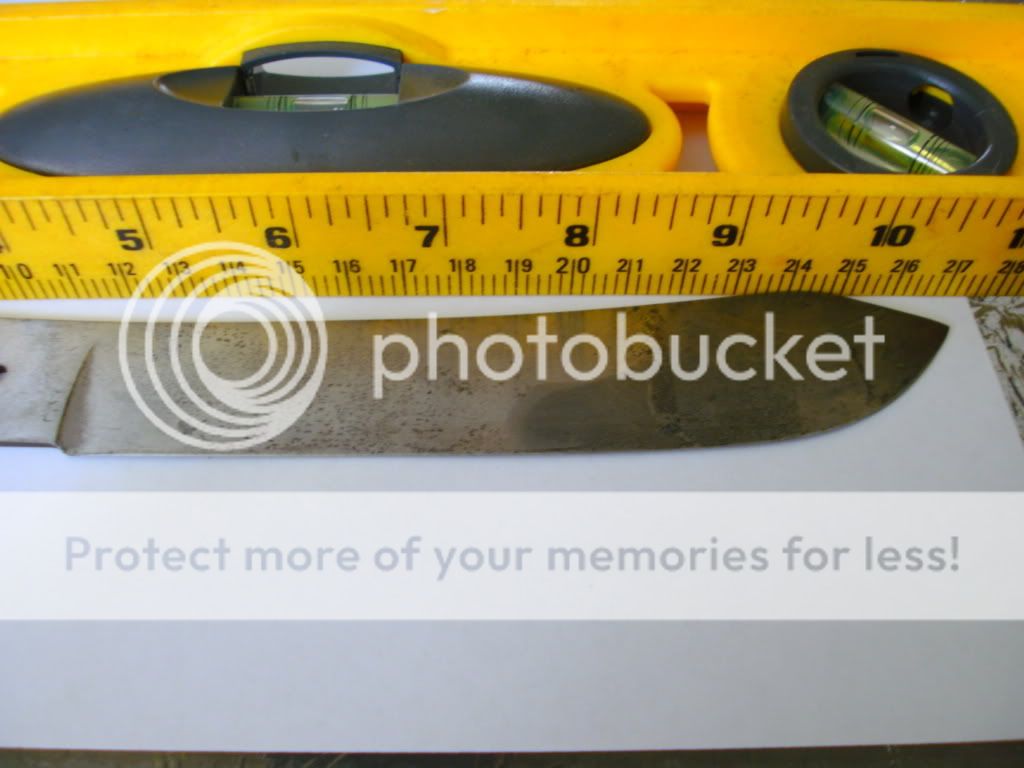
The knife in question is a Dexter-Russell Traditional 6 in. Butcher (just under 10 1/2 in. overall, exactly 1/5 cm at the thickest), it's has a profile of something between a trailing point (in that it's upswept) and a clip point, and a drop point, the curve goes from tip to butt, it decreases after hitting the balance point, which happens to be at the very edge of the handle. The handle still curves though, just enough to make it annoying to hold.

So, my question is, how would I go about reshaping this knife into a drop point with a perfectly flat spine and leveling the handle? Also, how would I go about skeletonizing the handle between the pin holes?

Also it seems that the previous heat treat was ruined, I determined this from the discoloration at either end of the knife, butt and tip. I do not know what grade of steel it is, but according to the Dexter-Russel site, it is made of either stain-free high carbon or classic high carbon, no actual grade is given.

I would like to give it either a convex or scandi edge as well.

Thank you in advance for any advice and/or help you can offer.

Edit: I will have pictures of it up soon.

Edit 2: I have pictures. Sorry if they're blurry, I get shaky hands when I haven't eaten in a while...
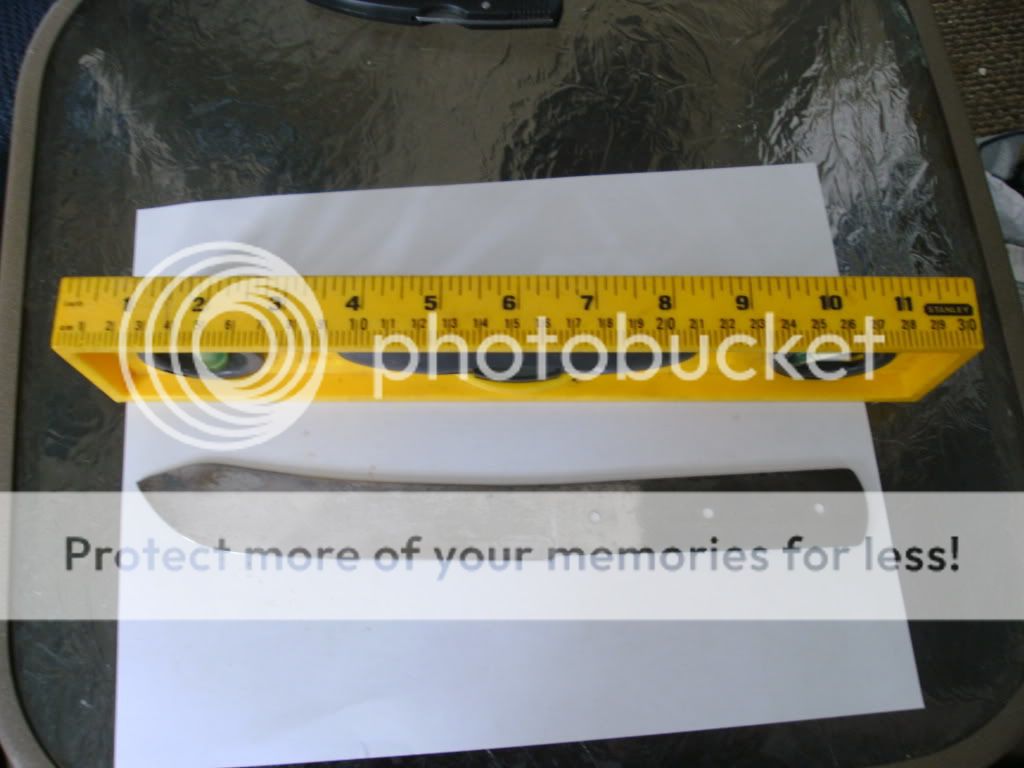
BILD0654.jpg

BILD0637.jpg

BILD0653.jpg

BILD0652.jpg

BILD0649.jpg

BILD0643.jpg

BILD0641.jpg

BILD0644.jpg
 
Last edited:
First-tape the edge so you don't accidentally cut yourself. You can use files or sandpaper or a belt sander or even a bench grinder. If you are patient a Dremel will work. Mark the profile of your new knife with a Sharpie or similar. You should have eye protection and a good dust mask or respirator. The belt sander will throw a lot of sparks as will the bench grinder so you need to watch out for combustables. Then patiently cut away the highlighted material taking care to cool the blade often if you are using a power tool.
The temperature needs to get hot enough to start burning the handle @ 500 degrees F before the temper will ruined. I've read that the steel is 1095 for the older knives. What color is the discoloration?
 
The temperature needs to get hot enough to start burning the handle @ 500 degrees F before the temper will ruined. I've read that the steel is 1095 for the older knives. What color is the discoloration?

The guy that gave it to me was at the same reenactment with me, our fires were upwards of 700 degrees on the embers, where I suspect it was, and the discolorations go from something slightly darker than gunmetal gray to almost black with some blue and brown (not rust, took care of that), and I have recently cleaned it so it's not left over soot.
 
Last edited:
Just read your profile. Check with your parents and scoutmaster. You might be able to get another badge out of this. Two cautions though; first you should have some adult supervision, and permission when you start doing a project like this and second, many localities frown on juveniles with large knives. That being said, depending on how long the blade was at temperature the RHc should still be 50 -55. This is in the range of most knives made previous to the late 1800s. So it would make a good reenactment knife. You should be able to get a large number of knifemaking books from your library. Knife modification and knife making use many of the same techniques.
 
I thought about how the metal working badge fits into this, but so far it doesn't match up enough to spend the extra time and resources on getting the badge in conjunction with this project. My parent's are OK with it since I already have the knife and they know I will likely shorten it a little bit. And my Scoutmaster is not someone I would go to for anything about knives, forget re-profiling them.

And as for the juveniles with knives deal, I live in Florida, the only knife laws here are on concealed carry, and that just says the only knife you can carry concealed is a folder under 4", anything else has to be visible. And being as it's Polk County, there is a higher concentration of red neck (police and sheriff dept. included) here than any where else in the state, I don't know one person that isn't pro-knife as long as it's not a machete at the bank or at a mens store. Everyone here carries a small folder at all times, except my parents who aren't pro-knife but aren't anti-knife either.
 
Last edited:
Bo T has given some good advice on where to get started with this project. I admire your ambition for taking it on. If you use power tools just go slow and keep the blade cool. In case you don't know, blades like that one are pretty cheap at several locations on the net. If you mess that one up find another and keep after it. In my twisted little mind I can see some kind of a tanto blade in there!
 
How long do you think sand paper would take? Or a file? The file seems to me to be the best manual option, given that it has more uses than sand paper. The reason I think the manual methods would be better is because I don't want to wait for my Dad to get a bench mounted belt sander, and I don't know anyone who has one.

I'm sorry if my other post made me sound somewhat snobby, after re-reading it that's the impression I got from myself.
 
Thank you. I just did a test recommended by Richard, thank you by the way, and found that one part of the cutting edge has an at least degraded heat-treat, the steel didn't roll, but it did bend, there is a bend in the edge, I will post a picture of it soon. Until then it looks like if you were to take a diamond dusted steel rod and pried it against the edge until it created an indentation on one side and a lump on the other.

Until I can get a decent picture of it here is a dash and arrow diagram: ______________/\_____________________

It's not a chip, it looks almost pushed....
 
Last edited:
Sorry for the double post but I got a half decent picture and I modified it to make the 'bump', as I've been calling it, as visible as possible, all I did to it was increase the black and white levels to show more contrast. Here is the picture, the arrow points to the 'bump'.
.......\/
BILD0672-1.jpg
 
Last edited:
i'm still curious to see how it does with an edge. i'm betting it will need to be re heat treated.
 
So, what's the verdict? At the risk of sounding newer than I am (that's hard to do, but it's still possible...) what should I next? So far I've determined that I have a knife with a heat-treatment ruined in one spot...... The only thing I know how to do at this point is run sand paper and a file along the knife to shape it....

Should I sand/file it down before I heat treat it, if I even have to actually heat treat the whole thing?
 
Last edited:
It seems as though the knife is a little softer than when it came from the factory. If you have a vise, pad the jaws and use it to hold the blade while filing. Or if you have some clamps you might be able to clamp it between a couple of boards while filing. Show a picture after it is profiled.
 
Will do! Just one question, should I use a file or emery cloth? Only asking because either way I need to wait a couple days, files are at grandparent's, I won't be there until Sunday, emery cloth I should be able to get tomorrow if there's enough time before church.
 
Start with a course file for fast metal removal. As you get closer to your profile file with less pressure or use a medium or fine file. Finish up using 220 or 320 wet sandpaper to smooth up any rough spots. You can use sandpaper. Start with (@ 60 grit), go to (120 -180), finish with (220 -400). Use a sanding block.
 
Okay, took me a little while to get underway with this, but I've had a scheduling issue with the local hardware stores, what would you guys think about me making the blade a little shorter and not having to deal with the ding/dent/nick or whatever it's really called? I was thinking about making it 4 1/2" from tang to tip, with the drop point it would eliminate the one issue I found in the cutting edge because it's right at the 4 1/2" mark.
 
Last edited:
Back
Top