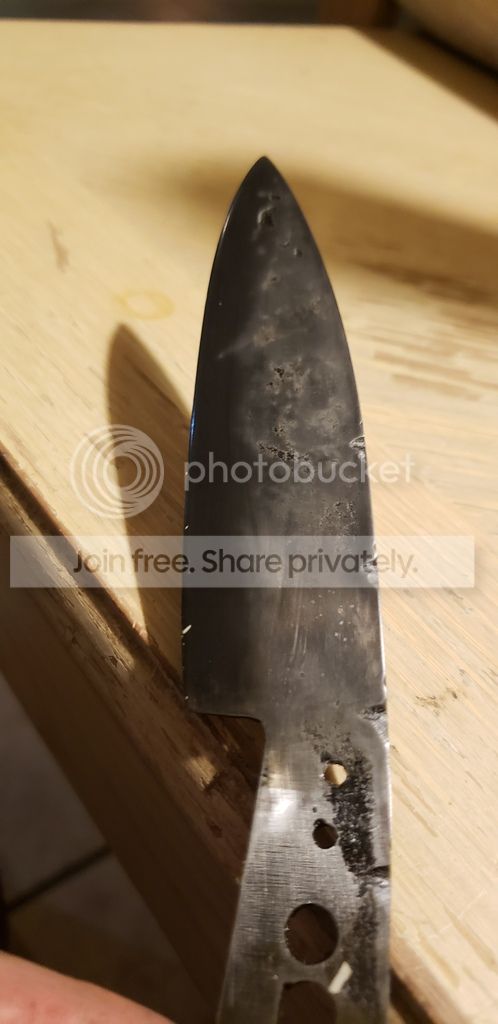
Unintentional 1095 hamon??

Joined
Sep 20, 2018
Messages
31
Hey guys, new knifemaker here. Also new to posting in any forums so please forgive me if ive posted in the wrong thread or if this has been answered previously. For the last year or so ive read insane ammounts of useful information on this forum and finally decided to make an account.

Anyway, when i first decides to buy known steel I foolishly included a 36 inch bar of 1/8" thick 1095 without truly knowing the challenges in heat treating especially with my equipment.

A couple days ago i decides to forge out a knife from this 1095 and heat treat it. (I use a brake drum forge with lump charcoal as fuel, i throw a piece of black pipe in there when heat treating for an even heat and do the heat treat outdoors at night... i used canola oil heated to 120°F for my quench..dont quite have the funds yet for parks 50).. anyway i brought the steel to non magnetic and attempted to hold it slightly over that for a bit over 10 minutes and went into my quench.

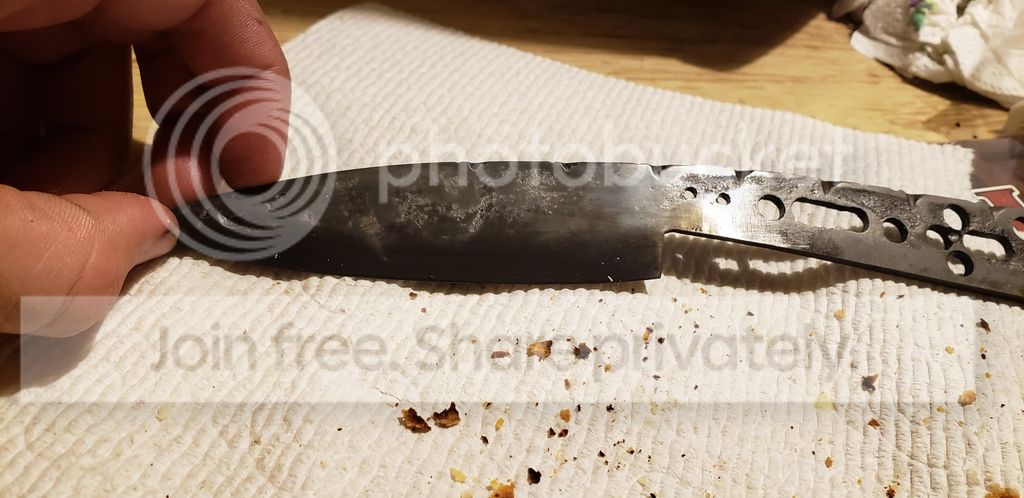
While sanding i noticed a sort of anomaly and decided to bring it up to about a 1200 grit and acid etch in 3:1 water to Ferric chloride mix and this is what it exposed. I cant really get a hamon line out of it but there are a couple different shades in
20180926_225249_zps2v4bipbx.jpg
the steel... (i did fully quench the blade but not the tang ... meaning i did not edge quench)
Everytime i scrub the oxides off completely using 000 steel wool or 1200 grit paper i can barely tell theres a difference. im going to try to add pics if anyone can tell me what this is??

SORRY FOR THE LONG POST


Last edited:
Pics aren't showing but 1095 is a very shallow hardening steel and with a less than optimal quenching oil besides, its extremely likely that some accidental differential hardening occurred.
 
That blade would probably need to be ground more and cleaned up a LOT better to truly assess what's going on. Looks like a lot of scale/decarb going on and possibly some blistering from overheating.
 
That blade would probably need to be ground more and cleaned up a LOT better to truly assess what's going on. Looks like a lot of scale/decarb going on and possibly some blistering from overheating.
I honestly dont think i can ground it any more. The blades already now pretty thing from that and I did a really fair amount with 40 grit to 120 on belt sander, and then hand sanded to 1200. I got lousy on the 1200 because i jumped from 600 to 1200 as i do not have any 800 grit paper. I believe Alot of those marks are reminiscences of my terrible hammering.

Heres a pic during lower grit sanding

 
Last edited:
Likely, your edge got up to temp, but the spine didn't. Also got some decarb goin on in the rougher upper area. It is not a bad thing.
 
Likely, your edge got up to temp, but the spine didn't. Also got some decarb goin on in the rougher upper area. It is not a bad thing.
Thanks j doyle and thankyou don hanson, so how can i avoid such deep gouges of decarb? I cant grind it all out because the knife would end up too thin.

So would that techincally be considered a hamon? I kind of have to leave some of the oxides on there to make any of it noticable or visable. Any advice on that?

Also whenever i etch, thay bottom edge gets really dark compared to the rest. And i dont see this as the case in most videos i see online of people etching their hamons using the same etching dilution and all.
 
So im thinking.. could the decarb on the top have caused the differential hardening??? Losing carbon content and not allowing it to harden evenly?
 
The decarb probably isn't the reason for the differential hardening. That was probably due to the shallow hardening nature of 1095 and an oil that's a little on the slow side for 1095. There does appear to be some definite differential hardening.

The decarb is probably a result of too high of a temperature coupled with too much time at too high of a temperature. 10+ minutes at an unknown/uncontrolled temperature is not the best practice for a steel like 1095.

But like Don said, differential hardening and even forge scale/decarb in areas above the cutting edge aren't necessarily bad things.
 
The decarb probably isn't the reason for the differential hardening. That was probably due to the shallow hardening nature of 1095 and an oil that's a little on the slow side for 1095. There does appear to be some definite differential hardening.

The decarb is probably a result of too high of a temperature coupled with too much time at too high of a temperature. 10+ minutes at an unknown/uncontrolled temperature is not the best practice for a steel like 1095.

But like Don said, differential hardening and even forge scale/decarb in areas above the cutting edge aren't necessarily bad things.
Thanks don, I really appreciate the input, i guess i should hold off on my 1095 until some future time when i have parks 50 and a heat treating oven. Im kind of interested on hamons now so maybe ill pick up some 1075 or something with a low manganese content.
 
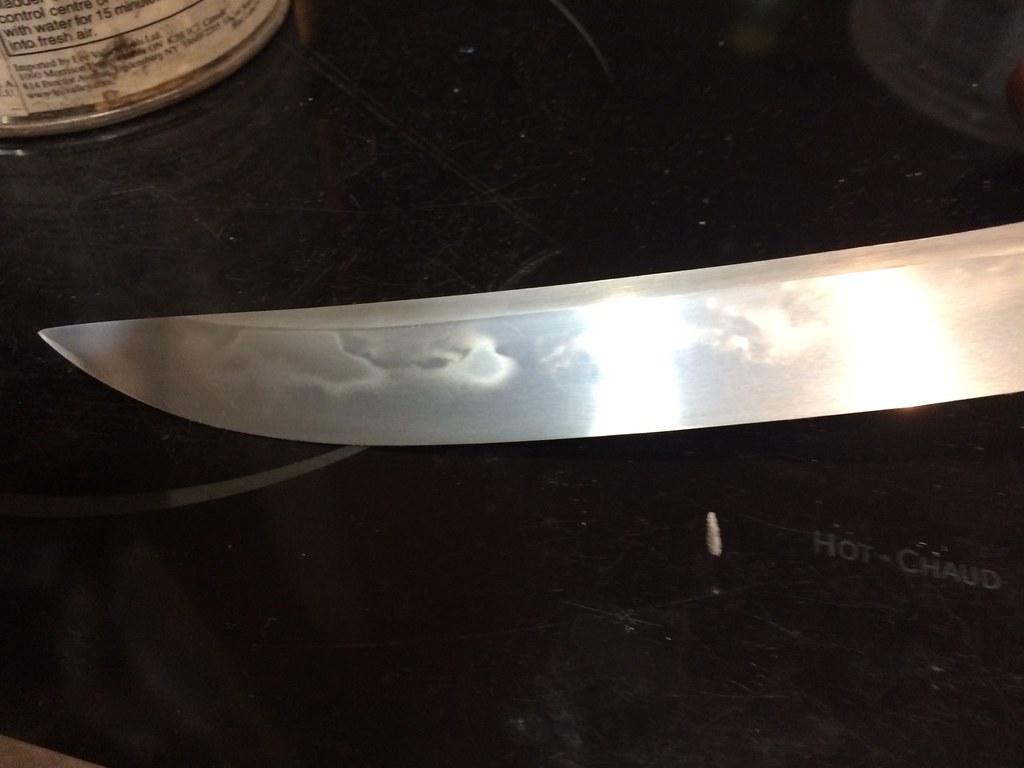
I can’t tell if we are seeing decarb, or a cloudy hamon. I like the cloudy ones best. Like this:

IMG_0767 by Wjkrywko, on Flickr

Same here haha. Those cloudy hamons are just awesome.
Yeah I cant tell either, I may play around with it and try to polish a hamon out when I have extra time. May just be decarb tho I guess? Ill post results.
 
so how can i avoid such deep gouges of decarb?

Leave the blade thicker when forging. When I started making knives, I had a tendency to calculate starting stock size to get to them close to final thickness, thinking like a blacksmith and not a blade smith and not wanting to waste steel. Being diligent about brushing off scale after each heat will help also.
 
Same here haha. Those cloudy hamons are just awesome.
Yeah I cant tell either, I may play around with it and try to polish a hamon out when I have extra time. May just be decarb tho I guess? Ill post results.

Try some etch amd Polish cycles, and see what develops. :thumbsup:
 
Back
Top