Unknown Wood Question

Joined
Jan 10, 2011
Messages
1,448
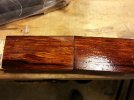
I received these two blocks of wood from a friend, who says that these pieces of wood are black walnut. He said that a friend gave him the wood 4 years ago and that he built guitars. He claims that the wood has been treated and he showed me a couple knives that he completed with the same wood from the same guy. Now here is where my question comes in. The knife that he showed me that was supposedly "black walnut" it looked nothing like these blocks of wood. I put some water on the scales to see how they would turn out below are the pics.

Would you use this wood and does it look like black walnut.

attachment.php


20130817_012859.jpg
 
That does not look like walnut to me, but wood identification from a picture is nearly impossible. You need to feel the weight, density, smell, end grain, look at it from several angles, then make a good guess. Knowing the location it was harvested or purchased can help as well/ Try to dent it with a fingernail. If you can't its probably dense enough to use as a handle. As a broad guess, it looks like one of the woods that replaced rosewood and ebony as staples in luthiering when the choice woods became more scarce. It looks sort of like a rosewood lookalike. I doubt anyone would give away actual rosewood.

http://www.wood-database.com/wood-articles/the-truth-behind-wood-identification/
 
?Tulipwood has a similar appearance. Pau Ferro was used in a lot of guitars, and looks a bit like this as well. I have seen stained and polished oak look sort of like this too though.
 
Repeat!!!!!: you cannot identify wood from a picture anymore than you can identify steel from sparks!!!
 
True, Willie, but if you've seen a lot of wood or a lot of sparks, you can make a pretty good educated guess.
 
my guess pau ferra or cocobolo. You could look at LMII.com they are a luthier company. I buy a lot of sides from them for my guitars. Look at images on their back and side sets. I would guess it's a rosewood. Doesn't look like Walnut, eastern or claro walnut which is used for guitars.
 
As said its very hard to figure out from pictures but if its pau fero or cocobolo its very easy to distinguish from the smell it has.

Pau ferro that I have used generally has a more distinct color lines in it that arent as broken as they are in that piece.
 
I'm going with the crowd. I am new to knives but used to build/repair/collect guitars for years. I know my woods really well, but this one is a bit odd from a photo. Some you can tell instantly almost without question. Incidentally, a lot of the places I used to buy instrument wood were knife/guitar wood suppliers, kind of how I got into knifemaking.

My first gut instinct was a funky piece of cocobolo (like everyone else), but once I read pao ferro I also thought that a possibility.
 
Without more than a picture, nothing above is better than a guess. Sorry if I offend anyone, but that is the reality of the situation. its like "what is my saw blade made of?"
 
Without more than a picture, nothing above is better than a guess. Sorry if I offend anyone, but that is the reality of the situation. its like "what is my saw blade made of?"

I dunno, I agree with you about 50/50. Some woods are so distinctive that you can't miss them. Wenge, and Snakewood are a couple that if properly photographed, there's just no mistaking them. They're too unique in their grain patterns. Same with some good birdseye maple, or really high quality California walnut. Also, curly redwood is pretty easy to tell. There are some oddballs that are also usually easy, like lacewood and zebrawood.

If the quality of the picture and wood are both high, I find it very east sometimes. Other woods, though, certainly do require more than a picture to tell apart. I've been familiar with exotics for quite a few years, but even the guys who have forgetten more than I've learned have trouble in person many times with certain similar woods, or very dusty or dry samples.
 
Look at the link above, and it has a quiz with five woods that seem easy to identify. It then lists the actual woods. I got the same exact answers as the author and was wrong on all five. I too have been working with exotic woods for decades, building my first electric and acoustic guitars and basses in my teens. I thought I was good at identifying woods, but learned I can make a good guess, but that's it.

I have wenge doors in my house. I have a piece of bocote that looks exactly the same. I have zebrano cabinets, and there are other woods that look identical. It's nearly impossible to tell saepele from Honduras mahogany, and I have pieces of tiger wood that I would have sworn were mahogany, except I cut the figured part off, and know what it is.
 
Last edited:
I started to post on this question when it was first posted, but deleted it.
What I had written was:

There is no way anyone can identify that wood from a photo. Twenty people can have twenty suspicions, and none may be correct. Wood is a 3D material, and even in the hand can be hard to identify, but from a small low quality photo....not likely at all.

On a side note, I send wood off to be stabilized in big batches... several hundred pieces.
I make an inventory - 20-black palm, 30-spalted maple, 25 sycamore, 15 Box elder burl, etc.
I notate how many are large blocks, regular handle blocks, and scales.
I note how many blocks of what are getting dyed brown/black/red/etc.
I make notes on any unique feature of certain blocks.
Even with this list, I spend anywhere from a few hours to a few days trying to figure out what wood is what after it gets stabilized. About the only woods that are easy to identify after stabilizing are the red and the green dyed wood...because there are usually only a few of them, and they are all box elder burl :)
 
When I purchase wood I have gone to buying only one type of similar wood at a time. It then goes into its own labelled box after I cut it up for use. For instance I won't buy several different rosewoods at a time. I still have a box of "rosewoods" from prior to starting this that I can't id.
 
Looks like ironwood I don't know for sure though so what I would do is drop them in a bucket and if they float the you can rule out ironwood as it sinks. Then if its not the grind some of it off one corner. Cocobolo's odor is almost unbearable
 
Back
Top