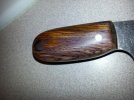
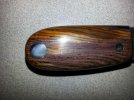
Look at the link above, and it has a quiz with five woods that seem easy to identify. It then lists the actual woods. I got the same exact answers as the author and was wrong on all five. I too have been working with exotic woods for decades, building my first electric and acoustic guitars and basses in my teens. I thought I was good at identifying woods, but learned I can make a good guess, but that's it.
I have wenge doors in my house. I have a piece of bocote that looks exactly the same. I have zebrano cabinets, and there are other woods that look identical. It's nearly impossible to tell saepele from Honduras mahogany, and I have pieces of tiger wood that I would have sworn were mahogany, except I cut the figured part off, and know what it is.
I respectfully disagree. Wenge is probably the most identifiable wood I've encountered.
I'll tell a small story. I went down to meet the guys at Tru-Grit a couple weeks ago. I met Jeff, their heat treater and got a mini-tour. Under one of the ovens on a utility rack, was a pile of wood. It was covered in dust all the way across the rear of their shop, sitting on a cookie sheet. As soon as I walked in, the first words out of my mouth were "Where'd you get all of the wenge?". Jeff seemed surprised and looked around really quick until he realized I was staring at the small pile of wood across the room. He then told me an interesting story about a boat, etc.
Every time I see certain woods, I know them immediately and nearly without question. Wenge is one of them. I'm not saying I would stake a large amount of money or my reputation on it, only that I am quite accurate when working within my comfort zone (woods that I've personally worked with multiple times). I'm not saying I can identify every wood. I'm just saying that some of the more well known exotics are so distinctive that it's almost impossible to not know what they are, for me at least. Yes, photos are not the ideal way to examine wood... but some woods have a fingerprint so strong that it comes through.
For me, it's no different than telling the difference between horse or dog breeds, it just plain comes naturally in certain instances. Just like breeding, wood requires a standard to conform to. The farther you deviate from conformation of that standard, the lower the chance you will successfully identify the item in question.
Since you have experience with instrument building, I'm sure you've experienced many moments where you said something to yourself such as "Wow, that natural curly maple works so nicely with the purpleheart", or "That is the best Koa I've ever seen", or "Wow, that is the most delicious spruce in existence".
If you haven't have those moments, I feel badly for you, but I suspect you have.

Either way, I'm not talking in absolutes. Usually a hard to identify sample is hard to identify whether it's through photograph or not. Usually a textbook example is fairly easy to identify regardless of how it is viewed. Of course there are lookalikes, but many times that does not come into serious play unless you are trying to go way off the beaten path, or working in a different geographical region/trade zone.
edit: I just read the article you mentioned in your post, and it actually appears that the author and I pretty much agree. The example he gave had a few pretty oddball species for US makers at least, and was intended to fool (which I assumed was the case anyways). On the other hand, he makes the same argument that I do above, which is that you really need to take market and geography into question. For instance, certain woods very common in instrument making are much less common in knifemaking, while others overlap almost completely.