
-
The BladeForums.com 2024 Traditional Knife is available! Price is $250 ea (shipped within CONUS).
Order here: https://www.bladeforums.com/help/2024-traditional/
You are using an out of date browser. It may not display this or other websites correctly.
You should upgrade or use an alternative browser.
You should upgrade or use an alternative browser.
Video: Takeda Hamono quenching
- Thread starter ikuyadas
- Start date
they are using liquid salt to heat the blade.... cool

Stacy E. Apelt - Bladesmith
ilmarinen - MODERATOR
Moderator
Knifemaker / Craftsman / Service Provider
From what I observe,
The first salt pot is for austenitizing. It is probably around 1450F.
The second salt pot is the quench and hold. It is probably around 400-600F.
The black stuff is charcoal powder to keep the salts clean and prevent oxidation.
The water bath is just to rinse off the salt and drop the temperature to room temp.
The unseen person ( hands only shown) is most likely inspecting the blades for cracks and warp and maybe giving them a rough scrub.
The woman is scrubbing off any remaining traces of salt.
The first salt pot is for austenitizing. It is probably around 1450F.
The second salt pot is the quench and hold. It is probably around 400-600F.
The black stuff is charcoal powder to keep the salts clean and prevent oxidation.
The water bath is just to rinse off the salt and drop the temperature to room temp.
The unseen person ( hands only shown) is most likely inspecting the blades for cracks and warp and maybe giving them a rough scrub.
The woman is scrubbing off any remaining traces of salt.

I don't think so Stacy...
The first pot is probably a pre-heat.
The second pot is the austenization. It is coming out red.
I believe they are quenching in oil. Does water steam that long after a 3 second quench? It looks more like smoke.
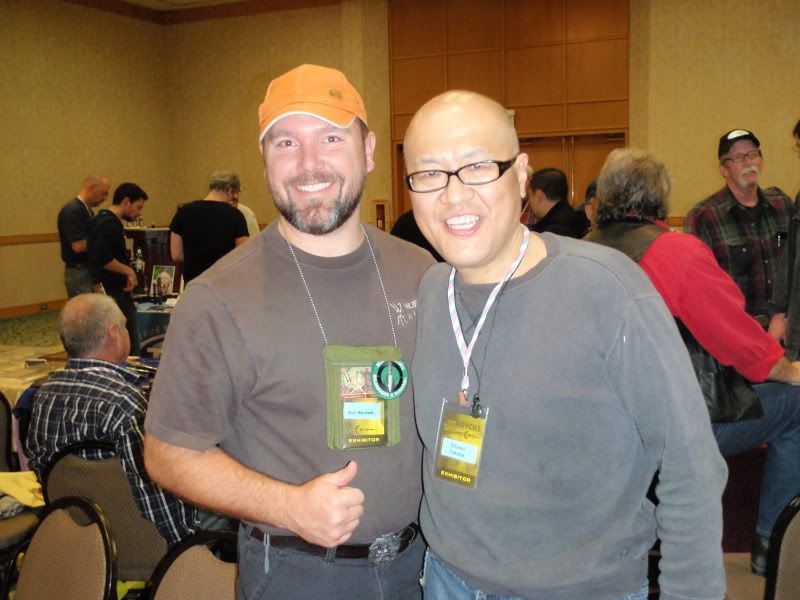
I like Sho and try to take time to talk to him at every show.
The first pot is probably a pre-heat.
The second pot is the austenization. It is coming out red.
I believe they are quenching in oil. Does water steam that long after a 3 second quench? It looks more like smoke.
I like Sho and try to take time to talk to him at every show.
Ahhhh.... it's lead not salt!
The blades are clay coated and the woman is wiping off the clay.
They are probably only inspecting for cracks at this point. Straightening is done throughout the entire process.
The blades are clay coated and the woman is wiping off the clay.
They are probably only inspecting for cracks at this point. Straightening is done throughout the entire process.
Last edited:
tattooedfreak
Steel mutilater is more like it.
I think they are quenching in water, hence why he keeps wiping the tongs off after quenching the blades. Whether it's lead or salt, water drops would cause spray in any molten liquid. I think the steam is coming off the blades and just looks like its coming off the quench.
I think they are quenching in water, hence why he keeps wiping the tongs off after quenching the blades. Whether it's lead or salt, water drops would cause spray in any molten liquid. I think the steam is coming off the blades and just looks like its coming off the quench.
The quench looks like it has the viscosity of a hot oil, not water
I think oil droplets into lead would vaporize and bubble like water would, best to skip it if you can.
?
If they are using either salt bath, or lead bath, then why would you do a clay coating ?
It looks as if it's an even layer for anti carb but wouldn't the salt / lead bath protect against that anyway ?
I think it is for differential hardening, Count. He is using AS steel and I do not think it is laminated with anything. He wants the spine soft for support and ease of straightening.
From the Takeda YT channel comments...
From the Takeda YT channel comments...
Lead bath. Blades coated with clay of natural whetstone.
We rubbed blade after quenching to wipe the clay.
Coal powder protect lead from oxidation.
Last edited:

I believe nearly all of Takeda's knives are clad in soft iron.
He is famous for his Kurouchi knives.
He makes other knives as well, but I don't ever remember seeing a honyaki Takeda.
He is famous for his Kurouchi knives.
He makes other knives as well, but I don't ever remember seeing a honyaki Takeda.

Lead to Austenitize, I knew it!

I think it is for differential hardening, Count. He is using AS steel and I do not think it is laminated with anything. He wants the spine soft for support and ease of straightening.
It is not for differential hardening, it is a thin wash to aid in hardening of the whole thing. A thin wash aids in the cooling rate.
It is not for differential hardening, it is a thin wash to aid in hardening of the whole thing. A thin wash aids in the cooling rate.
I think that's the ticket
Thanks for clearing that up.I believe nearly all of Takeda's knives are clad in soft iron.
He is famous for his Kurouchi knives.
He makes other knives as well, but I don't ever remember seeing a honyaki Takeda.
I have heard of that before, Sam. I use a thin wash to reduce oxidation in my electric kiln and was worried that it may hinder hardening. A few smiths told me it may actually speed up the quench..... I just didn't add 2&2 together in this instance.It is not for differential hardening, it is a thin wash to aid in hardening of the whole thing. A thin wash aids in the cooling rate.
It' OK, there was alot of conclusions jumped to quite quickly in this thread.
it's more precise really then just "a thin wash", slightly thicker and it will begin to do just that Rick.
it's more precise really then just "a thin wash", slightly thicker and it will begin to do just that Rick.
Last edited:
lead... .. there was a vid awhile back on some chaps doing that with swords in england.. it would work well !
cept for the eventual lead poisoning
guess every process has its little dangers ...
you could find lead alot easier than heat treat salts... and i bet if you alloyed the lead, you could reduce the mp enough for low temp salts... maybe... hmm
cept for the eventual lead poisoning
guess every process has its little dangers ...
you could find lead alot easier than heat treat salts... and i bet if you alloyed the lead, you could reduce the mp enough for low temp salts... maybe... hmm
Technical specs when I was researching lead bath Austenitization seemed to say that lead doesn't start to gas/vapor until quite a few hundred degrees above normal heat treating temperatures. So that would also lead me to believe that coupled with the charcoal dust on top to help negate lead oxide gas(?) it wouldn't be all that dangerous with adequate ventilation.
I just went through my tackle box to collect sinkers... I'm on my way!

The thin wash increases the surface area, large area=quicker cooling. So long as you don't make it to thick.\
Lead doesn't turn to vapor until around 3200F
http://www.ptable.com/ cool chart with all the elements and info on them. Theres a slider in the top right for temperature so you can see which phase of matter the elements are in at different temps.
Lead doesn't turn to vapor until around 3200F
http://www.ptable.com/ cool chart with all the elements and info on them. Theres a slider in the top right for temperature so you can see which phase of matter the elements are in at different temps.
yes, the vapour temp is high... but contact with the skin will happen with the solid lead on the blades,dust, dirt, ingestion ... unless they take some precautions .... also i'm willing to bet there maybe a fine spray of lead when it is quenched ...some sort aerosol
- its not as bad as mercury.... i probably shouldn't have mentioned safety... i get tired of the people that preach safety..... and look here, i turned into one... just the kind of day i'm having ... friggin heatwave
- its not as bad as mercury.... i probably shouldn't have mentioned safety... i get tired of the people that preach safety..... and look here, i turned into one... just the kind of day i'm having ... friggin heatwave