
Greg the heat makes EVERYONE insane!!!!!!!! INSAAAAAAAAAAAAAAAAAAAAAAAANE!!!!!!!!!!!!!!!!!!! So no worries.

-
The BladeForums.com 2024 Traditional Knife is available! Price is $250 ea (shipped within CONUS).
Order here: https://www.bladeforums.com/help/2024-traditional/
You are using an out of date browser. It may not display this or other websites correctly.
You should upgrade or use an alternative browser.
You should upgrade or use an alternative browser.
Video: Takeda Hamono quenching
- Thread starter ikuyadas
- Start date
Here's his second comment on YouTube.
About 3:
"wate" would means "water", and he uses both method (oil and water quench according to blade materials),
and maybe water tank is set under the oil tank and also used for temp control of the oil tank.
If it is so, and if the oil tank can be slided to the pot side (lever arms are seen at the oil tank),
I think he might use oil quench in this case, it's also because AS steel is not the toughest among blue paper series....?
Now they have a exhibition near my place so I will go there to ask if it is oil quench or not.
You guys could expand my interests and I want to appreciate all who posted here.
1, The first lead pot is for pre-heat.
2, The second lead pot is for quench.
3, Oil tank is in the water tank.We use oil for alloy steels, wate for pure carbon steel.
In this case we use the water tank for the coolant of oil tank.
4, We use three layers steel,so e don't need differential hardening.Sorry I can't understand anti carb.
Clay coating is essential for hardening.
5, My another daughter put only tang in the water bucket to make it cool to hold.
6, Same with 3?
About 3:
"wate" would means "water", and he uses both method (oil and water quench according to blade materials),
and maybe water tank is set under the oil tank and also used for temp control of the oil tank.
If it is so, and if the oil tank can be slided to the pot side (lever arms are seen at the oil tank),
I think he might use oil quench in this case, it's also because AS steel is not the toughest among blue paper series....?
Now they have a exhibition near my place so I will go there to ask if it is oil quench or not.
You guys could expand my interests and I want to appreciate all who posted here.
Mr. Kobayasi answered to my question.... I hope my translation is not so fatally wrong

(He said that these are just their way and every blacksmiths have their own process )
- Oil quenched in this video. All AS steel is oil-quenched and water-quench is done to White-1 steel.
Water-quench is done in winter, not in summer because water temp control would be more difficult.
- Clay coating is to add blacken layer aka kurokawa(黒皮
 for rust resistant, and to prevent decarburization.
Straightening (歪み取り is done after tempering and coating is not for that.
Clay content is whetstone powder and coal powder mixed.
- Two pot process is to keep a correct temparature of heat treatment.
- Tempering is done 2 times, each 40 minutes at 170-220 celsius.
(Of course it depends on purpose and materials)
- Straightening is done after 24 hours of second tempering.
These processes can make the blade tougher and more chip-resistant.
- They don't make Honyaki products because it has "no merits".
(Hard to sharpen and maybe decarburization, sorry I couldn't hear correctly)
- Both side of their thin cooking knives are similar to back side of Deba,
made slightly thinner at middle part, between spine and edge for ease of slicing.
Hammering is most part of the process to form this kind of shape,
and grinder is almost only used to form outlines.
(He said that these are just their way and every blacksmiths have their own process )
Last edited:

THANK YOU for the inquiry and translation of the answer, my friend. Very informative stuff!
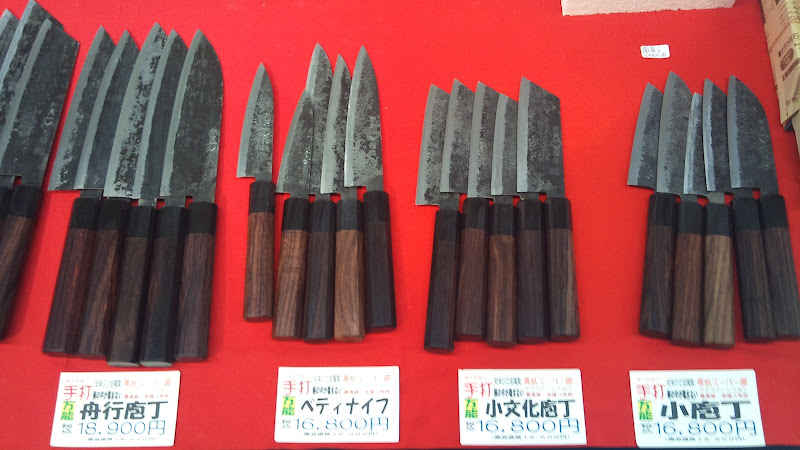


very cool pic's ... thanks bros !!!

Stacy E. Apelt - Bladesmith
ilmarinen - MODERATOR
Moderator
Knifemaker / Craftsman / Service Provider
Great photos.
It also proves that there is no one perfect grind or finish.
If I left the surface as-quenched on my kitchen blades, most of my customers would ask, " Why didn't you finish the knife?"
If Takeda Hamono sanded it off, his customers would ask, "Why did you ruin the finish?"
Another thing that is well illustrated in the photos is that the Japanese have a specific blade shape for almost every cutting task. IIRC, there are over 300 kitchen blade shapes. Every gardening task has its own blade ,too.
I have some laminated shiro-gami and ao-gami ( soft iron cheeks) coming that I plan on leaving the surface "patina" on and see how it sells.
It also proves that there is no one perfect grind or finish.
If I left the surface as-quenched on my kitchen blades, most of my customers would ask, " Why didn't you finish the knife?"
If Takeda Hamono sanded it off, his customers would ask, "Why did you ruin the finish?"
Another thing that is well illustrated in the photos is that the Japanese have a specific blade shape for almost every cutting task. IIRC, there are over 300 kitchen blade shapes. Every gardening task has its own blade ,too.
I have some laminated shiro-gami and ao-gami ( soft iron cheeks) coming that I plan on leaving the surface "patina" on and see how it sells.

IIRC, there are over 300 kitchen blade shapes.
According to one Japanese knife maker, there are over 800. At either rate, that's a freaking lot.

It also proves that there is no one perfect grind or finish.
If I left the surface as-quenched on my kitchen blades, most of my customers would ask, " Why didn't you finish the knife?"
If Takeda Hamono sanded it off, his customers would ask, "Why did you ruin the finish?"
Many of their cooking knives are extremely thin, and basically quite lightweight in hand.
Tang part is made of stainless and welded to blade part after heat treatment.
Blackened Kurokawa is pretty thicker and sturdier than it looks from photos.
I didn't confirm that they splayed resin to Kurokawa part of the blade, but I saw it reflected lights.
I think precise shinogi grind is not the way of them, and their policy is not a general way of Sushi and other professional chefs.
Their stuff did not start from Ryōtei cooking but from other practical needs such like fishing harbours and woodsman IMHO.
Another thing that is well illustrated in the photos is that the Japanese have a specific blade shape for almost every cutting task. IIRC, there are over 300 kitchen blade shapes. Every gardening task has its own blade ,too.
It looks like every prefecture has ever had their own shapes

My family was surprised to see a "爪切り鎌(sickle of nail cutting)" (7th photo, left side of 5,250JPY tagged), that was for cows I found after.