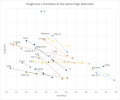
Visualizing the Tradeoff of Higher Hardness

There are many experimental reports on the effect of thickness on impact toughness. None of them say it is proportional to thickness cubed.
Hmm, I might have confused fracture toughness with impact toughness. Rookie move. Is there a correlation in the literature?
 
Hmm, I might have confused fracture toughness with impact toughness. Rookie move. Is there a correlation in the literature?
There might be a good chapter in a book somewhere but I don’t know of that off the top of my head. It is more complicated than a simple relationship. Toughness values are often normalized to the cross-sectional area but there are many known reasons why the behavior changes as the specimens get thinner, such as thinner specimens have a larger percentage of ductile shear. Here is an article that could get you started: https://www.sciencedirect.com/scien...23314e5&pid=1-s2.0-S2452321616304838-main.pdf

Let me know if the direct pdf link doesn’t work.
 
There might be a good chapter in a book somewhere but I don’t know of that off the top of my head. It is more complicated than a simple relationship. Toughness values are often normalized to the cross-sectional area but there are many known reasons why the behavior changes as the specimens get thinner, such as thinner specimens have a larger percentage of ductile shear. Here is an article that could get you started: https://www.sciencedirect.com/scien...23314e5&pid=1-s2.0-S2452321616304838-main.pdf

Let me know if the direct pdf link doesn’t work.
I read a few papers from Wallin and his work indicates that impact toughness is essentially linear with thickness at very low thickness, which should be applicable to knife edges. And yes, this is due to shear fractures being dominant. I'll see what this looks like in the model.

EDIT: The linear relationship produces very unrealistic results. Back to the drawing board. I'm wondering if maybe the disconnect is between notched and unnotched Charpy tests? Wallin's work is mostly about the notched test. Or maybe his model just doesn't work for thickness lower than 2mm.
 
Last edited:
There might be a good chapter in a book somewhere but I don’t know of that off the top of my head. It is more complicated than a simple relationship. Toughness values are often normalized to the cross-sectional area but there are many known reasons why the behavior changes as the specimens get thinner, such as thinner specimens have a larger percentage of ductile shear. Here is an article that could get you started: https://www.sciencedirect.com/scien...23314e5&pid=1-s2.0-S2452321616304838-main.pdf

Let me know if the direct pdf link doesn’t work.
I now remember where I got the cube of thickness relationship from, it was your article: https://knifesteelnerds.com/2018/08/27/what-is-edge-stability/
Thinner, sharper, more acute edges are not as strong as heavier edges. This is perhaps obvious but is supported by simple engineering calculations. For a rectangular cross-section the resistance to a deflection is greatly controlled by thickness, as the degree of deflection is divided by thickness cubed. You can read more about these calculations in the article on flexing of steel.
I think if we control for hardness then this gives us a pretty good proxy for toughness of an edge. In the second part of that article, you discussed the thesis of Roman Landes, who tested edge stability of 20° and 10° chisels. He never published the 10° data but maybe comparing the two data sets would confirm this or reveal a different relationship. If you could reach out to him about this it would be really helpful.
 
I now remember where I got the cube of thickness relationship from, it was your article: https://knifesteelnerds.com/2018/08/27/what-is-edge-stability/

I think if we control for hardness then this gives us a pretty good proxy for toughness of an edge. In the second part of that article, you discussed the thesis of Roman Landes, who tested edge stability of 20° and 10° chisels. He never published the 10° data but maybe comparing the two data sets would confirm this or reveal a different relationship. If you could reach out to him about this it would be really helpful.
That is for strength not toughness
 
Yes, I'm saying that if you control for hardness then strength could be a proxy for the impact toughness of an edge. Aren't the two related in how they affect edge stability?
No, the best proxy for strength is hardness, the two are nearly perfectly correlated. Hardness is an easy way to measure strength. So it wouldn’t make sense.
 
No, the best proxy for strength is hardness, the two are nearly perfectly correlated. Hardness is an easy way to measure strength. So it wouldn’t make sense.
But hardness doesn't increase with the cube of thickness. So what's missing?
 
But hardness doesn't increase with the cube of thickness. So what's missing?
What’s missing is you are plotting vs impact toughness not vs strength. You can’t use an estimate of strength to adjust impact toughness.
 
What’s missing is you are plotting vs impact toughness not vs strength. You can’t use an estimate of strength to adjust impact toughness.
What I'm saying is, and I know this is very loose:

Strength ~ edge stability ~ toughness*hardness

So if hardness is constant then toughness should change with strength.
 
What I'm saying is, and I know this is very loose:

Strength ~ edge stability ~ toughness*hardness

So if hardness is constant then toughness should change with strength.
I need to be a bit more precise with my language. Material strength is already controlling for cross-section - it is force divided by area. The thickness cubed relationship comes from degree of deflection in bending. So it doesn’t make sense to say you are keeping hardness constant while changing strength. If you want to estimate changes in impact toughness with different geometry you need to look at experimental data and relationships with impact toughness. When you correlate with an estimate on top of an assumption (which may or may not be accurate) on top of an estimate you end up with something that is unlikely to bear any resemblance to reality if it were experimentally tested.
 
We could, but Spyderco won't allow it because it would destroy their business model of selling the same knife over and over in different steels 😂
Spyderco is not the only one, Benchmade does the same thing, as well as a few others. I think those are probably the biggest ones. But many people are always chasing the new and improved steels, even if they don't need them.
 
I need to be a bit more precise with my language. Material strength is already controlling for cross-section - it is force divided by area. The thickness cubed relationship comes from degree of deflection in bending. So it doesn’t make sense to say you are keeping hardness constant while changing strength. If you want to estimate changes in impact toughness with different geometry you need to look at experimental data and relationships with impact toughness. When you correlate with an estimate on top of an assumption (which may or may not be accurate) on top of an estimate you end up with something that is unlikely to bear any resemblance to reality if it were experimentally tested.
Understood, so the problem is there is no test of the tougness of an edge. But I'm only interested in toughness as it relates to edge stability.
 
The Charpy impact test will measure toughness (resistance to chipping, breaking and cracking).

Hardness is a proxy for strength, which is resistance to bending and deformation, such as edge rolling.

Together, those two qualities measure edge stability.

The problem is that different steel alloys have different characteristics -- some are higher on both toughness and strength than other steel alloys at a given heat treat. And edge stability depends on you are using your knife. If it's a chopper, you're going to want more toughness. If you're cutting cardboard, you'll probably want higher hardness and edge-wear resistance.

For any task, the best edge stability depends on strength, toughness and geometry.

My dedicated cardboard knife is a very thin blade of Rex 121 at 70 Rc. It has great edge stability for that purpose. But it would break with even moderate use.

 
The Charpy impact test will measure toughness (resistance to chipping, breaking and cracking).

Hardness is a proxy for strength, which is resistance to bending and deformation, such as edge rolling.

Together, those two qualities measure edge stability.

The problem is that different steel alloys have different characteristics -- some are higher on both toughness and strength than other steel alloys at a given heat treat. And edge stability depends on you are using your knife. If it's a chopper, you're going to want more toughness. If you're cutting cardboard, you'll probably want higher hardness and edge-wear resistance.

For any task, the best edge stability depends on strength, toughness and geometry.

My dedicated cardboard knife is a very thin blade of Rex 121 at 70 Rc. It has great edge stability for that purpose. But it would break with even moderate use.
It's not quite an exact proxy for strength.

You can have a knife at a higher hardness and It's actually less strong because it experiences brittle failure BEFORE reaching the yield strength and ultimate tensile strength point.

You can have a knife with a better microstructure and slightly less hardness that technically has higher yield strength.

The microstructure is a composite filled with constituents with different properties. When you put those at a sub-micron edge, the individual properties of those constituents really start to come out.

So, if you got extra hardness from excess plate martensite, lots of carbide formation on the PAGB and grain growth the edge will just chowder up and hardness, steel, geometry usually gets blamed.

The grail would be to develop a test that can quantify edge stability better with experiment.

Roman Landes carried the torch on that the most but it would be interesting to see more testing with a wider range of HT conditions on the same steel to see the effects of microstructure better.
 
Back
Top