Water Jet cutting?

Joined
Jun 16, 2008
Messages
3,415
Do you smile or frown upon it. I have a full time job and cutting out profiles is really no big deal. I go through a belt with every profile I do and it gets expensive and if I use up all my belt while I am on a roll then it really sucks. The closest store that carries the size I need is sears and thats about 30-40 minutes from my house. I was thinking that when I get alot of requests for a particular style of knife whick I am getting now. This could help cut some time from the whole process. I have read about GreatlakesWJ. If this is gonna keep me from calling my knives hand made then I will just stick to the old ways. What say you?
 
What difference does it make if your blanks are cut for you?
 
I'm still pretty much a newb but the method I have started to develop and refine for stock removal knives is this; to make two ~8" hunters, I'll take a 15" piece of steel and cut a diagonal in the middle that somewhat resembles the shape of the tip and I end up with two pieces about 8" in length, then use a 4.5" grinder with a cutting disc to rough shape the handle profile - making several notches in the concave curves and cutting diagonally across to remove the remaining material. For a small knife like this I've been able to grind the bevels on 2 - 3 knives with one belt then use the same belt to finish up the profiles.
 
Personally I see no issue with it. If it is a method you can use to provide your customers with a knife that is still one of a kind, made by hand by you, but save yourself some time, why would i be bad? It's a measure of efficiency. You can drill a hole with a hand-cranked drill press, but it's faster and easier to use an electric one. Is THAT Ok?

Sure, there's a limit, but profiling is a chore in knifemaking, not an artform ;)

-d
 
A silhouette is not a knife, that comes much later. You are the one that makes it a knife. If you plan on doing nothing more than selling a rough blank and calling it a knife, I would say you're cheating with the waterjet, but a profile has yet to become a blade, and nobody can make it just the right knife except for you.
 
Yep I call it ok in my book, As long as your grinding it (Flat grind or hollow grind) or filing then I say you are the one breathing soul into that knife.
Chris
 
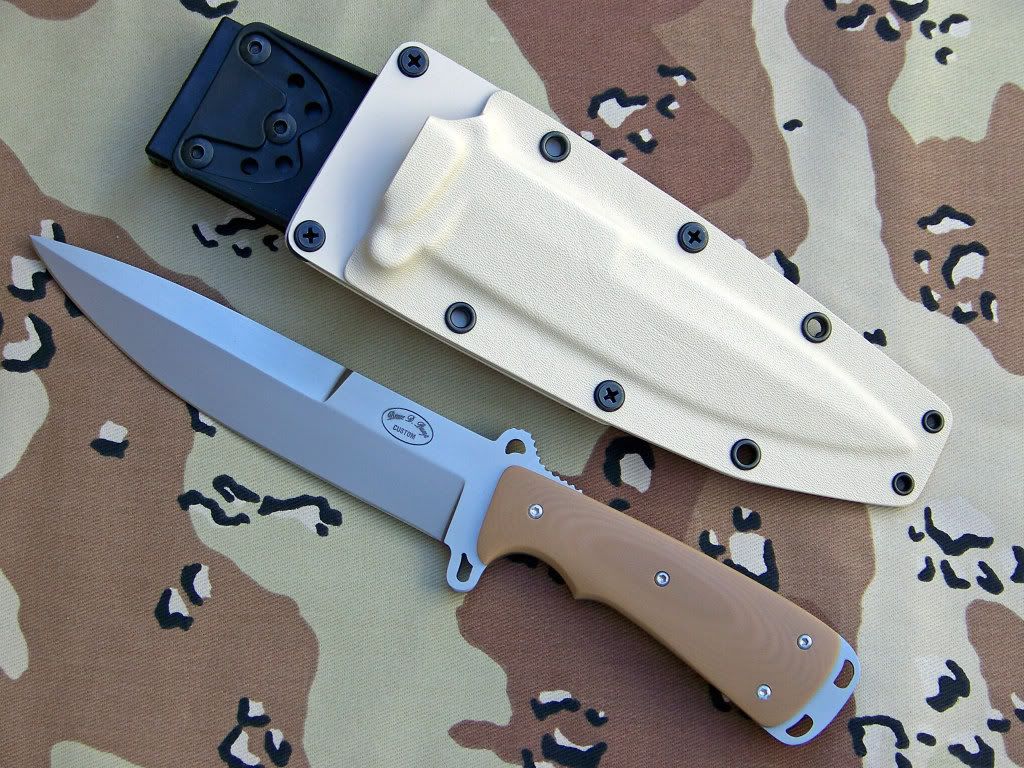
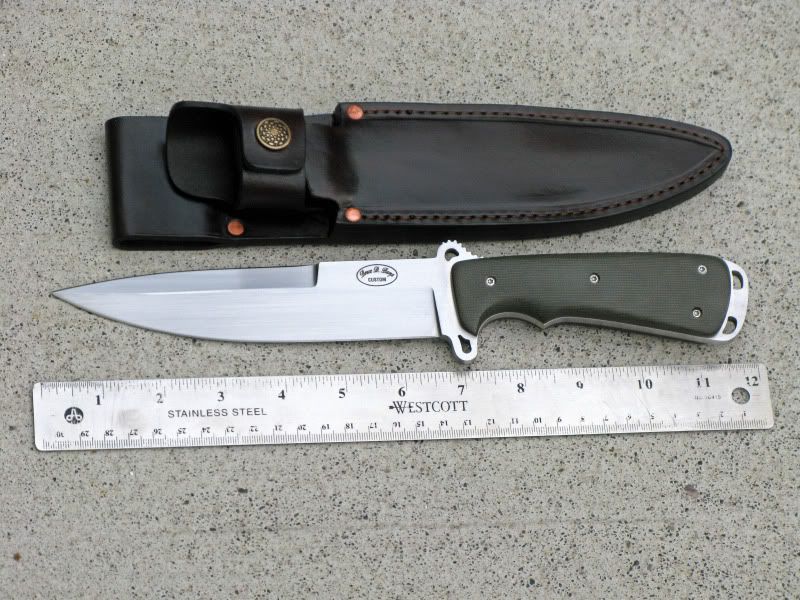
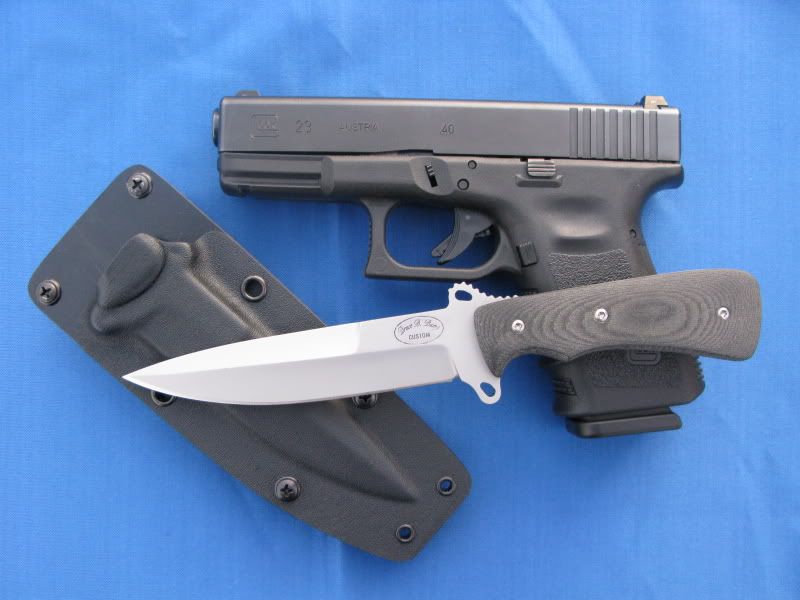
Well you can think less of me if you want but I have some of my patterns cut out by GLW (greatlakeswaterjet) and I absolutely love the results. Do you think all I have to do all day is sit on my bandsaw and inch through 1/4" S-30V all day long and then inhale a ton of abrasive dust the next day just so I can tell somebody who really doesnt care anyway that "I did it myself"? No I have somebody cut my stainless knives out for me unless they are indeed a "one of a kind".

Look at these Bad Boys:
100_2903_edited.jpg


IMG_2365_edited.jpg


IMG_1642.jpg


These tangs are skeletonized also which is really hard to do with shop tools. The oval shapes in the guards are also hard to achieve. For me its cheaper if I am going to make several knives of the same model.
 
Last edited:
There's no problem with it, in my opinion, but I'm wondering why you go through a belt with each knife profile. I just use old ones to do my profiling.
 
Instead of ordering your billet in the normal shape, square, order it shaped like a knife. Billet is billet. :) IMHO
 
Whether or not you have the blade profiled by waterjet or ground out by your apprentice there seems to be no difference.

In any case the patterning and prototyping has been done by hand and cutting it out to order is just copying a pattern.

Use of purchased elaborately lost wax cast pommels or bolsters designed and executed by others seems incompatable with hand made guidelines.

George
 
There's no problem with it, in my opinion, but I'm wondering why you go through a belt with each knife profile. I just use old ones to do my profiling.

I guess I get a little impatient, and tend to apply more pressure when profiling. Plus the belts I have been using are the 50 grit from sears. I have purchased 36 grit and 40 grit from trugrit and progrit and have the same results as the ones from sears. I have to admit that I had been buying the cheaper ones carried. That might be the case. But the profiling is like a barber having to sweep the hairs after every hair cut to me, and I was just wondering what the veterans thoughts where on this. From what I gather and the one who have responded I think it is ok then. If the caliber of makers that have responded think its ok, then its definitley ok. Thanks for taking the time to answer this. I know it has been asked a thousand time, but I just wantes some reassurance.


Bruce those are sweet blades.

-frank
 
I see nothing wrong with it, doesn't take any skill to profile a blank.

At the end of the day, it's what you end up with that matters.
 
So... I know there is GLW and I will probably call them for a quote, but is there any other reputable companies with an online presence?

 
Man, I haven't seen any of my raw steel in better than a year.

David is the man, I've used a few others, but he does a great job, at a fair price.

I won't even recommend the others...
 
There are lots of companies... you usually get what you pay for (in other words, the company with the lowest price usually has the lowest quality and customer service, as I found out).

A dxf file of your blank will help a lot when fishing for quotes.

When you send a quote request, its good to send:

-material description (quantity, material type, material condition (ANNEALED), thickness, desired blank/bar yield, bar/sheet size). Keep in mind that they need to clamp your material somewhere.

-dxf, dwg, etc file

-pdf with overall dimensions and your name/number. Many times, dxf files will be screwed up when opened on a program other than the one used to draw the file. This is especially true with curved entities such as ellipses and splines. The pdf gives them something to compare the dxf to.

-desired due date

-desired cut quality ("normal" or "medium" should be fine). David's cut-quality is excellent. Keep that in mind when comparing his prices to others. This was discussed in the thread "Laser or Waterjet?".

I got a lot of quotes from RFQwork.com. Prices ranged from $5 to $22 per blank... so there are certainly people out there who will see you as a piggybank, especially if your quantities are low. $5 is a good price, but not great (again, price is relative to cut quality and customer service).


So... I know there is GLW and I will probably call them for a quote, but is there any other reputable companies with an online presence?
 
Lets not forget price per blank is also based on quantity. It takes time to load the file into the waterjet program and then tell waterjet program what size steel blank you are working with and thickness and type of steel and then to line up Waterjet cutter to stock so all cuts are inside dimensions of steel. Then you have to adjust machine tip to height of of stock. If it takes longer to setup the machine than it will to run your parts then your price will be higher. Its all in the setup.
Higher number of blanks = lower price of blanks.
If it takes 45 mins to setup machine and you only want 5 blanks that only take 2 mins per blank well your paying for 55 mins on the machine.
Hope this helps.
Chris
 
First of all, stop buying your belts at sears, trugrit has much better belts with much better prices. The sears belts are cheaply made and not worth buying, IMO.

Secondly, stop using belts to profile. An angle grinder does it much faster, for that matter a bench grinder with coarse stone does a good job of it, and the stone will outlast the belts by a wide margin.

Nothing wrong with water-jet cutting...
 
Do you think all I have to do all day is sit on my bandsaw and inch through 1/4" S-30V all day long and then inhale a ton of abrasive dust the next day just so I can tell somebody who really doesnt care anyway that "I did it myself"?

I think Bruce hit it on the head here.

However, one big caveat. I have seen makers who have excellent intuitive metal shaping skills that can achieve outstanding lines and flow by hand. But they have poor CAD skills. So their waterjet cut knives look chunky and mechanical, lacking the organic flow of their handmade pieces. So, I say use the process, but don't let weak CAD skills translate into inferior knife design.

I suggest you draw your design on paper first, then create the design in CAD, rather than let CAD "drive".
 
Last edited:
Back
Top