Welding a threaded rod to a blade

Joined
Feb 16, 2010
Messages
3,668
I suck at welding, so I am having someone else do this for me. I have a 1/8" thick blade and a 1/4" threaded rod. Can the rod be from a bolt, or do I need to use something different? I assume grind the bolt to the thickness of the blade and have them weld it on? I really have no idea.


I didn't find much in the stickies about it. Tips and suggestions highly appreciated.
 
If possible, install the guard first before welding the bolt on. I'm sure you can see why, you probably have already done this anyway. If the tang is 1/8", you could maybe use a 10-32 bolt instead. I would. Either way, I think it best to grind the end of the bolt/allthread to a v-shaped point, use the bandsaw or cutoff blade in the angle grinder to cut a corresponding v-notch in the tang end, then weld or perhaps even better, braze the bolt in there. That increases the mating surface of the pieces. A butt splice is never good if you can avoid it.
 
I have been known to weld a bolt with long thread section on the end of a tang. Do not use Zinc plated bolts or galvanized (same thing) as the fumes are deadly, I also have used threaded rod (allthread) or just take a piece of cold finished or drillrod and run a threading die on it, or anneal the end of the tang, grind it round, and run a threading die down it. Whatever is appropriate for the blade

-Page
 
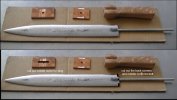
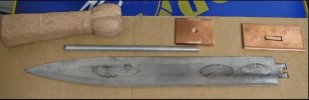
The $50 knife shop describes a great method like salem and sunshadow described. The pictures help a great deal understanding how it is done. I use a high quality hard solder and it is very strong.
 
I've repaired a few knives and swords where the threaded rod broke, I cut a slot about 3/4" deep in the tang the width of the rod and weld the tang to the rod just at the sides, not at the end of the rod
 
Whichever of the suggested methods you use, don't grind the bolt/rod down until after the weld/braze is done. Once the joint is done, then grind the bolt to match the thickness of the tang. If you have already placed the guard on the tang before the weld/braze, there is no need to grind down the bolt at all.

I have switched to putting a small "Keyhole" slot at the end of the tang. I make the bolt end a small "hook" to fit this hole. Then I can hook them together and slide the "flex tang" down the handle hole. This works exceptionally well for stag handles where there is a good bit of curve to deal with. Once the pommel nut is tightened down everything fits snug and tight.
 
Once it's all done and final fit up is right, do you put some thread locker on it to keep things snug? Of the 2 threaded tangs I have made, I find I have to be constantly tightening the nut to keep the handle fit snugly. I suppose locator pins in the guard / handle would help?

Jason
 
OK, having read the posts several time I now understand what you mean(hopefully). New problem: The guard I planned to use is copper(bad idea? {I don't have any bronze.}). It's gonna melt when I have the bolt brazed on. How sturdy is the hook idea? Do I need to extend the tang into the handle a little to make room for it? I need to HT before installing the guard and rod, right? Doesn't the brazing harm the HT of the blade?
 

Attachments

  • bollocks2.jpg
    bollocks2.jpg
    56.1 KB · Views: 126
Last edited:
May just be me, but I don't think you have enough tang. That looks pretty weak to me.
 
1/2" shorter blade, but 1/2" longer tang. Still about 1" longer than originally planned, but who knows how many times I will have to regrind the tip. . . . Note there is a different guard as well, don't know why I thought a guard needed a hole instead of a slot.
 

Attachments

  • bollocks3.jpg
    bollocks3.jpg
    36.2 KB · Views: 89
I'm real confident that's not what most of the guys were picturing when they answered...

Personally, I would not feel confident in that blade. Sorry :(
 
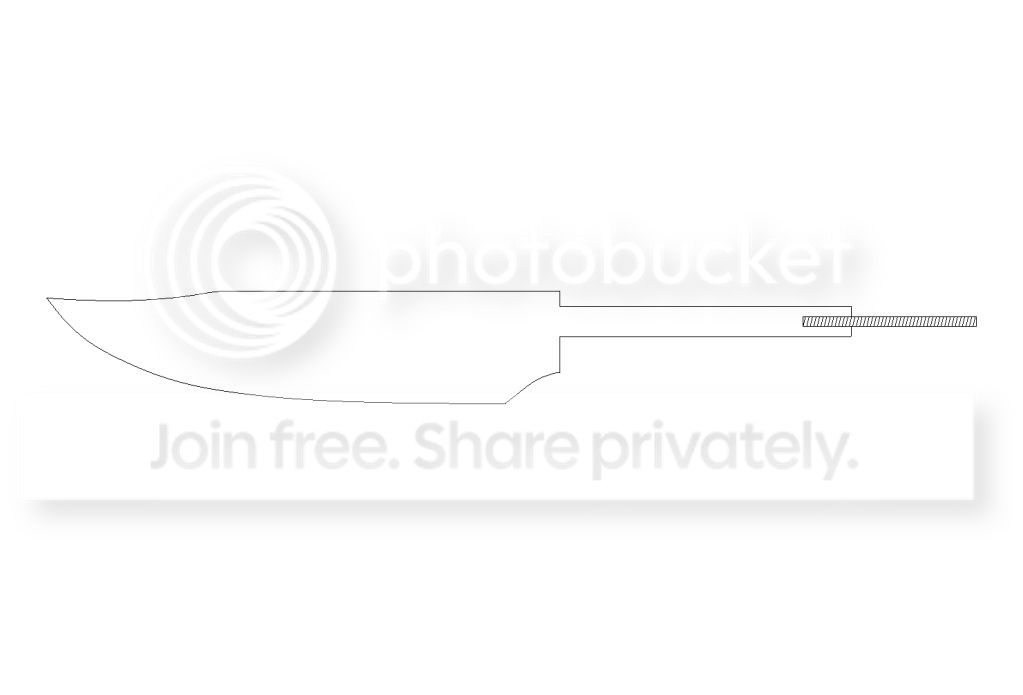
That is not what I was picturing either, I had something more like this in mind
threaded.jpg

Where you are only extending the tang a couple of inches at most

This was just a quick edit to a drawing I already had to add the threaded part. I am assuming that the welding would be done after HT too because I don't know how the allthread or bolt would stand up to HT
 
I'm sorry,too.

I do not suggest that sort of attachment. You need at least 1.5" of tang before the rod joint. It will break as it is now. I would cut back the shoulders a minimum of 1" to finish it, but would not sell the knife under any circumstance. Do the weld, and then grind back the shoulders.
 
Just weld on the rod and then grind in from the sides to make a 1" long by 1/2" wide tang. The change in length won't be that bad. BTW, if you melt the copper when attaching the rod, you are really getting things way too hot. With some ca and a bit of skill, you should be able to weld the rod to the tang without ruining the existing HT. A MIG welder is an advantage here. Wrap the blade in a wet rag while welding the tang extension.

Now, next time follow this procedure:
1) Read up on general knife making procedures and become familiar with them first.
2) Decide what style knife you wish to make
3) Read up on that style and learn how it is built.
4) Draw up full size plans. Posting them here will get a lot of advise ( you don't have to take it, but it is good to hear from folks who have done it before).
5) Write down a full plan of the process you will take to make the knife. It should detail when each step will be done. Again, posting it here may avoid problems later.
6) Keep showing photos of the progress, and ask questions before you do a step if you aren't sure.
7) Take your time, no need to rush a project done too soon.
8) Master the basics before tackling advanced projects.

 
Sorry Stacy, it's that impulsiveness taking control. Is 1.5" of tang the magic number, or is it proportional to the length of the blade? Would 2" be better, or just unnecessary?
 
I would say that 1.5" is the minimum. Longer is good on heavier use knives. As long as the part in the handle is firmly epoxied in the channel, and the handle is firmly screwed down on the guard, 1.5" should hold up.
 
Back
Top