
Welding help needed for a quench tank

Horizontal tanks aren't just for edge quenching, by the way.
I find them far superior to vertical tubes. I think vertical tubes got popular because of the ease of construction.
Unless I'm doing a completely symmetrical dagger, a horizontal tank is the way to go.

Mild steel and 6013 rods.
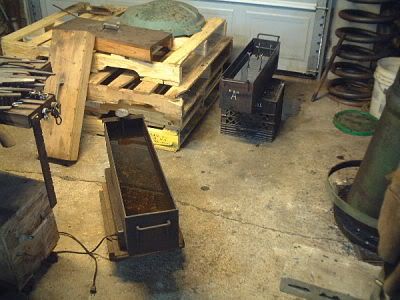
tank.jpg
 
Don't give up on the MIG. Pay attention to where you start and stop weld beads though, it's easy to leave a pinhole there. I've made watertight welds on mild steel with ER70S-6 wire and CO2 shielding gas
 
Thanks for the tips guys. I probably gave up too fast the last time I tried it. I am using a Miller 135 with gas (75/25 (CO2/Argon) like Robert said). I am now leaning towards an horizontal tank.
 
Here is were I have experience! I also use a Miller 135 for most everything.

A couple of things. With anything thicker than 3/16" even on mild I pre-heat the part before welding.

Clean beveled joints. When you set your wire speed and power watch your weld bead and try slowing the wire feed slightly from the recommended setting. Then make another pass with the original setting with slightly more power.

I've used a miller 180 a bit too to compare what is possible with a 220 vs a 110 and the 110v and 75/25 works fine if you keep your stock thinner than 3/16" or/and you pre-heat. I'm off to the shop as we speak to cut and weld up a few
things.
The 135 is a good little welder if you take your time. I welded up my anvil stands with a 135. 1-1/2" plate for the base of the anvil. I had a leg shift on me during the build and I had to grind it off. The weld in examining it had great penetration as I had pre-heated the 1-1/2" plate with a heat gun for an hour before welding.

All that to say. "You can do it!!!!" :D:thumbup::p

As to earlier in the thread the question of getting a stick welder. Since all you have is a 110v welder I'd think about getting a stick for anything thicker than 1/4".

Also I'll tell you the biggest secret to good welding. Shhhhhh.
Buy an auto darkening welding hood if you do not have one. Your ability to weld a good bead is hugely dependent on being able to see. Sounds kinda obvious but in my last welding class I figure half the people in there struggled with seeing through the school supplied welding hoods.
 
Last edited:
another tip for making a watertight bead... if you can run each bead onto the one before it... it's called backstepping your weld... don't start on top of your last pass... go to the end of the length you're comfortable with and run your pass backwards towards the first pass... then run it up onto the previous bead a little bit... this will seal up the weld seams better... and don't be afraid of an overlap... if you need to, make the base piece a little bit bigger than the top piece... give yourself a lip to weld to... then weld inside and out... marking the bead joints on the opposite side of the plate so that there aren't any start/stops at the same place on either side of the plate... I.E. if you weld the inside corner to the corner... make sure you're in a position that you can weld a short bead around the corner on the outside... even if it's only 1" off start with the corner at a 45* away from you, then work to the corner and a short ways up the other side... this will help to seal up the seam... and 90% of all watertight welds are left just the way they are... so don't worry about thinking you should grind everything down to make it look all purdy... if you happen to find a slag inclusion inside the bead while grinding you may well have a leak that wouldn't have been there before... and if you do have a leak... drill a small hole into the weld (if possible) then start in the bottom of the hole and make small circles outward... don't just sit in one spot and try to fill it... the bead needs to move to burn in the edges...

and if it isn't a structural weld... don't be afraid to put a long downhill pass over the top of it... a downhill weld, even at a 45* angle, will seal and flow quite nicely... if you have a bit of a caterpillar looking weld... run a downhill pass on either edge of it... it'll look like a nice stacked weld and seal the edges nicely...
 
When you weld watch the edges of the weld puddle not the fire in the middle. Many people go to fast because they are worried about burn through on thinner stuff. Never try to weld stuff that is butted up tight. It is difficult to see, there is no where for the filler metal to deposit. Much better to bevel the ends on a butt joint or on thin stuff have a gap about the thickness of your material. On corners setup a ledge(s), weld so you just burn off the corners of the ledge. Never start your welding where you want the weld to start, fire up a couple inches away and then slide to where you want to start, hold for long enough for melting of parent metal and then move. Run a bit hot for better fusion. All the deposit in the world is no good if you don't melt into the parent pieces. If you have a bad spot or leak, grind it out and refill, don't try to weld over it, good on bad is still bad. For your application on mild steel 70 series wire or rod would be best, stronger than 60 series and does not penetrate as deep as 60 series so less likely to burn through. If you burn a hole clean it up and then circle the hole welding to the edges. You can also put a thicker piece of brass or copper behind the hole or gap and use it as a backing plate to keep the molten metal from falling though. You can do what you want with a mig, tig or stick. Stick is hardest on thin metal. Tig best and small wire with gas next. I used to weld and now run crews of high pressure pipe welders, and one of my brothers is a certified welding inspector.
 
After welding up a tank that had a tiny leak, I got an idea. I cleaned out the tank real well with soap and water, then acetone, and dried it well. I mixed up a pint of thin epoxy resin ( used for fiberglass work) and poured it in the tank. I made a simple "cap" of a board with a rubber sheet glued to one side, and with a air hose connector fitting screwed into a hole in the board. I put it on the tank and pressed down while applying air pressure. The air was probably not necessary, but I felt it wouldn't hurt to force the resin into any cracks. I let it cure fore a week, and the tank never leaked after that.
 
Thanks Jim, you guys are just so nice to give me such detailed instruction like that. I really appreciate.

Stacy, if I can't get it sealed with just welding, I'll give that a try. Thanks.
 
Lots of great tips here- I want to second the one about making sure the edges of the weld bead are wetting the material you're welding- I have a small wire feed and had this same situation.
A wire feed bead can look really pretty and be no good because it doesn't actually melt into the steel. Depositing a pretty bead on top of metal doesn't make a bond.

Been there done that, good luck and let us know how it works!!
 
An old water fire extinguisher would provide the right size for your needs. They stand up without tipping easily, just cut off the top, fill with quench and good to go. They can be found where fire extinguishers are recharged.
 
I am relatively new at the welding but sometimes the really good guys miss some stuff that seems too obvious. I have learned a few things:

1: use the right helmet and lens. If you can't see the puddle correctly, you can't weld.
2. Prep properly. Clean properly ground metal with proper bevels makes a world of difference.
3. Use a few scrap pieces and get your amperage right. Most new welders use too little power for fear of blowing through, which is probably from the wrong helmet settings, not the welder settings. Cold welds leak like a siv.
4. 6013 with DCEN is really forgiving for a beginner. I like 7018 for good strength and penetration and 7014 for nice looking fillets or filling gaps. 6013 has a nice even penetration and for an inexperienced welder will make you look a bit better than you are.
5. Get the angle right on the rod with the the right arc length for the specific rod.

I spent a lot of time here: http://www.weldingtipsandtricks.com/ last year and ordered his DVDs. They were a great investment for me as a newbie. I feel much more confident with my welding now. Have you considered brass brazing with is easy to make waterproof?
 
Sorry for the late reply, I missed this.

I did not start work on the tank yet Mike, haven't had time.

Bufford, I am pretty sure I will go with an horizontal tank but I will keep that in mind, thank.

Thanks also for the tips Willie. Sadly I don't have an OA rig yet so brazing is not an option just now.
 
I have been in the welding/welding supply business for years. I would bet money, that your leaks will be on your start/stop points! I have welded tanks, and built a couple of boats. On your stopping point, grind back about an inch or so, then start on top of the previous weld, weldover the ground off part and keep going until your next stop point. Hopefully that makes sense.

My quench tank though, is an old oxygen cylinder, I cut the top off, welded a hinged lid on it and called it good. NO SEAMS as all high pressure gas cylinder are 'spun"(mold is spinning and molten steel is put into the mold, then the valve end is machined and threaded) check your local welding supplier, maybe you could score an old cylinder for scrap price or free. We do that where I work, we just cut the threads out of it, so it cannot be used for its intended purpose.
 
Back
Top