what are the proven advantages of a convex edge

That strikes me as being a very material dependent "advantage". Might be beneficial for cutting something like manila rope but would be a disadvantage in cutting carrots.

Not really because the less friction will lead to a easier cut and the convex shape of the blade pushes things away instead of letting it stick to the sides of the blade. Everything you cut needs to be pushed away from the blade if you want the cut to be smooth, the more friction you have the harder it is to do anything.
 
Not really because the less friction will lead to a easier cut and the convex shape of the blade pushes things away instead of letting it stick to the sides of the blade. Everything you cut needs to be pushed away from the blade if you want the cut to be smooth, the more friction you have the harder it is to do anything.

Less point of contact just means that the same amount of pressure is being exerted on a smaller area, which I would imagine would offer less control with the cut. With the carrot example I was pointing out that pushing material away faster can sometimes fracture the material being cut.
 
Sodak as I am also on the old side I'll see if my wife will help me get a video up on convexing with a stone. But really just give it a try like DOW said. Just go back and forth really fast and you wwill end up with a convex bevel. If that doesn't work drink a few good beers and try again.
 
Sodak as I am also on the old side I'll see if my wife will help me get a video up on convexing with a stone. But really just give it a try like DOW said. Just go back and forth really fast and you wwill end up with a convex bevel. If that doesn't work drink a few good beers and try again.

excellent advice.
 
Sodak as I am also on the old side I'll see if my wife will help me get a video up on convexing with a stone. But really just give it a try like DOW said. Just go back and forth really fast and you wwill end up with a convex bevel. If that doesn't work drink a few good beers and try again.
Now THAT'S advice I can follow! I'll give it a shot, I've got a few that need to be worked on, anyway.

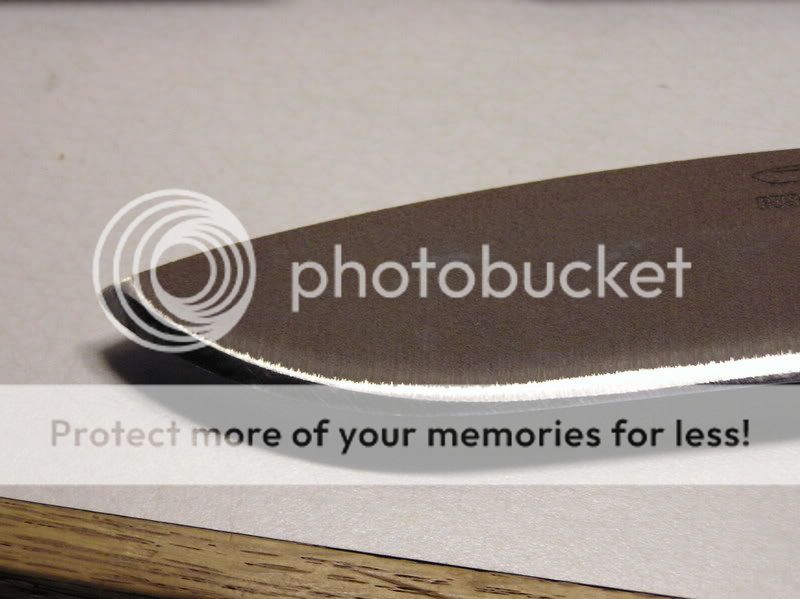
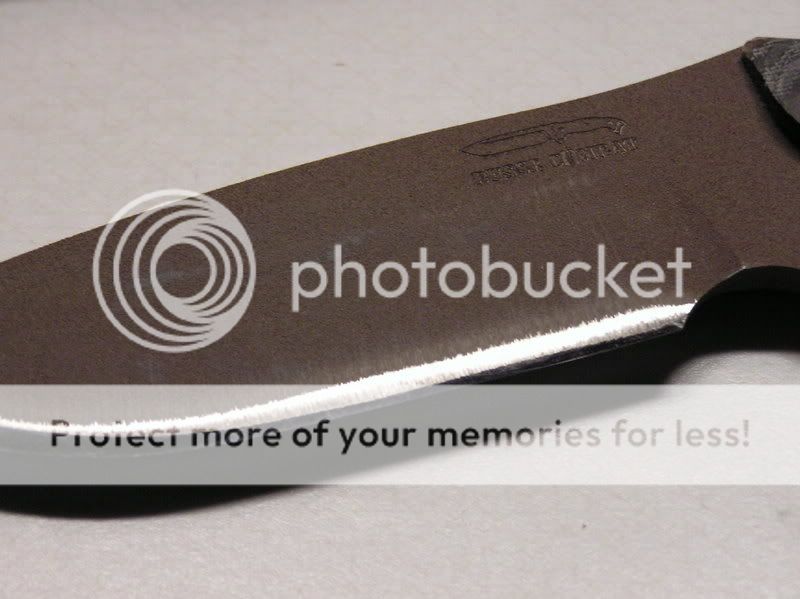
By the way, here's a pic of a Busse BATAC that I got about a year ago. The edge was way too thick for my liking, so instead of putting it on my Edgepro and spending an hour or two knocking it down, I put it on my HF 1x30 belt sander with a real coarse grit. Once I had it thin enough to suit me, I put it on my edgepro to polish the secondary bevel. Almost like what DOW does, but I did the secondary rather than the microbevel. Hopefully you can see it, this baby cuts pretty good now!

p1010002-1.jpg

p1010001-2.jpg
 
That strikes me as being a very material dependent "advantage". Might be beneficial for cutting something like manila rope but would be a disadvantage in cutting carrots.

I think overall blade thickness is more of a factor in such a scenario. A carrot will exert greater friction and pressure on a thicker blade. Thinner ones in general will meet with less resistance.
 
DoW said:
I agree. Especially a mousepad with paper is way too soft IMO, too easy to round the edge if you get too much pressure or increase the angle just a bit.
While you can get any convex shape using stones, the mousepad technique gives you a microbevel automatically, what you call "rounding the edges". That's what gives edges their strength and still allow them to be thin. Using stones tend to give that "appleseed" convex shape and you have to put on the microbevel in an additional step.

!#^&*$! ... lost nearly a full reply thanks to a power glitch. :mad:

Anyway, I don't think we necessarily disagree here, cotdt ... I admit to being a pretty impatient, lazy sharpener anymore, thanks to a whole lot of edge retention testing I did in the past. Bet I bet you'd agree, with a softer backing like a mousepad, you do have to be more careful -- and have a certain skill I probably never developed -- to keep from getting a final edge angle that's inconsistent and too obtuse, and avoid using too much pressure in the process. Personally I find abrasive paper, or especially emery cloth, with a rubber sanding block like used for auto body work, to work a lot better and let me bear down harder. Another guy who used to post here a lot, StretchNM IIRC, uses leather as a backing; again much less "give" than mousepad and that's what worked best for him. So I'd say a lot depends on the person doing the sharpening, how they like to go about it, and the skills they develop after a while using a particular method.

Regarding microbevels, it looks like we use the term a bit differently, but that's OK; pretty much the same idea. However this brings up my greatest objection with convexing with abrasive paper on soft backing: hard to control the final edge angle, and the tendency for it to get more obtuse with each successive sharpening. Because I like to control the final, or "apex" edge angle in a pretty tight range, I want the control of adding the microbevel as a final step, and that of course means making certain the rest of the edge is at a lower angle. With soft backing, I just find it too easy to mess up.


sodak said:
I'll give it a shot
Might work but the recommendation was for beer :D

ROFL! A definite 3-pointer there, nothin' but net! Of course I guess both make good "lubricants" for sharpening, and you gotta have that. :D
 
Anyway, I don't think we necessarily disagree here, cotdt ... I admit to being a pretty impatient, lazy sharpener anymore, thanks to a whole lot of edge retention testing I did in the past. Bet I bet you'd agree, with a softer backing like a mousepad, you do have to be more careful -- and have a certain skill I probably never developed -- to keep from getting a final edge angle that's inconsistent and too obtuse, and avoid using too much pressure in the process. Personally I find abrasive paper, or especially emery cloth, with a rubber sanding block like used for auto body work, to work a lot better and let me bear down harder. Another guy who used to post here a lot, StretchNM IIRC, uses leather as a backing; again much less "give" than mousepad and that's what worked best for him. So I'd say a lot depends on the person doing the sharpening, how they like to go about it, and the skills they develop after a while using a particular method.

Regarding microbevels, it looks like we use the term a bit differently, but that's OK; pretty much the same idea. However this brings up my greatest objection with convexing with abrasive paper on soft backing: hard to control the final edge angle, and the tendency for it to get more obtuse with each successive sharpening. Because I like to control the final, or "apex" edge angle in a pretty tight range, I want the control of adding the microbevel as a final step, and that of course means making certain the rest of the edge is at a lower angle. With soft backing, I just find it too easy to mess up.

Sorry to hear about your power glitch.

I guess it depends on what brand of mousepad we are using. The ones I use are pretty stiff, they are the older kind. It feels like stropping on leather, and gives the same results. In fact, in the Sandpaper/Mousepad Sharpening video he staples leather onto a block of wood and considers it part of the same technique. If you can manage to find a stiff mousepad, and you already know how to sharpen freehand on stones, I think you would be right at home with the sandpaper/mousepad.

Don't worry about angle control, the angles used in the technique are very extreme and sharpen/polish the entire face of the blade. It is not friendly to ungrooved prints on the side of the knife, engravings are OK.
 
2 zings, 1 sharpmaker, 1 convexed off of a mousepad up to 2000 grit with no stropping. Sharpen, use , repeat three times with the convexed zing lasting longer with less edge rolling and chipping then the V sharpened zing every time.
 
What was the final included angle of the convexed knife? Did you use a 30 degree back bevel and 40 degree micro on the Sharpmaker? How did you finish the edge from the Sharpmaker? 2000 grit sandpaper is 1 micron, fine rods approximate 7-9 micron, ultrafine rods leave about a 3 micron finish.
 
The angle on the convexed zing is approx. the same as the 40 deg. angle on the sharpmaker. I used the basic sharpmaker set up, finishing with 40 degs.on the fine ceramic. I did the same test with a pair of delicas some time ago, but i didnt repeat it more then just the one time, however the results were the same.
 
The first knife I convexed was a full convex regrind on a Schrade Peanut using sanding belts stretched out by hand. Took about a week of work every day, even starting with 80 grit belts. This was the first knife I was ever able to get to whittle hair. However, since then, I can consistently get the same edge off Spyderco's white triangles, and even better off a flat honing film. After switching back and forth between convex and flat, I have not been able to tell a difference in cutting ability between them. I usually use a belt sander to rebevel a knife after I get it, and use either the belt sander or stones to resharpen. With no difference it sharpness or cutting ability, I use whatever is handiest. With 3 or more knives, I'll use the sander. If its just one, I'll use the stones. The distinction may have been made earlier, but I'll do it again. I'm using a convex edge, not a convex primary grind, except on the peanut, and that was soon converted to a convex primary grind with flat edge bevels. I havent used a convex primary edge since, so cant comment on that.
 
Anyway, I don't think we necessarily disagree here, cotdt ... I admit to being a pretty impatient, lazy sharpener anymore, thanks to a whole lot of edge retention testing I did in the past. Bet I bet you'd agree, with a softer backing like a mousepad, you do have to be more careful -- and have a certain skill I probably never developed -- to keep from getting a final edge angle that's inconsistent and too obtuse, and avoid using too much pressure in the process. Personally I find abrasive paper, or especially emery cloth, with a rubber sanding block like used for auto body work, to work a lot better and let me bear down harder. Another guy who used to post here a lot, StretchNM IIRC, uses leather as a backing; again much less "give" than mousepad and that's what worked best for him. So I'd say a lot depends on the person doing the sharpening, how they like to go about it, and the skills they develop after a while using a particular method.

Regarding microbevels, it looks like we use the term a bit differently, but that's OK; pretty much the same idea. However this brings up my greatest objection with convexing with abrasive paper on soft backing: hard to control the final edge angle, and the tendency for it to get more obtuse with each successive sharpening. Because I like to control the final, or "apex" edge angle in a pretty tight range, I want the control of adding the microbevel as a final step, and that of course means making certain the rest of the edge is at a lower angle. With soft backing, I just find it too easy to mess up.
Well, I've never been a purist in sharpening myself. I tend to use the mousepad/sandpaper method to convert my V-grinds to convex. I use a soft mousepad going through a grit series of 220, 400, 800, 1000, 2000. I start off using fairly hard pressure in the lower grits and ease off on the pressure as I progress. This seems to increase speed of the process.

I usually finish the process with a microbevel on the sharpmaker - white rods - at the 40 degree angle. Soft strokes until the blade easily shaves hair. Then I proceed to strop with green compound on a leather strop.

So in the end - I'm not sure what the heck I have - some weird mix of convex blade with 0.5 mm microbevel V-grind. Anyhow, it works for me. I've had a few knife makers comment on my edges as being quite good during show and tell's and I can't tell the difference between my edge and ones done on a slack belt grinder.

Still, my edges don't compare to a true master with waterstones. Magnussen's edges are pretty scary.
 
Back
Top