What aspect of knifemaking have you learned that makes it easier?

Joined
Feb 24, 2000
Messages
1,947
I thought I would start a thread where knifemakers could share things they have learned that has made a particular aspect of knifemaking easier.
I sold my first knife in 1980, and have learned a lot of ways to do things easier and to save time.
One thing I have learned that makes it easier and saves time has to do with hand sanding a satin finish. I do both forging and stock removal. I started using ATS-34 for stock removal. I would grind the blade to 400 grit send it off to Paul Bos heat treating and then when It came back I would start hand sanding. I would start with 220 grit, go to 320 grit, etc. and stop with 1200 grit. It took forever with the 220 grit to get all the 400 grit scratches off the blade.
So, I got smarter and started hand sanding BEFORE the blade was heat treated. I would start with 220 grit and hand sand up to 400 grit and then send the blades off to be heat treated. Sending blades to Paul Bos heat treating I can grind the edges really thin and they come back in perfect shape, no warping. Sanding before heat treatment made it a lot easier.
Then I decided to try to use a Norax 22 belt after the 400 grit belt. It's amazing. Now after the Norax 22 belt I skip the 220 and 320 grit and start hand sanding with 400 grit and in a very short time less than five minutes I have all the grinder scratches out of the blade and it's ready for heat treatment. I now use CPM 154 steel but it sands and works the same as the ATS-34.
That's one thing I have learned that makes a satin finish much much easier and saves a lot of time.
 
What makes my life easier is having thing "aligment pins" go trough multiple layer handles.
That way you can work om them before glue up
 
If I'm going to hand sand air hardening steel I also do it prior to heat treat. I recently tested an S7 blade, where I sanded it to 1000 grit, heat treated it in a foil pouch after coating it with WD40. I was able to clean it up at 1000 grit paper again after the final temper in about 10 minutes. Obviously this won't work with oil hardening steel unless it's being heated in a controlled atmosphere.


Normalizing and thermal cycling was giving me enough decarb that I didn't feel hardening without removing the scale would allow something like W2 to quench fast enough, which turned heat treating into a multi day affair for me. I started wrapping my blades in foil for the normalizing and thermal cycles. I don't notice any difference in grain from doing it outside of foil, and I have no scale to deal with and can harden immediately after the last cycle without feeling the need to grind. Another way to get around this is to just do all the normalizing and thermal cycling to your barstock before grinding if it's stock removal. You'll notice a slight difference in machinability but hardly worth mentioning.

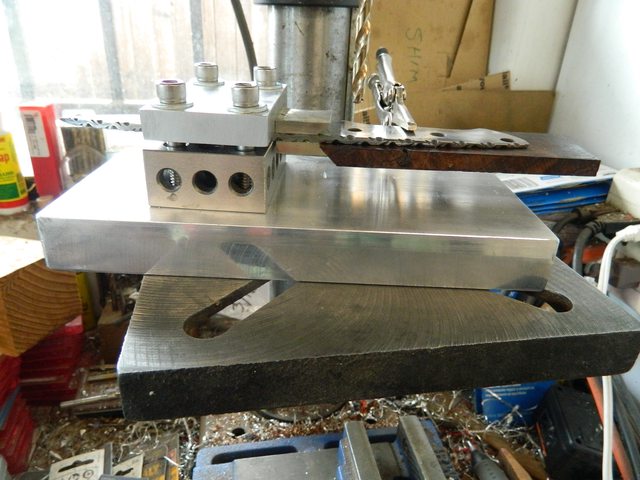
This jig and a dab of CA glue makes scale drilling on tapered tangs, uneven materials, anything a breeze without having to permanently gluing one side at a time.
yPJjiEJ.jpg
If you have a horizontal grinder and your work rest is adjustable enough, you can even use it to profile scales that have been preassembled with Corby bolts before glue up and get everything square to the ricasso.
 
I'm dealing with only folder blades but I have found that sizing the sides correctly to be parallel and to have them finished down to 400 allows for far more ease when the bevels are created.
Frank
 
This jig and a dab of CA glue makes scale drilling on tapered tangs, uneven materials, anything a breeze without having to permanently gluing one side at a time.
yPJjiEJ.jpg
If you have a horizontal grinder and your work rest is adjustable enough, you can even use it to profile scales that have been preassembled with Corby bolts before glue up and get everything square to the ricasso.
That jig is slick as owl chit! I will have one of them, thanky!
 
Last edited:
I need that jig! Where'd ya get that?

I made it but I can't take credit for the idea. I got it from a BRTBladeworks thread and he got it from Nick Wheeler iirc.
 
When flat grinding I will tilt the platen about 15 degrees toward me.

This allows a much better view of the edge when grinding and takes the strain out of the neck and back from trying to look over the top of the platen.
 
I made it but I can't take credit for the idea. I got it from a BRTBladeworks thread and he got it from Nick Wheeler iirc.

To whoever is interested in jigs like that, look up the Nick Wheeler "Stuck in the metal with you" WIP. He has a few different really helpful jigs and describes how he builds/sets them up/uses them throughout it.
 
For those that are hand sanding before heat treat, what are you taking your edges down to? I normally go to .010" finished and wouldn't go below .020-.030" before heat treat. Maybe I should try some thinner.
 
To make hand sanding easier I've been going from Norton blaze 120 off the grinder to the disc sander going from 120 to 220 to 400 Rhynowet papers. It gets the bevel very flat and the 400 grit scratches are easy to hand sand. Hand sanding I go back to 220 and work up to 600 grit but with the blade being extremely flat the time on each grit is minimal.
 
On CPM 154 I grind and hand sand to less than .020. I have Paul Bos do the heat treating and there has never been a problem. When I get them back from the heat treat I don't go back to the grinder. I start hand sanding with 400 grit and go up to 1200 grit.
Now when I do Damascus or W-2 which I heat treat myself, I leave the edge a lot thicker before heat treat and I do go to the grinder after heat treat.
 
I've found it easier since I started grinding all my 3/32 and 1/8 thick stainless knives post-heat treat. The yellow 967's will cut it just fine, for three or four knives even.

I second Erickson's comments on the disk making bevel final finishing easier. Disk gets you much flatter and takes out so many of the dips that are hard to sand out.
 
Easily the best thing I did to advance my knifemaking abilities was taking classes with mastersmiths from the ABS. Regardless of what the course was about I learned far more than what was listed in the curriculum. I got my moneys worth just by being able to pick my instructors brain while taking a break or going to lunch. Of course it doesn't have to be an ABS instructor but I think they have the most accessible courses since they have multiple locations and a host of excellent instructors.

I'd also recommend going to hammer ins and shows. I've learned everything from new skills, show locations to making quite a few new friends in the knifemaking world. So if I had to give one piece of advice to a new knifemaking or someone struggling to achieve the results they are after, it would be take a course or two. You will not regret it.

A bonus tip to the new guys, because it seems almost daily someone posts something about a problem that this could fix; plan out your knives before you start and take your time. If you try to wing it on the fly you can easily end up with something that ends up in the scrap bucket or even worse have everything perfect and do something like grind a big divot in the spine because you were in a hurry.

-Clint
 
For those that are hand sanding before heat treat, what are you taking your edges down to? I normally go to .010" finished and wouldn't go below .020-.030" before heat treat. Maybe I should try some thinner.

Like Tom said on air hardening stuff I'm going down to .010 with no bacon edge problems.
 
Good stuff in this thread. Probably the greatest time saver aside from just getting experience would be having the right tools for the job. Nothing is more frustrating or time consuming that trying to make the wrong tool do the job.
 
I borrowed this design using a "123" block from David Sharp I believe and it works well. I have a long wooden taper that fits under the handle for support when drilling. This is easy to make if you can tap a few holes for cap screws. Larry

Tef8gJRl.jpg
 
I thought about doing that but I couldn't live without one of my blocks 😊
 
Back
Top