What aspect of knifemaking have you learned that makes it easier?

Burt Foster and Dr. Jim Lucie gave me some sage advice on hand sanding. Dr. Lucie taught me that a hard rubber blocks your best friend for getting up into the plunge area. Burt told me that it's not the grit that makes for a pretty hand sanded finish but that everything is STRAIGHT AND EVEN. He showed me a 220 grit knife that looked better than my 600 grit did at the time. Either he or Dan Farr also told me that it is not a sin to go back to grinding belts when you are trying to sand away lengthwise scratches of a lower grit by going at 90 and 45 degree angles. You don't have to hand sand in EVERY direction, just the final one.
 
I just learned a new one yesterday.

I've seen a lot of discussion about flat grinding and the little variables that can throw it off. Belts worn unevenly if you ground a groove into them, metal platens wearing dishes or streaks, cleaning off the black gunk, etc. Eventually the discussion leads to "get a pyroceramic glass platen" and everyone is happy and the discussion is over.

Has anyone, other than cleaning the black gunk, really looked at their well used glass platen? I was starting to have some really odd trouble getting repeatable bevel finishes. Right to left would change, streaks, all kinds of funny business. I tried new belts, different belts, tension, tracking, but nothing was really working. I would get one or two good grinds and then bleh it would look like crap. Blade isn't warped. Steel is flat. Not moving as I'm grinding. Platen isn't too warm. Tracking is good. What is going on? None of the issues were too severe, easily fixed hand sanding, but then it migrated to my plunges and started bugging me so much I set my platen aside and did 20 knives hollow ground to think about it.

Yesterday I put my platen back in and had decided to scrape it clean and knock the corners off the glass to try and resolve the plunge issue. I have a little diamond plate that's flat and glued to a wood hand block I use for different things and I was using this to round the corners and decided to just stone off the face of the glass as well because of some really stubborn black gunk that wasn't scraping off.

Holy crap that thing wasn't even close to flat anymore. It had a vertical dish, a horizontal dish and a couple odd streaks of dishing running through it. So with the little diamond plate and some soapy water I stoned the whole face flat again. Fired it up and problem solved. Beautiful bevel grinds exactly how you would expect them to come out.

So long story short, your glass platen probably wears quicker than you think. Maybe I'm doing something to cause mine to wear prematurely, I don't know, I've had this one less than a year and have ground maybe 50 knives on it. But if your flat grinds are acting funny, check your glass and see if it needs to be dressed flat. The diamond plate cut it quickly and easily with soapy water.

I couldn't see any of these deviations because of how translucent the glass is, until I started stoning it.

 
I just learned a new one yesterday.

I've seen a lot of discussion about flat grinding and the little variables that can throw it off. Belts worn unevenly if you ground a groove into them, metal platens wearing dishes or streaks, cleaning off the black gunk, etc. Eventually the discussion leads to "get a pyroceramic glass platen" and everyone is happy and the discussion is over.

Has anyone, other than cleaning the black gunk, really looked at their well used glass platen? I was starting to have some really odd trouble getting repeatable bevel finishes. Right to left would change, streaks, all kinds of funny business. I tried new belts, different belts, tension, tracking, but nothing was really working. I would get one or two good grinds and then bleh it would look like crap. Blade isn't warped. Steel is flat. Not moving as I'm grinding. Platen isn't too warm. Tracking is good. What is going on? None of the issues were too severe, easily fixed hand sanding, but then it migrated to my plunges and started bugging me so much I set my platen aside and did 20 knives hollow ground to think about it.

Yesterday I put my platen back in and had decided to scrape it clean and knock the corners off the glass to try and resolve the plunge issue. I have a little diamond plate that's flat and glued to a wood hand block I use for different things and I was using this to round the corners and decided to just stone off the face of the glass as well because of some really stubborn black gunk that wasn't scraping off.

Holy crap that thing wasn't even close to flat anymore. It had a vertical dish, a horizontal dish and a couple odd streaks of dishing running through it. So with the little diamond plate and some soapy water I stoned the whole face flat again. Fired it up and problem solved. Beautiful bevel grinds exactly how you would expect them to come out.

So long story short, your glass platen probably wears quicker than you think. Maybe I'm doing something to cause mine to wear prematurely, I don't know, I've had this one less than a year and have ground maybe 50 knives on it. But if your flat grinds are acting funny, check your glass and see if it needs to be dressed flat. The diamond plate cut it quickly and easily with soapy water.

I couldn't see any of these deviations because of how translucent the glass is, until I started stoning it.

Yes!
I busted mine off and went back to the steel platen. I've been bugging Nathan Carothers (well Jo more than Nathan) to see when some d2 and radius platens might be available.

My plunges sucked with the glass platen no matter what I tried. I wasn't getting symmetrical grinds. I chalked it up to a bad piece and took it off. I'm getting better results even without a hardened platen.

Downside, lots more heat build up.
 
I'll second all the others who talked about using their disc grinder to make hand sanding a breeze. I use mine all the way one grit higher than I want to go. Then I go back and do Straight pulls by hand. Cuts the time down huge.

Especially with knives that I don't have to worry about washing out plunges on.

epn7yu.jpg
 
Last edited:
Yes!
I busted mine off and went back to the steel platen. I've been bugging Nathan Carothers (well Jo more than Nathan) to see when some d2 and radius platens might be available.

My plunges sucked with the glass platen no matter what I tried. I wasn't getting symmetrical grinds. I chalked it up to a bad piece and took it off. I'm getting better results even without a hardened platen.

Downside, lots more heat build up.

I made two air cooled A2 platens like he had in the past. A flat one with radiused edges and a 36" radius one. I like grinding on them better but I haven't been this winter because I try not to run my compressor too much in the winter because it's not in a heated shop and I don't want to freeze the condensation. But now that isn't a concern and I'll be using them again, likely build a water cooler for them too. Then I can just run antifreeze through the winter.

But I tried using them once without the air and that just doesn't work. Too much heat. Especially on the radius one.
 
Here is another tip. On a full tang blade I would drill the holes in each scale, then scribe the tang outline on each scale and then use my wood bandsaw to cut each scale to the scribe line.
One day I decided to stack the scales up using pins to hold them in place. Then I cut the tang outline on both scales at once. It saves a little time and has the same results.
 
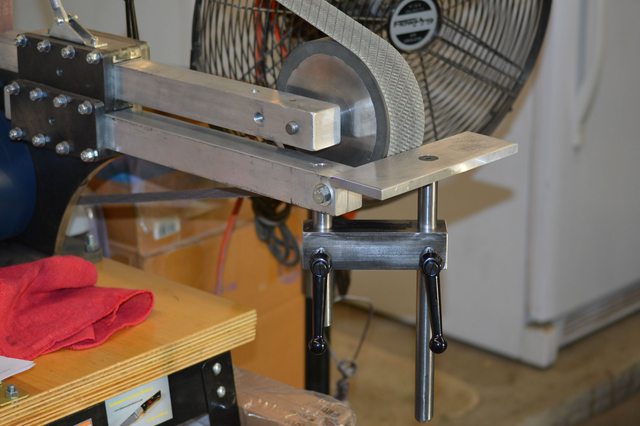
I believe that good grinders have a second tool arm slot...something that us knife makers did not have ten years ago when we bought a 2x72 belt grinder. So I want to say that the most important improvement for me in the last couple years was this tool rest that I copied from the one offered on the TAG grinder by Chris Williams. Mine does not swivel to and fro for angles but swings out and up for all the wheels and my platens. I have built and used at least six tools rests in the past ten years and now I use this one for 95% of my work. Here are 2 photos of the rest. The last photo is my angle rest for swedges. Larry

ofqB79ql.jpg
PkU2R2Dl.jpg
EvOCebAl.jpg
 
Last edited:
I need to copy that rest Larry. I built my grinder with 3 tooling arm slots but just essentially laid a piece of flat stock on a tool arm for a workrest to get by with. I especially need help with my swedges.
 
Back
Top