What Did You Sharpen Today?

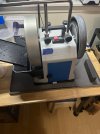
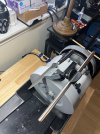
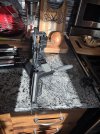
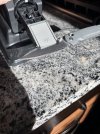
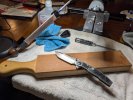
Playing with a new to me Tormek. Just added the fine diamond and basically breaking the stone in.
 

Attachments

  • IMG_7629.jpeg
    IMG_7629.jpeg
    283.5 KB · Views: 2
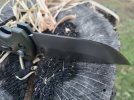
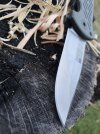
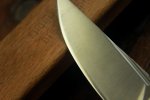
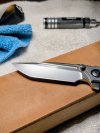
I recently got a Spartan Blades George Raider Dagger. The edges weren't bad, especially for something that is primarily a stabbing weapon. Still, I couldn't help myself and sharpened it anyway :D

I have never sharpened a dagger before so I took some precautions in order to avoid cutting my fingers off...

V4ixqxe.jpeg


For quick removal of metal I used the Baryonyx Manticore silicon carbide stone. I followed that with 400 grit and then 1000 grit vitrified diamond stones. I finished on leather with black and then white compound.
The result isn't perfect, but better than I anticipated. And it's sharp :)

XkTaa0H.jpeg


qM4EtBZ.jpeg
 
Most of the knives I keep handy these days have powdered steel or other hard core blades that are not easily sharpened on natural stones, so I have been reaching for diamond plates automatically for some time.

Recently I became interested in Japanese kitchen knives, so I had to put these thin hard blades on some water stones, to see how the masters do it. I pulled out some Shapton ceramic water stones that I had not used in years. I splashed on some clean water and put some different blades on there! AEB-L, tough old West German stainless, M390, R2/SG2 at 63-64 RC.

B0Vz4LJ.jpg


8AEpMvu.jpg


The coarser stones cut really fast. The feel was even and controlled, it didn't sound like a cement mixer, but it removed steel a little faster than DMT's or Ultra Sharp diamond plates of the same grits. I think I could lower the number of strokes needed for the same job by 20 or 30%, which helps keep my bevels flat and crisp. The ceramic water stones handled the hardest steels easily, although those were thin blades and didn't require as much steel to be removed.

The stones kept that smooth feel and provided good feedback as I climbed the progression. I was getting a fresh and even scratch pattern more quickly than I could with diamond plates. I think learning to use the slurry effectively is going to make the process even better. A slightly toothy kitchen edge at 1K through 2K, a BESS-approved mirror finish beyond that, I could do anything with these ceramic water stones that I could do with my diamond plates. The water stones might produce a neater bevel by reducing the number of strokes from start to finish. As I used edge-leading strokes for the most part, I stropped on plain leather. No need to get crazy here.

If you factor in the time setting up for the wet mess and then cleaning it up afterward, it may take longer overall than using diamonds, but it might work better in some cases. And it sure does feel good when you set that edge on the wet stone, as you can really feel it as you creep up onto the bevel and start getting that portrait-flat geometry going!

The splash-and-go feature is very convenient, as you can do the whole job right on a kitchen counter or table and clean up in the sink with a few paper towels. No extended deep soaking or ankle deep water, you just need to keep the top of the stone wet. You can use the plastic box to hold the stone (It is the right height and it has rubber feet to hold it in place.), and keep it in a kitchen drawer so when you need a touch up you can do it in minutes without having to go anywhere. I gave the printed side and the other sides a coat of shellac so the stone doesn't absorb more water than is necessary. This might help prevent the stone from cracking over the years, and it speeds up drying.

I haven't used them enough to see how quickly they will dish, but a sharp, flat lapper is all we need to keep them up. Overall a very efficient way to go for some excellent results. The price is low through the grits I use, and that feel, that feedback really works for me.

 
Last edited:
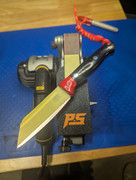
I snatched victory from the jaws of defeat. I managed to bump the apex of my like-new Bark River Taskmaster with a swinging belt buckle, and the impact put a little crescent dent into the apex. It is in magnacut, but it is also ground very thin.

I took it to my Ken Onion MK2 which has a 3D printed platform on it to help keep the knife flat and even when using the 1" 18"grinding attachment. I set the belt adjustment to the slackest and the angle to 16. I had the dent out and a fresh apex in about 40 minutes, and I am really slow and methodical when I sharpen. It slices great again, with no drag, and is just as sharp as new. The new bevel doesn't blend into the factory rough buffed finish, but it's so small it doesn't stand out.

I always feel low loooooow when I damage one of my knives, so the KO MK2 really saved the day.

 
I had a couple of steak knives that had seen hard use, with a few very small nicks and rolls. German mid-line stainless, made in Italy by Berkel. I used a Naniwa Chosera 800 grit splash-and-go water stone to square up the 15 degree bevels and make the nicks disappear. I finished them with a 2K grit Shapton Kuromaku splash-and-go water stone. They benefitted from about 5 strokes per side on a 4 micron Nanohone and a couple of passes over plain rough side leather. Fifteen degrees is too fine for steak knives, but that's what I sharpen the other knives in the block to, and suddenly I can't be bothered with two different angles. Less than optimal, and probably at least partly responsible for the rolled edges! Along with my wife!

These knives would still cut brocolli stems, tomatos, and bread smoothly, but the aggresive bite you get from about 800 to about 1,500 grit is getting noticeably weaker at 2K.

I have a few Miyabi Koh's with good AEB-L blades. These are everyday knives that get almost all our use. I keep on top of these blades, so when I felt like sliding them across a stone I just needed a few passes at 15 degrees per side over the 2K Kuromaku to get them crisp and ready for the Chosera 3K. They were still biting everything in sight.

After the Chosera 3K the bevels were bright and shiny, BESS scores were pushing 100, and the produce and bread were very impressed. They were show-off sharp, doing paper tricks and slicing through balls of paper towels smoothly and deeply. Stropping didn't seem to improve the cutting power. These AEB-L blades won't win any awards for holding an edge, but they can be sharpened to a spooky level very quickly without fancy equipment.

I have kind of fallen back in love with water stones after using these Naniwa Chosera's and Shapton Kuromaku's (sp?). Both are splash-and-go stones that are convenient to use on a kitchen counter or table. Both use ceramic abrasives, and they are cutting SG2 at 64-65 RC very quickly. Great feel, which I miss with diamond stones. Hard, not pricey, although you still need to factor in the cost of a lapping stone.
 
Back
Top