When an unexpected event arises and you reach for your knife.Is the knife at hand?You are glad if you have it.It may or it may not be the answer to your problem.If you are like many, you will not have one when you need it.It will be like where is the flashlight?The flashlight is where you left your knife.

-
The BladeForums.com 2024 Traditional Knife is available! Price is $250 ea (shipped within CONUS).
Order here: https://www.bladeforums.com/help/2024-traditional/
You are using an out of date browser. It may not display this or other websites correctly.
You should upgrade or use an alternative browser.
You should upgrade or use an alternative browser.
What do you classify as a survival knife?
- Thread starter ultrafine
- Start date

- Joined
- Feb 16, 2006
- Messages
- 2,679
My vote would be swiss army knife. It can open cans, slice food, cut bandages, and can be used very effectively for self defence.
B
Use saw on SAK to cut club from tree/building/furniture/whatever. Hit other person with club.
this is officially the best post of the thread.
Ok since noone want to take only one knife and we all live in different types of areas, the time would be tomorrow and the place you would go to is outside of your house and to somewhere that you would deem safe, and you´re in a hurry. lets say if you live in a city you try to go as far as possible away from this area and you have to survive with your only knife.
I still don't get it. I'm in a city right now. I work in an office. Its an ordinary day. I have I think 3 or 4 knives on me now.
If SHTF is coming, and I know it, I'm gonna have every knife I own near me. Why wouldn't I? If I gotta bug out, my car's trunk is gonna be packed. Then I'm driving to WalMart and "acquiring" anything I don't have.
I don't understand the logic of "preparing" to be underequipped.

is it a fair assumption that you need something that fits your evironment. there is no place i know of that has urban,forest, jungle closeby earth?..but i do live very close to jungle. i would grab a decent fixed and a huge machete, notice how im partial to machetes. i like machetes. i need machetes must get more machetes.. i like big machetes especially martindale machetes. oh my did i mention tramontina machetes.
im fried again:jerkit:

FPK... I like your style, but , if I recall, I think the "jerkit" smiley is often frowned upon here.
I think its not to be used lightly. Things may have changed...I could be wrong.
- Joined
- Aug 25, 2010
- Messages
- 160
FPK... I like your style, but , if I recall, I think the "jerkit" smiley is often frowned upon here.
I think its not to be used lightly. Things may have changed...I could be wrong.
wow sorry i thought i was." im thinking about it". oooops it wont happen again. again sorry. after looking close wow im a idiot..........
fried
Last edited:
wow sorry i thought i was." im thinking about it". oooops it wont happen again. again sorry. after looking close wow im a idiot..........
fried


- Joined
- Aug 4, 2009
- Messages
- 6,234
You can't just classify blades' roles by their size. I've split logs 4-6 inches thick with my less-than-3-inch DPx HEST. Blade thickness, shape, ergonomics, grind, steel etc should all be taken into account. I believe that an ideal survival tool should be able to take rough use in dire circumstances, and be easily maintained in the field, so I tend to favor quality high carbon steels (between RC52 and RC59) for both my designated rough use blades and my slicers. That's not to say I haven't used stainless knives for extensive outdoor use... a Mora 860 or Cold Steel Finn Bear can be super performers, and AUS8 is one of my alltime favorite outdoor use steels. I just don't believe these high end, hard brittle stainless steels serve much of a practical role when it comes to extensive outdoor use. I firmly believe the simpler the design, the more tasks the blade can perform. Simple spine, simple belly, simple grind, simple point... I have blades ranging from 2 inches to 16 inches that I would consider practical survival tools. Thankfully I have a go bag in the closet that sits packed with multiple blades for multiple roles (and maintenance kit), and ALWAYS have a HEST and Victorinox Spartan on me.

- Joined
- Feb 27, 2010
- Messages
- 2,137
I think the question needs to be separated into two areas that people tend to get mixed up in:
1. Surival "Sports", ie camping
2. Life or Death situation
The first is where you go out and build shelters for fun, try a but of wood craft and enjoy nature. The latter is a genuine disaster (large or small) that means you have a real danger of dying. Two very different things.
You choose the environment (and your level of prepareness) in one and in the other, the environment chooses you.
1. Surival "Sports", ie camping
2. Life or Death situation
The first is where you go out and build shelters for fun, try a but of wood craft and enjoy nature. The latter is a genuine disaster (large or small) that means you have a real danger of dying. Two very different things.
You choose the environment (and your level of prepareness) in one and in the other, the environment chooses you.
- Joined
- May 20, 2009
- Messages
- 648
Only one, it's going to be the Bark River Bravo 1.
If I can grab a second, it will be the Bark River Gunny.
If I can grab a second, it will be the Bark River Gunny.
Only one,
...it's going to be the Bark River Bravo 1.
If I can grab a second,
...it will be the Bark River Gunny.
Great choices, :thumbup:
 :thumbup:
...but as good as the Bravo is, the one I tend to carry the most,

...is this Jim Stewart Custom.
Just as tough as the B-1 but in a tidier package.
Though I like a really big blade for survival in the field,
...it's that knife on your belt when you need it that counts. :thumbup:
:thumbup:Big Mike
- Joined
- May 22, 2010
- Messages
- 984
well, if I'm bugging out, I'm going to be doing it in my truck. in there I have a fixed blade knife (~4" blade), a multi-tool, and a (~3" blade) folding knife (m-tech rescue). Plus in my pocket, I always have a SAK rambler, and will soon have a byrd cara cara. Plus I have a utili-key on my keychain.
Do/Will I have enough knives with me?
(though for reference, I do plan on replacing the m-tech rescue knife with a Smith & Wesson (911n) rescue Knife.)
Do/Will I have enough knives with me?
(though for reference, I do plan on replacing the m-tech rescue knife with a Smith & Wesson (911n) rescue Knife.)
- Joined
- Jun 8, 2010
- Messages
- 3,723
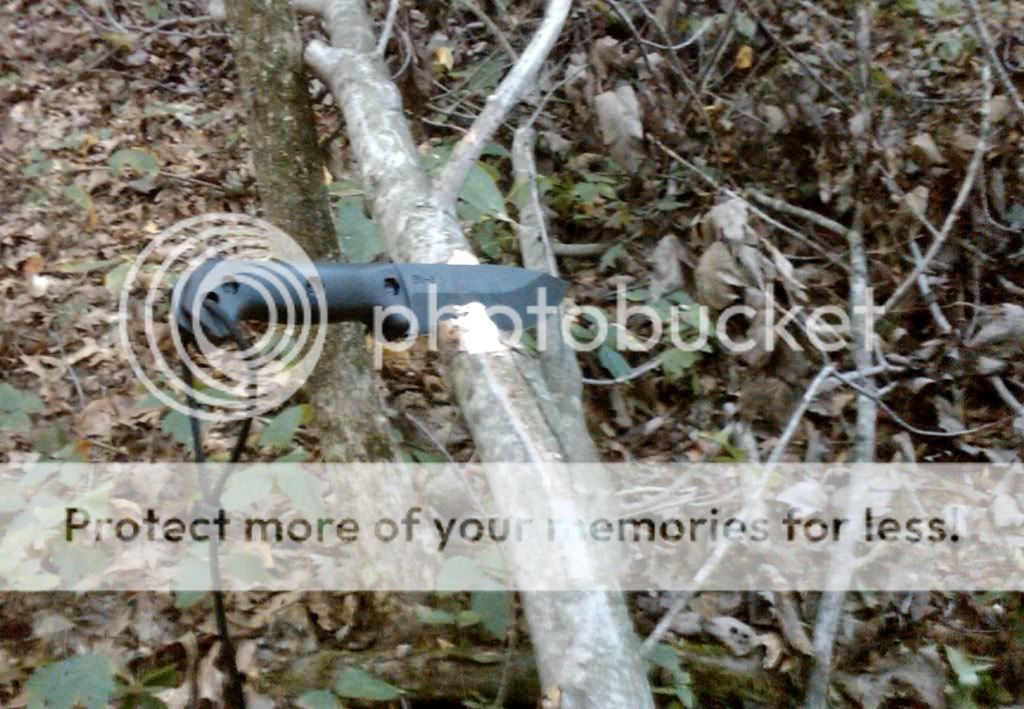
If I only get one, first I'll have to dump the 2 or 3 in my pockets, and collect my Becker BK-2. If I get two, then I want two BK-2s... just kidding... a bit.

- Joined
- Dec 23, 2006
- Messages
- 15,036
A survival knife to me is one knife that if it was your only knife could get every job done that was required of it
so it would have to be large enough to handle big tasks
A big knife can do small knife duty maybe not as well as a small knife but better than a small knife can do large knife duty
so it would have to be large enough to handle big tasks
A big knife can do small knife duty maybe not as well as a small knife but better than a small knife can do large knife duty

- Joined
- Sep 7, 2006
- Messages
- 6,214
If I had the time to pack a few in, these would def be on the list:
Gransfors Small Forest Axe
Cold Steel Kukri
SAK One Hand Trekker
Multi-tool (SOG Powerlock or LM Wave or Core)
I would have a folder in my pocket, and it would be something decent enough.
Its a fun exercise but I dont think one knife can do it all in that scenario. If it had to be only one it would probably be my Busse BATAC. And a MT. The BATAC because I know I can trust it to perform no matter what. Blade length is around 5 inches which I feel is big enough to do a lot of tasks but not too big to hinder movement. I also have two excellent sheaths for it.
But I would do everything possible to include the axe. It's a great piece of equipment.
Gransfors Small Forest Axe
Cold Steel Kukri
SAK One Hand Trekker
Multi-tool (SOG Powerlock or LM Wave or Core)
I would have a folder in my pocket, and it would be something decent enough.
Its a fun exercise but I dont think one knife can do it all in that scenario. If it had to be only one it would probably be my Busse BATAC. And a MT. The BATAC because I know I can trust it to perform no matter what. Blade length is around 5 inches which I feel is big enough to do a lot of tasks but not too big to hinder movement. I also have two excellent sheaths for it.
But I would do everything possible to include the axe. It's a great piece of equipment.
Last edited:
- Joined
- Sep 7, 2006
- Messages
- 6,214
Come on Joe, pick one.... not like you're short of choices. 
A survival knife to me is one knife that if it was your only knife could get every job done that was required of it
so it would have to be large enough to handle big tasks
A big knife can do small knife duty maybe not as well as a small knife but better than a small knife can do large knife duty


Pilot1
Gold Member
- Joined
- Sep 24, 2005
- Messages
- 2,113
I keep a Fallkniven F1 in my flight bag. It STAYS in there along with some other survival implements (Leatherman, signal mirror, transceiver, etc). However, when over hostile terrain, Rocky Mountains for instance, I have a RAT RC-5 strapped to my leg.
So my definition would be a stout fixed blade anywhere from 3.5 - 6 inches, that is durable, stays sharp but can be field sharpened relatively easily. I've used a Buck 119, BRKT Bravo-1 and RAT RC-4 in the woods as an all around woods/get lost survival knife.
So my definition would be a stout fixed blade anywhere from 3.5 - 6 inches, that is durable, stays sharp but can be field sharpened relatively easily. I've used a Buck 119, BRKT Bravo-1 and RAT RC-4 in the woods as an all around woods/get lost survival knife.