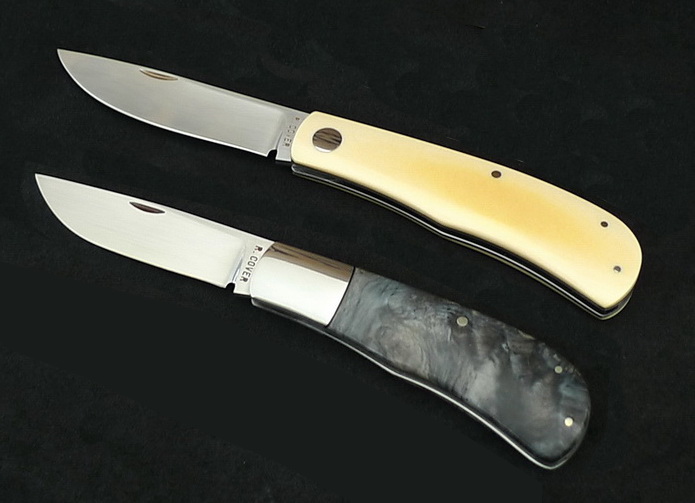
What do you look for in a custom slipjoint-mark of quality?

Study some Bose knives. Got it. Have been, will do more. Hopefully I can go learn from the man himself. I may not be able to speak being next to the MAN, but I will write some questions down before I go so I can just hand him the paper. ;) Don, be prepared to get peppered with more questions. Maybe not today, but its probably going to happen.


So dovetail bolsters are out then.

Not that it has to do exactly with this thread, but I'm soliciting opinions on shadow vs barehead for this particular knife. Covers are going to be brown canvas micarta, unless I find something else better.

Very interesting talks gentlemen. Now, what about swedges? Yes, no, absolutely necessary or doesn't matter? Cut or drawn?

Specifically on this knife.....do I take a chance and do cut swedges with a long pull, drawn swedges with a nick, or just go simple with a nick sans swedges.

Shadows are cool at a lower price point, but good to offer bolsters and natural covers too.

Swedges add to the 'Look' of the knife. Not really necessary on a single blade, but adds clearance to multiblade. Still. Every knife I make, fixed, slip, linerlock, etc. gets a swedge. They just look Right !

Either type of swedge would look good on that knife.
 
What STeven, Don and Bret said is spot on IMO. I studied pictures of Bose knives until I was blue in the face, but when I went to blade and saw them in person my eyes were opened. Just the way they feel in hand, the action and attention to detail gave me something to shoot for. I would recommend going to Blade next year. It seems like a big expense but you can do it cheap and the chance to to handle knives from other makers is invaluable.
 
There´s a wealth of information to be found in this thread.

Pardon me for hijacking it, but could someone please enlighten me on how to rate the pull? I mean, I see statements all the time saying "pull is about 6" or similar, I just dont know what it means:foot:

Also; besides personal preferences, is there a practical use for a half stop?

Thanks

Brian
 
There´s a wealth of information to be found in this thread.

Pardon me for hijacking it, but could someone please enlighten me on how to rate the pull? I mean, I see statements all the time saying "pull is about 6" or similar, I just dont know what it means:foot:

Also; besides personal preferences, is there a practical use for a half stop?

Thanks

Brian
Rate of pull (how easy/hard to open blade) will vary a bit between diff people. I call 5 a good medium pull, not hard, but still very snappy. Below 5 starts to get wimpy. Above 6-7 starts to get hard on the thumb nail. I pretty much shoot for 6 on the scale.

Only practical use for a half stop is to maybe keep the blade from closing on one's hand, but that would only happen if a person didn't know how to use a knife. Other than that they are pretty cool.
 
Half stops also make the pivot self-clearing/cleaning. The corners on a half stopped pivot rub and push the dirt and gunk out of the blade-spring union.

On a related note, I HATE half stops on my personal knife. No knife I make for myself will have them. To me they interrupt the smooth closing and opening of a knife.
 
Great thread! Good questions, lots of well informed responses. If I am just looking at a picture, the first two things I check out is the backspring/liner area, and are the blades/blade centered? It is special when things are seamless, like the Tony Bose example here. And, an instant turn off is an off-centered blade, for me. The good makers have these two traits working for them on a consistent basis.

Boseserpentinejack3_zps4609b66b.jpg


I like a harder pull, and am okay on a single blade if it even needs to be pinched or squeezed early on. Through continued use, it will lighten slightly. It just seems more sturdy, solid to me when there is a little work involved in opening. I am not opening my users more than a half-a-dozen times a day, anyway.

Favorite user steels I have grown to like are W2, CPM D2, and 440V. The more sharp they come, the better. Which is why I like a half stop (unless a traditional pattern that did not use one is involved). I like my fingers, and want to keep them. :)

No sharp edges, no sharp corners...rounded spines, bolsters, scales, etc. Very important, along with the whole folder needing to be as slim as possible for the pattern. Thick isn't good if you want it pocketable, especially.

Just a few of my thoughts. Interested in hearing more here. This has been an enjoyable thread to follow. Your interest and the input received here will help you a ton as you figure out the 'slipjoint puzzle'.

- Joe
 
I admittedly like half stops and have only made a few without them. They have saved me some pain in moments of carelessness while finishing a knife. I still get a little "bite" because I make sure my knives are like razors but at least that's all it is.

Half stops also make the pivot self-clearing/cleaning. The corners on a half stopped pivot rub and push the dirt and gunk out of the blade-spring union.

On a related note, I HATE half stops on my personal knife. No knife I make for myself will have them. To me they interrupt the smooth closing and opening of a knife.
 
Rate of pull (how easy/hard to open blade) will vary a bit between diff people. I call 5 a good medium pull, not hard, but still very snappy. Below 5 starts to get wimpy. Above 6-7 starts to get hard on the thumb nail. I pretty much shoot for 6 on the scale.

Only practical use for a half stop is to maybe keep the blade from closing on one's hand, but that would only happen if a person didn't know how to use a knife. Other than that they are pretty cool.

Thanks Don. That explains it very well.

@Medicevans; The self cleaning effect makes sense to me. Thanks.

Brian
 
Jared, Could you elaborate on your comment "They have saved me some pain in moments of carelessness while finishing a knife." I had one knife maker tell me he thought half stops were easier to get "right". Is it true?
 
Sometimes when I'm working on a knife, even before I put an edge on it, I'll get careless and not pay attention to where my fingers are. The half stop has saved me from some nasty cuts.

I actually think half stops are a little more work. You now have three positions to get flush vs. just 2. There is a little learning curve with cam tangs but then there's a learning curve with everything on slipjoints.

Jared, Could you elaborate on your comment "They have saved me some pain in moments of carelessness while finishing a knife." I had one knife maker tell me he thought half stops were easier to get "right". Is it true?
 
What I look for is how they feel in the hand and flow. How the blade works with the shape of the handle. I like gentlemen's pocket knives with clean lines and clean shapes

Blade that is centered when closed and no gaps between spine and blade when open

I own 4 Ray Cover models as I just like the overall look of his knives

raycover5.jpg


DON
 
There are a couple things I try to do as a maker and always looked for as a collector.

First as has been mentioned above is the thickness of the grind before putting an edge on it. I like to keep it at .010 or less. Usually .005-.008

Second is the swedge which doesn't always have to be dramatic, just aesthetically pleasing and crisp.

Then come the nail nicks/pulls. Most of the time, but not always, they should line up with the swedge and sometimes the spine.

Again, all of these can be seen on Bose knives in photos and especially in person.
 
A lot of the details make up the entire package.

1. Nail nick-shape, polish, alignment....match striker nail nicks are awfully cool and not done very often.
2. Maker's mark-size, location, type(struck or etched), depth, crispness
3. Liners-thickness, finishing, texturing
4. Blade finish-satin rules...is it clean, is it even, are the grinds nice and crisp?
5. Handle material choice and finishing....I collect pearl and stag slipjoints, material should be of BEST quality and fitted to perfection as the situation permits
6. Thickness is very important, not too thick so it sits in the hand like a lump, not so thin that it is not up to the work it was designed for.

Have to admit....it was over 20 years into collecting before I even considered purchasing a custom slipjoint, I thought the guys ponying up big cash for Bose knives were clueless rubes. Turns out I was the clueless one. There is more detail oriented work involved in the creation of a top quality custom multi-blade slipjoint than just about any other type of knife, with the POSSIBLE exception of a complicated automatic. I get great joy out of owning the models that I have, and developed a good friendship with Bill Ruple over the years that has provided as much joy as owning his knives.

Bill is not Tony Bose, but he is very accomplished as a slipjoint maker, extremely generous with encouragement and how-to's with other makers and as genuine and approachable a maker as I have ever known.

Best Regards,

STeven Garsson
 
Not to veer too far off topic but meeting Bill and spending some time talking with him was one of the biggest highlights of my trip to Blade this year. He is one heck of a great guy that I hope to get to know better in the future.

Bill is not Tony Bose, but he is very accomplished as a slipjoint maker, extremely generous with encouragement and how-to's with other makers and as genuine and approachable a maker as I have ever known.

Best Regards,

STeven Garsson
 
My thoughts echo many others.

I like no gaps at all. I don't want any side to side wiggle.

I want the knife to look "clean".

I am ok with nice crisp tangs. I would rather have a seamless fit in that department than have the spine/tangs rounded. When open, I like to see a perfect transition to the spring and the tang.

I like both half stops and cam tangs. Though, for a knife that gets used, the half stop cleans out the action better than cam tangs. From experience. I cut some cows with a J. Oeser gunstock, and it was dropped in the dirt, kicked, and stepped on. Bloody, and full of dirt (and other less desirable things). The half stops cleaned the gunk out, and did not feel gritty the next time I used it for the next cow! I have a user/beater AG Russell Cowboy (large sodbuster style) and it is a cam tang. It is not a smooth when you get dirt and sand in it, as the half stop/square tangs are once opened and closed.

But that said, I will buy, and like both, if that is the original pattern, I am fine with it.

I like long pulls, and pinch-able designs more than nail nicks.

I like a good feeling in the hand too. If a liner feels too sharp, I will take some high grit sandpaper and run a folded piece over it. Not enough to take the crisp lines away, but enough to take the bite off.

I carry in slip sheaths, for the most part.

I like carbon/tool steel just fine. Patinas are great, and I enjoy them. That said, I ordered my only custom slip joint in CPM 154. D2, both polished and satin, has been pretty darned stainless to my uses! Holds a great edge too.

Thin grinds, and sharp edges. For me, a traditional is all about the slice. They are not meant for stabbing, or prying. No tactical nonsense. They should cut and cut well.

I like the primary grind to be thin at the edge. You can often tell, on an otherwise nice looking slip joint, that the primary grind is too thick, because there will be a wide secondary bevel on it. This happens with some customs.
 
Back
Top