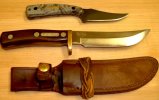
What do you use your medium length fixed blades for?

Big knives are a trade off if you want to do large tool job without carrying the weight.

When I'm hiking, I generally spend more time walking than cutting stuff, so the cutting part might be a bit more complicated but it is largely counterbalanced by the weight I don't have to carry the rest of the day. If I go in the woods for lumbering near a trail where I can park my car, I'll probably carry an axe, or even a chainsaw...

Now considering that even a small blade can do large job if your patient enough, the size of the knife is all about where you set the cursor between the work efficiency you need and how much you're ready to carry.
 
All of us WSS knifemakers are paying attention. :D

I started out around the 4 inch mark on my wilderness knives but seem to do most of them around 5.5 to 6.5 inches.

A lot of the knives in that range from production companies seem to go about it a bit wrong, either miniaturizing really big knives (seems the most common problem) or overbuilding medium size knives into KSAs

It's not really that hard to make a 5 inch knife do well on fine work. It's all geometry and handle ergonomics. I go from a small knife and grow it- To misquote George Buehler, I make a lot of big little knives.

For my own use, I find the extra inch or two is great for batoning, food prep, and doesn't take away too much from fine tip work.
 
as long as it is thin, like tonym said about his koyote chopper, i think a medium and even a large fixed blade can do good whittling, and , with proper technique, many delicate carving tasks. also, depending on the size of the person, a 5-6'' blade length would probably be more appropriate for bushcraft than a standard 4'' bushcrafter.
 
As a side note, I avoid calling other people (or their choices) stupid.
Codger
Yeah. Right.

back to the question,

The "in-between" or medium fixed blades are probably your "one knife fits all" category. The BK7 is a great camp knife, as is the Busse SH-E. I would be quite comfortable carrying just one of these on a multi-day backpacking trip.
 
Guess you don't get out in the rain much.

I don't carry a hatchet. You'll probably just call me stupid for that. Why would I pack more stuff when my knife can do the job just fine? All I need is enough wood to get a hot fire going, then I can add wet wood and it will burn. One decent sized log can do that.

I batoned through over 30 feet of Maple with my JK Kephart and still shaved hair off my arm afterwards.

Wrong tool for the job...but if that's how you like it!!!
 
While I much prefer a big bowie and a small companion knife a 5 to 7 1/2 inch blade is great for certain jobs. For a hunting knife a good fixed blade about 4 to 5 inchs is best for me.
When you want one knife that can do everything and still be worn on a belt a 4 1/2 to 7 1/2 inch is ideal. My Rosarms Bayonet or classic USMC Ontario are great examples.

For a really first rate fighter I like about a 7 inch blade. Anything longer makes it hard to use in a small space and anything shorter not enough knife to pierce vital organs through heavy clothing. Buck 119 is a good cheap one and I also like the USMC and Rosarms bayonet in this catagory.
 
I tend to use my RD7 for anything I wouldn't want to mess up my other knives doing. I know I can beat the hell out of that knife, chop down a tree, baton through it, Rambo the sentinel, pry open a door, whatever, and it'll come out still sharp and asking for more. While that's more specific to that particular knife, mostly it boils down to batoning and chopping. I don't have a bigger knife yet, don't really see a need for anything bigger, so the RD7 gets the 'bigger' work, and does it just fine. It can do, and has done, finer stuff quite well too. It's just a matter of knowing how to use it. Until recently (yesterday) I didn't have a hatchet, so it did everything I might otherwise use a hatchet for.

Honestly, I don't use my RD7 all that much of late, because it's a lot of weight to haul around. Still, it's one of the last knives I'd part with.

I can see a knife with a 5"-6" blade being much more 'handy'—excuse the pun—though. If properly ground, it would be just as capable of fine work as a 4" blade, as already mentioned, but should still be plenty able to take on light chopping and batoning if full tang. Now, before anybody jumps on that, I'm not saying a knife has to be full tang to baton, only that it's generally a lot less likely to break if your technique isn't quite perfect (which is likely in an actual survival situation). Probably my next knife purchase is going to be something in this size range. That Woodsman model Andy showed us a couple weeks ago is looking mighty good. :D
 
About the only thing I use the longer blade for is cutting meat. I like a longer blade for some food prep. I never have found much need to baton with my knife as I always have a hatchet or Machete close by. I also don't use my knife to split wood. A bit of whittling from time to time but I like the 3 inch Mora carving knives for that. I could make do with one five inch if the blade geometry was right. I was pretty comfortable with just the SOG Northwest Ranger.
 
It seems to me that we all talk from our respective experiences, whether it be on knives, guns, survival equipment, martial arts, etc. We've all seen what we've seen and know what we know. Seems to me that what we have here are various people with different ideas that come from vastly different experiences.

Some of us camp out of the back of our cars, and that allows us to carry things that a backpacker, who likes to get at least 50 miles from nowhere, probably has elected to leave behind. Some maybe only spend, at most, three days out in the woods, and don't have a need to chop anything that requires hauling an axe. Some may leave civilization for weeks and may need the utility that comes with having multiple tools, whether they have to carry them or not, to survive comfortably because they can't just walk down to the camp ground general store for bundles of firewood and a bag of Cheetos. Some may love to make all sorts of things out of wood while camping and will need a knife that allows them to do more precise work. Some may hunt pheasant, some may hunt deer, some may hunt bear, some may only fish. You may be able to do all those jobs with just one knife, and maybe you do. Maybe you don't. Maybe you want the right tool for the right job. Maybe you pride yourself on being able to circumcise a gnat with a double-bit axe.

It's easy to say, "I don't have a need for that." or, "I don't see the sense in that." But what kind of camping or hiking do you do? If you're not building a shelter, then you probably can get by doing enough chopping to build your little fire with your 7" knife. If you're buying bundles of wood from the rangers, then you probably only need enough of a knife to make a fuzz stick or two and to clean your nails and the occasional fish you're planning on lying about. ;-)

As for me, I try to know what I know, but what's even harder is to know what I don't know. It's apparent to me that I don't have anywhere near the experience that most of you have, but I've had enough experience to know what seems to make sense. I appreciate everyone's point of view, understanding that you're speaking from your own experience and I take it for what it's worth.

Most of the time, it's worth a lot.
 
I guess what I should have said is most long blades are to thick for my liking. As a rule the long blades grow in width and weight since I don't do much chopping with my knives, I like to keep them thinner. I like to have a big thick heavy knife available but seldom use them. Your knives are the exception and I wouldn't be afraid to do some heavy cutting and chopping with them. To me thin cuts better and the lighter the better. I am starting to like the 1/8 and thinner knives best. As Shang said, it's what works best for the guy using the tool.
 
Last edited:
I was asked today what the smaller companion knife to my 165OT was and I decided to post a picture of one in case anyone else was wondering. It is a Schrade Old Timer 152OT Sharpfinger. I am sure that a lot of you are familiar with this old knife, produced from 1974-2004.
11t4uvc.jpg


It is far handier than it's small size might suggest, and this circa 1974 magazine ad was not far off the mark.

2agotxc.jpg


These have been discontinued since 2004 when Schrade closed, but they made millions of them in the thirty years they were produced, so they aren't hard to find at very reasonable prices. I have about two dozen variants in my collection besides my users but... sorry, no spares. I do have a few spare new sheaths from the bankruptcy sale though if you need one.

Most were made in 1095 carbon steel, but the last year and a half of production they were stainless for those who prefer it over carbon steel blades.

Codger
 
I collect medium-length fixed blades to provide a good transition in my display cases between the little knives and the really big knives. This is a crucial function. :D

Seriously though, I find that I keep coming back to 5" blades as my preferred size for a belt knife - especially when supported by a small neck knife for precision cutting. Sometimes, a large chopper or axe just feels like overkill for a day hike in familiar territory.

Also, there are a lot of interesting sheath options for knives in this range. I like to carry a multi-tool in a sheath pouch, and you can find sheaths with this feature in the 5-8" range. You don't see many ballistic nylon sheaths with pouches in the 3" range. Of course, you can find this feature on large sheaths, but then we get back to my point on overkill for short hikes.

All the best,

- Mike
 
My all-round long time companion knife has a 5 1/4" blade (9.5" O.A., 8.8 oz. wt.). I have used it for many years doing all sorts of tasks in the outdoors and never felt "under-knifed". It has butchered more fish, fowl and wild game than I could recount. I've used it to bild fires under adverse conditions (no not in Oregon or the tundra either), shelters, traps, and a hundred other tasks. Never did I wish for a larger knife, though once or twice a smaller knife would have been handier.

I do own larger knives and smaller knives, several hundred in fact. But none has ever won my favor like my old trusty 5 1/4" carbon steel bladed knife. One smaller fixed blade ((3.5", 7.5" O.A., 4.1 oz. wt.) is a close runnerup, and sometimes the larger one has been left behind in favor of the smaller knife's portability and unobtrusiveness.



2i28l5e.jpg

I own this same knife. (what is it called?) I got it from an Uncle as a birthday present. I have to agree with you completely. I have a dozen or so knives, but this is the one I tend to take above all others. Just took it on my last deer trip.

I can't figure out why though. It often seems a little big. I never like the look of the upswept tip. Fit and finish are OK, but nothing to write home about. But it is a seriously useful knife. There is something about its sturdy design that is reassuring. As you said, I never felt I needed more knife, if anything slightly smaller would do.

Funny enough, a friend just gave me a Schrade Sharpfinger. I think it must be re-released. I like it too, but that big Old Timer Schrade is the one that will end up in my pack again and again. Someone knew what they were doing when they designed the one pictured above. (Maybe they only had model numbers back then: 165.)

In my experience a 4-5" drop point is ideal for 'bushcraft' use, but if you get a chance to pick up one of the above Schrades, do it.

Jack
 

Attachments

  • Schrade OT's.jpg
    Schrade OT's.jpg
    40.1 KB · Views: 10
Last edited:
I meant perfect for me:o not everyone. I don`t think there is a perfect knife for everyone.

You are surely right, but it's still a good attitude to see in a knife maker! I wasn't poking fun at impossibility, just happy to see the word 'perfect' in a goal statement. :thumbup:
 
I own this same knife. (what is it called?) I got it from an Uncle as a birthday present.

The 165OT was/is called the "Woodsman". Henry Baer seemed to be the hunting knife designer for Schrade Walden in the 1960's and had an affinity for Cooper's "Leatherstocking Tales". His patented 15OT was the "Deerslayer".

I can't figure out why though. It often seems a little big. I never like the look of the upswept tip. Fit and finish are OK, but nothing to write home about. But it is a seriously useful knife. There is something about its sturdy design that is reassuring. As you said, I never felt I needed more knife, if anything slightly smaller would do.

I think that for me it has to do with the geometry of the serpentine handle and it's allignment with the blade. That trailing point tip has come in handy for me over the years when piercing and "fine work" was required. Drop points just won't do that as well, IMHO.

Funny enough, a friend just gave me a Schrade Sharpfinger. I think it must be re-released. I like it too, but that big Old Timer Schrade is the one that will end up in my pack again and again. Someone knew what they were doing when they designed the one pictured above. (Maybe they only had model numbers back then: 165.)

That version of the Sharpfinger you showed was made in China for Taylor Brands, the new owner of the Schrade name. I'm not versed on the quality of those newer Chinese copies, but I do have one of the first imported ones circa 2005, and it was very poorly done. It doesn't help that I am not a big fan of stainless for hunting knives, or Chinese made knives in general.

In my experience a 4-5" drop point is ideal for 'bushcraft' use, but if you get a chance to pick up one of the above Schrades, do it.

Jack

Well, as you know by now, I agree. The larger knife gets in my way when I sit in a vehicle or canoe for any length of time and I find myself having to reposition it on my belt. The Sharpfinger tends to be less obtrusive until needed.

But I have to repeat that the American made originals of both knives are still readily available (the Woodsman is also being copied in China for Taylor Brands) for those who want one and are willing to take the time to find them. While the new copies sell for about what the originals sold for thirty years ago, excellent used, slightly less than mint examples can also be had for those prices ($15-35, almost always less than $50). Mint new in the box examples are the ones which are more expensive because of their appeal to collectors. Those often top $100 with some early ones and special editions nearly doubling that.

Codger
 
Back
Top