What is Patina, really?

Joined
Apr 15, 2008
Messages
3,010
Ok, so I look at the pics here, and see many rave about the patina that forms from use over time. What confuses me is this: about half of the 'patina' I see in the pics looks more like RUST! I have a fairly old and definately used Mora Carbon Steel knife with a little discoloration, which I dig, but it is not rusty in the least.

Am I the only one that sees the difference, and would definately NOT be bragging about a rusty knife?
 
I tend to think of a "true" patina, as something that builds up over time. I think what most of us here are referring to when we say "patina", is more of a controlled rust to keep a carbon blade from red rust. 
 
Last edited:
Ok, so I look at the pics here, and see many rave about the patina that forms from use over time. What confuses me is this: about half of the 'patina' I see in the pics looks more like RUST! I have a fairly old and definately used Mora Carbon Steel knife with a little discoloration, which I dig, but it is not rusty in the least.

Am I the only one that sees the difference, and would definately NOT be bragging about a rusty knife?

If you have to ask, you wont get it.
 
If you have a well-used carbon steel blade, it will patina.

If it doesn't have patina, then you either don't really use the knife, or you are making your knife thinner by polishing the crap out of it.
 
Ok, so I look at the pics here, and see many rave about the patina that forms from use over time. What confuses me is this: about half of the 'patina' I see in the pics looks more like RUST! I have a fairly old and definately used Mora Carbon Steel knife with a little discoloration, which I dig, but it is not rusty in the least.

Am I the only one that sees the difference, and would definately NOT be bragging about a rusty knife?

No, I believe that there may be one or two other BF members smart enough to know the difference between a patina and rust, but just a couple. It takes a trained eye...:rolleyes::rolleyes:
 
The Mountain Man, Sodbuster Jr, Large Stockman and Canoe are all good examles of a blade with patina. The Copperhead, Tiny Toothpick,and the Medium Stockman now also have patina but that is an old shot. The rest are stainless except the Scagel which I haven't really used much.

ry%3D400
 
know why you would a nice patina, and I love the nice patina on my mora. The old slipjoints with rusted liners and joints? I figure that if it turns your hand orange, you probably let the 'patina' run amuck...

Any truth to the idea that a true patina will help cut down on rust?
 
know why you would a nice patina, and I love the nice patina on my mora. The old slipjoints with rusted liners and joints? I figure that if it turns your hand orange, you probably let the 'patina' run amuck...

Any truth to the idea that a true patina will help cut down on rust?[/QUOTE]

That's what I heard but if you wipe your knife down regularly and store them in dry place they will be fine anyway.
 
know why you would a nice patina, and I love the nice patina on my mora. The old slipjoints with rusted liners and joints? I figure that if it turns your hand orange, you probably let the 'patina' run amuck...

Any truth to the idea that a true patina will help cut down on rust?

Yes. The controlled build-up of iron oxide prevents further penetration of oxygen to the underlying metal. When I know I'm going into the much on a wet field exposure I will force a patina on my carbon blades by giving it a vinegar soak overnight, mustard or the old potato treatment. Gives is a nice black coating and then I re-touch up the edge. Protects it very well in this case. When I get back, I often just remove the patina. Some patina's I like, some I don't and sometimes I just like my blades a bit shiny. I certainly see the method of forcing a patina more for function than for aesthetic purposes.
 
I find that keeping my carbon blades polished I rarely have to worry about rust. Unless you force the Patina, neglecting the blade long enough for a natural patina to develope is just one step away from rust pits.

Bill
 
Bluing and patina serve the same purpose.
 
i guess im just one of the few who just really dig the patina! I enjoy forcing patinas because i feel like im customizing my blade to my liking(cause i am). I actually just forced a really beautiful patina on my new BRKT Canadian Special last night with mustard and its my favorite so far. I live in south east texas about 45 min from the coast so the humidity is high. As much as i like a nice patina, i also find it very functional but i guess YMMV.
 
I find that keeping my carbon blades polished I rarely have to worry about rust. Unless you force the Patina, neglecting the blade long enough for a natural patina to develope is just one step away from rust pits.

Bill
Once I get a new carbon slipjoint I use it to peel the apples I love to eat. Even though I wipe them done after each use patina develops. It happens even faster when I cut up limes for Coronas.:D I don't have any pitting on my knives and love the colors that come with a nice natural patina. To each his own though.
 
my currently missing after a move schrade slippy has an almost black patina and since it got that from several years of EDC it no longer even hints at rusting...after use i wipe it with my shirt usually and lump it back in my pocket.

I hope i find that knife once the unpacking is done! a perfect patina is a glorious sight!
 
Real patina...

HF2.jpg

No kidding. Now that's the real deal. What stories that knife could tell, eh?

As far as patina goes, on steel it is a combination of staining and rust. As a professional woodworker, in 40 years in the trades using all manner of steel tools, I have never heard of anyone think of discolored or lightly rusted metal as being protected.

My best forged chisels, my hammers, my old Disston handsaws (rolled from spring steel stock), steel/wood handled Irwin screwdrivers, forged auger bits, my old Stanley planes, and on an on have never benefited in any way from a light coat of rust or staining. Yes, it does make the new stains or rust harder to see, but it provides no waterproofing or surface protection.

While the staining usually does no damage at all (look at your average wood chisels from a carpenter - not a shiny one in the bunch!) the thin layer of corrosion or rust can prevent easy cutting (would you shave a board with a plane that had a very lightly rusted blade? ) and attract more moisture as it it much more porous than a smooth, polished finish.

This is easy to see. Take two very lightly patinated chisels that your helpers have left in the open on a very humid day. Polish and clean one up. Dip them both in water. Which one stays wet longer?

I think of the forced patination here as the guys not wanting their knives to look new or unused. Think of it this way, on the jobsite, you don't want to be the guy that shows up with new, shiny tools. A no-no.

On the other hand, I think knives look better with the patina as (even if it is mimicked) as it speaks to a knife that is well loved and well used. All of my old Case, Schrade, etc. knives got there eventually with enough use. My Benchmade, Spydercos and Kershaws never develop that character as they are all stainless, so the are just nice knives, even after years of use. But I like my old carbon knives with their pits, scratches, blue blades, etc. as they have a real sense of being a good knife.

Like Guyon's. The pits, stains, and well smoothed bone handles tell the whole story on that one. That knife sailed past patina all the way to provenance.

I have to ask Guyon if you are still here, did you carry that knife the whole time to get it that way?

Robert

 
Charlie Mike, explain more about blueing. How do you do this (I know it is done to guns, but they are not in my forte).
 
Charlie Mike, explain more about blueing. How do you do this (I know it is done to guns, but they are not in my forte).

I don't know too much, not much of a gunsmith here... I have used cold bluing on carbon blades. It won't work on stainless though.
 
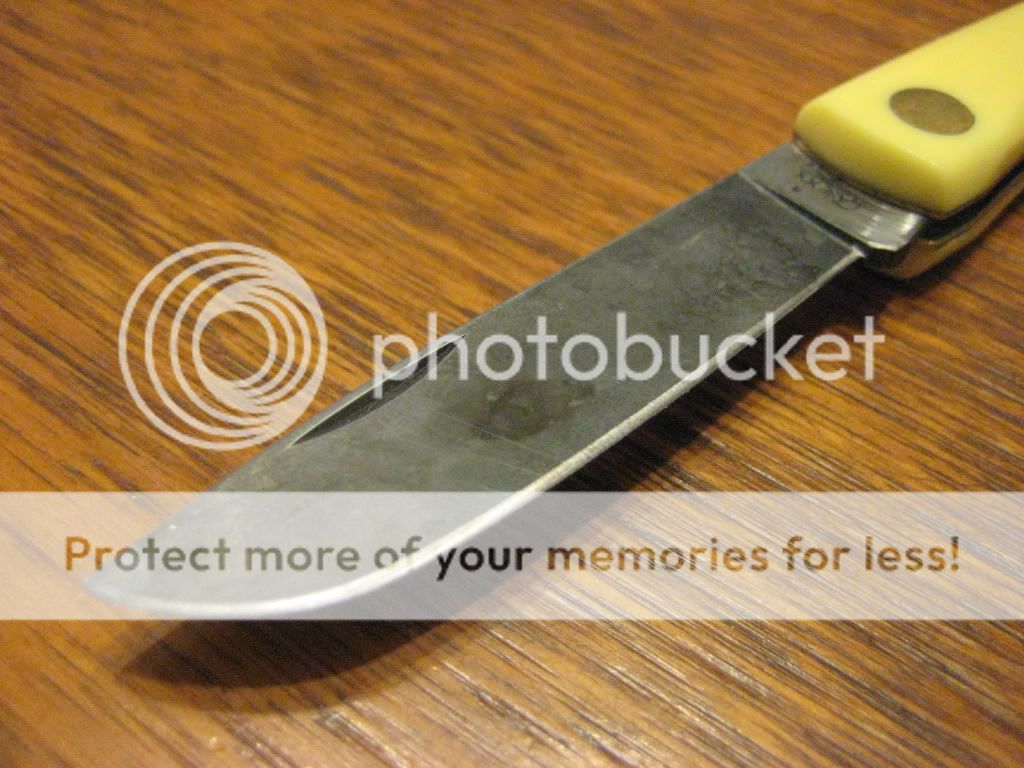
This is forced "patina", which developed while the blade was buried in an apple for a few hours; the oval spot is where it bisected a seed:

jan052009001.jpg
 
Back
Top