What is Patina, really?

Like Guyon's. The pits, stains, and well smoothed bone handles tell the whole story on that one. That knife sailed past patina all the way to provenance.

I have to ask Guyon if you are still here, did you carry that knife the whole time to get it that way?

Robert

Robert, that knife is a Honk Falls made in Napanoch, NY back in the 1920s. I don't know who had it and carried it before my grandfather, but both he and my father carried the knife. I've carried it some, but because I have plenty of other slippies to choose from and because I'd so hate to lose it, I don't carry it any more. The Honk Falls knives actually have quite a bit of collector's value from what I'm told, but more importantly, I'd hate to lose something that connects back to two men who were so important to me.

A blurb on Honk Falls...

At about the same time, two Carman brothers, trained by Dwight Divine, joined with W.D. Hoornbeek to form a
rival company, Napanoch Knife Company, and began manufacturing knives in the old DuVall rake factory on
National Street. In 1919, the factory was sold to the Winchester Repeating Arms Company of Connecticut.
Many of the workmen moved to Connecticut.

Within two years, some of the veteran employees returned to Napanoch. John Cushner was one of them. He
associated himself with Melvin Schoonmaker and Melvin Quick, both skilled knife makers, and George Brackley,
who brought good business experience to the group and formed the Honk Falls Knife Company, setting up (again)
in the old DuVall rake factory building. They were very successful and produced well-accepted knives, but a 1929
fire destroyed the building and its contents.

Source: http://www.wawarsing.net/22/COPDF/409-17-Forward2.pdf

HF3.jpg
 
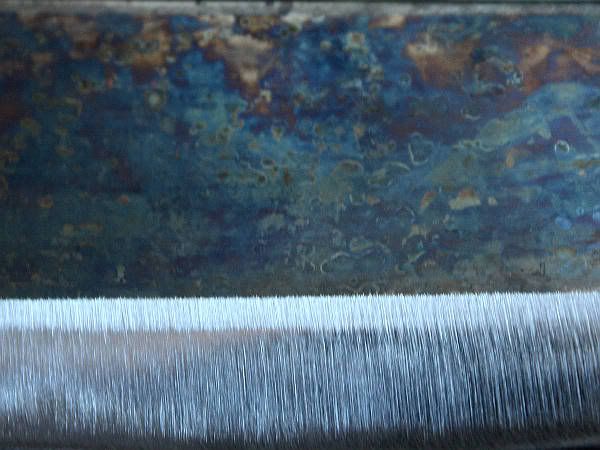
If you use a carbon steel knife in the kitchen a lot, you can get some pretty colourful patination going on, as shown in this closeup of my Kumar Karda:

KumarKarda20091212d_sm.jpg
 
Robert, that knife is a Honk Falls made in Napanoch, NY back in the 1920s. I don't know who had it and carried it before my grandfather, but both he and my father carried the knife. I've carried it some, but because I have plenty of other slippies to choose from and because I'd so hate to lose it, I don't carry it any more. The Honk Falls knives actually have quite a bit of collector's value from what I'm told, but more importantly, I'd hate to lose something that connects back to two men who were so important to me.

Somehow, I kinda suspected something like that. An old warrior that is still in such good shape almost had to be family kept. I think the full history of the knife is really great, too.

I just received my grandfather's barlow from my Dad. At 83, it was time to get my Dad where he could get some full time help, so he gave his knives to me when we moved him to assisted living. There are some nice knives in his small collection, but I was stunned to see Grandad's Barlow. It could be the only knife my grandfather ever took care of.

Grandad passed in '64, and the knife saw a few years of carry time from my Dad. Dad doesn't like the old patterns, and I am nuts about them, so was particularly happy to see this knife pop up. I thought dear old Dad had traded it off. But now that I have it, like you, I won't carry it. It is the only thing I know of that physically connects both men. I have plenty of other knives to have in the rotation before I would take a chance with it. Heck, it's family history!

Thanks -

Robert
 
I wonder why a lot of people like patina on their knives.

Because usually it reflects the knife's participation in the owners life (unless forced) .

I personally love opening one of my slippies, and noticing a new dark patch here or there. It is a different tact to my previous enthusiasm in tactical folding knives that seemed to expensive for me to justify use, I'm encouraged to use my working knives now, as I like watching it age with me, and with use.
 
I had a very nice patina develop on my craftsman triflex Mora while eating a steak dinner with A1 sauce. Not the whole blade just mostly the lower half. It looks very cool. Not at all like rust (I was only using it for 15 minutes.........I eat slow)
 
I wonder why a lot of people like patina on their knives.

It's similar to the appeal of antiques... something that looks old and well-used, but still serviceable. Heck, personally I even like a forced patina, though that'll typically lack the nuances and variations of one obtained through repeated cutting. With use and re-sharpening, a blade will get scuffed and scratched. I find this kind of wear just looks more natural and pleasing on a patinated blade than on a coated, polished, or stainless blade.
 
I love a good patina. Really shows a blade's character, and makes me feel like it's truly mine. Helps establish a comfort level with your tools.

Also... as far as oxidization is concerned... Fire (combustion) is rapid oxidization. Rust, patina, verdigris, etc. are slower forms of oxidization. In fact, pretty much EVERYTHING around us is oxidizing all the time.
So.....
Thinking for a moment about light and sound: there is only a small range of the entire spectrum that we can sense (visible light, audible sound). If we think that, just maybe, other phenomena in the universe work similarly, then it can be (playfully) surmised that...
Everything around us is oxidizing, is "on fire," it's just happening so slowly that it doesn't look like fire to us.
WE'RE IN THE LAKE OF FIRE! AHHHH!

wink.
 
Patina looks better to me than a badly scratched (which all my stainless blades end up looking like) stainless blade.
 
It's similar to the appeal of antiques... something that looks old and well-used, but still serviceable. Heck, personally I even like a forced patina, though that'll typically lack the nuances and variations of one obtained through repeated cutting. With use and re-sharpening, a blade will get scuffed and scratched. I find this kind of wear just looks more natural and pleasing on a patinated blade than on a coated, polished, or stainless blade.

I agree. I love some of my stainless blades for their utility value, but no matter how much they are carried, they don't have that "character" that develops with use.

They just look scratched or dinged. They could be 10 years old or ten months old and not have much difference in appearance.

Robert
 
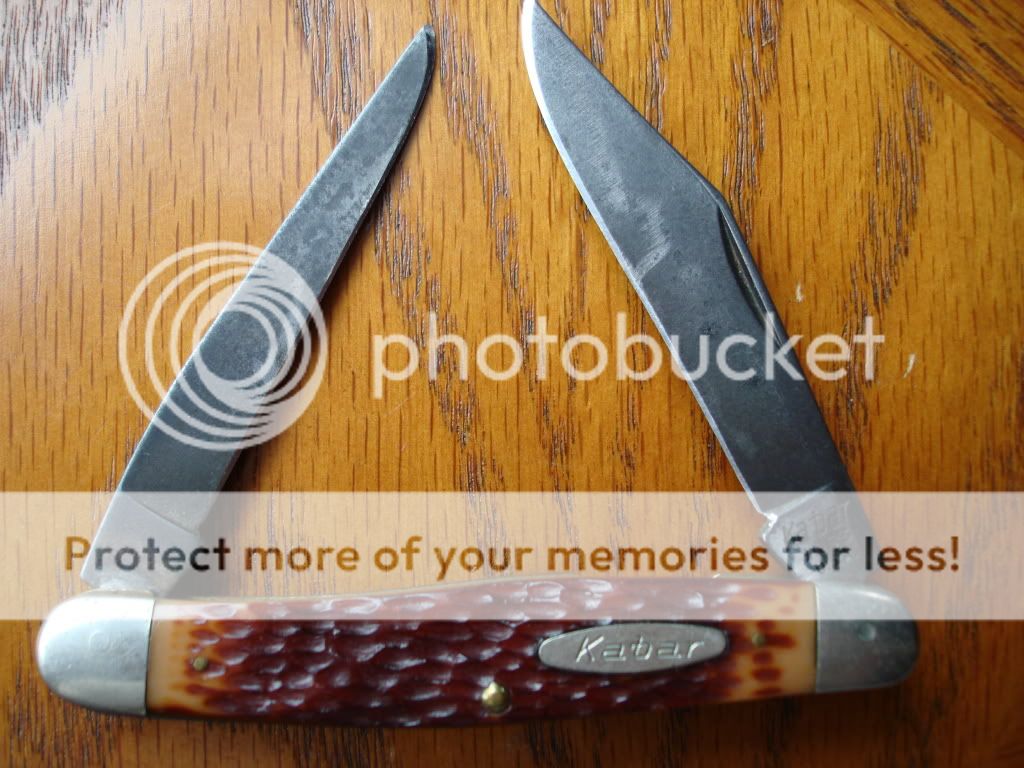
Just thought I'd share a pic. This one belonged to my late grandfather who used it often. After he passed, it sat in my moms garage for about 20 years, and was pretty much a solid chunk of rust when I found it.

I cleaned it up, but found that I realy liked the character the patina gave it. So instead of fully pollishing it I sharpened it up, and left it looking like this...

various2008-2009123.jpg


...Something to remind me of Grampa, ....old and worn, just like he was. :)
 
Back
Top