What kind of wood do you like for your High End Knives?

Joined
Dec 7, 2008
Messages
7,187
Things seem to be changing a lot with the preferred knife handle woods through the last year. That is why I am asking this question. When I say high end knives I mean ones that would be a better than EDC type knife. Not a utility knife, more a work of art.

One knifemaker recently took his Journeyman test with the ABS and was told that curly maple was too plain. I believe there were other issues as well but the comment about the curly maple caught my ear. I had always thought it was a classic handle wood, but what do I know.

I am hoping some of you who are long term knife makers would be willing to give your input.

I know figured Desert Ironwood will never fall out of favor. Same with Blackwood. But what else do you like and why? Do you like the really bizarre dramatic stuff? or prefer something more conservative.

Any and all comments are welcomed. Thanks for your input.
 
Last edited:
Being a relative noob still I can only go from what I have used so far. I really love the grain of rosewood, and will use it again. Cocobolo is really nice but I hate the way it loads a belt. lacewood is another that I will use again. hopefully soon I will be able to try some of the more better woods.

Bennie
 
I only use stablized and highly dense woods that I dont have to worry about swelling,shrinking,and moving.Rare and highly figured is highly sought after.I wish someone here in the USA would search out more east Asian and Russian/East European woods.I look at some of the knives coming from the East and am amazed by some of the woods they have available.For instance I got some Vietnamese blackwood used for high end violin making and it is jet black with zero other color unlike much of the blackwood being sold.
 
Burlsource,
In addition to Ironwood burl, and blackwood, I have strong
preferences for highly figured crotch Black Walnut, and
Amboyna burl...
 
Burlsource,
In addition to Ironwood burl, and blackwood, I have strong
preferences for highly figured crotch Black Walnut, and
Amboyna burl...

How about English Walnut?
At the last Blade West show it was the most popular non-stabilized wood I had. I am wondering if that was a fluke because it all went to just 3 makers then I was out.
 
Amboyna and snakewood are both near the top. Additionally any other dense burl (rosewoods, and so on). For conservative pieces, cocuswood and quartersawn rosewoods are great.

I also think curly maple (or curly anything) is a little plain on something as small as a knife. I love the stuff for boxes, but I rarely use it on knife handles, and I'm usually a little disappointed when I do.

Phillip

P.S. Heathen, If you haven't already, invest in a ($2) rubber cleaning block for your belts. It really helps for that cocobolo gunk.
 
I don't know if it was a fluke. One stabilizer will say that Black
Walnut is difficult to stabilize well, another will say Claro or
English. Some will choose based on that.

I prefer the figure, density, and rich colors of Black Walnut.......
and of course Missouri Black Walnut is the best of the best...;-)
 
I love anything that ends with the word burl. But, my customers seem to love ebony above anything else. I don't like working with it, but they want it.
 
I'm a big fan of the stabilized stuff with lots of figure, birdseye and uniqueness. As Bennie posted earlier favoring the Lacewood, the Lacewood is pure poison to me. A few years ago I was breaking out in these rashes that resembled poison oak. One morning woke up after an evening of grinding a handle and my eyes were swollen shut, looked like someone had beat the crap out of me. Come to find out it was the Lacewood dust, gave it all away, didn't even sell it just wanted it out of the shop.
 
I love anything that ends with the word burl. But, my customers seem to love ebony above anything else. I don't like working with it, but they want it.

I love ebony and use it in almost all of my boxes, but I feel it's beauty is lost on a knife handle. It's great for setting off the colors of another wood, but by itself it looks, well, black. Durability isn't where I like it to be, either (and if you stabilize it, you might as well be using expensive black plastic).
 
Phillip, I agree. But I have had several customers walk right by a beautiful figured chef's knife and pick up the ebony one time after time. I try to set it up with brass bolsters or some colored inlays for contrast.
 
Please give a little more back ground of what was meant by too plain (curly maple). Did the knife pass anyway, or was the figure of the wood a deal breaker.

Just curious, Craig
 
Can you get some of this? This is a fine set of compact (or Colt Officer's) 1911 grips made of exhibition grade African Sapele wood

Grips639-2.jpg
 
Please give a little more back ground of what was meant by too plain (curly maple). Did the knife pass anyway, or was the figure of the wood a deal breaker.

Just curious, Craig

The maker who told me did not pass. He said the judges comments were about the wood and that his knife was too chunky.
 
Larry sent me a piece of stabilized quilted pomelle sapele that I'm itching to get onto a knife. It looks really nice.

--nathan
 
Have you asked this question in the custom knife forum? It might be interesting to hear what the collectors have to say.
 
Have you asked this question in the custom knife forum? It might be interesting to hear what the collectors have to say.

That is an excellent idea Phil. Right now I am photographing the last (I still have a small stash) of the hard redwood burl and getting ready to list it. After that I will take your advice. Thanks, Mark
 
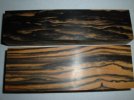
Ebony doesn't have to be boring as these black and white ebony pieces suggest. Curly Macassar ebony can be nice, but curly jet black ebony just looks splotchy.

Any change in the past year is only a fad usually short lived and starting with a Blade magazine photo or something similar. Real changes have been happening the past 10-15 years. The cover of Blade Mag for May 2003 showed a two-tone stabilized Amboyna burl handled knife by R.W. Clark which used Liquidmetal. I provided that wood and Clark ordered a couple dozen two-tone (sap and heartwood) amboyna blocks for orders off that cover and two-tone amboyna has been a runaway seller ever since.

I think high end custom knife makers fall into the same market trap hand made acoustic guitar builders fall in. They don't often get to use the wood or other materials they want, but must make what the market expects and the customer will purchase. There is certainly more acceptability in the knife market than the traditions long lived in the instrument craft.
 

Attachments

  • 2004_0730bladeebony0001.JPG
    2004_0730bladeebony0001.JPG
    54.3 KB · Views: 73
Back
Top