What might this be?

Robert Erickson

Knifemaker / Craftsman / Service Provider
Joined
Feb 2, 2014
Messages
2,892
Hey guys,
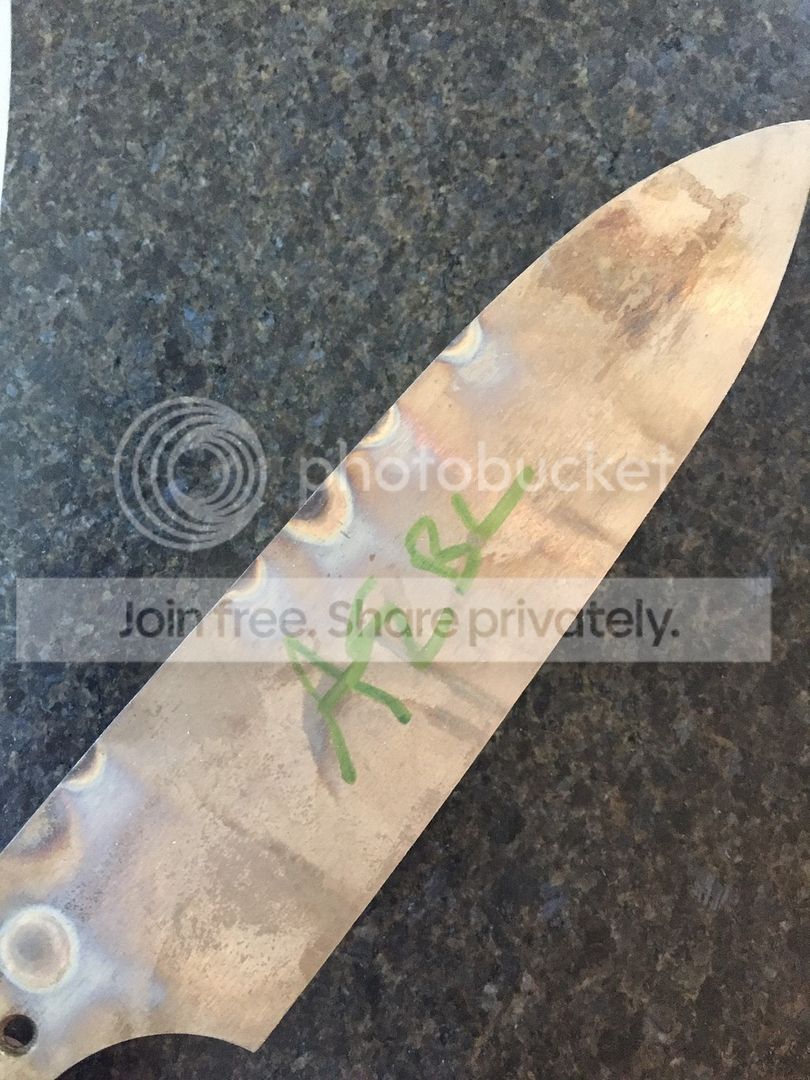
I just got a batch of AEB-L and CPM154 back from HT. (Peter's HT) The first picture is what the blade looks like untouched after HT. I didn't think too much of the circular marks because they disappeared after surface grinding in preparation for bevel grinding. I ground the bevels without any noticeable marks and then began hand sanding when I noticed that the marks became visible again. It's subtle and not visible from all angles but definitely noticeable and unwanted. (second photo). I seem to recall a discussion like this before but I couldn't locate it. If it were during the work week I'd call Peter's (and probably still will) but thought I'd throw it out there to see what's going on. I know with carbon steel you can re HT but with stainless I'm not sure. Thoughts?

 
Last edited:
Sorry to bump this but I'm really curious if anyone else has seen this? What, if any, remedy is there? Thanks!
 
I've had it with AEB-L before. Probably some type of flaw in the metal as it became more pronounced with acid etching. Mine was along the spine.

IMG_20150512_205904_zpsqpuvbnug.jpg


IMG_20150520_171949_hdr_zpshnqphmo3.jpg
 
Huh, I wonder what's going on chemically to cause this, then? I was thinking it was some type of HT issue.
 
it could be, or it could be the heat treater placed the blade very close to the elements
 
I'll see what the heat treater says. Whatever it is it's not just a surface issue it goes all the way through the steel.
 
FYI: Just got off the phone with Brad at Peter's HT. What those spots represent are where they use a low temp torch to help straighten the blades. He said that most of the time it goes away with sanding. Interesting enough they do go away when I surface grind them (even with a fine grit A30 finishing belt) but re-appear with hand sanding (even at 320 grit). I'm going to try a cork belt and scotch-brite finish and if that doesn't work he's going to re heat treat them trying not to use the torch to straighten.
 
Yes, that is exactly what those spots are. They are part of their straightening process. I am sorry, I could have told you that when I first saw the thread...but I thought you were more worried about how to remove them...and it has always been a no issue for me. I've had them on an AEBL knife or two that had 400 grit finishes. Once I received them, a quick 400 grit re-sand and they came right out....just like tempering colors are supposed to come right out.

On AEB-l and CPM M4, the two steels I work with and send to Brad, I take them to finish dimensions before heat treat. Edges right down to .010, anyway. And a 400 grit finish. When I get them back, it's just a matter of quick touch up finish. On keen slicers, I'll go back to a more coarse grit and bring the edge down to .005" or whatever (post HT, of course).

Love your signature quote, BTW!!!!
 
Yes, that is exactly what those spots are. They are part of their straightening process. I am sorry, I could have told you that when I first saw the thread...but I thought you were more worried about how to remove them...and it has always been a no issue for me. I've had them on an AEBL knife or two that had 400 grit finishes. Once I received them, a quick 400 grit re-sand and they came right out....just like tempering colors are supposed to come right out.

On AEB-l and CPM M4, the two steels I work with and send to Brad, I take them to finish dimensions before heat treat. Edges right down to .010, anyway. And a 400 grit finish. When I get them back, it's just a matter of quick touch up finish. On keen slicers, I'll go back to a more coarse grit and bring the edge down to .005" or whatever (post HT, of course).

Love your signature quote, BTW!!!!

Thanks Stuart!
Yea I'm surprised that it's re-appearing like it is. Maybe it is, as Lo/Rez states, a material issue. I got the steel from a reputable dealer (AKS). I've used their AEB-L before with no issues. Hopefully I can come up with a finish that works. Otherwise they'll become neckers, kiridashis or filet knives :D
 
Last edited:
Work with a lot of AEB-L all heat treated by Peter's. I finish to a 220 grit Gator and then a Scotchbrite belt. The torch marks go completely away. Glad you called Brad. Never knew what those marks were. Never been a problem with this finish.

7oNT51f.jpg
 
Work with a lot of AEB-L all heat treated by Peter's. I finish to a 220 grit Gator and then a Scotchbrite belt. The torch marks go completely away. Glad you called Brad. Never knew what those marks were. Never been a problem with this finish.

7oNT51f.jpg

I took it back to the grinder and belt finished it like you describe. I went back to A300 gator up to A65 gator then scotch-brite. Looks good with no marks. Thanks Dave!

Just for fun I decided to scotch-brite the blade length wise the see if I could simulate a hand sanded finish. The marks became visible again even with the same scotch-brite belt I was using before. :confused: Maybe something about length wise finishes that reflect light just right to make the marks visible?
 
I don't understand the torch marks reference as I do my own heat treat (Evenheat Rampmaster oven) and grind post heat treat. I've had it on the spine (in the pic) and once that it was under the scale, but not along the spine. I heat treat with the spine down on the ceramic holder/rack.
 
You bet Rcetoy. Works for me. Interesting about the direction of the finish.
 
Lo/Rez....the marks are spots that are made by the small torch that Brad uses to straighten blades that are warped. If grinding post heat treat, then it's not an issue. But if grinding pre heat treat, as I most often do because of my limited equipment (way easier for me to grind soft steel...no belt grinder in shop), then warped blades post quench are just part of the game, sometimes. Yes, most usually the warp can be straightened during Ms-Mf with gloved hands, but sometimes a warp will not manifest itself until temper round 1. In that case, the 3 point clamp system for straightening blades is employed. But Brad has a different set up. Instead of 3 point clamp, he uses a small torch to warm the spine in the area of the bend, and then straightens it that way. This leaves tempering marks where the torch hit the spine.....which sand out just like any other tempering color mark. Hope that helps!
 
Lo/Rez it sounds like your issue is different. Doesn't sound like HT issue. But I certainly don't know enough about this to say.
I was just wondering if, in my case, the steel has something different about it that is causing the marks on my blades to not sand out as easily as they other guys are describing.
To me the most interesting thing about these particular blades is the fact that with certain finishes the marks are visible (length wise finish) but with standard perpendicular finishing they aren't visible.
 
Retro I had something similar happen on a kitchen knife sort of looks like splash marks on it I could never get rid of them I sanded to 500 then I went back down to 320 and they were much less noticeable my steel was from the same place as yours but I used a different heat treater. You can barely see what looks sort of like to splash or stain by the end of the blade on the bottom there are also some on the top closer to the point View attachment 591719
 
Lo/Rez....the marks are spots that are made by the small torch that Brad uses to straighten blades that are warped. If grinding post heat treat, then it's not an issue. But if grinding pre heat treat, as I most often do because of my limited equipment (way easier for me to grind soft steel...no belt grinder in shop), then warped blades post quench are just part of the game, sometimes. Yes, most usually the warp can be straightened during Ms-Mf with gloved hands, but sometimes a warp will not manifest itself until temper round 1. In that case, the 3 point clamp system for straightening blades is employed. But Brad has a different set up. Instead of 3 point clamp, he uses a small torch to warm the spine in the area of the bend, and then straightens it that way. This leaves tempering marks where the torch hit the spine.....which sand out just like any other tempering color mark. Hope that helps!

Thanks for the info. I appreciate it.
 
I have had many AEB-L blades done at Tru Grit. They quench with 3" water cooled plates and mine always come out perfectly straight and never had to have a torch used on it.
 
i don't know, i am actually a bit dubious about the validity of the straightening method applied. Those marks looks like annealed, i just imagine the carbide segregation in those areas.

Rcetroy, also the hamon appears/disappears depending on the finishing; in this case i think the carbide preferential array runs along the mill direction, enhanced by the sanding along, disrupted across
 
Back
Top