What To Do With This Bar?

Don't worry about being fast. Say that out loud a few times.

You can make a great knife, just don't worry about speed. Worry about quality. Like Greg said, master the file.
 
As I suggested earlier, screw/bolt the blank to a board and clamp/screw the board to a sturdy work table.
The kitchen counter is NOT the best place to work on knives. A garage workbench, a picnic table outside, or even an old students desk will be a better choice. The tutorial in the stickies deals with setting up the work arm (Board), and the work area.

Once the knife is on the board, and the board is firmly attached to the work surface, Start filing the taper in. Flip the blank from side to side, and slowly get the taper centered. Then start on the bevels.
Holding the blade in one hand and filing with the other is self-defeating. Holding the file, and moving the blade is even worse.....clamp the blade and move the file in long, even strokes.
 
Update!

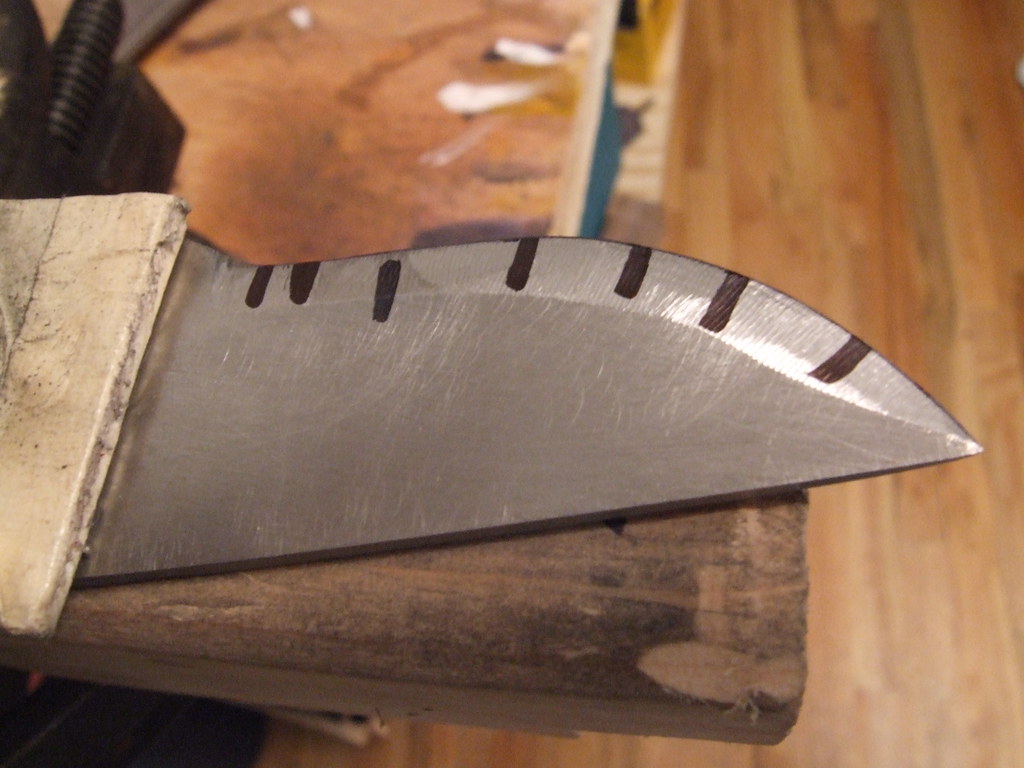
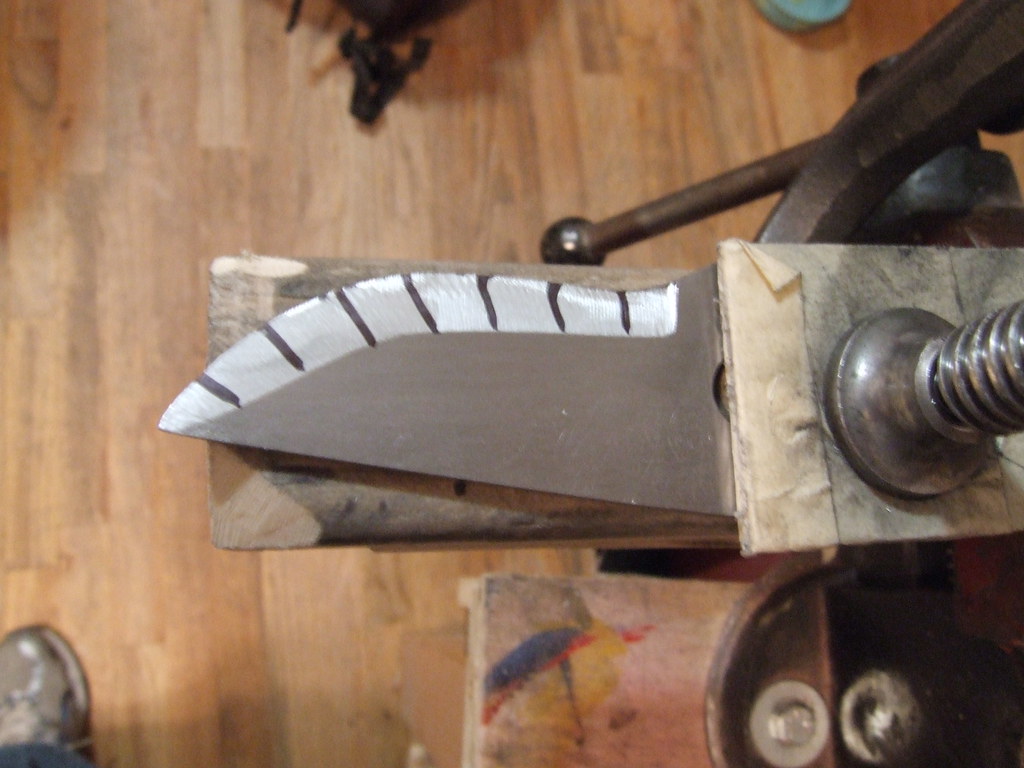
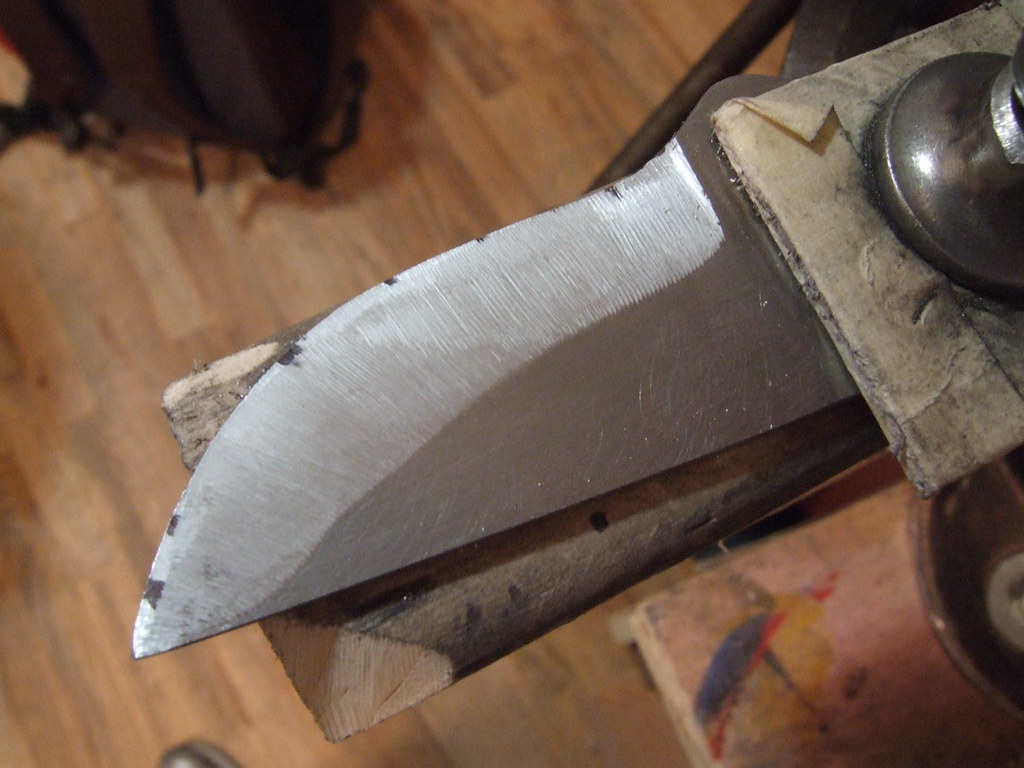
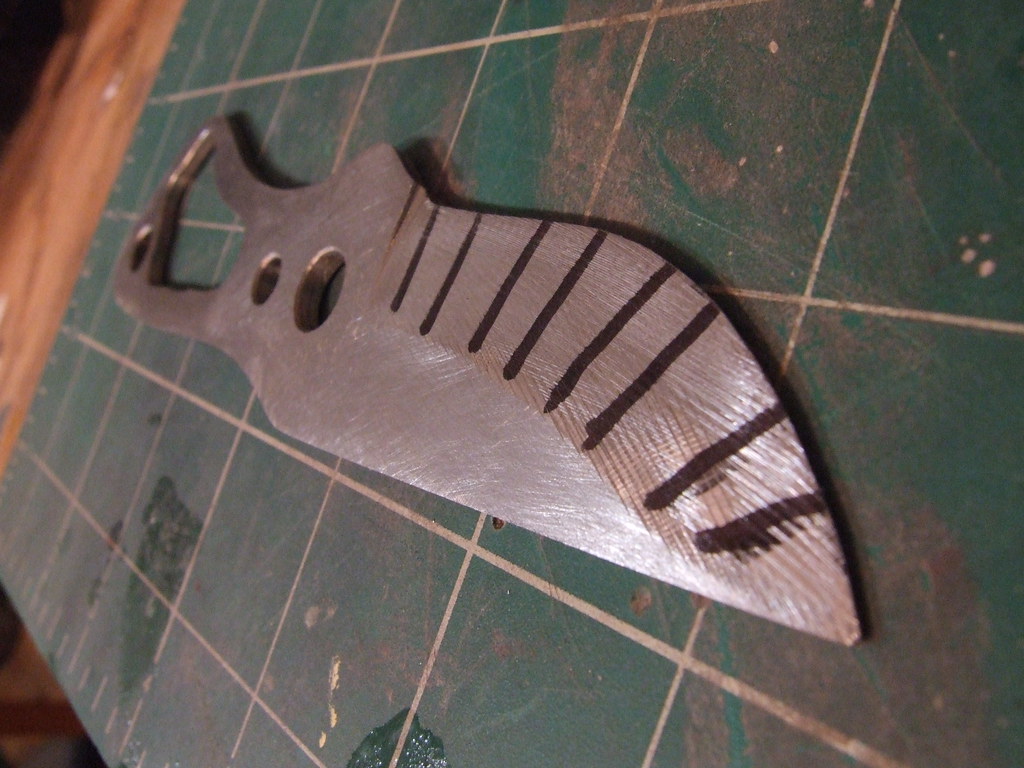
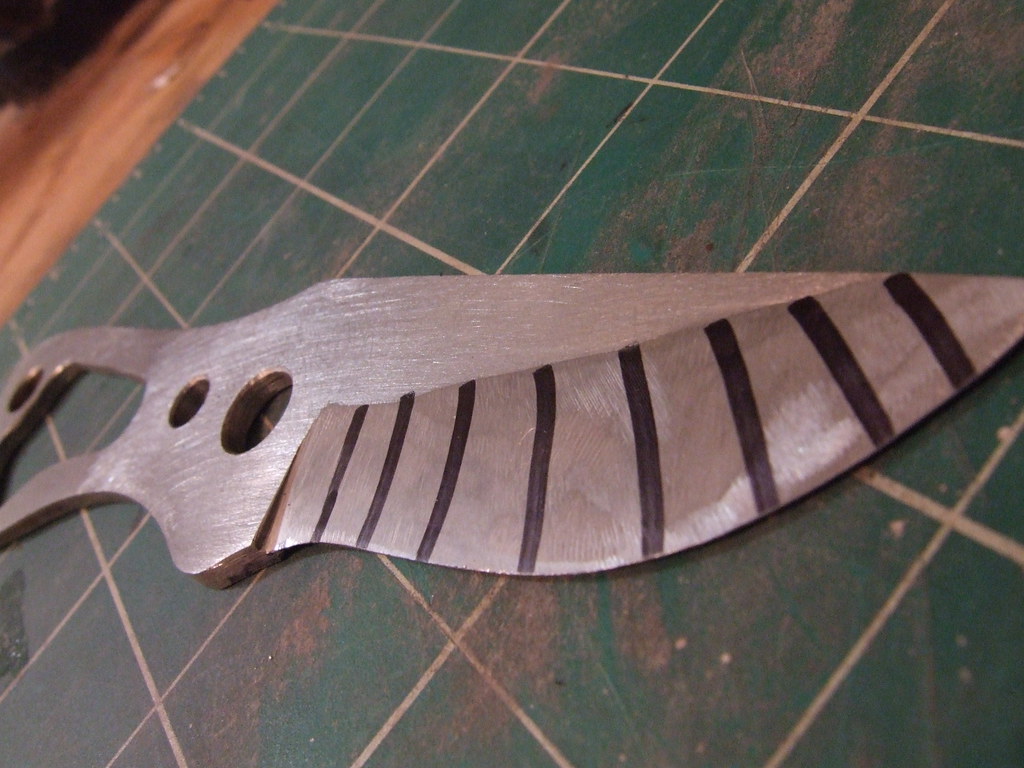
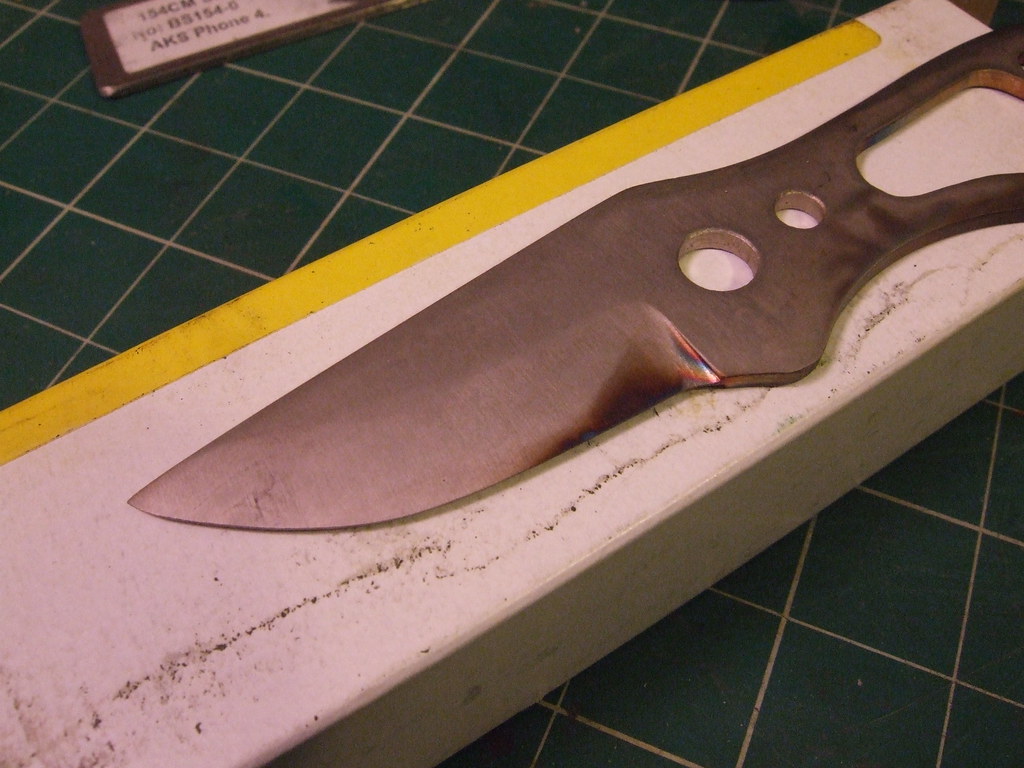
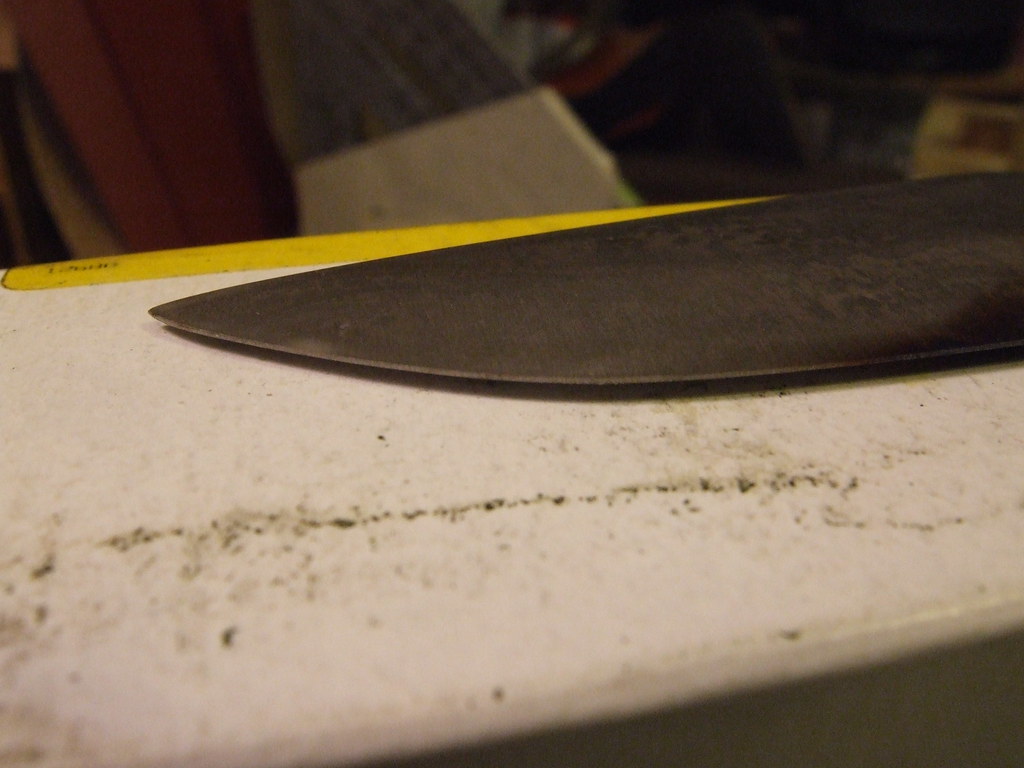
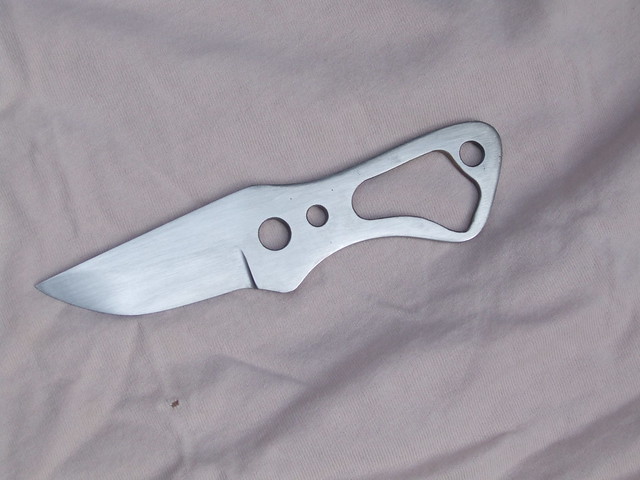
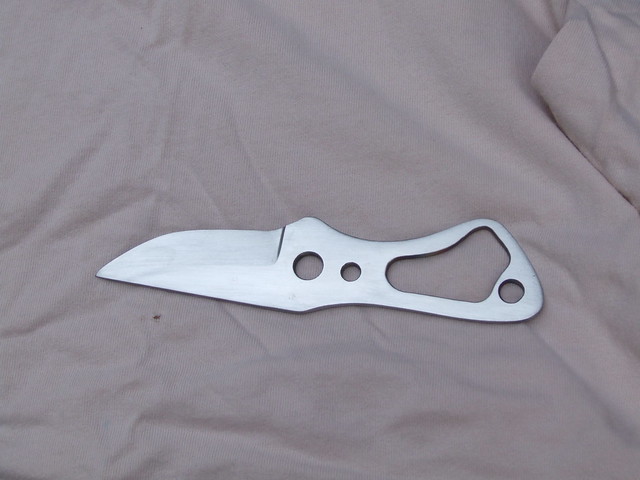
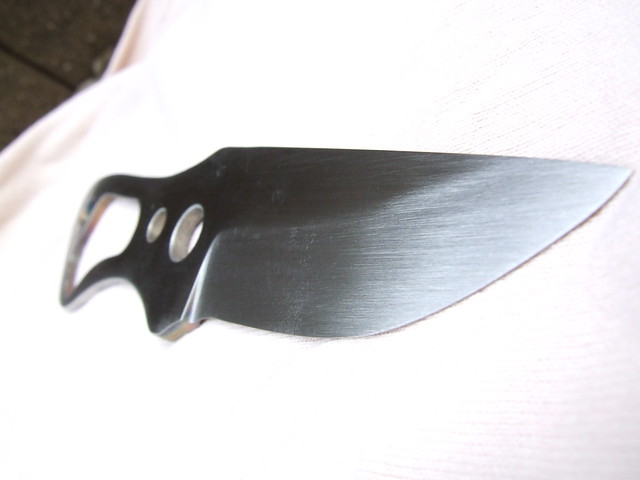
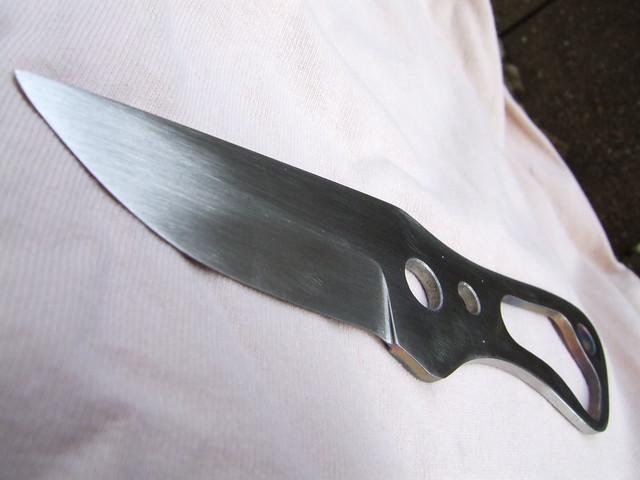
I created an edge fairly early in the filing of the bevels. It's a edge out on the belly area, and it is just a little off center. I am not sure how to correct it, but I think it would be difficult. I don't think it will make much difference in the useability/performance of the knife. I hope. :)

[Edit] As I continued filing, the edge apparently corrected itself. It's good now.

I filed these bevels pushing straight towards the edge. I did not do much draw filing. I think next I will start with my sanding block, and 80 grit.

7001719537_fce7f32064_b.jpg


7001719989_854f20d814_b.jpg


7001721199_9969311305_b.jpg
 
Last edited:
As I suggested earlier, screw/bolt the blank to a board and clamp/screw the board to a sturdy work table.
The kitchen counter is NOT the best place to work on knives. A garage workbench, a picnic table outside, or even an old students desk will be a better choice. The tutorial in the stickies deals with setting up the work arm (Board), and the work area.

Once the knife is on the board, and the board is firmly attached to the work surface, Start filing the taper in. Flip the blank from side to side, and slowly get the taper centered. Then start on the bevels.
Holding the blade in one hand and filing with the other is self-defeating. Holding the file, and moving the blade is even worse.....clamp the blade and move the file in long, even strokes.

I will go back and read the part about setting up the work arm.
 
nice job im not one for filing my self so i give props to anyone who can file the whole bevel

Thanks, Mike. It's fun.

And thanks to Bladsmith, who has made it so much easier.
 
More Pictures. Here is a sanding block I made:

7001805839_12386ceca8_b.jpg


and a couple more pics of the bevels. It looks like I blunted the tip, but I think it is fixable. It looks worse in the pictures than it does IRL:


6855688628_9ebb11588f_b.jpg


6855688176_59c4c3f354_b.jpg
 
Looks good. Don't worry about the small places that go awry like the tip. They will get taken care of in the final shaping and sharpening after HT.
Your bevels look excellent.

The board you are clamping on will work fine, but if the tip is curved to match the blade, it will be easier to file/sand on.

The one place I see you getting ahead of yourself is the edge. It should be a flat surface about as thick as a dime right now. If you don't leave enough metal there in the early filing and sanding stages, there will be three problems later on.
First, the edge should not be too thin when it goes to HT. This is a stainless steel blade, and you can get away with a pretty thin edge, but it should still be about .010" thick at HT.
Second, if you make the edge sharp as you file the bevels, and then continue to smooth and shape things, by the time the blade has been through HT and sanded to its final surface, then sharpened, the 1.25" wide blade may be only 1" wide.
Third, it is very easy to cut yourself while filing and sanding the blade if the edge gets a sharp spot. If the edge gets too thin, or worse - sharp, file it back a tad so it is a flat surface. This will take a tiny bit off the blade width, so try and avoid it happening too many times. When done sanding the bevels, sand the edge smooth and flat, with slightly rounded edges. This helps prevent the edge warping and cracking in HT.
 
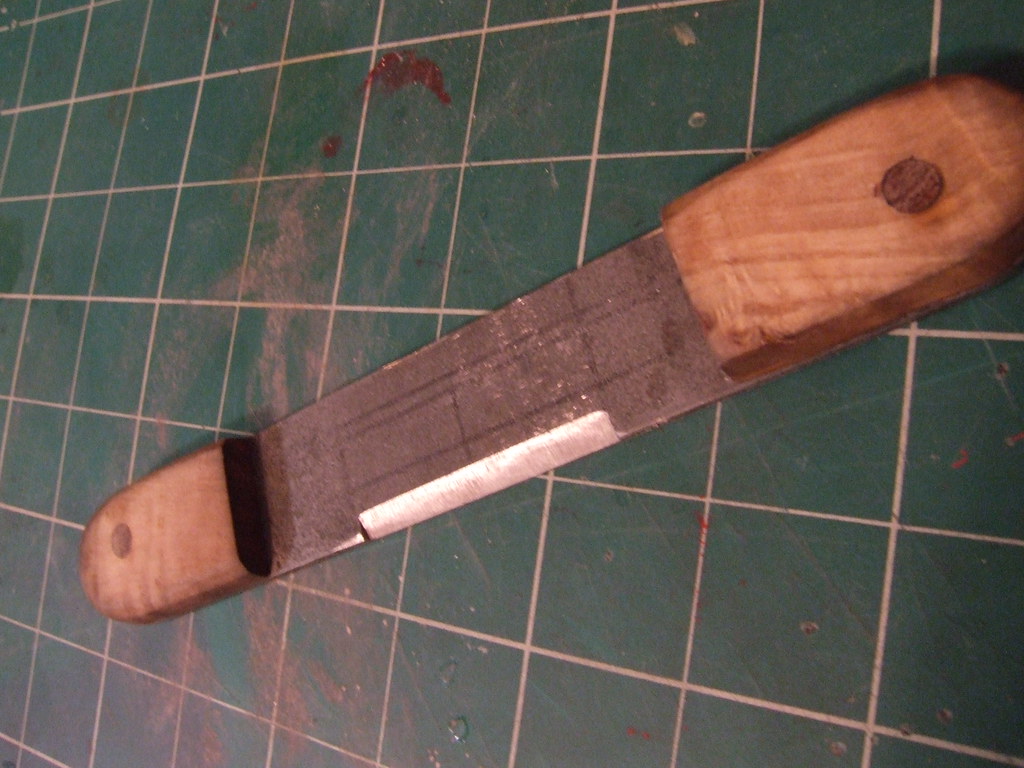
So far I am still working on that same blank, and I have sanded everything to 320 grit. There are still file marks on the tang. I will take the time to sand those out, because it is going to be just a minimalist neck knife -- no scales. Can't cover up my mistakes so I will correct them.
 
Shipping out to Stan Buzek for heat treat today.

I find it very tricky to get the bevel looking truly flat. Still, I am happy with how it looks.

Will post more pics when it comes back from Stan.
 
squid
just set it aside for now.It will still be fine when you get around to working onit.Get steel from Stacy.
When ready for H/T if you want send it to me.I'll do it and send it back.
Stan

I own a folder made by Stan. I will vouch for his heat treat. That knife sharpens like it is butter, but holds the edge forever. Aside from one made by ProTech, other blades made of same material are not as awesome.
 
Stan shipped it back today. Said it tested at 59.5 RC. So awesome!
 
Pictures forthcoming. It came in the mail today. The more I handle it, the more I like the balance and feel. I will make a couple of different sheaths, for different carry options. I think it will mostly travel in my mess kit, inside the backpack.

Looking at the edge, I see I did a good job of making it thin, but not too thin. I don't remember exactly where I got my guideline on that, but the guideline was "1/3 mm before HT." I do not have calipers, and estimating 1/3 mm by eyesight is easy.

I expected the blade to be blackened, but it is just slightly discolored, like the color of oxidized aluminum.

Now I start sanding again.

Many thanks, Stan. I have confidence in your HT. I think it is rare to get stainless to 59.5 RC.

:)
 
Got some sanding to do.

6971088196_b0ae1f27a1_b.jpg


6971090280_98eec9bc66_b.jpg


7117164775_32277d9265_b.jpg
 
Sanded to 320 grit:

6978571288_2fe02f8572_z.jpg


7124655405_f05c9788da_z.jpg


6978562014_464643d8c0_z.jpg


6978564490_7d6db1cff6_z.jpg


I think I will make a leather sheath for it, rather than kydex. Kydex always seems to scratch.
 
Last edited:
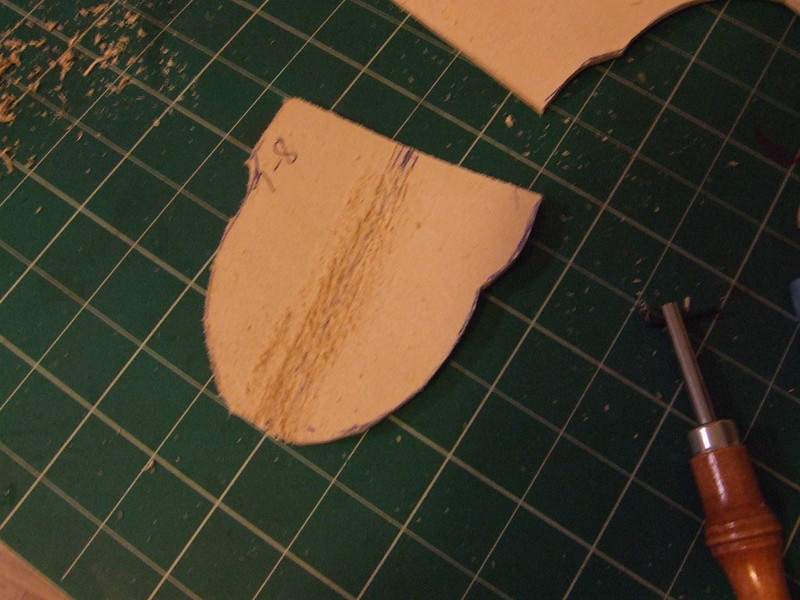
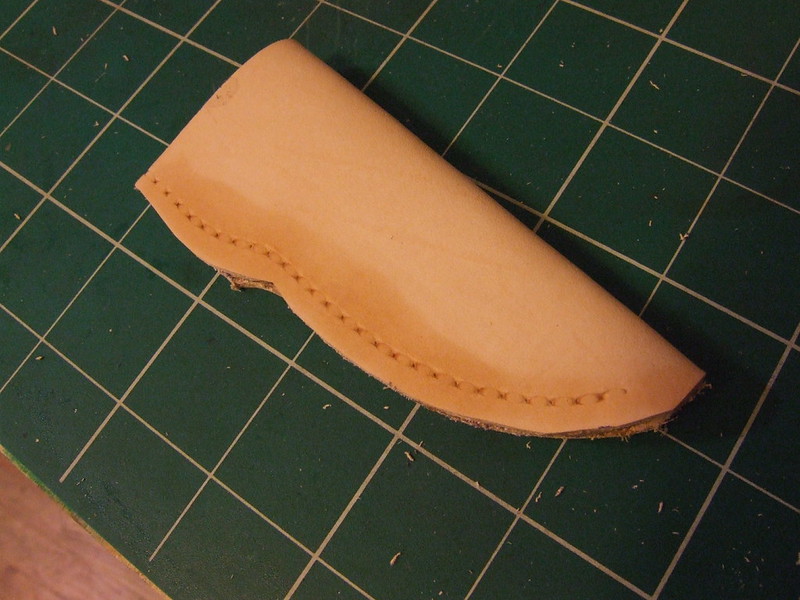
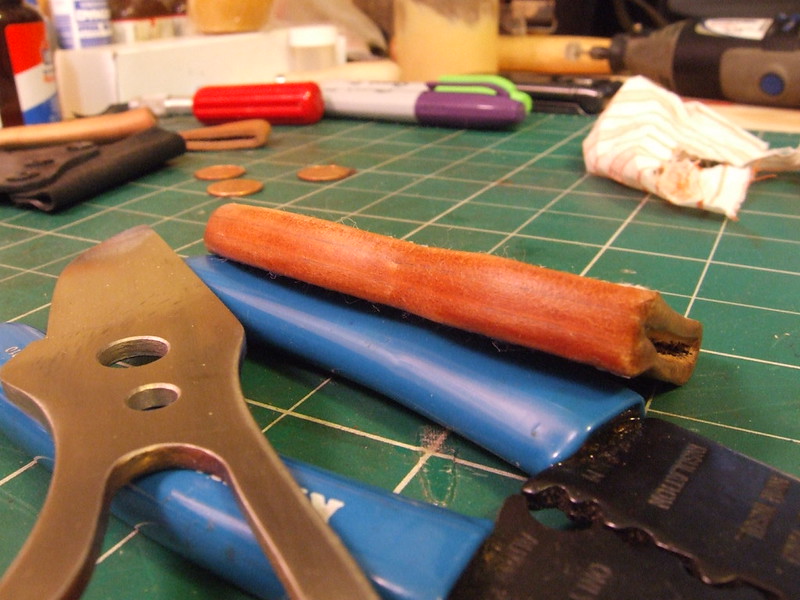
Pictures of sheath-making:

7133609943_7763e4a06c_c.jpg


7133607405_152d9d1f74_c.jpg


When I started out making the sheath, I thought the knife would just be travelling inside my mess kit, therefore no need for a belt loop. I am starting to change my mind now. It won't be too hard to add a loop.

7133605331_f087f40f46_c.jpg


I don't have a edge beveler, so I tried a potato peeler, and that didn't produce good results, so I didn't bevel the edges. I just sanded them and then burnished them.

7133601105_1cc64c5258_c.jpg


For water resistance, I tried neatsfoot oil. According to what I have read, it will darken with exposure to sunlight.
 
Back
Top