
-
The BladeForums.com 2024 Traditional Knife is available! Price is $250 ea (shipped within CONUS).
Order here: https://www.bladeforums.com/help/2024-traditional/
You are using an out of date browser. It may not display this or other websites correctly.
You should upgrade or use an alternative browser.
You should upgrade or use an alternative browser.
What's that under the Tree?---Walrus Artifact/Feather Blade Hunter
- Thread starter John White
- Start date


- Joined
- Feb 28, 2006
- Messages
- 3,494
Question for John if I may...Are there any special steps you take to stabilize ivory that has inclusions like this piece? I have a lot of natural material handles and go to great lengths to ensure appropriate temperature and humidity. I am always drawn to artifact materials and wonder what steps are taken to retain the essence of the artifact while preserving the material itself.
I agree with everyone else, that is one GREAT looker!!! Although I must confess, when I imagine using the knife (blood and fluids etc) I wonder about hygiene and care for the handle.r connally, holding ivory for some time open in the house, often for a year or more is, as you suggest, a good idea to let it "stabilize" naturally to a future "home environment." Artifacts such as this have a head start over excavated items since they've been in open air so long.
The main thing I do is give that "round-over" next to all metal fittings, to allow for the inevitable expansion or contraction of a few thousandths that will always occur in natural materials.
Question: So you ancient ivory workers do not seal the cracks in any way? Are there no long term risks to the handle when put to use, gets wet and dry, etc.? Are there special care instructions you pass on to the user?

- Joined
- Jun 23, 2007
- Messages
- 2,142
Phil,
One of the very great pleasures of working with experienced collectors to create custom knives is the mutual selection of just the right materials for the project. Handle material, in particular, is critical to the appearance, value, and type use of the knife.
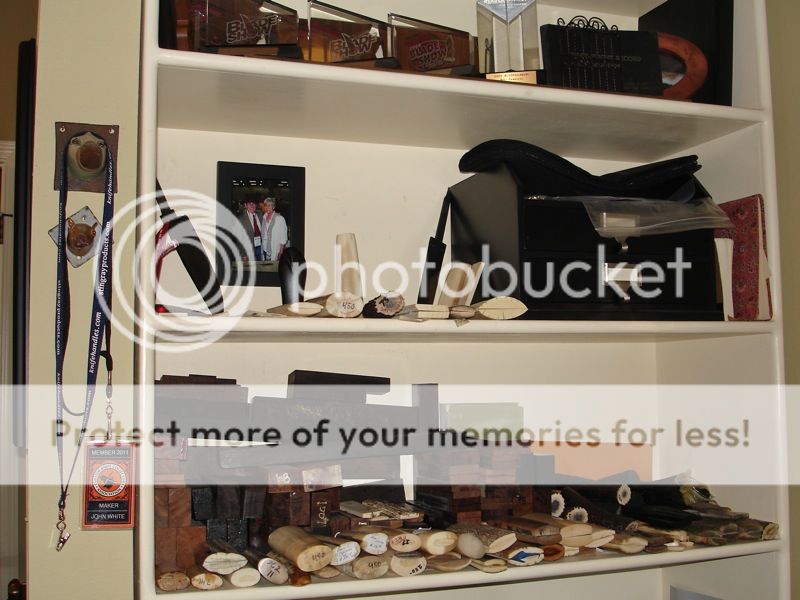
On my "acclimation" shelf are high density, stable woods such as African blackwood, desert ironwood, and ringed gidgee, as well as stabilized woods such as koa, bog oak, and claro walnut. There's stag, both "natural" and dyed, and horn.
I've got slabs of G-10 and old Westinghouse yellow Micarta, as well as my favorite black linen.
There is also Ivory, Walrus, Mammoth, and select Pre-Ban. (Way too much Ivory for the good of my bank account.)
All of the ivory was carefully selected for appearance and quality. Most of the ivory was picked to avoid any cracks or signs of instability. Some was selected specifically because it had that wonderful "ancient cracked" character.
All ivory and most natural woods pose long term risks if exposed to wet-dry cycles, improper storage, dishwasher cleaning, or extreme hard use.
The maker can and should take steps to accommodate natural material's behavior, but both maker and owner must be aware of the choices, (carbon vs stainless, Micarta vs Ivory,) and design intent involved involved in each knife.
The knife I'm working on now is a massive stag-handled W-2 carbon steel chopper, designed to be "rode hard" but not "put up wet."
This little knife was designed to introduce a well loved son to a well loved collecting mania.
The beautiful cracked Walrus artifact is imminently suited to the intended use.
John
P.S. Here's an up-to-date look at that handle material "acclimation shelf."
One of the very great pleasures of working with experienced collectors to create custom knives is the mutual selection of just the right materials for the project. Handle material, in particular, is critical to the appearance, value, and type use of the knife.
On my "acclimation" shelf are high density, stable woods such as African blackwood, desert ironwood, and ringed gidgee, as well as stabilized woods such as koa, bog oak, and claro walnut. There's stag, both "natural" and dyed, and horn.
I've got slabs of G-10 and old Westinghouse yellow Micarta, as well as my favorite black linen.
There is also Ivory, Walrus, Mammoth, and select Pre-Ban. (Way too much Ivory for the good of my bank account.)
All of the ivory was carefully selected for appearance and quality. Most of the ivory was picked to avoid any cracks or signs of instability. Some was selected specifically because it had that wonderful "ancient cracked" character.
All ivory and most natural woods pose long term risks if exposed to wet-dry cycles, improper storage, dishwasher cleaning, or extreme hard use.
The maker can and should take steps to accommodate natural material's behavior, but both maker and owner must be aware of the choices, (carbon vs stainless, Micarta vs Ivory,) and design intent involved involved in each knife.
The knife I'm working on now is a massive stag-handled W-2 carbon steel chopper, designed to be "rode hard" but not "put up wet."
This little knife was designed to introduce a well loved son to a well loved collecting mania.
The beautiful cracked Walrus artifact is imminently suited to the intended use.
John
P.S. Here's an up-to-date look at that handle material "acclimation shelf."

- Joined
- Aug 13, 2002
- Messages
- 5,703
And John you execute that "round over" so well! I also like how makers will slightly contour or round the edges of the frame or liners...
I would love to know more about that round over (how its done and specs). Never thought about doing that except when the design called for a distinction between both and then it was a pronounced rounding of the edges.
And also the difference between the round over and contouring the edges as you said above Kevin.
Thanks
PS: John, that "acclimation shelf" is making me drool.

- Joined
- Feb 28, 2006
- Messages
- 3,494
Thanks John for your time and explanation. I need to stretch my idea of usage not only to be using in the field (so to speak), but that "collection" is a type of "usage" as well. What a glorious piece to start a collection with! I agree with Patrice, that's quite a stash of material you've got there!
- Joined
- Jun 23, 2007
- Messages
- 2,142
Patrice,
Both the "round-over" and contouring of the edges between scales and handle frames are accommodations to the reality that natural materials will shrink and swell with time and circumstance.
It's always a gamble butting natural material evenly and smoothly to metal fittings, and often a bad idea.
One common technique for dealing with this is to stand the ivory or wood slightly proud of the metal, and "round over" the edge. This becomes a design feature similar to the one you reference, as well as disguising any slight movement.
The amount left "proud" need only be a few thousandths. Nick Wheeler does a truly masterful and distinctively subtle job using a couple layers of tape as a gage. I tend to leave 20-30 thousandths as a pronounced design element.
An equally useful technique, and very suited to the frame/scale seam,but capable of being used elsewhere, is to very slightly ease the edges of both metal and scale, while the surfaces are held level. The handle material can still move a few thousandths, yet the hand slides across without encountering any sharp edges. This solves the technical problem without becoming a design element.
This is a case where design and craft meet, and can be worked to serve both.
By the way, I like your design explorations. Glad to see you posting up your knives over here!
John
Phil,
Use in the field and joy of collection are both fun parts of this game.
I'll post up that chopper along with some rope and 2x4 "kills" when it's finished.
"It's all good," as my old hippie buddy used to say,
JPW
Both the "round-over" and contouring of the edges between scales and handle frames are accommodations to the reality that natural materials will shrink and swell with time and circumstance.
It's always a gamble butting natural material evenly and smoothly to metal fittings, and often a bad idea.
One common technique for dealing with this is to stand the ivory or wood slightly proud of the metal, and "round over" the edge. This becomes a design feature similar to the one you reference, as well as disguising any slight movement.
The amount left "proud" need only be a few thousandths. Nick Wheeler does a truly masterful and distinctively subtle job using a couple layers of tape as a gage. I tend to leave 20-30 thousandths as a pronounced design element.
An equally useful technique, and very suited to the frame/scale seam,but capable of being used elsewhere, is to very slightly ease the edges of both metal and scale, while the surfaces are held level. The handle material can still move a few thousandths, yet the hand slides across without encountering any sharp edges. This solves the technical problem without becoming a design element.
This is a case where design and craft meet, and can be worked to serve both.
By the way, I like your design explorations. Glad to see you posting up your knives over here!
John
Phil,
Use in the field and joy of collection are both fun parts of this game.
I'll post up that chopper along with some rope and 2x4 "kills" when it's finished.
"It's all good," as my old hippie buddy used to say,
JPW
Last edited:

- Joined
- Dec 8, 2011
- Messages
- 2,183
Very nice knife John. Thanks for posting it and for sharing your expertise. Your willingness to share is telling of the gentleman you are. Thanks.
Chris
Chris
- Joined
- Aug 13, 2002
- Messages
- 5,703
Thanks for the good words John and the explanation. This kind of info is priceless to me. I like your way of using this as a design element. I will definitely try doing this from now on. :thumbup:
Exactly!
Your willingness to share is telling of the gentleman you are.
Exactly!

- Joined
- Jun 2, 2009
- Messages
- 1,564
That's a great little knife and a one heck of a Xmas present.
As stated above, you are a true gentleman and thank you for being so generous with your knowledge.
As stated above, you are a true gentleman and thank you for being so generous with your knowledge.