What's the deal with gaps?

I think gaps matter because we've all seen knives with no gaps, so we know it's possible.

I sent back my 1990's Case Mini Trapper for a couple of large gaps. They replaced it. I just got the new one today. The clip blade rubs the liners.

I should've kept the old one.
 
The Burke Barlow, which was mentioned earlier, has very thick blades compared to other barlows. Although I thought it was a good knife for several other reasons, the thick grind was a deal breaker for me.

C'mon Jake, don't be such a wuss. ;) The DB barlow is just right. I don't consider a slipjoint blade thick until it starts to approach Scagel thickness.

Left to right: Scagel #8 Barlow, Queen 2010 Bladeforums Moose, Northfield #73 Scout
dsc0866x.jpg


The Scagel blade is 5/32" at the spine! :eek:

- Christian
 
Christian, That's a beefy blade! :eek: It's the thickness above the edge bevel that is more important to me. I like the spine to be sturdy... these aren't fillet knives ...though I'm not sure if I can handle 5/32". :D
 
Christian, That's a beefy blade! :eek: It's the thickness above the edge bevel that is more important to me. I like the spine to be sturdy... these aren't fillet knives ...though I'm not sure if I can handle 5/32". :D

Yup, spine thickness and blade grind are two different ideas in my mind.
 
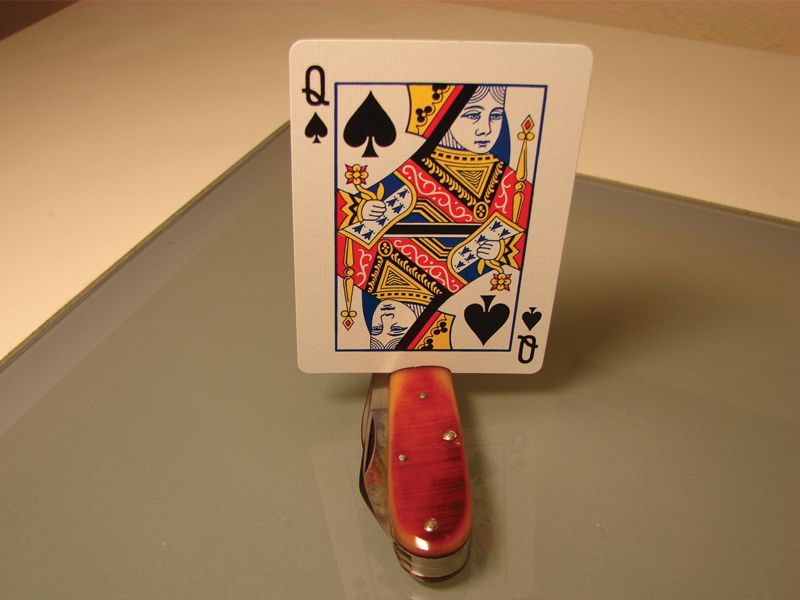
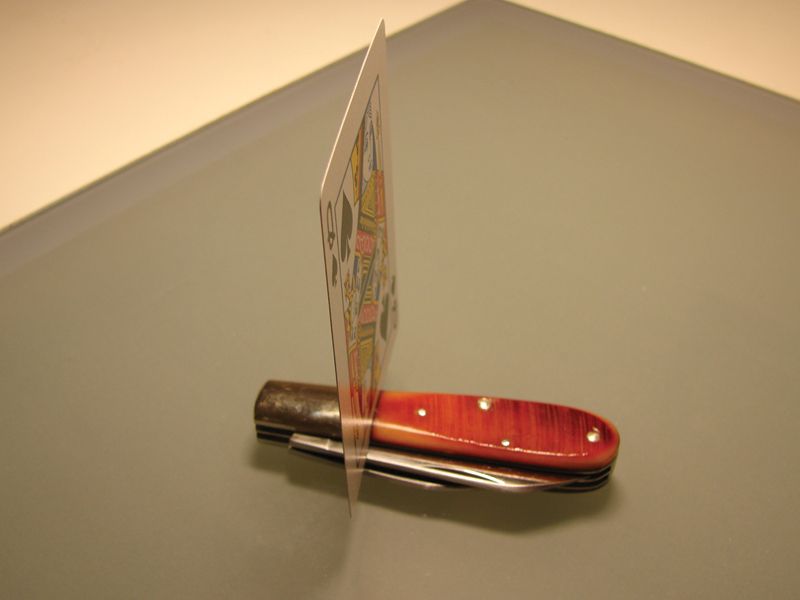
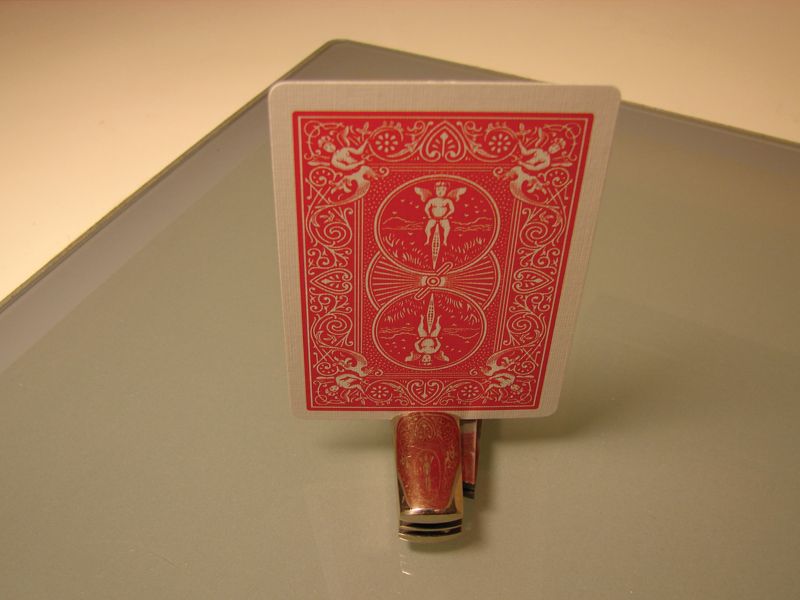
My QDB is not only great for looking at and cutting things, but I also found out that it comes in handy for poker night at my buddy's house too!!!! :thumbup:

qdb_1.jpg


qdb_3.jpg


qdb_2.jpg


In all seriousness, I was pretty disappointed with the f&f of this knife. :thumbdn:

And yes, it also makes a great business card holder as well.
 
Last edited:
That one would've gone back, if it were mine.

Hey Jeff, I completely agree... Unfortunately I purchased this one on the secondary market with no box or paperwork. One day I'd love to find a QDB with great f&f and add it to my collection. On the upside, this one will always make an awesome EDC, minor production flaws and all. ;)
 
Hey Jeff, I completely agree... Unfortunately I purchased this one on the secondary market with no box or paperwork. One day I'd love to find a QDB with great f&f and add it to my collection. On the upside, this one will always make an awesome EDC, minor production flaws and all. ;)

Think about it this way; that knife is probably a lot more historically accurate than the perfect specimens we all want. Barlows were a workingman's pocketknife, and fit and finish of the knife were not nearly as prized as it being sturdy and reliable.

I have owned several Barlow patterns over the years, and the Queen DB was not only the most expensive (by a long stroke) it is the nicest. On my DB the fit and finish was good, but there were a couple of burrs on the bone, and the brass pins looked like someone cut them with a nipper. A little time with a Dremel and then some buffing took care of both problems. It was just a little too "traditional" and authentic for me when I got it. Love it now, though.

Robert
 
Think about it this way; that knife is probably a lot more historically accurate than the perfect specimens we all want. Barlows were a workingman's pocketknife, and fit and finish of the knife were not nearly as prized as it being sturdy and reliable.

Robert

An excellent point. Barlows were originally inexpensive, strong knives for working men. This dates from when the frames were forged instead of pieced together.
 
Gaps appear for various reasons. Some of the reasons may be as simple as lack of attention to detail when assembling a knife. Perhaps a burr is not removed from the edge of a liner or spring or perhaps a tiny chip of steel or brass falls between a cover and it's liner or between a liner and it's spring thereby not allowing the pieces to lay closely together as designed.

There is a much more serious cause and that can be/is the fact that the dies for a particular pattern my be wearing badly or perhaps are worn out. A company may elect not to make a new die or dies because of the high cost of doing so and just keep putting knives out on a hit and miss basis hoping that the percentage of errors such as gaps are small.

Then again, a new company may drain off the experienced employees of another company. GEC a relatively new company and Queen/Schatt & Morgan a very old company are a good example of this. Many of the employees that used to work at Queen now work at GEC. For awhile, Queen even had to shorten their hours and were close on Fridays altogether for awhile if not still closed on Friday. So, Queen has lost a lot of expertise while GEC has managed to get some of the cream of the crop as far as cutlers go. Charlie (waynorth) can address this with much more detail than I can as he often deals with both companies.

Now, let's not assume that GEC puts out knives with no gaps. I've had a couple/three or four as have others. I've elected to keep mine or give them away -- others have elected to send them back.
 
Ed, I'm sure you are correct about worn dies/equipment leading to inferior construction and gaps. Even good workers can't perform miracles with this kind of situation.

One reason why Guilloche/ Filework can be so appealing is that gaps don't matter! However,I really don't like large gaps between liner and spring, the sort you don't even have to hold up to the light. Anything that can interfere with the feel of a knife in the hand, raised/sunken springs etc these will give gaps too. Gaps between bolster and scale (that Queen DB that was shown is simply shoddy workmanship in my book) or liner and scale not good. Frankly, they do matter to me, I'd much rather have a knife without gaps through which light can be seen than grin and bear it and say it doesn't matter. A knife with little or no gaps is simply a better constructed more desirable knife.

Recently, I got hold of a J.Nowill & Sons Equal End 4 blade knife(alas 2 snapped off)in ivory. I know this knife is 1890-1903 Sheffield so it's well used and maybe 122 years old. No gaps on this old boy despite shining powerful light through it (the sunken joints are impressive too). I've got cheap knives and expensive knives with gaps a plenty but the gap free knife is always the better one, no question.

Regards to all, Will
 
I'm just teasing when I posted the photo.

I do think that gaps are extremely common based on the production knives that I've seen. But there's a wide range. Does it count as a gap in the liners/springs if you can see a space or only if light passes all the way through? I've been calling any measurable space or inconsistency a gap.

Ed, I see how those things could cause gaps. I don't have proof but I suspect that sometimes the liners aren't perfectly flat from the beginning.
 
I'm just teasing when I posted the photo.

I do think that gaps are extremely common based on the production knives that I've seen. But there's a wide range. Does it count as a gap in the liners/springs if you can see a space or only if light passes all the way through? I've been calling any measurable space or inconsistency a gap.

Ed, I see how those things could cause gaps. I don't have proof but I suspect that sometimes the liners aren't perfectly flat from the beginning.

I'm certain of it. I think the brass used in knife liners is tempered (makes it springy), and I'm sure that introduces a little bit of warp, just as with thin knife blades. Maybe worse. I have at least a few folding knives with obvious bends or warpage in the brass liners, which just 'springs back' to the same condition if one tries to use pliers/whatever to straighten them. It's more easily noticed in the blade well, along the unsupported edges of center liners between two blades. I have a Schrade-Walden 25OT folding hunter, with just such a center liner. It's warped enough, right in the central portion, that one of the two blades rubs against it upon closing, sometimes even impeding full closing.
 
Last edited:
Classic movie, I love it Jake!

I just received my S&M Heritage premium stockman, if I study it very carefully I can find a single, minute gap, not bad at all. Came fairly sharp too, and with decent walk and talk though a bit of a strange feel as others have noted. Since it's going into my pocket I'm happy with how it is.
 
[...] Many of the employees that used to work at Queen now work at GEC. [...]

I bought three of Queen's gap-back whittlers from '08, hoping in vain to pull one decent knife out of the bunch. No such luck. I can see why GEC passed on the worker(s) who cobbled these stellar examples together. I've seen better workmanship from Rough Rider at 1/10 the price.

This was a typical example. Knocked Queen right off my list. Can you believe that this POS (and many more like it) made it through QC?

Gaps.jpg
 
I bought three of Queen's gap-back whittlers from '08, hoping in vain to pull one decent knife out of the bunch. No such luck. I can see why GEC passed on the worker(s) who cobbled these stellar examples together. I've seen better workmanship from Rough Rider at 1/10 the price.

This was a typical example. Knocked Queen right off my list. Can you believe that this POS (and many more like it) made it through QC?

Gaps.jpg

Rick,

I picked up a few queen whittlers too. Pathetic.

Kevin
 
That's definitely the worst that I've seen on a new knife. :eek:

I don't remember the year of production but the springs on this "Queen Classic" whittler were assembled with greater care. It's well used and the stag has shifted a bit near the liner but otherwise it's holding up.

queen-classic-whittler-springs.jpg
 
Back
Top