Whats the deal with locking Liners???

DaveReb

Gold Member
Joined
Sep 15, 2007
Messages
1,519
I'm for the most part a nooby, and I'm getting pretty confused....not all that hard to do:). Anyways I've been sprending way to much time on this forum ;)and it seems that of all the knife locking methods, Liners seem to be the least favorite.:thumbdn: The main reasons given are lock failures and wear due to metal to metal contact. When I buy something, with proper care and maintenance, I think it should be able to last a lifetime. Knives with Locking Liners don't appear to be in this catagory. Where my confusion really sets in, is that it seems like more and more of the new knives coming on the market are locking liners, and some seem to be very popualr with Forum regulars. If these knives are potentially dangerous(lock failure), and subject to premature wear as a daily EDC, why are they so popular with manufacturers/Designers, and users alike? I recently bought a Mini Dejavoo:D with a Titanium locking liner, before I started researching the lock style, Now I'm paranoid about the knife's lock, and premature wear, if I were to put it into my EDC rotation. I decided to try and trade it away, and get something with a stronger/ robust lock, but I do really like the knife. Anyways am I being too paranoid about this?? Are Liners actually more durable than the opinions I'm reading about?

TIA
Dave

OOPS almost forgot...GO TRIBE!!!!!!
 
I have been carrying a William Henry locking liner for nearly 6 or 7 years, it is used everyday in one fashion or another. I do not perform whacking spline test on it, I just use it. The lock has held up well and have no evidence of wear. Some other brands may not be the same and William Henry has discontinued the liner lock (although I thought I spotted a new one on their site recently). Unless you are cutting heavy lumber or rope on an hourly basis, I see no reason to fear one of their liner locks.

Just my .02,
James
 
I think in general if you get a quality well made knife you won't have issues with locks regardless of design. I have a second generation Spyderco Military that I carried for years and have taken care of it. I also don't "flick" my knives open like many do and the result is the lock is still solid.

It's not possible to design a folding knife or locking mechanism to last a life time. It is possible to design a knife and make it well. The rest is up to the user.

Now lets clarify the above statement looking at both ends of the spectrum and assuming well made well designed knife.

If the knife is used normaly like cutting bailing twine, opening boxes/mail and general light work and it's cleaned and oil regularly then it might last a lifetime. But expect some wear.

If you flick it open most of the time you need to use it and use it hard as in prying, battoning, chopping, digging etc well expect it to wear out or break quickly.


How long anything lasts is up to the user and the circumstances not the design (again assuming its well designed and well made).

As for lock preferance well thats up to each user. As long as the knife is well made and well designed and you take care of it and don't abuse it it will serve you a very long time.
 
Liner lock really exploded in popularity some years ago. As you would expect so many companies made liner locks, including imports, that there were quite a few badly made ones out there as well. Love for it cooled a bit and many companies started making frame/integral lock instead.

I don't have a problem with a well made liner lock.
 
There was a long thread a while back about Liner Locks vs Frame Locks, I don't have the link but a quick search would find it. Anyways I have always heard something is "only tough as its weakest part." This said, all Frame Locks have a cut out in them. This allows the bar to act like a spring, and also not be to stiff.
My point is that most Liner Locks I have seen (and I have seen a bunch ;)) do not have this cut out.

So in theory Frame Locks are not that much tougher than Liner Locks. A well made Liner Locks that is. Not the crap you find at the flea market, or the crap they sell 200 knives for $50.

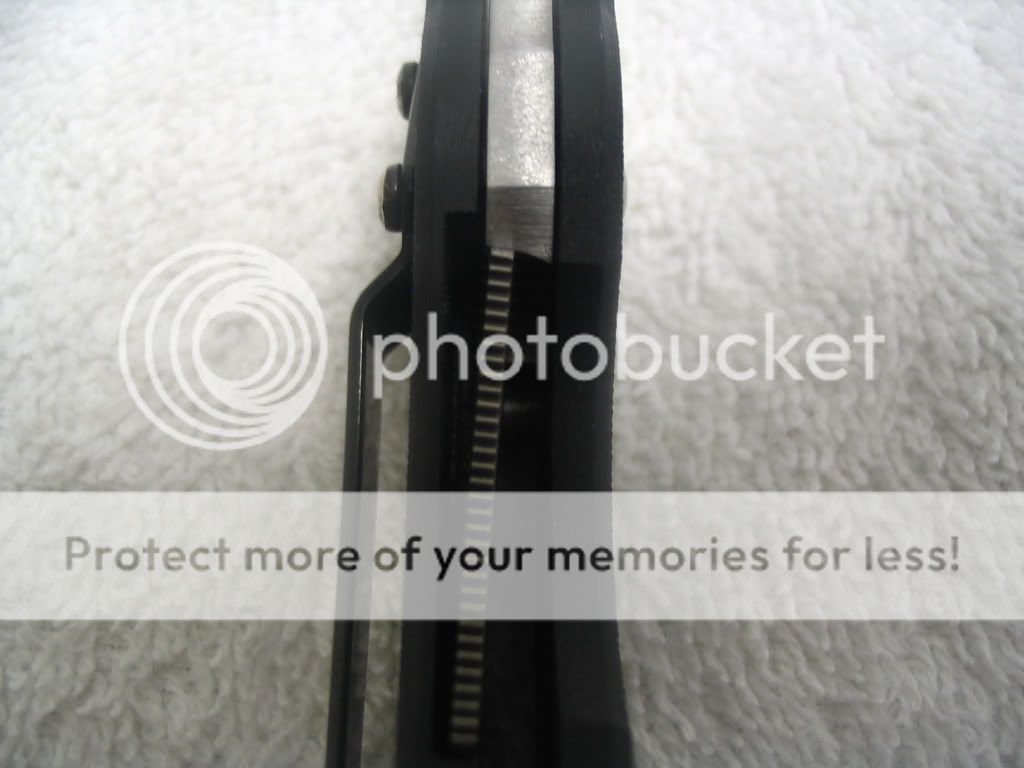
Here are some pics to help explain what I mean. :cool:

SnG (known for bank vault lockup), but do you see that cut out? Looks thin Huh?
IMG_5809.jpg


Spyderco Mili (see the thickness of that liner, its not much smaller than the SnG.) :cool:
mili-lockup.jpg


I'm not sure about you, but I cut with the sharp part of the blade, not the spine. So I have nothing to worry about Liner Lock or Frame Lock. ;)
 
Here is a reply I did awhile back concerning "Spine whacks"

Question from ignoramus:
Have you done any hard spine whack tests with either of these knives?
(Spyderco Chinook II and large manix)

Response from Bors:

No I have not. One of the things that has always concerned me about spine whack test is the stress it puts on the lock. I know that's what it's supposed to do, however my real concern is the creation of vertical play by over stressing the metal in an otherwise tight lockup.

The question of lock strength was brought up at an MBC seminar in cunjunction with using a reverse grip.
The concern of coarse was catastrophic failure. After some demonstration and slow work you realize that the forces on the lock are not that great. With the edge facing the opponent (reverse grip) the knife is used primarily to hook and redirect after off hand checking followed by the cut. The redirection on a somewhat padded taget (arm) is pulling not striking therefore involving much less force. The hand since it is generally incontact with the target during redirection (but not always) also absorbs some of this force.

If you were to compair the force curve of a redirect on an arm and a spine whack on hardwood the redirect would have a lower amplitude over a somewhat longer period while the spine whack would generate a very sharp high amplitude in a very short time.
Spine whacks unless performed in a controlled fasion are very subjective since no to people will consistantly strike with the same force. For this reason (at the moment) I think the only thing to be gained by stepping out to the shop and performing a spine whack test would be to shorten the working life or destroy an otherwise perfictly good knife.

During the MBC course Mr Janich pulled out a spyderco stainless steel police model and did a "very light" spine whack on the table and it failed. Was Mike showing us just how weak an poorly designed the police was, no actually quite the contrary the knife had seen a lot of use and was worn out. His point, knives wear out with use so check them often and replace when needed. Close examination of the police revealed both the blade and locking bar to be worn as such to no longer function as designed.

If the edges on the lock well of the blade show signs of wear (rounding) then you can bet the lock bar is also worn and it might be time consider rotating in a new knife.


Here is the original thread. The picks are no longer available.
http://www.bladeforums.com/forums/showthread.php?t=433202&highlight=Whack
 
Did Bladeprice ever get a new Manix and if so did it pass the spine whack?
 
Thanks again for that response Bors:). It was from that thread that I decided how ridiclulous hard spine whacking is to test lock strength and security.

One thing that I think hasn't been mentioned about the higher numbers of liner lock failure is that most cheap knives are made with liner locks. It seems to be the easiest to produce in general. With a higher number of cheapo knife companies producing cheapo quality locks, and the majority of those cheapo locks being liner locks, simple math will tell you that the chances for liner lock failure will increase as well.

Just about every user of the Spyderco Military that I've read reviews about feels secure in the liner on the Military. Benchmade is also one of the high quality companies. I would feel secure with the Dejavoo lock as long as I was using it the way it was designed to be used.
 
I don't test with a hard whack... I wrap the blade then grab the blade and handle (horribly dangerous, never do this at home!) and try to overcome the lock by muscle power. I've defeated lots of older backlocks this way, but only one linerlock, and that was an import with a bad angle on the back of the blade where it interfaces with the liner. My problem with older linerlocks is that there would be so much of the liner exposed that if you had a hard grip and twisted the knife at the same time, you can release the liner. Newer liner locks have a lot less liner exposed. Newer backlocks seem better - the Manix and Chinook passed my test, no problem.

That being said, I think a good framelock is about the best lock out there.
 
Mechanically, a framelock and liner lock are the same thing, the liner has a scale over it. What happens in execution of the design for the part is that the framelock is usually much thicker at the lock up point, so wear is spread over the larger face. Framelocks are often made with Ti, which has a much higher friction in contact with blade steels than the cheaper stainless liners used on inexpensive liner locks.

There is some concern about the strength of the cutout in a framelock, but few have demonstrated it's a problem other than in their mind, as the rest of the leaf is full thickness and not subject to flexing as a thin stainless linerlock. As for the lock actually failing there, it would take thousands of pounds of leverage to overcome the material strength in compression - something else would give first, likely the lock interface, which is what happens to a cheap linerlock in a spinewhack test. Even liners don't crumple into folds doing that, they just bounce the leaf to the side and unlock, as widely reported.

Lots of good linerlocks are out there, but the makers of cheap junk overran the market with ignorant and poorly designed locks looking to cash in on the tactical market before they "educated" the public on how badly made they could be, just like hollow handled survival knife makers were ruined. Chris Reeve Knives still suffers from ignorant comments from newb forumites who don't know the difference between an integral CNC'd one-piece-of-steel knife and junk stub tangs shoved in a plastic handle. Now linerlocks are getting the same rap, which is a shame for the competent makers who know what it takes to get them right.

Long Ti liners with sufficient stiffness, the proper ramp angle, and stiff handle scales that resist torquing seem to be required, and also the hallmark of the good makers.
Short Stainless liners with ramps that push the lock open housed in FRN should be avoided - but are precisely the stock in trade of the budget maker. Their numbers are legion right now.

I don't think you'll have much problem with your knife.
 
I have no problem with liner locks. Like others said, I don;t whack and hack away at it doing a "spine test" and I don;t stab it into maple trees. I've been carrying a Benchmade 975 for over ten years. It's been inertia slammed open 3 billion times. It's fine even now. Liner locks from reputable manufacturers are going to be just fine. When you read a post or thread where guys are saying their liner locks "failed" after they hacked away at the spine, then it's time for scepticism..... on the part of the poster, not the knife.
 
There is some concern about the strength of the cutout in a framelock, but few have demonstrated it's a problem other than in their mind, as the rest of the leaf is full thickness and not subject to flexing as a thin stainless linerlock. As for the lock actually failing there, it would take thousands of pounds of leverage to overcome the material strength in compression - something else would give first, likely the lock interface, which is what happens to a cheap linerlock in a spinewhack test. Even liners don't crumple into folds doing that, they just bounce the leaf to the side and unlock, as widely reported.

Anytime you have a long cut such as that used to make this type lock which in effect creates a long bar you will be able to see that it can show some downward movement from leverage if you open the blade half way and just squeeze down on the lock. This movement is even more profound on some that are taken down to extreme thinnness and so much so that you can actually close the gap between the bar and the body of the folder easily by pushing downward on the lock. On others (the thicker ones in the relief area usually) you can't move them at all or only very slightly by comparison. In other words they are more rigid. It isn't the fold or kink problem that is so much a concern here with this cut out so much as it is the downward movement and double wear that goes along with it in conjunction with the sticking locks as a result of this added movement.

For examples, try moving the Cuda Max lock downward. Now compare that to one that is thin and you will see the difference. Without the lock stabalizer these locks will move down during use sometimes binding in such a way as to become quite sticky. Strider saw this as a problem and so did Rick Hinderer. I think it can be prevented to a large extent also by simply paying attention to how thick or how thin these cut outs are. Even the Sebenza can be made to move downward to some extent and its much thicker than most frame locks in the cut outs. So imagine how flimsy it would feel if Chris Reeves took his down to these rediculous thinnesses also. This is not in anyones imagination. It can be easily verified by simply testing your own knives. After .058 there is no real reason to go any thinner. This thickness seems to work just fine and even assisted opening knives can work with a .058 thickness at the cut out. I just did one and sold it in that Blur that way.

Some of these locks are thinned down to sub .040 thickness. Some of the harder use ones have been .033 which in my humble opinion makes the locks far too easy to bend downward unnessarily.

Sal has said in his own testing that this relief cut out is exactly where the locks defeat. I can vouch for that because I have seen it also and it does not take thousands of pounds of pressure to do it. Ask yourself why I converted my first Emerson liner lock to a frame lock. I tested it with free weight hanging through a cable through the lanyard. They don't hold the weight you think they will. In fact a strong liner lock can hold 100 pounds max. Don't believe me? Try it.

STR
 
If, when opening a liner lock, you can remember to slip a piece of plastic between the blade and the lock and then gently slip the plastic out while holding the liner and releasing it slowly to rest upon a freshly greased liner relief in the blade, you should NEVER have a problem.
Then, when closing, pull the liner gently away from the blade and ease the blade down using the same shim that you used to open it, that would also be a good idea.
This requires using two hands and a separate piece, but it will definitely extend the life of the knife.
There are some who also advocate never subjecting the blade to any force that would tend to drive it against the locking liner and putting stress on the liner such as sticking or slicing, but they are usually the sort who haven't figured out that this post is complete BS.
:D
 
I don't like linerlocks at all and agree with the previous poster. If you buy a Columbia River and get one with AutoLAWKS, fine, but I wouldn't have any other kind. If you're going to buy a good folder, get one with a framelock or a lockback. Or, Cold Steel's Recon 1 has what's called an Ultra Lock, which I understand is fairly bullet proof.

My fingers are worth too much for me to risk them on a linerlock. For an inexpensive locking knife that won't see many tough cutting jobs, fine. But if you're a'fixin' to pay more than $30 on a knife, there's no good reason to buy a linerlock.
 
Bottom line: not all liner locks are created equal. Design, materials and quality of manufacture are what matters.

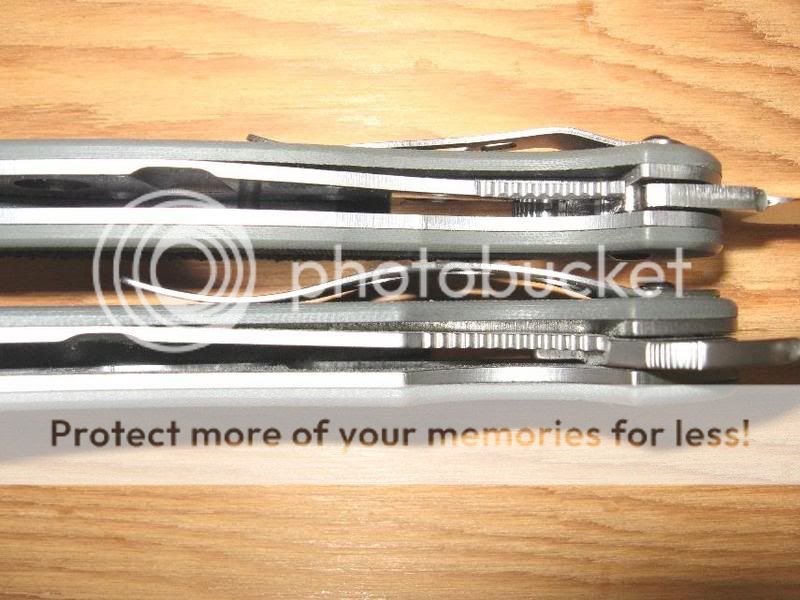
Below is a picture of two relatively new Kershaw liner locks, the ENER-G2 (top) and Junkyard Dog II. Both have .070" steel liners (just compare these to the MIlitary, above) and are very well made. I'm confident in the safety and reliability of both.

energ2-6.jpg
 
Bottom line: not all liner locks are created equal. Design, materials and quality of manufacture are what matters.

Below is a picture of two relatively new Kershaw liner locks, the ENER-G2 (top) and Junkyard Dog II. Both have .070" steel liners (just compare these to the MIlitary, above) and are very well made. I'm confident in the safety and reliability of both.

How thick is the cutout on these two (just out of curiousity)? The Military's lock isn't as thick as those, but I wonder if those cutouts are thinner than the Military? Either way when it comes to liner locks I know the Kershaw Cyclone and Military I have both lock up very solid, and I trust them both about as much as I will trust a liner lock. The Military does seem more solid than the Cyclone to me (maybe a mental thing?), but looking at those pics of yours I'm sure those 2 will take a beating, and they certainly look strong. I think it still comes down to the issue of side torquing the knife while cutting with a liner lock, which I've read can disengage even the best made liner locks. Personally, I do some light, fast spine taps (not whacks) to test mine for security, along with some hard cutting. Another thought, choils come in handy for both choking up on a blade and presumably for protection, because if a knife disengages on you it is nice to have that choil to hopefully hit your finger before the sharpened edge does. I wouldn't want to have to test out that theory of the choil protecting me, though.

Mike
 
If, when opening a liner lock, you can remember to slip a piece of plastic between the blade and the lock and then gently slip the plastic out while holding the liner and releasing it slowly to rest upon a freshly greased liner relief in the blade, you should NEVER have a problem.
Then, when closing, pull the liner gently away from the blade and ease the blade down using the same shim that you used to open it, that would also be a good idea.
This requires using two hands and a separate piece, but it will definitely extend the life of the knife.
There are some who also advocate never subjecting the blade to any force that would tend to drive it against the locking liner and putting stress on the liner such as sticking or slicing, but they are usually the sort who haven't figured out that this post is complete BS.
:D

Great suggestion ! I'm going to make a little shim tonight while watching TV , one I can keep on my keyring , this way all my linerlocks will last much longer and I can pass them down to my pups. :thumbup:


:p
 
After reading all this about the strength of different locks, it makes me wonder why anyone uses non-locking knives, like stockmans, SAK's, ect.
 
After reading all this about the strength of different locks, it makes me wonder why anyone uses non-locking knives, like stockmans, SAK's, ect.

I am fascinated with the degree of paranoia towards liner locks. Heck, I have been using slip-joints for 40 years and have yet to have one close on my fingers.
 
APF if people used all knives as if they were slip joints there would not be a problem but put one that locks in their hands even if the lock is made of brass and they suddenly think they can do things with it they'd never try with a slippy.

Compound this natural tendency to suddenly feel invincible with the hype presented many times by such promotional videos as Cold Steel puts out and you suddenly have reason to be a bit hesitant to put total faith in what is said even by the more reputable folks.

The liner lock started out as a helper to a slip joint with a back spring like the locks we still see used in slip joint electricians knives. These were usually work hardened brass locks and they basically set the idea in Walkers mind to re design it without the back spring and out of a stronger metal with a detent ball to prevent accidental openings. I don't think he ever intended for it to take the world by storm the way it did but history shows us that shortly after he refined this and recieved bad advice about patenting his work that everyone and their brother took off with the idea.

Frankly the idea of putting these light duty gents locks in hard use categories and tactical knives was never a good idea but it sold. After Chris Reeve came out with a better idea in the frame lock it set a new standard that stands out to me as not only the best way to make a heavy duty integral style locking folder but really the one that end line users should demand in that style of folder. Personally, I feel short changed when I see these thin liner locking tactical folders being sold for the money they bring when a bigger better deal is available to makers. There is no excuse not to do it the best way possible now that we know how and there is nothing keeping one from doing it right.

On another note. Its been said that if liner locks had not been invented and did not exist the world would be 2/3rd less full of knife makers. If all makers still had to make locking folders in a lockback, well, not everyone can do that. Many want to but its a different league of craftsmanship.


STR
 
Back
Top