When is a knife too sharp?

A knife is never too sharp for me. A knife can have too acute of an angle on the bevel, where the edge looses it's ability to resist deformation. That is about the limit for me.

If the edge can handle the cutting chores I have for it, without deformation, then it is not "too sharp".
 
I believe the answer to this question this depends on the situation. When you are forbidden from sharpening certain friend's knives after a series of "incidents" resulting in repeated accidental injuries, the knives "in this situation" were too sharp. For my personal use, I'm with Karl. Respect bordering on fear is a good indicator of a properly sharpened blade. -Doug
 
If you believe its a matter of the right edge for the work being done then the question of how sharp, is a moot one.
 
If it happened to me, I'd think sheath design for sure (but as mentioned, I'd still be a little proud). I like sheaths to draw or guide the blade in a certain way, then pop into place. Designing the handle is part of that process too. A well designed sheath will never have the option of exposing the blade.

Besides the sheath, I think a knife can be too sharp in the sense that the geometry is wrong. I can make a hatchet split hairs but the edge will get badly damaged doing it's designed purpose.
 
I say never. I wouldn't fault the knife, but the sheath in that instance.

:thumbup:

A knife should be as sharp as the person using it needs it to be, plus one level sharper. When in doubt, "too sharp" is much better than "not sharp enough".

A sheath should be as sturdy as needed to protect the knife from getting dinged up, and protect everything else from the knife's edge/tip.
 
Assuming edge geometry is correct for the purpose of the knife, there's no such thing as "too sharp." IMO. You work up a burr, refine the burr, and strop it off. I like to take my edges to a high polish too.

Now an edge can be too acute for a given task. It would cut "better" and I guess could be considered "too sharp" if it wasn't obtuse enough to hold up to the required use. i.e... battoning wood with a .060 gyuto.
 
the edge needs to be the sharpest and deburred as you can manage to hone, regardless of the angle choice which depends on the application.
I second what Karl said: you should be scared of the edge!!!!
Sheating/unsheating is something should be done with a great deal of care...go see Nick Wheeler's video, cutting thick leather is a breeze, and trust me, you can split in half the thickest welt.
 
Here is an example of when a knife can be too sharp. When I gave my son,grandsons,granddaughter,nephews,knives when they were young,I intentionally dulled them because they were too sharp for a young inexperienced person to be playing with,which is what they did,they played with them but that was the beginning of their learning about and appreciating knives.
For me,they are not sharp enough untill the shadow will cut you!
 
eh eh ;) Calvin is super-right!! I started appreciating sharpness as a boy, the day i learned myself to sharpen on whetstones....it was an old yellow belgian stone, then i started respecting knives for what they really are!
 
Can't have one too sharp. I have always cut myself more with a slightly dull knife by trying to force it to do more work before I had to stop to sharpen it! You learn with age and experience not to do that anymore.

Jeff
 
If it won't easily shave arm hair, it isn't sharp enough.

shaving arm hair isn't sharp enough for some folks - they want "tree topping" sharp! I've never seen nor achieved tree topping sharp, just read about it. I did see a photo where slivers was cut on the hair strand - photo was under microscope. He claimed it was real.

Ken H>
 
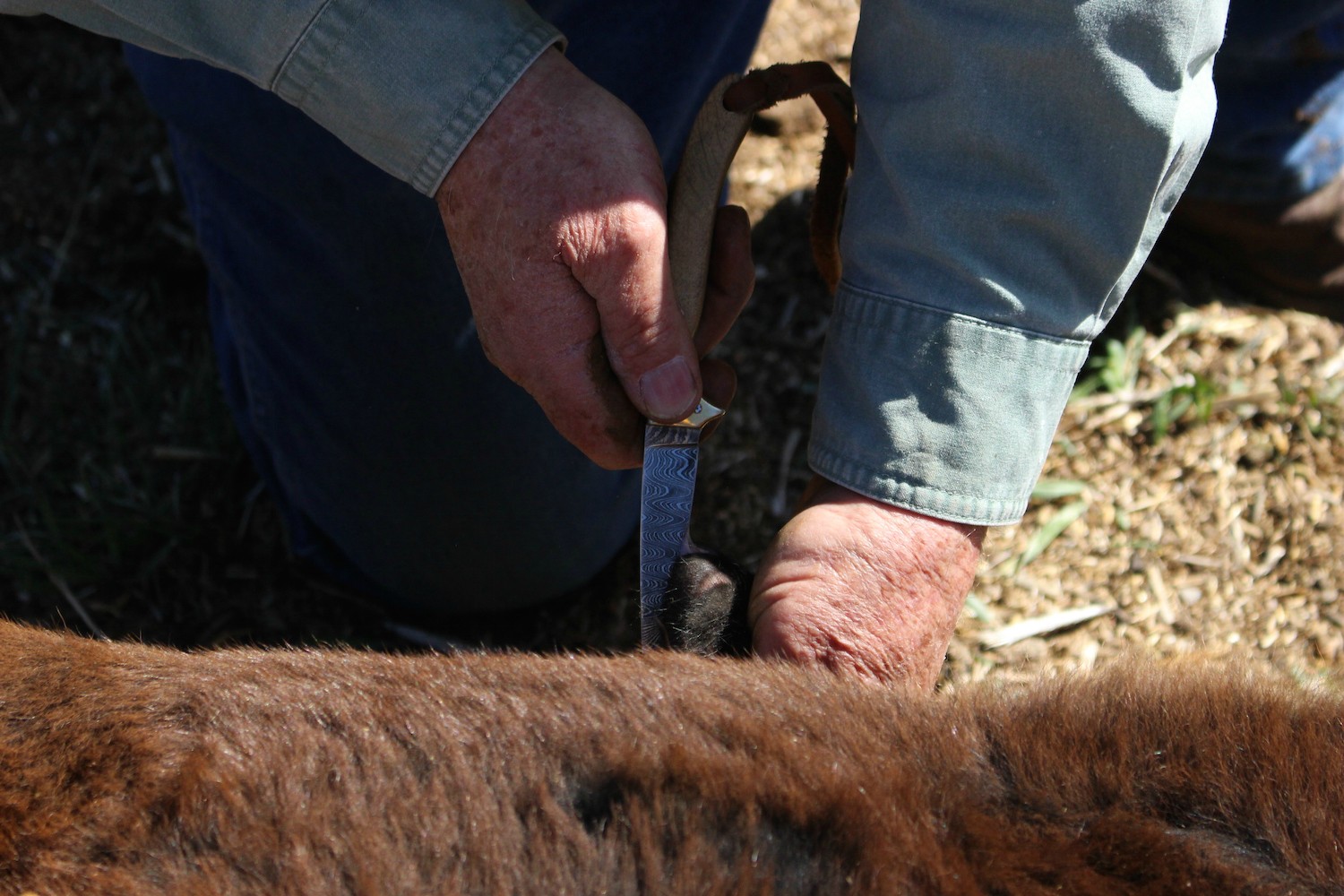
There are applications where a knife can be too sharp. A knife used in the branding pen can be too sharp. Here young bull calves become steers. A very fine, polished edge will "slide" and not cut "right" in this job. Whats about right? 220-330 grit with the burr knocked off.

uvBkomf.jpg


While there are many different ways of cutting your way through this job; good methods have in common that it is quick, very little trauma and little bleeding. Thats what occurred here.

7MGrY8W.jpg


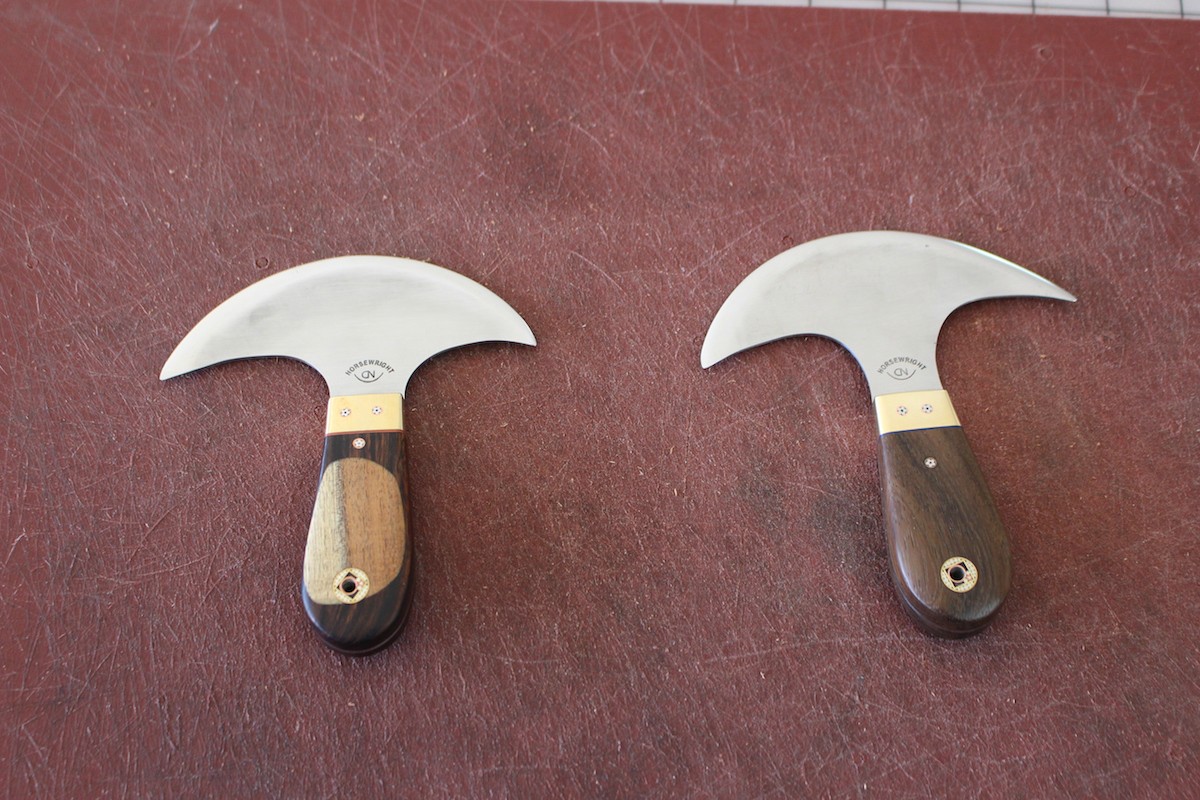
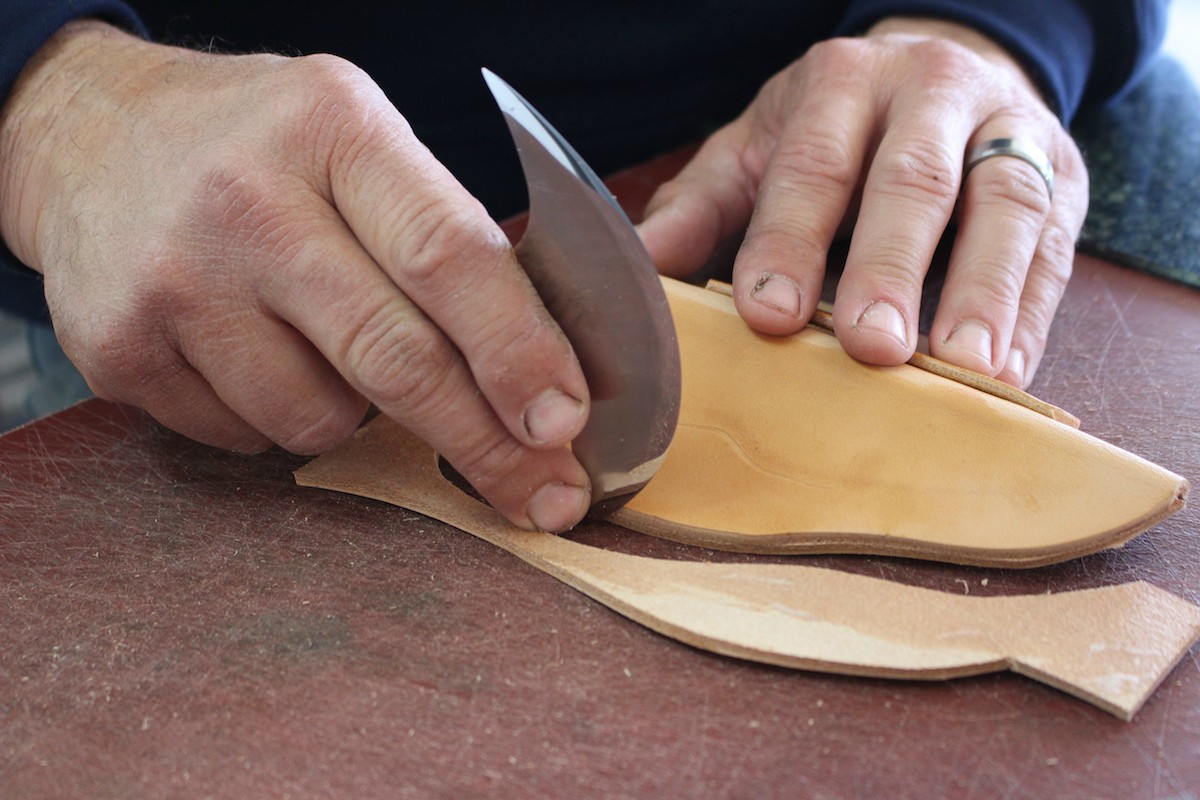
In the leather shop I want my roundknives past "scary" sharp into "ugly" sharp. AEB-L @63RC, HT by Peters. I use these knives very hard, they cut heavy leather for hours at a time.

qUUc2i8.jpg


I expect them to make a smooth cut in one pass. But even then I can't use that upper end. It is too sharp, it will stick in the cutting board. It is mostly used for skivving.
 
Last edited:
shaving arm hair isn't sharp enough for some folks - they want "tree topping" sharp! I've never seen nor achieved tree topping sharp, just read about it. I did see a photo where slivers was cut on the hair strand - photo was under microscope. He claimed it was real.

Ken H>
I've found that with this AEB-L I've been working with you can shave your arm hair individually into several pieces if you want. It was designed for razors so I guess that's why it is what it is. I like it.
 
There are applications where a knife can be too sharp. A knife used in the branding pen can be too sharp. Here young bull calves become steers. A very fine, polished edge will "slide" and not cut "right" in this job. Whats about right? 220-330 grit with the burr knocked off.

uvBkomf.jpg


While there are many different ways of cutting your way through this job; good methods have in common that it is quick, very little trauma and little bleeding. Thats what occurred here.

7MGrY8W.jpg


In the leather shop I want my roundknives past "scary" sharp into "ugly" sharp. AEB-L @63RC, HT by Peters. I use these knives very hard, they cut heavy leather for hours at a time.

qUUc2i8.jpg


I expect them to make a smooth cut in one pass. But even then I can't use that upper end. It is too sharp, it will stick in the cutting board. It is mostly used for skivving.

That's a good point. Definitely meat and hide cutting edges should be sharpened accordingly (I'm liking a Spyderco Medium bench stone).

Fun discussion
 
I used to agree that there's no such thing as "too sharp", however a while back I made a nice little patch knife out of 52100 and put an edge on it that that would fillet cigaret paper and scare atoms. First time I tried to trim pillow ticking after starting a ball it just didn't want to cut the patch. It would, but took some effort and had a very thin geometry. Next time I sharpened on a Norton fine india and just a touch up with a Arkansas stone. It would still shave, but not straight razor shave, but it made cutting patches a very easy task, vs. the scary sharp edge I'd first put on that didn't want to cut the patch. Both edges were sharp, but one still had some aggressive teeth to it and it made cutting coarse material easier.
 
I've heard many times that the scary, micro-toothed edge is even better for some task (tomato skin and the like...), but in pratice i still like more the honed-black edge. I believe the scary one rips, the honed one cuts, tomatoes and everything else.
Of course the ripping edge is more "forgiving" when less than optimally sharpened, the same as a saw blade.
 
Back
Top