When/whether to hand sand???

Joined
Jun 3, 2019
Messages
2,714
I literally mean this as a "whether" not "how" question. I have tried enough grinding sessions not to see that, even following an apparently appropriate progression of grits on the grinder belts, that there are still some residual areas on the blades that are not quite consistent with the rest of the blade. I am not talking about residual larger scratches, it is more of a "hazy", "fuzzy" background appearance that can be seen with certain lighting conditions. I this something that can only be addressed by hand sanding, or am I looking at something more like a belt/technique thing? (current process is 600grit ceramic, 120 AO, 240 ceramic, 400 grit silicon carbide). (I am still learning the belts, and I clearly need to get in some 120grit ceramic - or trizact??).

Anyway, the real focus of my question is whether hand sanding is a "must", or a "choice", depending on whether you can get your grinder technique down well?? Tutorials on hand sanding (for example Nick Wheeler's) dont cover that particular question, and most threads on this forum dont really explicitly discuss that "choice"? (though there was a thread earlier this year on producing a set of steak knives where the aim was to grind using only a final hand "pull" and avoid residual surface marks) ... but it is still not quite clear to me what can be done to avoid/minimize hand sanding. (I am not totally averse to hand sanding - but I am kind of in the same boat as Horsewright in that I have broken my right hand several times - and it has gotten weaker with each break :-(. Please let me know your thoughts???
 
On the very few knives I hand sand I follow my normal progression down to a 16 trizac then 400 cork. Then hand sand with 400 and 800.
 
Good grander technique makes and sanding much faster. I would also say that a hand sand is a mark of a well done handmade knife. To me, the choice is do you want to look factory or handmade?
 
Hm, pictures would help...

But if I'm understanding what you're saying - you feel like some parts of the blade are being 'missed' by the belts?

Have you tried blending in those spots on a slack belt?
 
This is so subtle i dont know if a camera would catch it ... but i can try. I have not tried the slack belt ... is worth a shot.
 
being a must or a choice would depend on what kind of finish you are looking for. i do 90% mirror finishes, and it took years to get it off the grinder @ 1000 grit and go right to 2000 grit hand sanding and only have it take 45 min to get to 3000 grit and then onto the buffer. eventually you will become an expert at not missing any spots. if you miss removing some 220 grit scratches with your 400 grit belt, and then go higher, it will mean much hand sanding later. try coloring your blade with dykem marking fluid between each grit belt. it will help you not miss any spots. i like the spray dykem better than the brush on.
 
I usually get the hazy look with a warn belt.
that might very well be it - I am still working to understand when I need to swap out belts. Pls see below for picture and see if it matches your experience?

Hm, pictures would help...
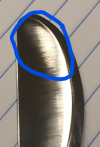
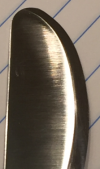
Here are a couple shots that I think capture what I am talking about:
upload_2019-8-24_14-45-31.png
upload_2019-8-24_14-45-42.png
I am talking about that patch near the tip (circled in one photo). Its visibility is totally dependent on the angle of the light - from one direction the surface of the blade looks totally uniform. with light from another this patch becomes visible (it is not a reflection ... it is really there). I saw it unfold while on the grinder. My recollection is that on the grit before this appeared I had a nice uniform grind with no residual scratches from the earlier grind. then this thing appeared - and I worked at it, and worked at it ... and just could not get it to go away. Eventually I gave up as "good enough for now". I might well have been using an older belt on that step - Tim - does this look like what you see with an overly worn belt?
 
It’s hard to tell from picture. I’d start with a fresh belt at the grit you think it started at and only finish with fresh belts the rest of the way. See if that clears it up.
 
That photo looks like a worn belt. I've also gotten that when the belt and steel start to get hot. Sometimes only cooling the blade will still leave your platen and belt hot. That's when I start to get that look on my blades. Of course sharper belts run cooler so it helps to have a fresh belt for finish grinding
 
only finish with fresh belts the rest of the way

I've also gotten that when the belt and steel start to get hot
Yeah - there definitely was the occasional spot of "ouch - HOT" involved. sigh ... I WAS warned about fresh versus worn belts. Lesson learned!

I was planning on getting some 120 ceramic belts (and currently have silicon carbide for the really fine grits). Others have spoken about going to Trizact at 120 (and keeping ceramic for grits above that). Is this a personal preference thing - or are trizacts that much better when you get above 80??? (I still need to order, so guidance would be helpful......)
 
I concur that Fresh Belts are the key! Some of the best advise ever was, “use belts as if they were free” ———-It makes a BIG Diff!
 
Ummm ... i also have been running the belt slow .. could that be a contributing factor to this “haze” ... and should i in fact be running faster?
 
It looks like it's not flat to me. Wrap a single piece of 220 or something around a file and make a couple passes back and forth. Dye or color it with a marker for contrast if needed. Your high and lows will show you how flat it is.
 
It looks like it's not flat to me. Wrap a single piece of 220 or something around a file and make a couple passes back and forth. Dye or color it with a marker for contrast if needed. Your high and lows will show you how flat it is.
That was my first thought ... but ive checked it with an engneering reference straight edge, and it was precision ground in the first place. Nothing is perfectly flat, but this seems to be close enough for the belt to get to it. Also, with light from a different angle the grind marks are continuous through that area. If fresh belts don't fix this though, iwill revisit the flatness question...
 
Honestly, I don't think a straight edge will do you much good in assessing flatness.

Hand sanding, however, will quickly indicate how flat it is.
As i said, nothing is ever perfectly flat - even with hand sanding with a backer you have questions about the flatness of the backer. The “straight edge” i am referring to is an engineering tool... i have been using it for decades to assess straightness or flatness of surfaces. Its been so long that i dont recall its actual tolerances, but in technical terms it wold be dscribed as pretty darned small. Easy to use. Put across surface, illuminate from back, look for light shining through the gap between between straight edge and surface. Easy to see irregularities even smaller than a mil.
 
Back
Top