
When/whether to hand sand???

As you go higher, belts with some give to them let you get into not-quite-flat areas. Cork, scotchbrite, etc. - at the risk of washing out crisp surface transitions. The not-flatness is probably on the order of 0.001". Hard to spot with a straight edge, and "flat" is really only meaningful in a particular line across the blade at a given point, not across the surface as a whole. Almost no blade is technically flat from plunge to tip unless it's a rectangular shape with a die-straight edge.

Also, I truly believe that a good belt finish is technically more difficult than a hand finish - but less laborious. Since you're just starting, you might consider learning to hand-sand now to truly understand what's happening with your surfaces.

Clamp the blade flat to a knife board and get at it with some 180. About 30 seconds will show you exactly what's up with your surface, and you can bring it to a "flatness" that's hard to match with a belt. Then the following grits proceed fairly quickly. I'd call 360 or 400 the minimum for finish. Or if you're sanding pre-heat, just do 120 or 180.The first grit is the hardest as you clean out your tool marks. As your grinding gets better, this step will be faster, and you'll have a really good idea how reliable your hands are at the grinder.

 
Clamp the blade flat to a knife board and get at it with some 180. About 30 seconds will show you exactly what's up with your surface, and you can bring it to a "flatness" that's hard to match with a belt. Then the following grits proceed fairly quickly. I'd call 360 or 400 the minimum for finish. Or if you're sanding pre-heat, just do 120 or 180.The first grit is the hardest as you clean out your tool marks. As your grinding gets better, this step will be faster, and you'll have a really good idea how reliable your hands are at the grinder.
I have been trying my hand (no pun intended) with hand sanding on some previous blades - and what I am seeing here is different. No evidence of underlying grind scratches not being taken out (which I have experienced before on other blades) - just a vague fuzziness whose visibility is extremely light-direction dependent. Also, the surface in question is not one I ever ground - it is the blade flat which was precision surface ground before I ever got my hands on it - I only had it on the grinder - more flat grinding - to take it to a higher finish. Look - I am not saying it is not flatness, but I am not going to jump solely to that conclusion without first verifying the "worn belt" possibility (which if it is the case I definitely want to know the limits of my belts!). I should be able to test - most likely tomorrow. I promise, I will post the results one way or another
 
The light direction dependency is the give away that you have a faceted section at a lower grit that's not been ground uniformly to the next grit.
 
The light direction dependency is the give away that you have a faceted section at a lower grit that's not been ground uniformly to the next grit.
quite possibly .... except for the following. Just had a little while to experiment: took it back to 120 grit (fresh belt) - looks fine. took it up to 220 grit (fresh belt) - looks fine. I have no fresh belts currently at 320 or 400 (need to order) - but for yucks took the best-condition 320 belt I have (worn) - same mottled/fuzzy appearance. HOWEVER, the "fuzzy" sections are in a different location from the one I shot a photo of the other day. If I had a definitive low area, I would expect the "fuzzy" area to remain in the same location - no??? Like I said, I am not ruling out surface flatness - but the picture just does not seem so clear as to run only to that conclusion (like I said, I have seen the effect of lack of flatness - and this is behaving differently. I need to order in some fresh belts at higher grit....
 
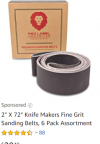
so ... here is another possibility / question: for AO belts, I have been using the "red label" belts from amazon:
upload_2019-8-26_12-16-39.png
for these are fine for handles and brass bolster, but for some reason I am only now seeing in the description that they are for soft "non-ferrous" metals. I am now seeing these others on their website, which are exclusively labeled as "knife makers" belts:
upload_2019-8-26_12-18-16.png

HOWEVER, both of these are labeled as aluminum oxide abrasives. (website is not clear on backing weight).

The question is: are all AO belts created equal (aside from tracking issues)? Is part of my problem potentially due to an "inferior" product somehow not suitable for finer grits on metal? (just ordered the "knifemakers" belts by the way.) Is there something here about belt abrasive quality that I need to learn about?

I am probably slowly working my way towards the Trizact line - people seem to have good luck with them...
 
quite possibly .... except for the following. Just had a little while to experiment: took it back to 120 grit (fresh belt) - looks fine. took it up to 220 grit (fresh belt) - looks fine. I have no fresh belts currently at 320 or 400 (need to order) - but for yucks took the best-condition 320 belt I have (worn) - same mottled/fuzzy appearance. HOWEVER, the "fuzzy" sections are in a different location from the one I shot a photo of the other day. If I had a definitive low area, I would expect the "fuzzy" area to remain in the same location - no??? Like I said, I am not ruling out surface flatness - but the picture just does not seem so clear as to run only to that conclusion (like I said, I have seen the effect of lack of flatness - and this is behaving differently. I need to order in some fresh belts at higher grit....
This is a fairly typical result. You can spend the rest of your life chasing highs and lows with the belts you're using, and the "fuzzy" spots will move around until you go insane. You have two options: hand sand (you really should try it here to prove this to yourself) or buy a whole bunch more expensive belts and experiment until you hit the grit progression and belt type you like best. And, structured abrasives really are that good. I've not used the Trizacts myself, but I do like and use Norax belts.
 
Belts and belt grinders, by nature, can only sand so flat. Regardless of how good your platen and other features are, it is a moving surface of varying thickness moving over an unsupported metal surface. Industry spends millions trying to minimize these situations. A home grinder is a wild machine to a machinist.

Hand sanding with a hard backer on a blade firmly clamped down on a rigid arm is much more controlled and will sand flatter.

If you want dead flat bevels, get it to 400 on the grinder, go to hand sanding by dropping back to 220, then increase by doubling the grit up to 1000 or higher. The more rigid your hand sanding and the smoother the strokes, the better the results.

Or, be lazy like me and use a Scotch Brite belt after taking the surface 400 grit and call it good.
 
quite possibly .... except for the following. Just had a little while to experiment: took it back to 120 grit (fresh belt) - looks fine. took it up to 220 grit (fresh belt) - looks fine. I have no fresh belts currently at 320 or 400 (need to order) - but for yucks took the best-condition 320 belt I have (worn) - same mottled/fuzzy appearance. HOWEVER, the "fuzzy" sections are in a different location from the one I shot a photo of the other day. If I had a definitive low area, I would expect the "fuzzy" area to remain in the same location - no??? Like I said, I am not ruling out surface flatness - but the picture just does not seem so clear as to run only to that conclusion (like I said, I have seen the effect of lack of flatness - and this is behaving differently. I need to order in some fresh belts at higher grit....
Which speed you use for 400 grit belt ?
 
This is a fairly typical result. You can spend the rest of your life chasing highs and lows with the belts you're using, and the "fuzzy" spots will move around until you go insane. You have two options: hand sand (you really should try it here to prove this to yourself) or buy a whole bunch more expensive belts and experiment
Hand sanding with a hard backer on a blade firmly clamped down on a rigid arm is much more controlled and will sand flatter.
good points both of you - and I especially appreciate that hand sanding is more controlled (perhaps I have mis-appreciated how un-controlled working on the grinder can be and that this affect of "fuzzy spots" moving around has been seen before....). I have tried my hand at hand-sanding to appreciate what it takes, and to understand that physically it would be difficult for me (due to hand injuries) to take that approach for all my knives - hence my original question on if/when/under what circumstances to hand sand (and to understand the alternatives and their limitations. Looks like I will just need to go right to either the Norax or Trizact belts.

Or, be lazy like me and use a Scotch Brite belt after taking the surface 400 grit and call it good.
I would not call that "lazy" - I would call it practical!!! :) . that is not to say I believe I would never hand sand - just probably reserve it for "special" blades (wedding presents? special gifts to friends? ) where I wanted the absolute best appearance...

Thank you to everyone for your input here - I'll experiment a little more with old versus fresh belts, structured abrasives, and yes, even hand sanding :) and see what affects I get and can deal with....
 
play around with different sanding blocks and ways to clamp the knives, you may be able to find an option that doesn't stress your hands.
 
good points both of you - and I especially appreciate that hand sanding is more controlled (perhaps I have mis-appreciated how un-controlled working on the grinder can be and that this affect of "fuzzy spots" moving around has been seen before....). I have tried my hand at hand-sanding to appreciate what it takes, and to understand that physically it would be difficult for me (due to hand injuries) to take that approach for all my knives - hence my original question on if/when/under what circumstances to hand sand (and to understand the alternatives and their limitations. Looks like I will just need to go right to either the Norax or Trizact belts.


I would not call that "lazy" - I would call it practical!!! :) . that is not to say I believe I would never hand sand - just probably reserve it for "special" blades (wedding presents? special gifts to friends? ) where I wanted the absolute best appearance...

Thank you to everyone for your input here - I'll experiment a little more with old versus fresh belts, structured abrasives, and yes, even hand sanding :) and see what affects I get and can deal with....
What are you set up with for your grinder? You are welcome to call me at 360.305.6225. I am by no way a expert but I do think that some skills can be taught better by those nearer the learning process just out of sympathy for a similar struggle.

I have been getting better belt finishes lately and find wet grinding with a 120 to be very helpful as a foundation for your hand sanding or switching to j weight belts. I don't have time to lay out my journey right now but I find that I can go to a 1k grit within 30 minutes from the 120 belt.
 
It’s amazing how non flat a flat grind can be off a flat platten. The belt seams to not rid evenly. It’s all most like the belt bunches up before it’s sucked under the blade. A vacuum platten has been on my list of things to try and build.
 
I literally mean this as a "whether" not "how" question. I have tried enough grinding sessions not to see that, even following an apparently appropriate progression of grits on the grinder belts, that there are still some residual areas on the blades that are not quite consistent with the rest of the blade. I am not talking about residual larger scratches, it is more of a "hazy", "fuzzy" background appearance that can be seen with certain lighting conditions. I this something that can only be addressed by hand sanding, or am I looking at something more like a belt/technique thing? (current process is 600grit ceramic, 120 AO, 240 ceramic, 400 grit silicon carbide). (I am still learning the belts, and I clearly need to get in some 120grit ceramic - or trizact??).

Anyway, the real focus of my question is whether hand sanding is a "must", or a "choice", depending on whether you can get your grinder technique down well?? Tutorials on hand sanding (for example Nick Wheeler's) dont cover that particular question, and most threads on this forum dont really explicitly discuss that "choice"? (though there was a thread earlier this year on producing a set of steak knives where the aim was to grind using only a final hand "pull" and avoid residual surface marks) ... but it is still not quite clear to me what can be done to avoid/minimize hand sanding. (I am not totally averse to hand sanding - but I am kind of in the same boat as Horsewright in that I have broken my right hand several times - and it has gotten weaker with each break :-(. Please let me know your thoughts???
 
that might very well be it - I am still working to understand when I need to swap out belts. Pls see below for picture and see if it matches your experience?


Here are a couple shots that I think capture what I am talking about:
View attachment 1184542
View attachment 1184543
I am talking about that patch near the tip (circled in one photo). Its visibility is totally dependent on the angle of the light - from one direction the surface of the blade looks totally uniform. with light from another this patch becomes visible (it is not a reflection ... it is really there). I saw it unfold while on the grinder. My recollection is that on the grit before this appeared I had a nice uniform grind with no residual scratches from the earlier grind. then this thing appeared - and I worked at it, and worked at it ... and just could not get it to go away. Eventually I gave up as "good enough for now". I might well have been using an older belt on that step - Tim - does this look like what you see with an overly worn belt?
I literally mean this as a "whether" not "how" question. I have tried enough grinding sessions not to see that, even following an apparently appropriate progression of grits on the grinder belts, that there are still some residual areas on the blades that are not quite consistent with the rest of the blade. I am not talking about residual larger scratches, it is more of a "hazy", "fuzzy" background appearance that can be seen with certain lighting conditions. I this something that can only be addressed by hand sanding, or am I looking at something more like a belt/technique thing? (current process is 600grit ceramic, 120 AO, 240 ceramic, 400 grit silicon carbide). (I am still learning the belts, and I clearly need to get in some 120grit ceramic - or trizact??).

Anyway, the real focus of my question is whether hand sanding is a "must", or a "choice", depending on whether you can get your grinder technique down well?? Tutorials on hand sanding (for example Nick Wheeler's) dont cover that particular question, and most threads on this forum dont really explicitly discuss that "choice"? (though there was a thread earlier this year on producing a set of steak knives where the aim was to grind using only a final hand "pull" and avoid residual surface marks) ... but it is still not quite clear to me what can be done to avoid/minimize hand sanding. (I am not totally averse to hand sanding - but I am kind of in the same boat as Horsewright in that I have broken my right hand several times - and it has gotten weaker with each break :-(. Please let me know your thoughts???
 
Has anyone considered it might not be the sanding that is causing the fuzziness, but the heat treat? I've had blades which showed a orange peel effect in the area where the blade rested up against a metal holder in the heat treat oven.
Jim A.
 
Oh sure, blades can warp in very creative and subtle ways during heat-treat, so if it's finish-grinding... I've had blades curl left or right very slightly. That sucks. Also, some alloys will show (what I assume is) carbide banding at certain grits. But if it's clearly abrasive marks, nevermind that.
 
good points both of you - and I especially appreciate that hand sanding is more controlled (perhaps I have mis-appreciated how un-controlled working on the grinder can be and that this affect of "fuzzy spots" moving around has been seen before....). I have tried my hand at hand-sanding to appreciate what it takes, and to understand that physically it would be difficult for me (due to hand injuries) to take that approach for all my knives - hence my original question on if/when/under what circumstances to hand sand (and to understand the alternatives and their limitations. .

Honestly, this is actually one of the perfect circumstances to hand sand.

Take a piece of that precision ground stock you got and wrap sandpaper around it like you saw in Nick Wheeler's videos.

Hand-sand it as Nick Wheeler does - start with even 220 grit in your case (just so you see for yourself)

Did that 'fuzzy' spot suddenly become clearer after some hand sanding? I bet it did and that's how you know your grind was not perfectly flat.

Why? Because by handsanding we are changing the direction of the scratch pattern. With a hard-backing like your precision ground stock any low spots will become clear pretty quickly (until you sand them out). Sometimes it is impossible to see those low spots unless you change the direction of the scratch pattern. That's also why Nick recommends changing the direction throughout hand sanding in-between grits - so you never miss a spot.

It could be a thousandth of an inch different and it will still show up!

I know you cite difficulties due to hand injuries so you could try a palm sander too (I've tried it though and I actually think it is slower than pulling by hand!)
 
quite possibly .... except for the following. Just had a little while to experiment: took it back to 120 grit (fresh belt) - looks fine. took it up to 220 grit (fresh belt) - looks fine. I have no fresh belts currently at 320 or 400 (need to order) - but for yucks took the best-condition 320 belt I have (worn) - same mottled/fuzzy appearance. HOWEVER, the "fuzzy" sections are in a different location from the one I shot a photo of the other day. If I had a definitive low area, I would expect the "fuzzy" area to remain in the same location - no??? Like I said, I am not ruling out surface flatness - but the picture just does not seem so clear as to run only to that conclusion (like I said, I have seen the effect of lack of flatness - and this is behaving differently. I need to order in some fresh belts at higher grit....

It's showing up in a different location because the belt is no longer cutting evenly (due to wear) - but - even 320 is still removing material. If material is not being removed evenly - that is creating low/high spots - even if you can't feel it and you can only see it in certain directions. So - just because you got out one fuzzy spot (a low/high spot) ... it doesn't mean that belt (or you) isn't creating other low/high spots... (trust me, I have ruined plunge lines with a 600 grit belt before lol)

Like others have said: low/high spots being completely relative to the surrounding surface area. It could be less than a thousandth of an inch difference but light (and our eyes) will still pick it up
 
Back
Top