Where diamond leaves off and waterstone picks up....??

Joined
Sep 25, 2009
Messages
231
In any and all of your certainly humble personal opinions, if putting together a "upper crust" stone set up, at what point do the diamonds plates leave off and waterstones pick up? Ideally I should say. I mean obviously you could use either one exclusively from XC or C in diamond and 500 grit in waterstones up through 8000 grit diamond / 10k to 30k grit (depending on how deep your pockets were) with the waterstones. To my minds eye (read: this is the direction I'm leaning), it seems that it would be ideal, considering how fussy Ive read the coarser waterstones can be flatness wise, to use diamond up to a certain point and waterstones on up from there. Of course, for the sake of this argument we'll assume the final finish will be with a strop of some sort and some CrO or .25 to 1 micron diamond slurry (though that's another thread entirely I'm sure). So to sum it up, if you were starting essentially from scratch and money was certainly a consideration but not to the extent of cutting corners, what would you put your hard earned cash towards?

I just want some feed back on this before I start dropping multitudes of C-notes on small hunks of various and sundry hardened minerals lol.
 
I would get exactly what I have now X-coarse, fine, X-fine, and XX-fine, though the whole set would be nice what I have now and a 1 micron strop does this.

Picture445.jpg
 
It doesn't matter how you get to your final finish. It's the angles and final finish that matter.
 
It doesn't matter how you get to your final finish. It's the angles and final finish that matter.

True, but the stones you use also make a big difference in your final edge. Diamond stones, ceramics, and waterstones all yield a different final edge.
 
It doesn't matter how you get to your final finish. It's the angles and final finish that matter.

Absolutely..

If I'm going for a full polished edge I prefer to finish with the finest ceramic possible before going to the strop...
 
True, but the stones you use also make a big difference in your final edge. Diamond stones, ceramics, and waterstones all yield a different final edge.

Would you mind giving me some detail on what your perceptions are on the differences of the finished edges, and what each is ideal for, respectively. Ive read a good many of your posts and I respect your opinion. Thanks.

I would get exactly what I have now X-coarse, fine, X-fine, and XX-fine, though the whole set would be nice what I have now and a 1 micron strop does this.

Picture445.jpg

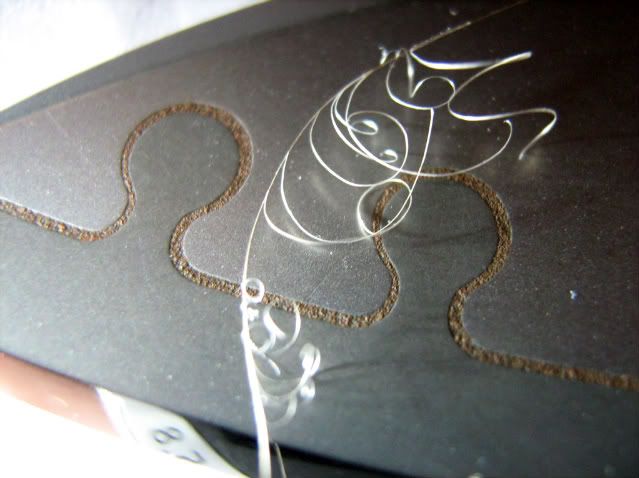
Can't argue with that!!! What is that material you frayed and flayed on there?
 
Would you mind giving me some detail on what your perceptions are on the differences of the finished edges, and what each is ideal for, respectively. Ive read a good many of your posts and I respect your opinion. Thanks.


Can't argue with that!!! What is that material you frayed and flayed on there?

Ceramics and waterstones will both give you a very sharp edge but they don't work well on all steels. I've almost completely stopped using the ceramics because of the excessive burring with almost all steels and edge chipping with some high Rc steels. My waterstones only get used for large bevel knives like scandi and sushi blades, ZDP-189 also responds well to waterstones but that's about it. I still like waterstones for the traditional feel but they are messy and don't work too well with CPM steels. There is less of a learning curve with diamond hones and for me they produce the sharpest edge. Diamond hones also sharpen with almost no burr, this makes stropping faster and easier.

Hair :D
 
waterstones pick up at 3 micron, since that is where diamond stones leave off, now if you add compounds or lapping film, you can go to 0.1 diamond.

I'm still waiting for my nakayama kiita, to see how it performs. I hope I got a good one, around 40K. Not quite as much honing area, but half the price of a Chosera or 30K glasstone.
 
I only use diamond to reprofile the edge. If I'm doing that, I go from "C" (coarse) diamond, to fine diamond then to waterstones on the Edge-Pro:

220
400
800
1200
Then to 2K, and 6K mylar tapes,.
Then to plain mylar tapes sprayed with 1 micron CBN, then .5, .25 and .1 micron diamond.

That's the full polish job for "bragging rights." :p

With most knives, I stop after the 6K (pink) tape, or even after the 2K (blue) tape, depending on the steel, and the useage if the knife.
 
"True, but the stones you use also make a big difference in your final edge. Diamond stones, ceramics, and waterstones all yield a different final edge."

Not so, if you polish the edge, the last grit or compound you use is the end result.
If you start on a 20 grit stone, and progressively go to 10,000 grit, removing all scratches from previous grits, your end result is a 10,000 grit finish.
If you are only using stones, without polishing with compound on a strop, your statement is correct to some degree.
 
"True, but the stones you use also make a big difference in your final edge. Diamond stones, ceramics, and waterstones all yield a different final edge."

Not so, if you polish the edge, the last grit or compound you use is the end result.
If you start on a 20 grit stone, and progressively go to 10,000 grit, removing all scratches from previous grits, your end result is a 10,000 grit finish.
If you are only using stones, without polishing with compound on a strop, your statement is correct to some degree.


So what your saying is that abrasive partical type and shape have have zero effect on final finish?
 
you guys seem to maybe have signals crossed

it doesn't matter what kind of abrasive or what grit you use as long as you remove the scratches with the next grit, but whatever grit you finish with, it will appear different under magnification because of the finishing abrasive and the way it abrades the metal.
 
I use DMT XX Coarse, Coarse, and fine stones, then go to my Shapton Glasstones in 1000, 2000, 8000, and 16000 grit. The Glasstones cut even S90V cleanly, require no soaking, and are very resistant to gouging and dishing. The DMT's flatten them right up nicely as well (I have Diasharps). On Phil Wilson's advice I may end up with a DMT X Fine, as he says it is great for S90V and S110V. For finishing if I want to go beyond the crazy sharpness of the 16000 grit Glasstone I use either lapping film in .3 and .05 micron, or for my S90V Manix 2 my strops loaded with Hand American diamond Spray in 1, .5, and .25 micron. I am getting better at using the strops and not rounding the edge, as I am used to the solid surface of lapping film over glass for my sharpening. Lately I've been experimenting with DMT Coarse and DMT Fine finishes with a very light stropping on the diamond spray loaded strops to remove any tiny burr (not visible at 100X) I didn't get rid of on the sharpening stones (I de-burr every grit to try to maximize sharpness on every stone, even if I'm going to a higher polish as I feel it gives me a better edge. Call it superstition but I feel getting a very sharp edge at the coarser grits is the key for an optimal finished product).

Either way I think you can even go to a X Fine and XX fine DMT with great results like Knifenut1013, but I just had clogging issues on my 6" X Fine that I ended up giving away because the Glasstones work so well. If I would have
broken in the stone more and used dish soap for lubricant I'm sure it would have worked great, but I wasn't that patient. I also hear it takes months and sometimes a ceramic knife or lapping a DMT XX Fine on another diamond stone to get it to polish out an edge for you. Once it is broken in Knifenut1013 shows in stunning detail that it is a great stone that gives unreal edges, but again I was lazy and had my Glasstones in similar grits to do the job. They cut fast and clean on any steel and leave a sharper and more polished edge than the grit would suggest. They are so much better than the Norton and especially King waterstones I have that it isn't even a comparison. I think a person that is put off by waterstones because they used a cheaper, fast dishing and quick to gouge stone that needs to soak for a long time really needs to try a Glasstone to see what a waterstone is really capable of. Whatever you use the bottom line is results. If you can use a Norton Carborundum stone to get a sick edge more power to you (Wayne Goddard is known for great edges off of that stone I believe), as long as you get a great edge who cares how you get there. I think different sharpening styles will be suited better by different stones, so if you are like me or most other sharpening nuts you will end up with a huge amount of stones before you end up with a set you really like. And, like knives, you will end up always wanting more stones as you try for the ultimate edge. It is a sickness.

Mike
 
Thanks Mike, though you may not have realized it you just said yourself that the higher quality the abrasive the better the results. ;)
 
That makes no sense at all.

You really got something against me don't you?

Every company has a set level of quality control and the higher that quality control the better the final product. For example: would you rather have chromium oxide from harbor freight or HandAmerican?
 
Not at all.
Potato, potatoe. Better tools work more efficiently, but grit size is grit size.
 
Back
Top