
Which is more forgiving during HT 1095 or 01??

Joined
Feb 25, 2007
Messages
934
I am new to this game and I am going to try my hand at a rather large project. ( For me at least)

Of the two which do you feel is a more forgiving steel during heat treating for a new knifemaker.

If you could include your reasoning with the answer it would be appreciated. I am trying to learn and not just be dependant on asking questions.

Oh yeah this will be stock removal.

Thank you in advance

Paul
 
O1 is much more forgiving H/T wise and many other ways too..
price wise, not so..
 
O1: You have a few seconds to get it from heat to quench...it likes to harden...but it will cost you.
1095: Unless you are a ninja, its almost impossible to get it in the quench as fast as required...but its cheap and easy to find.

That being said, 01 produces pretty boring hamons, if any at all. They can be distinct, but they aren't spectacular. 1095, however, can produce some of the most amazing hamons i've ever seen.
 
Thank you Gary and David. It looks like 01 for the first of my projects.

Paul

...or use 1084. Look up Aldo Bruno here on the forums. Great steel, great prices, easier still to heat treat!
 
Hey Matt,

Thank you for that additional advice. I was under the impression that all Aldo had was more along the lines of forging size 1084 I am not looking forward to grinding 1/2" stock. But maybe I am wrong.

Paul
 
Now though both are great steel, what about 5160? It is probably one of the most forgiving steels out there and makes a great knife. Easy to forge, comes in most all sizes though not cold rolled, so there may be a bit more grinding if you are into stock removal. Readily available and inexpensive. But then you may just want the O1. Just thought I would mention it.
 
...or use 1084. Look up Aldo Bruno here on the forums. Great steel, great prices, easier still to heat treat!

Matt,
How have you found HT on the 1084 in comparison to 1095? I HT it exactly like 1095, but wasn't sure if it had any more forgiving quench timing than 1095 which has to basically go from critical to below the nose in 1/2 second from everything i've read.
 
Oh Aldo had some .25x1" 1084 and is having another melt done this summer for .25x1.5. Good stuff not to mention Aldo's a great guy to deal with.
 
1084 is much more forgiving as far as speed of quench goes. It is a deeper hardening steel with a bit more mn. As far as I understand it the time from the HT oven to the quench is not as important as the speed of the quenchant. Granted if you mess around and take a few seconds to walk across the shop to get to the quench tank then it may cause problems. If you take you material out on an upward heat cycle then quench it, 1 maybe 2 seconds will elapse until it hits the quench. This will not significantly reduce the temperature of the blade enough to cause a problem. Once it hits the bath then it must cool below the curve to obtain max martensite conversion.
 
I'll put another vote in for 1084. You can get some from Kelly Cupples in 1/8" stock if you can't find what you need from Aldo. You can also look at 1080 (similar characteristics to 1084) and get more sizes like 3/16" or 1/4".
 
Thanks Chuck! I knew is was supposedly better than 1095, but wasn't sure if it was significant as 0-1 which seems to harden just by looking at it.
 
It is easy to harden 01. Not so easy to harden it properly, without an oven. 01 requires a soak of around 15, to 20 minutes at 1475o, to 1500o, in order to get it into solution.
 
LRB good point. 1095 doesnt require as extensive a soak so might be better for people with forges. Maintaining a temp for 20 minutes in a forge isnt the easiest task
 
1084 is all that you folks are saying that 1095 is, while being even easier to heat treat.
 
I agree with Danbo... 1084 is much easier to deal with but I am a Hamon nut now so W2 is my first choice and 1095 will be #2. Then I do have a load of O1 and 52100 and 5160 and L6......1084 and 15N20 for damascus though hands down. Just as long as i can keep the 1084 supply up.
 
1095: Unless you are a ninja, its almost impossible to get it in the quench as fast as required...but its cheap and easy to find.

Well, I agree 1095 is fast but that is a bit of an exaggeration :) . After playing with 1095 and reading and understanding the Fundamentals of Metallurgy I would say you have plenty of time to do 1095 if you are prepared and have the proper quench medium. I discovered you don't have to get from the oven the the quench in the blink of an eye. Although I don't have to book at hand (lent to co worker) . Here are the approx numbers. Yes you have to get it to about 1500, but once there the time from 1500 to about 1350 is not to critical the carbon is in solution the time from 1350 to about 800 is very critical. You have about .9 seconds so you best have water or a very fast oil and enough of it. Unless you are in Antarctica you have a several seconds to get to the quench and once there it shouldn't take long for a good quench to take the business parts of a blank thats ground to a proper shape from 1350-800 and from there to hand holding warm you have plenty of time
 
Well, I agree 1095 is fast but that is a bit of an exaggeration :) . After playing with 1095 and reading and understanding the Fundamentals of Metallurgy I would say you have plenty of time to do 1095 if you are prepared and have the proper quench medium. I discovered you don't have to get from the oven the the quench in the blink of an eye. Although I don't have to book at hand (lent to co worker) . Here are the approx numbers. Yes you have to get it to about 1500, but once there the time from 1500 to about 1350 is not to critical the carbon is in solution the time from 1350 to about 800 is very critical. You have about .9 seconds so you best have water or a very fast oil and enough of it. Unless you are in Antarctica you have a several seconds to get to the quench and once there it shouldn't take long for a good quench to take the business parts of a blank thats ground to a proper shape from 1350-800 and from there to hand holding warm you have plenty of time

Interesting....do you know where I can find that info? Just judging by color, the tips of my knives seem to drop below 1350 in less than "a few seconds" once I pull them out of the forge, but I could be wrong....
 
I'll put another vote in for 1084. You can get some from Kelly Cupples in 1/8" stock if you can't find what you need from Aldo. You can also look at 1080 (similar characteristics to 1084) and get more sizes like 3/16" or 1/4".

If you can work with the sizes Aldo's stock is in I would go with that, I got some of the 1/8 inch thick 1084 from Kelly Cupples, and by the time I had ground through the rolled in mill scale I had lost 30- 50 thousanths,

-Page
 
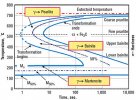
Here is a TTT chart sorry it is in C. I will get one in from the book next week if you like in F. Notice that the nose that sticks out to about .8 seconds is between 450 and 550 and that the eutecoid is at a bit over 700 and the bottom line a bit over 200. Notice also the nose moves away rapidly above and below the 450-550 area. Your time at those temps for martensite transformation increases greatly. The differnce between 700C and 600 c is 180 f and if you check the time line at the bottom you have several seconds at this time to hit the t line and another second and 80 f to hit the 550 crossing of the line.
 

Attachments

  • 1095tttt.jpg
    1095tttt.jpg
    29 KB · Views: 12
Back
Top