Why inferior steels in knives?

Status
Not open for further replies.
Joined
Oct 4, 2014
Messages
16
I buy the idea that some steels are better than others. My standard for a knife steel is that it do what I expect it to do without needing to be sharpened, and when it does need to be sharpened, it's not too difficult to sharpen it. For example, I'm thinking of 440C, AUS-8, AUS-10, 12C27, 14C28N, 5160, 1095, 8Cr13Mov, 52100, even "old Krupp steel" - not super-steels. But many makers use 440A, or something like, or Buck's 420HC. I've had knives in all these steels (I'm pretty old), and while not even slightly an expert, sooner or later the cheaper steel fails while the better steel gets the job done. And I'm thinking there is not a lot of difference in cost between the cheaper steels and the better steels. So the question: Why do manufacturers use inferior, cheaper steel? If it's a difference of a few dollars per knife, most of us, I think, would be glad to pay it.
 
I cant speak directly on prices, but im sure in quantity those super steels can get substantially pricier, and the vast majority of knife purchases are gonna be from people who think $50 bucks is way too much for a knife.

As for Buck, from what I understand, they've just perfected 420hc and love it lol.
 
I agree, comes down to what people want to pay.

Buck charges over $100+ for the same knife in Magnacut. Their heat treat on 420 is one of the best. Most people wouldn't care or notice, anything but the price.
 
I buy the idea that some steels are better than others. My standard for a knife steel is that it do what I expect it to do without needing to be sharpened, and when it does need to be sharpened, it's not too difficult to sharpen it. For example, I'm thinking of 440C, AUS-8, AUS-10, 12C27, 14C28N, 5160, 1095, 8Cr13Mov, 52100, even "old Krupp steel" - not super-steels. But many makers use 440A, or something like, or Buck's 420HC. I've had knives in all these steels (I'm pretty old), and while not even slightly an expert, sooner or later the cheaper steel fails while the better steel gets the job done. And I'm thinking there is not a lot of difference in cost between the cheaper steels and the better steels. So the question: Why do manufacturers use inferior, cheaper steel? If it's a difference of a few dollars per knife, most of us, I think, would be glad to pay it.
I disagree that 440A and 420HC are inferior to alloys which you say give acceptable performance. (AUS8, 14C28N, 5160, 12C27)

There are two modes which cause dulling of a blade.
One is wearing away due to abrasion. Carbides improve wear resistance. So 440C and AUS10 and PM steels.
The other is deformation. The edge bends. A proper heat treat can fix that.

420HC, NitroV, 440A, 13C26, 14C28N et. al. can be heat treated such that the blade edge won't bend. But 420HC and 440A have not always been heat treated very hard, and they get a bad rap. They can perform just as well as the others in this group, and there is test data to prove it.

440A can be heat treated to 58HRC.
Buck's spec for their 420HC steel is also 58.

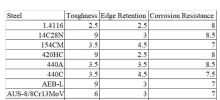
Properly heat treated, these alloys have edge retention equal to alloys that you say are acceptable for your use. In fact, 440A has better edge retention than either AUS8 or 14C28 in Larrin's testing.

1772438823640.png
 
Knife companies are industries that are professional knife makers. They have been using 420HC, 440a, 4116, etc. for many years for a reason, and that reason is that they are good knife steels and are affordable, readily available, easy to machine, and offer great balance between corrosion resistance, edge retention and toughness.
For the vast majority of knife users, they will work just fine for their intended purposes, because they are GOOD. In the information society we live in today, too much emphasis is put on "the best" People have the idea that anything that is not "the best" is bad, and that simply isnt necessarily true.
 
Wear on machines, as mentioned, and the way steel is supplied were big reasons cited by larger makers up until recently too. A lot of them are still running 50-100+ year old machinery. For instance, the 420 and 440 class steel were some of the only stainless steels that could be supplied in the proper coil sizes for blade punching machinery without special order and major cash outlay.

As those machines age out, and newer tech is brought in, you tend to see more acceptance of different steels, etc.... For instance, Case just mentioned that they'll be trying more things now, as they upgraded to more CNC tech, etc......
 
The heat treat protocols can be vastly different than the older steels which adds costs to the knife. The costs to grind go up rapidly on the higher wear super steels, which adds cost to the knife. Supplies can be lower on super steels which can raise prices of the knife. Powdered metallurgy steels are more costly to produce than ingot steels.

In my opinion, the real question is why some makers charge so much for knives made with low cost steels.
 
Great fixed blades are made from old pickup truck leaf springs. SharpBits SharpBits the short answer to your question is people are willing to pay these amounts. Why they are willing to pay so much is more complicated. How is it that Benchmade can get $200 for a small FRN Bugout from so many people?
 
I buy the idea that some steels are better than others. My standard for a knife steel is that it do what I expect it to do without needing to be sharpened, and when it does need to be sharpened, it's not too difficult to sharpen it. For example, I'm thinking of 440C, AUS-8, AUS-10, 12C27, 14C28N, 5160, 1095, 8Cr13Mov, 52100, even "old Krupp steel" - not super-steels. But many makers use 440A, or something like, or Buck's 420HC. I've had knives in all these steels (I'm pretty old), and while not even slightly an expert, sooner or later the cheaper steel fails while the better steel gets the job done. And I'm thinking there is not a lot of difference in cost between the cheaper steels and the better steels. So the question: Why do manufacturers use inferior, cheaper steel? If it's a difference of a few dollars per knife, most of us, I think, would be glad to pay it.

The simplest answer is to remember that companies make things entirely to fit a budget. Companies have run all the numbers down to the last cent, in order to determine the price of an item they want to sell, and what the market will bear. Some things to remember:

1. Knife people will pay absurd prices for special steels that in regular use may not outperform more pedestrian steels*.
2. We are an extremely small portion of the overall market for companies like Buck, Spyderco, Benchmade, Victorinox, etc.
3. Premium steels cost more than more pedestrian steels, and there are also further costs involved in the wear and tear on machinery, consumables like sharpening belts, and so on.

One easy example of this is that the Buck 110s have been made with perfectly serviceable steel for decades, however in recent years, they have done many special limited runs of Buck 110s in more premium steels, which always sell out because knife people (like me) have brain damage, but they don't offer their standard Buck 110s in premium steels because they know that the endlessly vast majority of buyers won't pay those increased prices, so they'd end up selling far fewer knives, and they'd eventually have to move back to a "lesser" steel in order to drop the price point, so that their products would start selling again.


* Again, I am speaking regular use in doing cutting task, not a Knife-Youtuber seeing how many pieces he can cut a piece of rope into before the edge dulls.
 
The real question in my mind is why so many people think they need super steel of the week knives? lol
In today’s modern world you hardly need a knife at all anymore. Lots of people (Neanderthals lol) get by just fine without having anything but 1 kitchen knife. Regular old “inferior“ steel works just as well as it ever has and it doesn’t balloon the cost of knives like Magnacut. A Buck 110 still does a great job, same as it ever has. And doesn’t need fancy sharpening equipment or a trip back to the mothership for sharpening when it dulls.
There is more to life than edge retention, and edge geometry is way more important than the name of the steel on the knife. Heck, a normal Buck 110 in 420hc outcuts a lot of super steel knives with thick “overbuilt” grinds!
 
Nothing wrong with Buck's 420HC, the toughest knife steel you can get, according to Larrin. CM-154 is another standard. That being said, powder steels with high carbide content will hold an edge a long time, albeit you really need diamond hones (or a lot of time) to sharpen them. Magnacut, developed by Dr. Larrin Thomas (a.k.a. Knife Steel Nerds) is a beautifully balanced, very tough, highly stain resistant super steel that is amazingly easy to sharpen: pretty well the best of all possible worlds (so far, anyway).
 
There are two modes which cause dulling of a blade.
One is wearing away due to abrasion. Carbides improve wear resistance. So 440C and AUS10 and PM steels.
The other is deformation. The edge bends. A proper heat treat can fix that.

You have to include chipping not just plastic deformation via bends/rolls. Hardness being a major factor.

High carbide steels often go dull from microchipping rather than rolling or extreme abrasion. Harder steels have this distinct advantage over softer ones.
 
You have to include chipping not just plastic deformation via bends/rolls. Hardness being a major factor.

High carbide steels often go dull from microchipping rather than rolling or extreme abrasion. Harder steels have this distinct advantage over softer ones.
May as well throw in corrosion too. Toss that carbon steel blade in a drawer without oil and it will likely come out less sharp. Yet these steels hold an edge well when used.
 
If you produce thousands or tens of thousands of knives per day you have to begin with steel that is able to be punched out with a die. No laser or water jet cutting. There is also a large difference between heat treating the steel at 2050 degrees F instead of 1450 F. Then there is the type and amount of abrasives needed to grind the blades. All these factors and a couple more point to the steels that are being used in the mass produced knives now.
 
Quiet Quiet Amen. I've given my opinion several times that extremely hard low wear tool steels are too brittle to be of practical use. One response to this is it gives collectors an opportunity to get yet another one of their favorite knives, usually a Spyderco as they cater to this market. That Benchmade can get $200 for a flimsy FRN Bugout is proof of how crazy this market is.
 
Status
Not open for further replies.
Back
Top