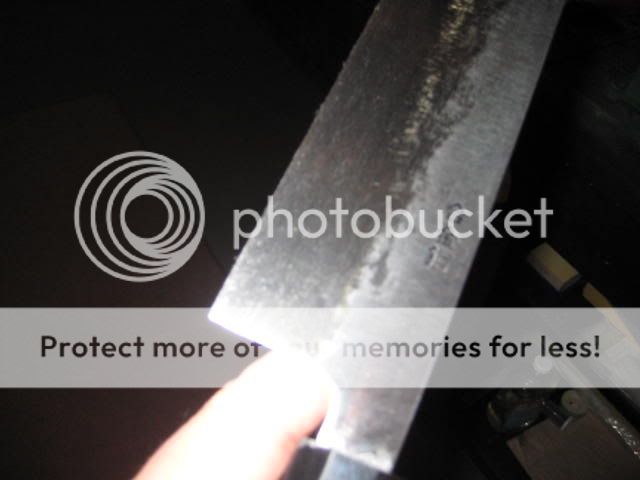
The convexing is easy - if you have a human skeleton and compressive tissue (skin, muscle, ligaments...), you, too, will make convex edges and often convex grinds when going above the edge.
The first grind was on an 80 grit wet grinder (the knife was muy gordo), but the mirror-polishing process used wet/dry sandpaper in 220, 320, 400, 600, 800, and 1,000 grit followed by polishing paper (1,500 or 2,000 grit wet/dry would've worked better, but it wasn't here) and hubcap polish. The sandpaper was layed flat on a piece of glass (I used restickable gluestick to keep it in place and any hard and flat surface will work so don't think it's glass or nothing) and the blade was rubbed perpendicular to the edge and spine in sections. The natural arc of my elbows convexed the edge.
Once a uniform layer of 220 grit scratches covered one side of the blade, 320 was used to put a new layer of scratches and so on. After finishing with the polishing paper, a dab of hubcap polish (I used Meguiar's because it doesn't have an ammonia smell) was worked into the blade with a scrap of shop towel (a little of either goes a long, long way) and rinsed and repeated three or four times. Never do so when tired or your thumb will gash open and you'll have to wait until you've stopped bleeding to polish more.
After the third or fourth application of hubcap polish is done, you'll see the blade is shiny, but not quite mirrory. Simply repeat the process, but start with either the 320 grit or 400 grit depending on how mirrory the blade was or wasn't. And when that almost works, repeat with the next finer step and you'll have quite the reflective blade when you're finished.
And a few uses of that knife later and you may lose all interest in mirroring more than just the edge.