Why is Convex bad?

Okay, I am growing to like the capabilities of Full convex for chopping. But, why do SOME people LIKE saber grinds? WHy would some prefer this over a convex? It seems like convex is the only grind anyone should have? I don't know anymore. I like chopping, but i also like the look of a saber grind.
 
There is some controversy as to what exactly a Scandi grind is. Some Sacndinavian knives come with a very small secondary bevel (Moras come from the factory like this), many modern examples come flat. But the few used vintage Scandinavian woodcraft knives that I've seen all had a mild convexity from edge to shoulder. Perhaps this was a result of sharpening on dished stones, but regardless, I am of the opinion that this is how they used to be.

Japanese blades traditionally are convex.
http://www.ksky.ne.jp/~sumie99/shaping.html
http://www.bugei.com/niku.html

I've got like 10 different Moras and other similar blades. The only one of them that has a secondary bevel (well, an additional edge on the edge) is a norwegian one. Pretty much all Moras I've seen have a single bevel grind without any microbevels or alike. And they're flat from the factory. The vintage ones you speak of must have become rounded due to incorrect sharpening techniques, which you're somewhat on about.

I'm in the process (half way) of converting a scandi into a full convex grind to see if the convex truly is superior to the scandi. Yes, it'll be slightly thinner, giving it an advantage, but we'll see how it does in testing...
 
I agree with all your points except this one. Much to my dismay, boxes on wheels are seemingly all the rage...

One of the most popular new cars in Japan today is so squared off it's even named "Cube." It's made by Nissan and is little more than an ugly box on wheels!! Several other manufacturers have followed suit and are producing rolling boxes as well, for both family cars and vans!

I look out my window and see a procession of unsightly mobile boxes with people inside! So much for 'style!'

Stitchawl
 
One of the most popular new cars in Japan today is so squared off it's even named "Cube." It's made by Nissan and is little more than an ugly box on wheels!! Several other manufacturers have followed suit and are producing rolling boxes as well, for both family cars and vans!

I look out my window and see a procession of unsightly mobile boxes with people inside! So much for 'style!'

Stitchawl

Eww.

Okay, I am growing to like the capabilities of Full convex for chopping. But, why do SOME people LIKE saber grinds? WHy would some prefer this over a convex? It seems like convex is the only grind anyone should have? I don't know anymore. I like chopping, but i also like the look of a saber grind.

The flat (or flat-ish) scandi grind is also notable, not because of the physics the edge configuration, but because of the ergonomics. It's not really physically optimized for cleaving into things, but works very well for whittling, shaving and other fine woodworking tasks because it's easy to control and orient the blade. Because of the wide bevel, one can easily see and feel EXACTLY which way the edge is pointing.

Chisels and plane blades are ground flat rather than convex for the same reason.
 
There is some controversy as to what exactly a Scandi grind is.

Excuse me, but I don't believe there is.
Scandi grind is defined as a single flat grind that goes from the edge to the spine. Period. Sabre grind is a single flat grind that goes from the edge to a point roughly midway toward the spine. Convex is a curved grind from the edge to the flat of the blade.
Virtually every sharpening FAQ shows clear photos and descriptions of these common grinds.

All too often people will look at old, well used blades that have been sharpened many times and believe that the edge they are seeing is what was intended by the maker rather than what was wanted by the user. Convex edges are much easier to produce with good results and so are often found on blades that are sharpened by people who have less skill, especially on larger blades. (This is NOT to imply that convexed edges are ONLY the result of less skill. Often they are the desired outcome of skilled sharpeners.) Most Japanese sword makers, even those who are/were called "Japanese Living Treasures" did NOT sharpen their own swords. Instead, they sent them to professional sword sharpeners, people who might spend two-ten weeks or more just sharpening one blade. However, I must confess right here that these guys don't use EdgePro's. :D


Stitchawl
 
For chopping edges, like axes and machetes, a convex edge is superior-in that it will not wedge as easily in hard material.
For a knife blade, it matters not one iota. There may be theoretical differences in the way the 2 edges cut, but in reality these differences are too small to discern.
A flat "V" typed edge will theoretically get sharper than convex.
Convex edges on knives have become popular because they are easy to form for people who can't seem to sharpen a "V".
And they are shiny......
 
Scandi grind is defined as a single flat grind that goes from the edge to the spine. Period.

Well excuse me all over the place, but that is WRONG! Scandi grinds don't go to the spine. That would be a full-flat grind. "Period".

morabasic.jpg


STOFFI — with regards from Sweden.
 
stoffi is right from everything I have seen. Full height grind with no secondary edge bevel is a zero grind, partial height grind with ~double digit per side angle is scandi, saber is partial height grind with secondary edge bevel.

I had two Hultafors, both had convex edges NIB, but the grind was flat.
 
Well excuse me all over the place,

O.K. You're excused. :)

but that is WRONG! Scandi grinds don't go to the spine. That would be a full-flat grind. "Period".

Not wrong. Just a another name for the same grind. :)
Scandi grinds often go from edge to spine. 'Flat ground knives will sometimes have a microbevel.

I have Moras that are flat ground with a micro bevel , sabre ground, and Scandi ground. All are marked 'Mora' and all have the factory edge.

Stitchawl
 
Last edited:
It'd be interesting to see some pics of the blades which you speak of. In the meantime, here are a bunch of others to look at:

http://www.knifeforums.com/forums/showgallery.php?fid/125/

A full flat grind and a scandi grind are two different grinds, even if they can both be seen on scandinavian blades.
Hell, a lot of scandinavian blades are fully convexed today! However, it doesn't make them "scandi ground blades".
 
Last edited:
A full flat grind and a scandi grind are two different grinds, even if they can both be seen on scandinavian blades.

Perhaps it would help me to better understand what you mean if you described what you see as the differences between;
Flat grind
Scandi grind
Saber grind

Stitchawl
 
all those grinds are generally understood to be flat (no curvature), it is the angle they are ground at and the presence of a secondary bevel that defines them.

Sal Glesser and Dan Koster had some lengthy discussions with customers when designing their bushcraft blades to determine which grind to use and what angles to apply them at. This was because the distinction between them was already in place and they wanted to know which ones the users actually preferred. One of Sal's original ideas for the Spyderco Bushcraft as a small series was a scandi ground 52100 blade with wood scales, with a sister blade flat ground from S90V steel with a synthetic composite handle.
 
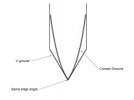
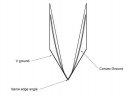
Its all about cross section geometry. A flat ground blade with the same edge angle at the V-edge will fit inside a convex ground cross section of the same width and thickness

You have this backwards. The intersection of the tangent lines of the curves that form the edge- AT THE EDGE- of a convex edge defines the edge angle. By definition, the edge angle is defined by the intersection of the straight lines of a V-ground edge. As a result, a convex edge with the same apex edge angle as a V- grind will have LESS- not more- metal behind the edge. Convex edges are generally considered more robust than V ground edges because they are typically left much more obtuse at the edge.
 

Attachments

  • Convex v V.jpg
    Convex v V.jpg
    14.1 KB · Views: 50
Perhaps it would help me to better understand what you mean if you described what you see as the differences between;
Flat grind
Scandi grind
Saber grind

Stitchawl

How about if you read up on the differences instead? This is really basic stuff and if you cared you would have looked it up by now.
 
You have this backwards. The intersection of the tangent lines of the curves that form the edge- AT THE EDGE- of a convex edge defines the edge angle. By definition, the edge angle is defined by the intersection of the straight lines of a V-ground edge. As a result, a convex edge with the same apex edge angle as a V- grind will have LESS- not more- metal behind the edge. Convex edges are generally considered more robust than V ground edges because they are typically left much more obtuse at the edge.
not exactly
 

Attachments

  • Convex v V.jpg
    Convex v V.jpg
    19.8 KB · Views: 33
How about if you read up on the differences instead? This is really basic stuff and if you cared you would have looked it up by now.

How about a bit less hostility?

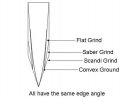
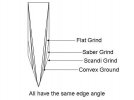
Here is a diagram for those interested in the differences between a flat gring, saber grind, traditional Scandinavian grind, and a convex edge. In this diagram, all edges terminate at the same apex angle.

Sorry hardheart, "your" convex edge is more obtuse than your v grind edge in the diagram.
 

Attachments

  • Flat, Saber, Scandi 3.jpg
    Flat, Saber, Scandi 3.jpg
    21.7 KB · Views: 54
the edge angle is the same. the primary flat grind has nothing to do with the edge angle. You first diagram does not even have a primary and secondary flat bevel, only one. It is at best a scandi grind. Except for one major problem, it is 30 degrees per side. We are talking about knives, not cold chisels.

The problem with the second diagram is that to the thickness of the blade is 126 pixels, and the thickness at the transition from 'full flat' primary (which is a more correct 4 degrees) to secondary 12 degree bevel is 71 pixels. If we translate that to a 1/8" thick blade, 125 thousandths, then the thickness at the edge bevel is 70 thousandths, more than 1/16th. If we go to a more reasonable 20 pixel thickness, this is what you have, with a 6 degree primary.
 

Attachments

  • Flat, Saber, Scandi 3.jpg
    Flat, Saber, Scandi 3.jpg
    26.9 KB · Views: 27
Unfortunately, the lines and planes that actually define a bevel have no thickness, so what is hidden in the additions that you have made to my diagram is that the v-ground blade is- in fact- still fatter at the edge.

Thinking in two dimensions- as in the cross section of a blade- the angle formed by the intersection of two lines (segments) or curves is defined by the slope of those two lines or curves. Additionally, the slope of a line or of a curve at any point along that line or curve is defined by the tangent to that line or curve at that point (even the beginning or end point). Given a defined angle of intersection, two lines intersecting at a point define the respective tangents of any curves that also intersect at the same point with the same angle of intersection. Any curves that deviate in a “convex” manner to the “outside” of these two straight lines (and intersect at the same point as these two lines) define tangents that are more obtuse than that of the straight lines - at that point. Moreover, the intersection of these curves occurs at a more obtuse angle than the straight lines. Therefore, convex can not both be thicker behind the edge and have the same apex edge angle as a V ground edge.

Mathematicians may quibble over the cumbersome language used by me to explain a relatively simple principle, but they will not differ in the substance of the argument.
 
Last edited:
Convexing is not bad and once you learn to convex and maintain the edges, I doubt you will ever go back to a v grind. I was one of those persons who thought I would never like convexing blades either. It is not hard and once you learn, you just can't go back
 
and it brings us back again, convex edges are not automatically thicker or thinner than v-ground edges, it is determined by the geometry selected. With a scandi grind, a 12 degree edge is created by a single 12 degree grind, per side. With a flat grind, the height and angle of the grind are independent of that 12 degree edge, and will determine the bevel thickness and width. The same with a saber grind, which is just a flat grind not taken to full height. The slope of the curve can be changed dramatically along its length if the user chooses, and the angles of the grinds, and the number of separate flat grinds, can also change. There is no universal answer for which grind is thinner/thicker, more acute/obtuse.

 
Back
Top