Why the rather fast and obvious move to convex edges......?

Sharp is sharp to me. But I can't afford a wicked edge or edge pro apex, so I do my sharpening on either sandpaper and strop or sharpmaker and strop. Convex doesn't necessarily mean obtuse, by the way. Any angle you can get on a V grind you can get on a convex. The point of the convex is that there's more metal behind the edge, though, which should support the edge and prevent rolling and chipping.

If you watch Virtuovice's videos on youtube, he also states that a convex grind has a tendency to roll off of bone when used as a hunting knife instead of hitting it head on and nicking the edge.

I usually just use the sharpmaker and strop for folders. I like convex edges for harder use fixed blades.
 
Good points by many of you.
To me as both a maker and a field user, I much prefer the convex edge. What many of you are saying about the convex edged, it all depends upon the convexing from the makers..
Does the maker leave it 1/8 inch [.125] thick or .010 thick before he convexes? That makes a world of difference in useage and sharpening.
I much prefer thin for my useage, both in blades and convexes.
 
Sharp is sharp to me. But I can't afford a wicked edge or edge pro apex, so I do my sharpening on either sandpaper and strop or sharpmaker and strop. Convex doesn't necessarily mean obtuse, by the way. Any angle you can get on a V grind you can get on a convex. The point of the convex is that there's more metal behind the edge, though, which should support the edge and prevent rolling and chipping.

If you watch Virtuovice's videos on youtube, he also states that a convex grind has a tendency to roll off of bone when used as a hunting knife instead of hitting it head on and nicking the edge.

I usually just use the sharpmaker and strop for folders. I like convex edges for harder use fixed blades.

A Sharpmaker and a few strops is all I use anway. I had an Edge Pro and sold it... too much hassle to set it up, use it, and clean up afterwards. It worked just fine... I'm just not into sharpening that many knives that often to justify the set up / clean up time since I don't do anyone's knives but mine. I get all the results I want with the Sharpmaker and two or three strops.
 
The point of the convex is that there's more metal behind the edge
There is not. I went with this idea when it was first presented, and thought about ho you could thin a convex out to a V-grind. But you can also thin a V-grind and convex it, on and on, back and forth.

But, and this is the important thing, is that the final included edge angle of a convex edge that is essentially equivalent to a V-grind is going to have less metal behind it. There really is no way for it not to. A V-grind consists of two planes each having a singe slope. A convex grind is two curved planes with continuously changing slope. If the two edges start at essentially the same angle, then the V holds that angle, but the convex angle changes all along its length. That changing angle means less metal, because by starting at the same angle, convexing puts the curve inside the V-grind line. The only way for the convex to be outside the V-grind/to have more metal, is to start at a more obtuse angle. The change in durability and cutting ability happens with thinning and thickening edges without relying on a change in grind type.
 
"convexing puts the curve inside the V-grind line"

That would be concave. Convex puts the curve outside the V-grind line, giving it more metal.

The problem I have with convex is that it's not as easy to get a precise, even edge as I can with a jig set up, like the Wicked Edge. Whatever advantage the convex edge has over a V edge is small, and likely to be lost to a very precise V-edge.
 
The sharpest blade I've ever experienced was a convex in 3V at rc 60. It is amazing and begins sliding right into skin as if there is no surface tension whatsoever.

I'm used to hand sharpening my own blades from pretty to extremely sharp depending on the knife. This is unlike any V grind I've sharpened. 3V can really perform too, I might as well throw that in.

Joe
 
There is not. I went with this idea when it was first presented, and thought about ho you could thin a convex out to a V-grind. But you can also thin a V-grind and convex it, on and on, back and forth.

But, and this is the important thing, is that the final included edge angle of a convex edge that is essentially equivalent to a V-grind is going to have less metal behind it. There really is no way for it not to. A V-grind consists of two planes each having a singe slope. A convex grind is two curved planes with continuously changing slope. If the two edges start at essentially the same angle, then the V holds that angle, but the convex angle changes all along its length. That changing angle means less metal, because by starting at the same angle, convexing puts the curve inside the V-grind line. The only way for the convex to be outside the V-grind/to have more metal, is to start at a more obtuse angle. The change in durability and cutting ability happens with thinning and thickening edges without relying on a change in grind type.

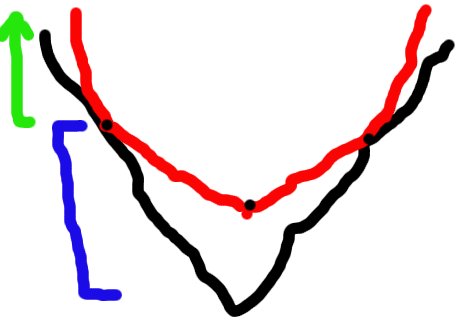
I don't think that's correct. When you convex a v-grind, you 'round off' the edge, changing the edge angle and putting more metal right behind the edge because you're moving the edge higher up into where the v-grind was thicker. Here's a picture of what I'm talking about. Please pardon the shakiness; I drew it with a touchpad on a laptop

lViaI.jpg


Suppose the black is a true v grind. To get a convex (the red line), you round it off, moving the edge higher up as in the picture.

Now, I marked in the picture where the convex and v-grinds intersect in width. The mean value theorem from calculus requires it to be the case that it's thicker nearest the edge because of the difference in slopes between them. The edges will intersect somewhere, and where they do their slopes are equal. Every part of the convex before that point (marked with blue) has a higher slope, while for everything above it (marked in green), the rate of change is lower.

Returning to the "turning a convex into a v-grind and vice-versa", the other side of it looks like

1pvRi.jpg


Note how you shear the shoulders off, making it thinner behind the edge.

Sound reasonable?
 
"Convex is stronger" stop it with the nonsense

"Convex puts more metal behind the edge" So, through the destructive process of sharpening we have somehow found a way to add material back on? Interesting.

"Convex is sharper" maybe if I sharpen it :D
 
"Convex is stronger" stop it with the nonsense

"Convex puts more metal behind the edge" So, through the destructive process of sharpening we have somehow found a way to add material back on? Interesting.

"Convex is sharper" maybe if I sharpen it :D

Yep....

Been reading this thread and it's really been amusing...

All the wrong information that gets spread around that's supposed to be truth is just amazing.
 
"Convex is stronger" stop it with the nonsense

"Convex puts more metal behind the edge" So, through the destructive process of sharpening we have somehow found a way to add material back on? Interesting.

"Convex is sharper" maybe if I sharpen it :D


I'd go with your last point.

I don't know how much stronger it is, but there is more metal behind the edge.

Convex doesn't put more metal behind the edge, it leaves more metal behind the edge compared to the V-edge, if the sharpening process starts at the same place.
 
You can only take away in sharpening.

The only way to end up with more metal at the edge is by starting with a thicker blade that you are comparing to a thinner V grind.
 
"Convex is stronger" stop it with the nonsense

"Convex puts more metal behind the edge" So, through the destructive process of sharpening we have somehow found a way to add material back on? Interesting.

"Convex is sharper" maybe if I sharpen it :D

Did you see my pictures right above your post? The edge has more material behind it without adding material but removing it :)
 
I'd go with your last point.

I don't know how much stronger it is, but there is more metal behind the edge.

Convex doesn't put more metal behind the edge, it leaves more metal behind the edge compared to the V-edge, if the sharpening process starts at the same place.

Nope there isn't more metal behind the edge over a V grind if the general starting angles are the same.

The only way for the Convex edge to have more meal behind the edge is to make the relative angle of the convex more obtuse than the V edge, or steeper so it would in effect cut less efficiently, or in effect like going from a 30 degree inclusive to a 50 degree inclusive.

If both edges are at the same relative angles the Convex will be thinner than the V edge, that makes it weaker.

There are no freebies here, to get one thing one has to give up something else.
 
Last edited:
Your picture is a example of your thought of convex.
 
I have a sneaking suspicion that the main reason most manufacturers that have taken up the convex edge with enthusiasm have done so because it is easier and faster to finish the knife.

This may indeed be true; I guess it's all the jig used. I think too that some manufacturers prefer it due to it's relative durability.

Personally, I can't freakin' stand covex edges. Every Sebenza I've used extensively has been re-profiled to a flat v-grind edge over time, starting with a microbevel and working toward a flat v-ground edge from there. The notion of stropping to resharpen a working edge, meaning an edge that you cut regularly with, is crazy to me. Gimme a flat DMT fine-grit diamond bench stone and let's call it a day. Gimme a sharpener that can be downsized and thrown in my briefcase. I ain't totin' a strop, stropping compound, or varying grits of sandpaper around with me. Fogetaboudit.

Prof.
 
Last edited:
I appreciate all the feedback to my original question. I found myself quite busy these last 24 hours, so I apologize for posing the question and not being able to respond.

I really do appreciate all the opinions/posts which obviously are quite diverse and mixed. With the substantial # of posts and the rather impressive # of viewings that this thread has received in just a short time, it is rather obvious that this subject is both of interest to many, while perhaps not having a definitive answer.

I have "reasonably" made some custom convex's into V-edges, but in two instances, I just couldn't get a worthwhile/working edge for whatever reason (these were all done or attempted with the Wicked Edge). I will say that one was a convex, custom skinner in 3/16 1095 and it might as well be a fish bonker as opposed to a skinner. My fault for not being a bit more selective. The skinner didn't even arrive sharp. I spent a few hours on that skinner with my WE, but no dice. I'm just a bit gun shy anymore in regards to knives being offered in the 3/16 and/or 1/8 ilk. Yep........I bought my WE to deal with such issues and it does an excellent job except on thicker, convex'd knives. Perhaps it's me and many others might be able to have success in transitioning the convex into a V-edge in 1/8 or larger, but I've been there and haven't had the love I need to try it again......at least with my layman's tools.

Great posts and thoughts guys.....keep 'em comin'.........this is a very interesting topic to me.
 
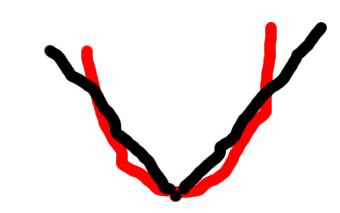
Your picture is a example of your thought of convex.

Would you mind drawing or describing one that contradicts that a convex has more metal than a v?

The math seems to imply otherwise, so that's why I'm curious :)
 
Nope there isn't more metal behind the edge over a V grind if the general starting angles are the same.

The only way for the Convex edge to have more meal behind the edge is to make the relative angle of the convex more obtuse than the V edge, or steeper so it would in effect cut less efficiently, or in effect like going from a 30 degree inclusive to a 50 degree inclusive.

If both edges are at the same relative angles the Convex will be thinner than the V edge, that makes it weaker.

There are no freebies here, to get one thing one has to give up something else.


Well, you kind of nailed it. The angles are not the same. I don't know which cuts more efficiently. But there is more metal behind the convex edge and the transition from edge to blade is smoother, which is why some people -- rightly or wrongly -- think the convex cuts better.

The drawing above is pretty close, except it shows the edge shoulder widths being different. Actually. The shoulder would be the same width. The V-edge makes a straight line to the shoulder. The convex edge makes a sweeping line, outside of the V-edge on its way to meet the shoulder. So you are correct that the angle is more obtuse by a slight amount. The edge sharpness won't change, but you will have balancing factors: a more obtuse edge angle and a more gradual transition to the blade. One helps cutting performance, one hurts. I don't know how it balances out.
 
Mag,

You are having problems because you are making the edge angle thicker. You can go thinner on a hollow or flat ground knife but putting a V edge on a convex blade will make the "behind the bevel" thickness increase greatly making the force needed to cut increase exponentially. Instead of the thickest point being the spine as with a flat ground blade a convex should be thickest in the middle. Now that you have changed the edge grind you have increased the shoulder thickness by shortening the distance to the thickest point of the blade.

Furthermore, you have created shoulders and points for friction to build in the blade geometry where it once had a smooth flow from spine to edge. Expect a overall decrease in performance with that blade.
 
If you guys really want to know the science behind convex, go to youtube and search "knivesandstuff". He has a video explaining everything to do with convexes. Actually I think he has two. Plus his knives are awesome. It's a win win really.
 
Back
Top