Why the rather fast and obvious move to convex edges......?

If you guys really want to know the science behind convex, go to youtube and search "knivesandstuff". He has a video explaining everything to do with convexes. Actually I think he has two. Plus his knives are awesome. It's a win win really.
 
Would you mind drawing or describing one that contradicts that a convex has more metal than a v?

The math seems to imply otherwise, so that's why I'm curious :)

Try this:

At the edge apex, draw straight line representing the V edge geometry.

Now, for an edge to have exactly the same edge apex angle, but convex, you'd have to draw the curve 'inside' the V. If you draw it outside the V lines, your convex will have a more obtuse edge apex angle.
The starting point is the edge apex being mentioned, not the secondary grind where edge starts to form from the blade bevel.

If you start with the bevel, at same angle, the convex will always have more obtuse edge apex, therefore the legend that it is stronger. On the other hand if you start with and make the edge apex angle, both being the same, convex will always be thinner.

Having said that, I like my sharpened convex edges. :D

Here's a thread with excellent diagram:
www.bladeforums.com/forums/showthread.php/940609-Does-super-sharp-mean-less-durable
 
Last edited:
Mag,

You are having problems because you are making the edge angle thicker. You can go thinner on a hollow or flat ground knife but putting a V edge on a convex blade will make the "behind the bevel" thickness increase greatly making the force needed to cut increase exponentially. Instead of the thickest point being the spine as with a flat ground blade a convex should be thickest in the middle. Now that you have changed the edge grind you have increased the shoulder thickness by shortening the distance to the thickest point of the blade.

Furthermore, you have created shoulders and points for friction to build in the blade geometry where it once had a smooth flow from spine to edge. Expect a overall decrease in performance with that blade.


To compare the performance of the convex to a V-edge, you have to control for other factors. The grind of the blade has to be held even. So, for example, take a flat-grind blade that is unsharpened.

A convex edge will remove less metal. The V-edge will remove more metal.

Shoulder widths will be the same. The convex edge will have more metal in the actual edge, but the widest part of both edges (V and convex) will be the shoulder.

The convex edge will have a more obtuse angle. The V edge will be more acute.

The transition from edge to shoulder will be smoother in the convex grind.

Both will be equally sharp, but cutting performance will not be the same. Which cuts better? I don't know. I suspect it would depend on the media being cut. However, I'd suspect the convex edge would take more abuse simply because there is more metal within the edge.
 
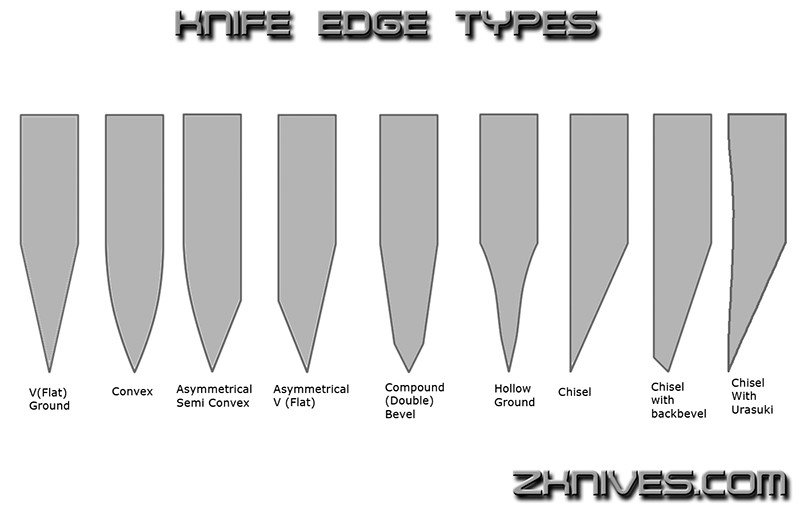
Some of the confusion is that some of us are talking about blade grind and others (me) about edge grind. They are different. Here's an image of the edge grinds.

knifeedgetypes.jpg
 
Chris "Anagarika";10982952 said:
Try this:

At the edge apex, draw straight line representing the V edge geometry.

Now, for an edge to have exactly the same edge apex angle, but convex, you'd have to draw the curve 'inside' the V. If you draw it outside the V lines, your convex will have a more obtuse edge apex angle.
The starting point is the edge apex being mentioned, not the secondary grind where edge starts to form from the blade bevel.

If you start with the bevel, at same angle, the convex will always have more obtuse edge apex, therefore the legend that it is stronger. On the other hand if you start with and make the edge apex angle, both being the same, convex will always be thinner.

Having said that, I like my sharpened convex edges. :D

Effectively you're saying start with the v grind and round off the side until you're right at the edge, but without rounding off the edge, correct? You're right, that works, and in retrospect it should've been obvious. Thanks Chris, and sorry guys for wasting time with the other posts.

edit: My mistake was taking as a requirement that they intersect between the edge and top of the initial v grind. Without that, it's clearly possible for a convex to be thinner at the edge.
 
Last edited:
They both cut great. And a V will quickly become a convex through variation during normal sharpening. I like having a convex geometry simply because of the smooth transition through the shoulder, but I sharpen the edge like a regular ol' V after establishing that smooth transition.
 
If you guys really want to know the science behind convex, go to youtube and search "knivesandstuff". He has a video explaining everything to do with convexes. Actually I think he has two. Plus his knives are awesome. It's a win win really.

There isn't any real science behind it, unless we are talking about the aerospace industry and those effects.

For knife blades it's very simple, thinner cuts better than thicker, that's for both blade grinds and edge angles.

People just love to try and make things sound more complicated than they really are so they can sound smart to others, it's really an ego thing. ;)
 
Last edited:
The ability for a steel to take abuse/impact will rely on the toughness of the steel and the apex angle+the behind the bevel thickness.

I consider 0.030 to be a thick edge so we can start there. If you make the final apex angle 50 degrees inclusive it will show very poor edge retention with high levels of deformation resistance. Take the same edge with the same apex angle and convex just the shoulders and it will cut smoother but NO other performance factors change. Continue the convex to the apex and you have thinned the bevel and changed the apex to a smaller inclusive angle.

From here we can now say we have a 40 degree inclusive apex but remember in the convexing to get there we have removed a 1/3 or more of the behind the bevel thickness where the bevel shoulders once were. Now things get interesting, the edge angle decreases while driving edge retention through the roof on the order of 200%-300% gains. Edge stability and its ability to resist impact start to slowly drop but is held in balance by the new ability for the blade as a whole to pass through the material being cut with less resistance. Eventually you reach the point where the thinning of the back bevel must be counteracted by a increase in edge angle or edge stability becomes so low the metal can actually deforming in sharpening.

Going backwards is a different story. I see I missed a bit of a sentence so that can add some confusion. The second sentence should read; you can go to a thinner angle on a flat or hollow ground blade because the grind of the blade has less metal in those areas allowing you to V sharpen. Ever put a 20 inclusive bevel on a convex grind?

You said it perfect, twindog. Shoulder widths the same. It sticks out to me because it would be impossible without having different thickness blades.
 
Kreole & Twin, another way to say it is that if you take the slope of the curve at the point where the edge is formed/the two sides intersect, and draw a line with that slope, then you have a V-grind of the same edge angle. A line on the slope on any point of the curve is not going to meet the curve at another point, so the curve is always inside that line. That makes a convex of the same edge angle thinner behind that edge. And yes, a convex edge with a more obtuse edge grind is going to have more metal behind it than a lower angle V-grind. A more obtuse V-grind is also going to have more metal behind it than a lower angled V-grind.
 
Mag,

You are having problems because you are making the edge angle thicker. You can go thinner on a hollow or flat ground knife but putting a V edge on a convex blade will make the "behind the bevel" thickness increase greatly making the force needed to cut increase exponentially. Instead of the thickest point being the spine as with a flat ground blade a convex should be thickest in the middle. Now that you have changed the edge grind you have increased the shoulder thickness by shortening the distance to the thickest point of the blade.

Furthermore, you have created shoulders and points for friction to build in the blade geometry where it once had a smooth flow from spine to edge. Expect a overall decrease in performance with that blade.


How can extremely dull get even worse......LOL.

Fish Bonker for sale.............
 
Send me a email if you want to see what that fish bonker could be with a proper grind.
 
Help me out on a couple of things (clarification please):
The ability for a steel to take abuse/impact will rely on the toughness of the steel and the apex angle+the behind the bevel thickness.

I consider 0.030 to be a thick edge so we can start there. If you make the final apex angle 50 degrees inclusive it will show very poor edge retention with high levels of deformation resistance. Take the same edge with the same apex angle and convex just the shoulders and it will cut smoother but NO other performance factors change. Continue the convex to the apex and you have thinned the bevel and changed the apex to a smaller inclusive angle.

From here we can now say we have a 40 degree inclusive apex but remember in the convexing to get there we have removed a 1/3 or more of the behind the bevel thickness where the bevel shoulders once were.
The bolded part - the edge shows high levels of deformation resistance but poor retention? Are we assuming that the edge is fracturing away, becuase I consider that a form of "deformation"...? Or did you mean poor cutting performance (relative to a more acute edge)?

Now things get interesting, the edge angle decreases while driving edge retention through the roof on the order of 200%-300% gains. Edge stability and its ability to resist impact start to slowly drop but is held in balance by the new ability for the blade as a whole to pass through the material being cut with less resistance. Eventually you reach the point where the thinning of the back bevel must be counteracted by a increase in edge angle or edge stability becomes so low the metal can actually deforming in sharpening.
The comparative performance values (and their rate of change) are the main points, I think. You generated this data? Can you link the thread or whatnot, please?
What I read is: by putting a convex bevel with more obtuse apex than a flat bevel of the same height, you can achieve optimum balance between edge stability (resistance to deformation) and cutting performance. At the same bevel height, a convex edge possesses more material support behind the edge than a flat edge and also provides a smoother bevel transition, making it more durable and aiding cutting performance.

That edge durability due to increased material support is what manufacturers are selling. Now, if you can show that the flat-bevel lasts through more cuts than the convex bevel (again, same bevel height), that is of paramount importance!

How the confusion began about flat-bevels having more material than convex is a mystery to me as that would require either a different bevel height or a different primary grind or even blade stock-thickness which are supposed to be held constant... ???
 
I'm glad Ankerson, Hardheart, and Knifenut posted as much info as they did since my last post. Thanks guys! My username held true, I took a closer look on paper and I see exactly what you're talking about.

So do you guys have any blades that you prefer in convex? What do you think the benefits and disadvantages are personally?
 
Help me out on a couple of things (clarification please):

The bolded part - the edge shows high levels of deformation resistance but poor retention? Are we assuming that the edge is fracturing away, becuase I consider that a form of "deformation"...? Or did you mean poor cutting performance (relative to a more acute edge)?


The comparative performance values (and their rate of change) are the main points, I think. You generated this data? Can you link the thread or whatnot, please?
What I read is: by putting a convex bevel with more obtuse apex than a flat bevel of the same height, you can achieve optimum balance between edge stability (resistance to deformation) and cutting performance. At the same bevel height, a convex edge possesses more material support behind the edge than a flat edge and also provides a smoother bevel transition, making it more durable and aiding cutting performance.

That edge durability due to increased material support is what manufacturers are selling. Now, if you can show that the flat-bevel lasts through more cuts than the convex bevel (again, same bevel height), that is of paramount importance!

How the confusion began about flat-bevels having more material than convex is a mystery to me as that would require either a different bevel height or a different primary grind or even blade stock-thickness which are supposed to be held constant... ???

The edge has poor edge retention at higher inclusive angles because once the apex smooths/dulls the remaining bevel is just a thick chunk of metal. A thin bevel of 30 inclusive would still be able to cut though just as dull. It only takes a cut or two to dull the apex of a sharpened edge, most of the "edge retention" knife users experience in a thin full flat ground blade comes from the knife and bevel being thin. Sharpness at this point can drop considerably before the user experiences edge failure, aka, dull and won't cut.

I cannot release my points of data at this time.

As to the rest, spot on.
 
I'm glad Ankerson, Hardheart, and Knifenut posted as much info as they did since my last post. Thanks guys! My username held true, I took a closer look on paper and I see exactly what you're talking about.

So do you guys have any blades that you prefer in convex? What do you think the benefits and disadvantages are personally?

I like full convex (spine to edge) on large blades such as a chopper or big bowie. I tend to add more convex in my sharpening of flat ground blades and pretty much everything I sharpen gets some degree of convex depending on the application. Everything just flows and glides smoothly, I find more control in the cut and convex is cool :cool:
 
I find that a well-done convex gives the user greater control of the cut, so rather than it significantly improving EDGE performance, it improves USER performance.
 
Toughness is only really relevant once you know what you are going to cut.

Different geometries will work better on different types of materials for different types of people. (sorry for the triple repeat, its complicated)

Navigating a cut through a block of cheddar cheese feels way different than navigating a cut through wood or meat. The pressures and resistances are much different. On top of that, each individual develops different cutting techniques, preferences, and habits for how they cut various materials.

I am not sure that anyone can really claim one geometry is absolutely superior over another, because it is up to each individual to decide what geometry they prefer for their given task.

Their is not necessarily an ultimate "best choice" of blade geometry.
 
Last edited:
I used to convex all my knives, now I only intentionally convex blades that are already convex, or my machetes and hatchets. All others I diligently thin the back bevel every time I sharpen, or grind it thinner from the outset when I do the first sharpening from the factory. I haven't noticed a huge difference in cutting between convex or other grinds as long as the overall geometry is sound (as Hardheart says, thinner cuts better) - large shoulders/thick back bevels on a V grind must be thinned, and convex edges with too much of an arc must be flattened out. Its all good!
 
I used to convex all my knives, now I only intentionally convex blades that are already convex, or my machetes and hatchets. All others I diligently thin the back bevel every time I sharpen, or grind it thinner from the outset when I do the first sharpening from the factory. I haven't noticed a huge difference in cutting between convex or other grinds as long as the overall geometry is sound (as Hardheart says, thinner cuts better) - large shoulders/thick back bevels on a V grind must be thinned, and convex edges with too much of an arc must be flattened out. Its all good!

Bingo. Thin wins in the cutting game.
 
Back
Top