Winter Freebie - WORLDWIDE

Esav Benyamin

MidniteSuperMod
Joined
Apr 6, 2000
Messages
90,915
This contest is open to everyone in the US and around the world.

The prize is a Bark River Knife & Tool Gameskeeper in a simple sheath.

I made this too complicated with two very similar contests -- no one looked at the other one. So I closed the other and am adding the prize to this contest: there will be two winners.

The added prize is a first run Dan Koster Bushcraft knife with sheath and firesteel.

1. You must have 6 posts in Wilderness & Survival Skills by last Saturday.
2. Post a wilderness story, adventure, or technique.
3. The contest runs from tonight through Sunday night, December 21, 2008
and winners will be announced as soon afterwards as I can evaluate the entries.

Pictures add to the value of your entry, especially pictures demonstrating actual wilderness activity: making a trap, building a fire, cooking a meal.

Pictures including family and friends, especially kids and pets, are best. If you are a morose, solitary, mean old man, pictures of your gear may do it.

Newbies are especially welcome. We already know what the regulars here can do, so they would need something spectacular to beat a new guy showing off. :thumbup:

The story can be long, but word it carefully. Rambling may put me to sleep! Picture quality isn't quite as important as the subject, and keep it to 3 pictures maximum, please.

I will be extremely forgiving of the occasional lapse in English language skills. :)
 
Last edited:
thank you for the contest Esav!

anyway, i got a few pictures of a knife a recently made. it was a fufiling expirience, and i hope to start making more.

3111450739_71ffbdb7fc.jpg


3111239319_01967c43fe.jpg


3112041002_2f1aa8ce95.jpg
 
Alright - I am game.

I was talking about camping towels this weekend with a buddy - I will pass along a tip I used when in college and working out a lot. I used a Divers Chamois. They are very light weight - very thirsty and are awesome at getting the job done. I think there is nothing better for bathing or swimming while on the trail. Here is an example:

http://www.lane4swim.com/sammytowel.html

However, I will tell you one 'wilderness' tale. I was in the USMC for a time - and we were on a 48 hour maneuver in California. We were set up in this dry river bed and had set up interlocking fields of fire to prevent an attacking force. It was very dark - and myself and another corporal were walking around and checking our fire teams out - to make sure they were good to go - and mostly - awake. Anyway, this other corporal used to always say 'Do me now!' in his best Arnold Schwarzenegger voice when he wanted to be funny. He just would randomly say it. We had been up for about 36 hours and both of us were walking with night vision goggles on. We had to use light and sound discipline.

We hear a wisper a few dozen yards away calling this corporal's name. He says 'Do me now!' as we both turn our heads - in the green light we could both clearly see the Major's gold leafs on his collar. He added... 'sir' to his 'Do me now' and I had to walk away smashing my mouth shut with my hand as to prevent dying laughing. Luckily they Major did not hear him correctly said 'What?' and he said 'I said 'Speak now' sir - but I did not see your rank - by your leave.' A little fast thinking and adrenaline saved his bacon that day. I still say 'Do me now!' when he calls.

Here are my pictures:

This is a class I taught at my college on starting fire 5 different ways without matches:

100_0966.jpg


However, you were fairly specific - you said you wanted kids and family - here is my oldest son and I carving a pumpking this fall:

Halloween2008Pics7.jpg


And here is my youngest - brandishing his type of blade for Halloween:

Halloween08009.jpg


TF
 
Last edited:
Well I'm going to look for the pictures, I think we took some, but I have no clue where they would be, and I would have to scan them in as this was pre-digital days.

As I was growing up, me and my dad my grandpa and my great uncle would always have a "boys weekend". It was usually in the late summer/early fall, and we would go camping for a weekend. The first one of these I was six years old, and we did one every year until I was about 14. We do one every few years now, and its still a great time. These "boy's weekends" were great, we would shoot guns, fish, camp and cook. I learned a majority of my bushcraft skills from my family on these trips. Locations would vary, as our family owns lots of small patches of woods all over michigan (its actually really cool, I'm never that far from some land we own). Whether beside the Garlic river in Michigan's Upper Peninsula, or near Tawas on Indian Lake, these weekends were always great.
There's the setup, so anyway one year (I was about 13, so 10 years ago) we couldn't get together until early november. We decided to camp out on the land in Tawas, and my dad and I got out there about noon, waiting for my grandfather and uncle to arrive. We had heard it was going to be a cold night (temps in the teens) and about 6 inches of snow. As we are unpacking my uncle's truck, we find out he forgot the tent. My dad suggested we just go stay in a hotel in town, but I would have none of it. I insisted that we could construct a shelter with the tarps and rope that we kept at the property in a small storage shed. The elders were hesitant, but I think it was just because they wanted me to take the lead and figure things out. We set up a rudimentary lean to with a big oak tree forming one side. we layed down pine boughs on the ground and covered them with wool blankets that my grandpa kept in his truck for emergencies. We put our sleeping bags on top of them, and bundled up for what ended up being a cold night. The tarps blocked most of the wind, and the insulation was clutch. We woke up early the next morning, and I still remember how long it took to cook breakfast, as it was so cold out and the propane stove was not working well due to the cold. We had an old 55 gallon drum that we used to burn trash, and we decided to switch up and cook over that. We built a huge fire in it, and put the camp skillet over it. Still not heating up enough, I remember my uncle grabbing an axe and putting a few "ventilation holes" into the sides of the can. I don't remember much else about the weekend, but the fun we had building the structure and then trying to find a way to cook in the cold were some important lessons for me, and it's a great memory. I'm so glad I did not yield and let my dad drive us into town to the holiday inn. We still always talk about that weekend, and it is truly one of my favorite memories of the "boy's weekends" I can't wait until I have a kid of my own to share all the fun things about life in the outdoors with.

I'm hoping I can find the pictures, but I'm not all that optimistic that I can before the deadline.
 
Cool Esav, very nice of you to include the whole durn globe!

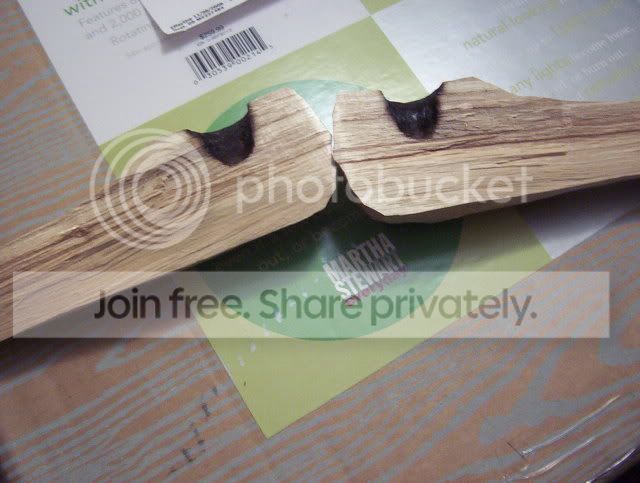
I've definitely got to use the most recent skill learned, making a pipe!

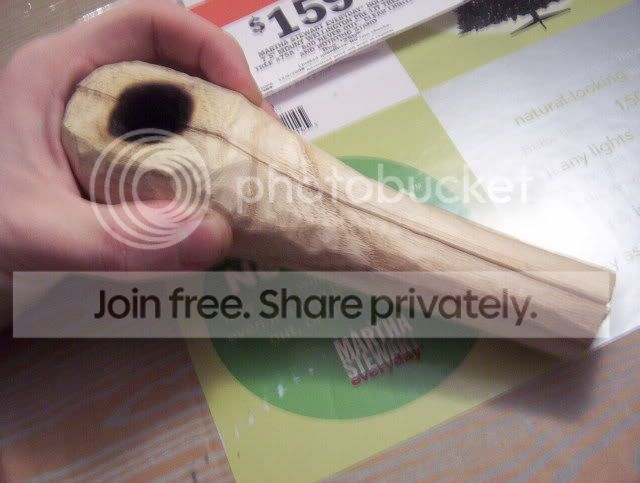
Used only a 4" scandi blade to make it, and started with a small piece of oak. I picked a straight grain, and carved just the rough shape. Then I used a bowdrill with a bit of sand to deepen and shape a hole that was to be the bowl. Coal blowing let me deepen the hole more fully (and with less sweat than the dowdrill!!!).

Then the tricky part: I very gently batoned through the pipe straight down the middle, splitting the bowl. Here is is, before the bowl had been deepened and with lots of carving left to do:
pipe001.jpg

pipe002.jpg


After that, I followed a grain-line down from the bowl (1/4" from bottom of bowl) to the mouthpiece, carving half into each side of the split pipe. Following the grain line lets you ensure you're matching the location on each. (less guess work).

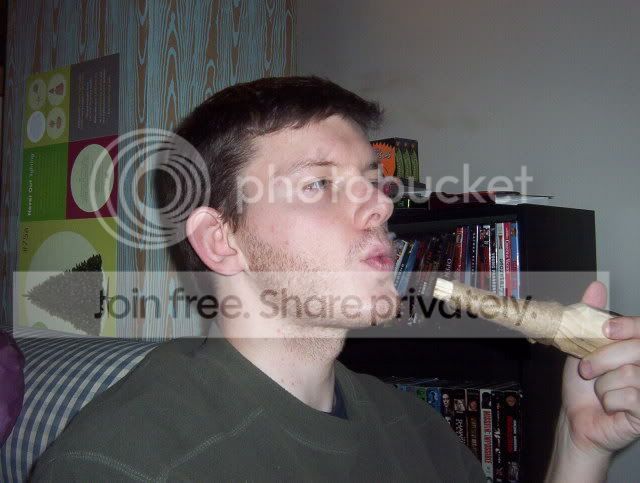
Then I just used a pipe cleaner to check when I had a 'through' line. A little more coal blowing to deepen the bowl, some more carving, and some jute twine to bind the halves together led to this guy:
pipe006.jpg


It's a really fun project that also does a good job testing a knife, because you'll use it in about every way and every position I can think of! It's really, really gratifying to take a puff on something you made from scratch, too.

Cheers-

PS- If that's too curmudgeon like, here's some figure-4 practice indoors (peanut butter bait for a pooch) :D :
100_0117-1.jpg
 
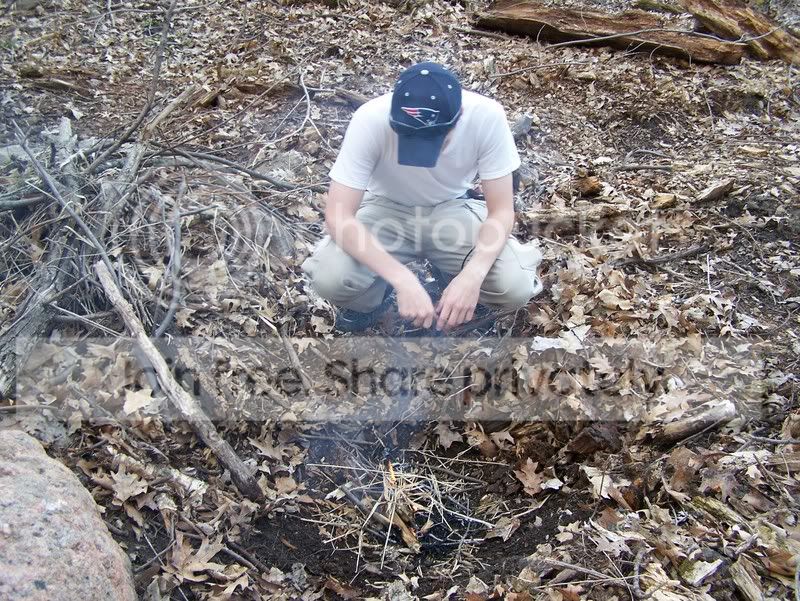
My older son practicing his fire-building techniques, with me giving waaaay too much advice from behind the camera, "Move those leaves, dig that pit deeper, get some dirt piled up in case a spark gets away from you, what are you doing that for?, are you blowing on that coal?, did you grab some stuff for fuel, no no no, that's not right, oh you got it! great job!!

100_0478.jpg


100_0474.jpg


100_0490.jpg
 
I'll go in with a story. Yes, it's true.

mountaininthefog600x450nt1.jpg


For years, I looked with disdain on trails and convention. To me, like many here, the real explorers were the ones who made their own trails. To be in the woods following a trail seemed unnatural, and seemingly mundane. Surely in light of this, it must be surprising to say that it was a trail that taught me many things.

Yes, it was this trail, unnatural and mundane, that over 5 trips injured me, taught me, found friends, and changed my outlook. It was from humble beginnings that it started, and I can't say why, or even why I will be back there soon.

So now, as I plan my next trip, there are a few things that must be said to all. Whether it is the road less traveled is not as important as simply traveling. Sometimes the important things are not where you are or what you have, but who you are with. Even the mundane can teach us, if we are in the mood to listen.

Have a good evening.

waterfallgreen450x600an2.jpg


waterfallice450x600gn4.jpg
 
Last edited:
I have never handled a Barkie so thank you so much for the chance !
Looking at the entries so far I doubt I will win but keeping with the christmas spirit if I am lucky enough to win then I will give a Ka-Bar D2 Spear point to whoever comes second !!!

Ever since we moved to Canada nearly 3 yrs ago now, my greatest wish has been to see a Bear. This probably seems quite lame to most on this forum but coming from the UK a badger was the largest creature I was likely to see in the wilds, except maybe for Deer but they are a little boring eh !!!

Anyway when my parents came over to visit this year we decided to drive up Island to Tofino where locals had told me I was guaranteed to see a Bear.Off we set with camera at the ready and eye's peeled, well we got all the way to Tofino and saw nothing !!!
My wife tried making things better by saying stuff like " well we had a nice drive and Tofino was lovely ", all of this just went in one ear and out the other because I was so dissapointed at not seeing a Bear, I told my wife I couldn't care less if I never saw a Bear for the rest of my life, which was totally untrue but I was in one huge sulk.

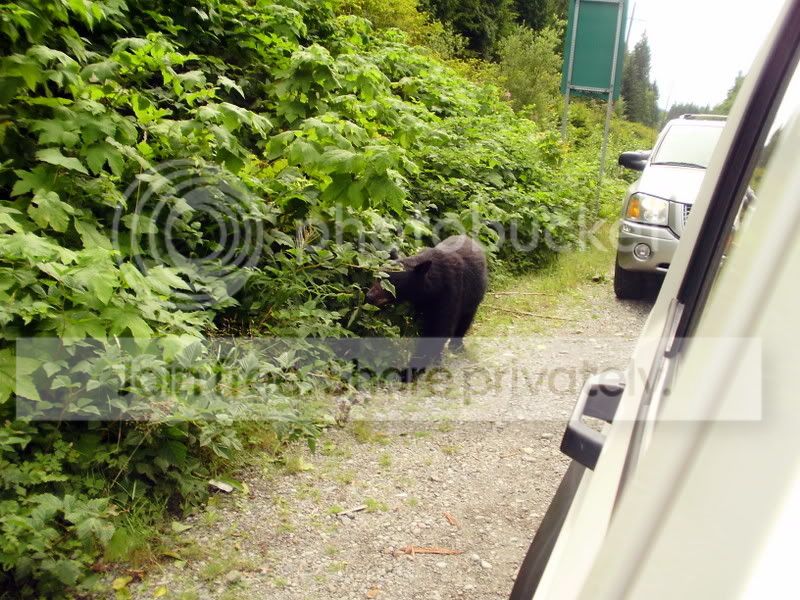
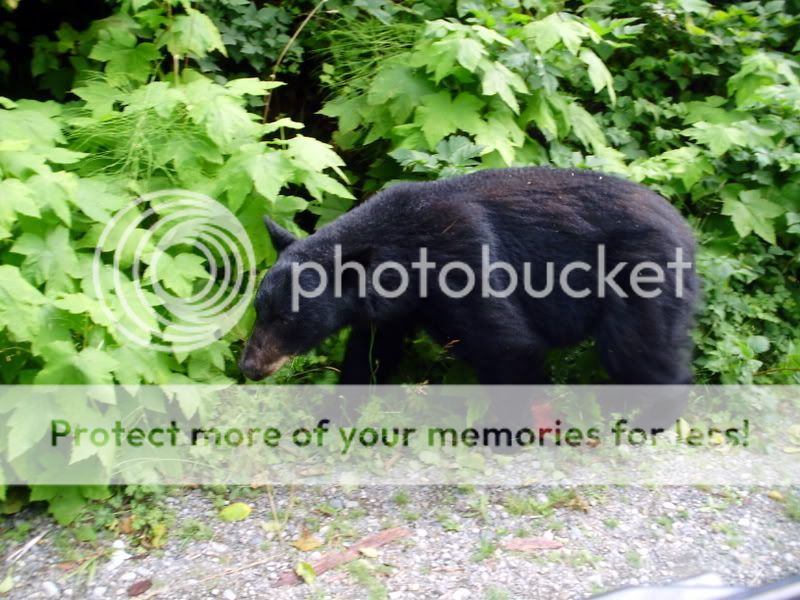
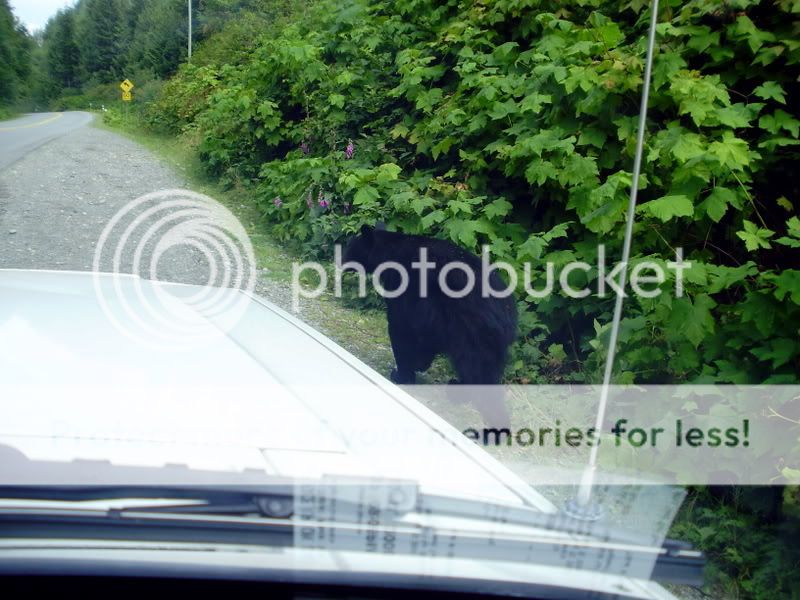
Anyway we had been left Tofino for about an hour when we rounded a bend and there at the side of the road was a Bear,my wife managed to pull our Jeep over about 60 yrds in front of the Bear and I jumped out and started taking pics with a stupid smile spread across my face. I stood on the opposite sid of the road taking pics till the Bear got to about 30 yrds away and then I decided I'd better jump back in the car !
We then sat and watched as the Bear ambled towards us munching on berries without a care in the world. By this time Maisy was going crazy in the back barking and jumping around causing the Jeep to rock about and as the Bear passed us it stopped and looked up briefly to see what the commotion was before returning to it's task of filling it's stomach. When we eventually drove off I felt a little bad for my parents as they were in a seperate car and had missed the action and I knew that with my dad being as animal crazy as me he would be gutted. Anyway when I phoned them it turned out that they had seen the same Bear about 20 minutes earlier and had plenty of pics to show their friends back home !!! I hope that living here I will see many more Bears but I will never forget this one as it was my first !!!

P8220014.jpg


P8220015.jpg


P8220016.jpg
 
I think my best bet on this one is the review of the Adventure Medical Kits heat sheet that I did a month or so ago... is it legal to repost something like that?

Thanks for the contest! :)
 
Primitive Pork..... a true story by Stephen Coote.

It had been a long walk. First up the valley, then up the hillside. I had stalked through most of the available bush and it looked like I was going to return home without a pack full of meat. Wild goats often browsed here, but this time they seemed to be elsewhere.

The hillside was steep and covered with loose rock. Nevertheless, the native bush had become well established. Kanuka was the predominant tree, but other species flourished in some gullies. And there was plenty of spiny bush lawyer vine to make things difficult.

I climbed to the next ridge and carefully peered over the top. On a spur in the middle of the gully stood two goats, easy targets for the rifle I normally carried, but too far away for an ethical shot with my bow. The bush was too open to head straight toward them, so I crept back behind the ridge, walked down into some better cover, then crossed the gully. Keeping low, I worked my way toward the spot where the goats had been. They had disappeared. Perhaps a wind eddy had carried my scent to them, or maybe they had just decided to move on.

It was fairly disappointing. I'd hoped this would be the day I'd shoot a goat with primitive arrows. I have had many successful hunts using a rifle, and a few years before I had taken a goat with a factory made bow - but obtaining meat with equipment I had painstakingly crafted was my current dream.

The bow had been cut from a branch of native Olearia paniculata. It was nearly as tall as me, but only pulled about 36 pounds. A bit too light for a goat really, but it was all I had. My arrows were tipped with home-made steel "trade point" heads. The fletchings came from Canadian geese shot by a friend. The shafts were made from bracken fern stalks that had been harvested as fat, ripe, living stalks and then dried by my woodstove.

There were now only a few hundred metres to travel through the bush before my hunt was over. Rather than feel disappointed, I made an effort to find things to be grateful for as I trudged on. The walk had been pleasant, it was a nice day, and at least I had seen some game. I could learn from the experience even if I hadn't been successful. There was plenty of food at home - I wouldn't starve no matter how this hunt turned out. And I knew, deep down, that the supply of things I needed didn't depend on my ability as a hunter or marksman or anything else - they came naturally from the operation of the laws of the universe.

Crash! Something was moving in the gully ahead of me. I strained my ears for more information. More crashing - and a grunt. Pigs! I had hunted this area for years and had seldom seen a pig - and now I didn't have a gun. At least this was adding some interest to the day. I decided to stalk the pigs to try to learn something about them. I headed toward the noise and finally saw two very big wild pigs. One was lying down on its side about forty yards away, while another nosed around in the undergrowth. They were too big, and too far away, to tackle with my puny bow.

I didn't often get a chance to observe wild pigs like this. I felt uplifted with gratitude. I hadn't been watching for long, when some movement above me on the hill caught my eye. A smaller pig, fifty pounds maybe, was meandering down the hill. I suddenly realized that it was likely to cross an open space just ahead of me at a distance of about fifteen yards. I stood still with an arrow nocked on the string. The pig entered the open space and stood side on to me. I drew my bow and loosed the arrow. As I shot, the pig turned slightly away from me. I saw the arrow hit. With a surprised "woof" the pig disappeared over a small ridge. The other pigs were now nowhere to be seen.

"What have I done?" I thought. I had tackled a pig with a light bow and now it had run off. Remembering some good advice, I decided to stay where I was for half an hour to let the wounded pig lie down and stiffen up.

I needed to find that pig. For a start I did not want to leave a wounded animal behind. Secondly, it would not be hard to identify the owner of the arrow if it was ever found - and I didn't want to give bow hunting a bad name, or let certain people get worked up about me hunting in "their" area.

After a few minutes I couldn't wait any longer. I walked a short distance and peered into the undergrowth. There was the pig - stone dead.

It is hard to describe the satisfaction I felt as I gutted that pig. No other hunt has been as good. I now had pork taken with my own hand-crafted bow and arrows.

If the pig hadn't turned slightly as I shot, the arrow may have just penetrated the lungs or liver. But because it had turned, the arrow entered just behind the ribs and travelled right to the heart. And it was such a good shot! It was as if some benign power had taken control of the situation. Perhaps it was my reward for being so grateful.
 
MAKING YOUR OWN ARROWS WITHOUT STORE-BOUGHT COMPONENTS

Natural shoots can make very good arrows. I dry the shoots indoors where I can keep an eye on them. Generally I would try to dry the shoots with the bark peeled off, but I would leave the bark on if the particular type of shoot seemed prone to cracking as it dried. Sometimes shoots can be dry enough to make arrows from in about two weeks if the conditions are favourable. As you experiment you will soon work out how long to dry them. Good shoots become quite resilient and can stay quite straight. As they dry I pick them up individually on a regular basis and try to straighten them by hand. Where there is a sharp kink, or when the kink is close to one end, I often use an arrow-straightening tool to bend the shaft back to a straight line.

An arrow straightener needs to be nothing more than a piece of wood with a hole through one end. The edges of the hole are rounded to avoid denting the shaft. My current favourite is cut from the handle area of a bow that broke. It is roughly 20 millimetres thick and about 150 millimetres long. The shaft is fed through the hole until the centre of the bend is alongside the tool. Holding the shaft in one hand, I hold the tool in the other and gently try to lever the shaft as required. I have drilled a large hole in my straightener so I can fit the oversized shoots through it.

Even fully seasoned arrow shafts can sometimes be straightened at room temperature. However heat may be required for stubborn bends. A candle flame can provide enough heat to straighten an arrow. I suggest that you wipe fat or cooking oil over the area to be heated, and that you don’t attempt to straighten the arrow until it is quite hot. Keep the arrow moving and at a sensible distance from the heat to avoid charring. Allow time for the heat to penetrate the shaft.

If a natural shoot needs to be reduced in diameter, it can be whittled, scraped, abraded or planed.

Some natural shoots can still make effective arrows even if they don’t grow perfectly straight on the parent bush. And although side-shoots can create problems on an arrow shaft, it does not mean that you should not try to make arrows from shoots with twigs growing from them. Some shoots shrink and warp more than others as they dry. You can cut shoots that are quite big in diameter if you are prepared to reduce them to the right size. I generally reduce large shoots to size after they have been dried and straightened.

Square sticks that have been sawn or split can be made round by planing. I use a small carpenter’s plane. The shafts can be placed in a groove that has been chiselled or routed into a plank. The groove should have a “stop” at the end to prevent the shaft moving out as the plane pushes against it. I start by planing the corners in turn to get a more or less octagonal shaft, and then I plane the corners of the octagon and so on.

I planed my first arrows while they were held in a groove long enough to contain the whole shaft. Lately I have used a shorter groove that leaves a short portion of the arrow sticking out. This enables me to rotate the arrow with one hand while I plane with the other. When the front half of the arrow is planed I then turn the arrow end for end and plane the other half. This is quicker. (Sometimes I just simply plane the shafts on a flat surface while holding them). Woodworkers know that sometimes wood will plane much better in one direction than another, and this quick method requires the planing to be done in both directions. However I believe that difficult planing often results from non-parallel grain, so if I have difficulty planing it is time to examine the shaft carefully and maybe reject it if the grain is bad. If the plane is adjusted to take a fine cut, and if it is sharp, it should cut fairly well in any direction. The shaft can be finished by sanding.

Of course arrows can be made without a plane. You can use a knife, scraper, sandpaper or an abrasive rock. An arrow doesn’t have to be perfectly round in cross section to bring home the bacon.

When shafts have nearly been brought to the final diameter I have sometimes hammered them through a hole of the right size that has been drilled in a piece of flat steel about 10 millimetres thick. If the hole edge is not chamfered it leaves a crude cutting edge that may shave excess material from the shaft. Sometimes a slightly oversized shaft has gone through the hole without any shavings coming off it… I assume that the wood was compressed into shape, and this may be a good thing. If the shaft is too big, sometimes it may jam and break. I have found that this process can leave marks on the shaft. Shafts should be cut a little longer for this because the hammering can damage the end.

Any natural arrow shaft may bend no matter how it was made, although some materials are better than others. Shafts should be straight before you add fletchings, heads and decorations, but they may still bend once they are completed. It is said that burnishing a shaft helps to keep it straight. I haven’t done this much, but burnishing seemed to improve some soft willow shafting I once used. I just vigorously rubbed the straightened shaft all over with a smooth rock while the shaft was lying on a table. A small amount of cooking oil wiped over the shaft can help to make a nice job when burnishing, but oil may prevent glue sticking to the shaft.

I cut my nock grooves into the arrow with three metal-cutting hacksaw blades that are bound together. I then tidy up the groove with a very sharp pocketknife blade or sandpaper. The groove should be about twice the depth of the string diameter. The string should fit snugly into the nock, and it is good if the arrow is able to hang from the string without falling off. The nock shouldn’t be so narrow that the arrow will tend to split as the string is forced into the nock. Sometimes I have had one side of the nock split away from the arrow during normal use (and this can be frightening because the arrow can slap you). A tight binding of thread immediately below the nock will help to strengthen it.

Sometimes good shafts can be a bit thin to have a decent nock cut into them. I once split the shaft and forced in a small wedge of wood to open the split to form the nock on shafts like this. I used a sharp knife blade to make the split. The wedge was glued into place. I bound the shaft under and around the wedge to help hold it together. The newly formed increase in diameter at the nock didn’t seem to affect accuracy. Theoretically this type of nock should be stronger than one made by cutting into the shaft because the full amount of wood is still in place at the nock area.

If you want to paint, varnish or oil your shafts it may be best to do this after you have made the nocks (and any slots needed to hold arrowheads), but before you add the point or the fletching. This will allow you to apply this protective finish to every part of the arrow. Be aware though, that some finishes may prevent glue from sticking properly. Some folk like to make a fancy paint job on arrows, and some of these look really good. I have simply wiped fat into some shafts, and I have protected others by dunking a rag in varnish and wiping the shafts with the rag.

ARROW HEADS

You don’t need a special arrow head to make the arrow fly properly, although it is probably best if the point of balance of the finished arrow is slightly forward of centre, and a head can help achieve this. You can have fun shooting arrows with no attached heads and these may be good enough to kill small game if that is all you have. In a survival situation you could simply sharpen the wooden shaft for larger animals. It is said that wood can be made harder by heating it, so if you charred the tips in a fire and scraped away the charred wood to form the point you might find that the points could be made to be slightly sharper and more durable. I recommend that sharp broadheads should always be used for hunting. In some places the law defines the types of arrowhead that can be used for hunting.

For a blunt head you can use an empty cartridge case of a suitable size, or you can bind the end of the arrow with fine wire (soldering it in place perhaps). The end can be bound with thread or natural cordage, but wire should last longer. I have used fibre-reinforced adhesive tape.

Sharp hunting heads are generally made from steel nowadays, but heads made from glass, certain types of rock, and bone can all be effective if they are sharp, well designed, and securely fastened to a shaft that is heavy enough.

You can make your own steel broadheads. The type I am about to describe are called “trade points” because they are similar in design to the types of arrowhead that were used in trade with the American Indians. Unlike many commercial broadheads, these do not have a socket into which the shaft fits. The heads are cut from flat steel and they are glued and bound into a slot on the shaft.

The best steel to use will have more spring and hardness than ordinary mild steel, although mild steel will make an effective head. Softer steel will not hold a sharp edge for as long, and it will bend more easily, but it will work. Steel cut from old saw blades is often a good choice. If you want to use a forge, then maybe you could hammer some out of thicker steel . You could try any sort of steel, but mild steel that is too thin will bend too easily. I have made a number of heads out of 16-gauge stainless steel sheet (around 1.5 mm thick).

Long narrow broadheads may penetrate better (in theory) compared to shorter, sturdier heads, but they may bend or curl more easily as well. It is said that a length to width ratio of three to one is good to aim for, but unless the material is particularly tough I feel that a head with a slightly smaller length to width ratio may be more durable.

With proper care, steel heads can be cut out with a hand-held electric grinder fitted with a cut-off disk. The steel has to be held securely in a vice or clamp, and the grinder has to be used in the proper manner. And safety goggles should always be worn. Even experienced operators have had the work jam and cutting blades shatter, so unless you really know what you are doing, don’t attempt it. One simple type of flat head I make can be cut out entirely on a metal-cutting guillotine. This head does not have a tang but it needs to have two holes drilled in it near the base for a binding cord to pass through and around the arrow shaft once the head is seated in the slot. Harder steel may be cut with a plasma cutter. Softer steel (or annealed steel) can be cut with a fine-toothed hacksaw… and this is the method that is likely to suit most folks.

Heads can be sharpened with a file if they aren’t too hard. A bench-mounted electric grinder may be an easier option, but be careful. It may be a good idea to hold the heads with self-locking pliers so you don’t have your fingers near the wheel. Sometimes a grinder can “grab” the steel with unpleasant consequences. Wear safety goggles.

Small steel broadheads could be made by beating a thick nail out flat with a hammer.

A general engineering workshop, or sheet-metal business, might be able to supply you with cut out broadhead blanks at a reasonable price. It can be a nice feeling to have a big supply of heads stashed away.

Instead of having a barbed broadhead, I prefer to cut the base of my heads at a slope that will allow the head to be pulled easily from the target. I think this is good for hunting arrows, because if the arrow hits in a non-lethal place there is a greater possibility that the head will dislodge from the body of the animal thus allowing the cut to heal.

The width of a hunting broadhead is sometimes governed by law. I generally make my heads about 26 mm wide (just over an inch). Heads used for small game don’t need to be as wide as this.

I have found that two hacksaw blades bound together will cut a slot of the right width to take a trade point. If your shaft material splits nicely, you might find you could split the shaft to take the point. In this case you would need to apply a tight binding below the head to prevent the split travelling further down the shaft. By splitting the shaft you still have all the original wood fibre in place to keep it strong. When you cut a slot you weaken the wood. See what works for you. Whatever you do, make sure that the head is firmly fixed in to the shaft. If the head tends to get driven into the shaft on impact, thus splitting the shaft, it will be inefficient as a hunting tool.

I glue and bind my trade points into position. I have used commercial hot-melt glue, and homemade hide glue. Melted pitch glue would be another option.

Sharp arrowheads can be very dangerous. Use and store them sensibly, and keep them out of the reach of children. Practising with broadhead tipped arrows in an area frequented by the public may not be a good idea - the anti-weapon fraternity may be offended, and children may pick up lost arrows. Broadheads used for hunting should be kept as sharp as possible.

arrowheadselections.jpg


See my next post for simple fletching ideas.

 
Last edited:
FLETCHING

A traditional fletch of three feathers is not the only option. I have enjoyed using a two-feather fletch (which has worked well), and I have had good results with fletching made from packaging tape. A two-feather fletch can cut your feather requirements by 33%, and the arrow can be nocked without having to ensure that the cock feather is facing away from the bow (as is done with a three-fletch). Furthermore I think that a simple two-fletch is generally easier and quicker to produce than a three-fletch. Sometimes feathers are hard to find, so soft, wide adhesive tape can provide a cheap solution.

FEATHERS

I have used goose, seagull and commercial chicken feathers. Discarded feathers can be found on the seashore and in areas frequented by any large birds such as ducks. My goose feathers were obtained from a friend who hunts geese. It is generally only large wing and tail feathers that are used for fletching. In some countries it may be an offence to be in possession of feathers from certain protected species of birds, so make sure you are doing the right thing. Turkey and goose feathers have been traditional favourites, but many other types of bird can provide feathers that will work, even if they aren’t quite as stiff as the traditional ones.

If you ever look at a bird’s wings, you will notice that the main feathers on one wing look different to those on the other wing. It is best to use only right wing, or only left wing, feathers on any one arrow. Feathers from different wings curve in different directions, so if you have left and right wing feathers together on one arrow they may try to spin the arrow both ways at the same time. However if you do mix your feathers you will probably find that the arrow will fly better than an arrow with no fletchings at all. For any type of feather fletching, try to use three (or two) feathers that are very similar in shape, stiffness and size.

Chap4CockFeatherEtc.jpg


THE THREE-FLETCH

I like fletchings that are around 125 millimetres long (about five inches) or longer. However I have seen shorter fletches that work well. If you have to use shorter fletching, it may be better to leave it a little wider to present more surface area. Long fletching can be trimmed quite low. You only use one side of the feather for this fletch.

Feathers can be split lengthwise with a sharp blade down through the middle of the quill, and then the excess quill is trimmed off. You may find that sharp scissors and sandpaper will work for trimming, but I generally just use a thin, sharp knife. It is important to keep the base of the trimmed quill at 90 degrees to the vane so the vane will sit correctly on the arrow. You may like to devise some sort of a gentle clamp to hold the feather for the trimming process.

Vanes can be “stripped” from the feather. Hold the feather upright with the quill pointing downwards. At the very tip of the feather, pinch one side of it with your thumb and forefinger. Pinch the other side with your other hand. Pull your hands apart and pull at a slightly “downwards” angle on the side you want to use for your fletch. Hopefully this side of the feather will start to tear away from the quill. Continue tearing the feather until the whole side is detached. You may have to experiment with your technique (pull angles, best place to hold etc), and you may have a few failures, but you should succeed eventually. The stripped vane may look a bit flimsy before you glue it to the arrow, but you will probably find it stays stiff enough when glued into position. I have heard that fresh feathers strip more easily than old ones, but I haven’t experimented enough to know whether the difference is significant. Maybe it is for some types of feather.

Now that you have your vanes you can fasten them to your shaft. One vane generally sits at right angles to the nock (and will point away from the bow when shot). The other two vanes are spaced at equal distances from each other around the shaft. In other words the vanes sit at 120 degrees from each other. Sometimes the arrows are applied in a helical fashion to help the shaft spin. I have found that the feathers don’t have to be applied at exactly the right spacing to fly well enough. And most of my arrows have parallel fletching rather than helical.

There are various ways of going about fastening the vanes to the shaft. I have done a quick job by using a hot melt glue gun, but sometimes the glue became unstuck (maybe I could have used a more suitable glue). There are special jigs you can use to hold the vanes in place while the glue sets. You can use fine pins for this purpose also.

Some vanes can be simply tied on with fine thread. I suggest that all vanes are thoroughly bound at the top and bottom, and this may be enough to hold some feathers in place, but it may be better to wind a helix of fine thread down the shaft between the feathers’ pinnules. The pinnules should mostly join with each other again once you have finished if you gently push them together. Six to eight turns of thread may be enough. This thread should be pulled tight and firmly bound into place at each end of the vane. If feathers are to be bound without gluing, then it may be best to use feathers that still have some quill on them rather than stripped feathers.

Don’t locate any fletching too close to the nock end. Keep it far enough away to allow your string fingers to stay clear of the vanes.

Here’s a good way of applying a three-feather fletch. Make up a thick batch of warm hide glue. This should get “tacky” fairly quickly. Apply a dab of glue to the tail end of a vane and press it into position on the shaft. I usually start with the cock feather. Hold the vane in place for a short time while the glue partially sets. Then do the same thing with the other two vanes. The arrow is then set aside to allow the glue bond to get stronger. When the glue has set enough, apply glue to the whole length of the underside of the three vanes and stretch them into position. At this stage the vanes can be held in position until the glue holds strongly enough, or the front end of the vanes can be bound with thread. Another idea is to temporarily anchor each vane with a dressmaker’s pin. Sometimes the vane has to be pressed against the shaft to ensure that a bond is formed.

Other glue, beside hide glue, will work for fletching. Hide glue can get tacky quickly which is an advantage, but other methods can be used to hold the feathers in place while the glue sets. Dressmaker’s pins are one option. Glue from a hot-melt gun sets very quickly.

When the glue is dry, I apply a tight binding of thread around each end of the fletching. Before this is done, a small amount of the feather material is trimmed from the quill. This enables a tidy job to be made of the binding. The binding can be applied in a similar manner to the serving on a bowstring (as described earlier). Glue can be applied to the binding to hold it in place.

At the leading end of the fletch (the end nearest the arrowhead) it is important to not have any sharp quill exposed where it could easily cut your bow hand when you shoot. You should think about this when you are preparing your vanes. Sometimes a high quill can be flattened by squashing it with another arrow shaft or something similar. The binding applied over the leading edge of the quills not only helps hold them in place, it should be done in such a way to protect your hand from these sharp bits of quill. Sharp bits of hard glue can also be dangerous, so remove them if you find any.

THE TWO-FLETCH

Feathers selected for this need a reasonably wide vane on both sides of the quill. Because the whole quill says intact along most of the feather in this method, it is best to select feathers with smaller diameter quills. Big quills may interfere with arrow performance, and to me they don’t look right on an arrow. It may also be best to select feathers with reasonably straight quills, because curved quills tend to make the fletch bend away from the shaft. I have had success using tail feathers about 170 millimetres long. The two-fletch method is hard to describe in writing, but once you have seen a successful two-fletch, everything should become obvious.

Three fletch vanes are generally aligned so that one feather always lies at right angles to the bow, and the other two are evenly spaced around the shaft. With the two fletch method alignment isn’t quite as critical, but I think it is best to place the feathers so that the quills don’t strike your hand or the bow directly as the arrow is shot. I try to place mine at about 20 degrees from the plane of the nock slot. If the quills lie in a position at right angles with the nock, one of them will always strike against the bow. If they are tied above and below the nock one of them will always strike your hand. Once you have tried to fletch an arrow or two you should see what I mean.

Strip the bottom two-thirds (more or less) off one vane on both feathers (see diagram). Trim the top of the feathers to leave a short length of quill exposed (say 10 millimetres), but don’t trim all the feather material off because what is left will be more easily gripped by the binding than a thin, bare quill would be (see diagram). Make a mark (actual or imaginary) around your arrow shaft at a distance of about 25 millimetres from the nock. Take the feathers and place them back to back with the concave sides of the feather touching each other and the quills pointing in the same direction. Take the arrow shaft and hold it near the feathers. The arrow should point in the opposite direction to that pointed to by the thick end of the quills. Lay the nock end of the shaft between the feathers so that the mark below the nock lines up with the point where the short bit of “trimmed” quill starts to emerge from the tip of the feather. Bind thread over the short quill tip to hold the feathers in place - be sure that the feathers are exactly where you want them in relation to the nock before you tighten the thread.

At this stage the feathers are tied in place “upside down” with most of the feather trailing behind the nock end of the shaft. The thick ends of the quill have to be trimmed in order to get them sitting correctly on the shaft when you bind them in place. The side to be trimmed is the stripped side of the feather, and it has to be trimmed so that the base of the quill is at right angles to the vane on the opposite side of the cut. Carefully cut away at least half the thickness of the quill for a distance of maybe 15 millimetres at the very end of the base of the quill. Now bend the feathers over and lie them along the shaft so that the thick end of the quill is now pointing the same way as the arrowhead. Gently rotate each feather 90 degrees so that the newly cut flat part of the quill will sit against the shaft. Carefully stretch the feathers along the shaft and bind the front part of the quill into position. If you pull the feather too hard you may snap the thin quill at the top binding, or dislodge it (if the centre of the feather wants to bend away from the shaft you can bind it down later). Take care to squash down the front tip of the quill before you bind (if necessary) to ensure that it will ride smoothly over your hand, or any obstruction, and cover the front end of the quill with the binding to add further protection.

I generally lay these fletchings parallel with the shaft, rather than bother with a helical type of fletch. Sometimes when the feathers are quite curved, they bend out from the shaft. To counteract this you can part the pinnules of the feathers at the point of maximum bend and apply a small binding to hold the fletchings closer to the shaft.

You may like to apply glue to your feather bindings to help make them more durable and secure.

ADHESIVE TAPE FLETCHING

This is not a strictly primitive fletching method, but it is a cheap, do-it-yourself fletching solution that can work well enough. I have tried different ways of using tape, but I have had the best success with a three-fletch configuration.

Some tapes are more suitable than others. The correct “stiffness” is hard to describe, but it shouldn’t be too flimsy or too stiff. Remember that the fletch should be able to bend out of the way as it comes in contact with your hand or the bow. I have had success with tape made for repairing rips in plastic hay bale covers. I have also got reasonable performance from two or three other types that I have tried. Tape that comes on rolls about 48 millimetres wide is convenient to use.

Cut three bits of tape about 150 millimetres (about six inches) long. Pick up one piece and bend it lengthwise to form a “U” with the sticky side outwards. The base of this “U” is stuck lengthwise along the shaft. Now pick up the second piece and bend it like the first one. This one will be stuck in position a third of the way around the shaft from the first one, while the first bit of tape is still bent in the “U” position to keep it out of the way. Things can get a bit tricky here because the two bits of tape can stick to each other before you are ready. If you feel that the two bits of tape are sitting in the right position, you can allow the two adjacent wings of tape to stick to each other, thus forming the first complete vane. Mould the tape against the shaft to get it to stick well. The two bits of tape will sometimes stick without being exactly in the right position thus skewing the vane or making it lumpy. It may still fly reasonably in some cases, but it doesn’t look good. Now the third piece of tape is applied in a similar manner (see diagram).

A big challenge with this tape fletching is to get three nice, flat, evenly spaced vanes. This should come with practice. Another challenge is to end up with the vanes where you want them in relation to your nock so that you get the conventional “cock and hen feather” configuration with the cock feather at right angles to the plane of the nock.

Once you have the tape firmly pressed into place, you can trim the vanes with sharp scissors. I have found it necessary to have the vanes tapering down to nothing at the leading end so that they ride nicely past the bow and my bow hand. Keep the vanes as narrow as possible. Make the taper as long as possible. I apply a tight wrap of soft insulation tape over the very front end of these plastic vanes to stop them catching and pulling away.

rabbitarrow2.jpg


Enjoy your time outdoors. Best wishes ..... Stephen Coote.
 
thank you for the contest Esav ,I will pass due to I have one and I like to see some one win that does not ....post'em up ,I enjoy the type of threads !
 
I grew up in the outdoors, made it to Eagle scout, and have fond memories of it. Unfortunately when I went off to college, and then started a career, it all went to the wayside. I am finally stable in my job, and realized that it was high time to get back outside again and enjoy the outdoors. I have to say, I have been hugely motivated to get back to it by the posts I read on this forum. It gave me the drive to get out again in the first place, and now I drool daily over the cool places everyone gets to go and the great 'toys' they get to play with. I have a few good folders, but I lack a good fixed blade and that is definitely on my list of items to add!

Regardless of the contest, I would like to thank everyone for doing what you do and motivating me to get back out there and do it myself! As a result my wife and I (and the dog too!) have had some pretty good adventures outdoors. I'm slowly rebuilding my outdoor equipment stockpile, and am hoping to take my wife on her first 'real' camping trip. She's done some overnighters at campgrounds, but never really primitive camped, which to me is 'real' camping :D

Here are a few pictures I've posted before, but they are from one of our first trips outdoors. The wife and the beagle both have a blast and now regularly ask to go again, which delights me like you wouldn't believe. Unfortunately I just realized that since she runs the camera and I wrangle the dog, there are no pictures of us together, let alone her, so I'm sorry but you're stuck looking at me and my dog :D

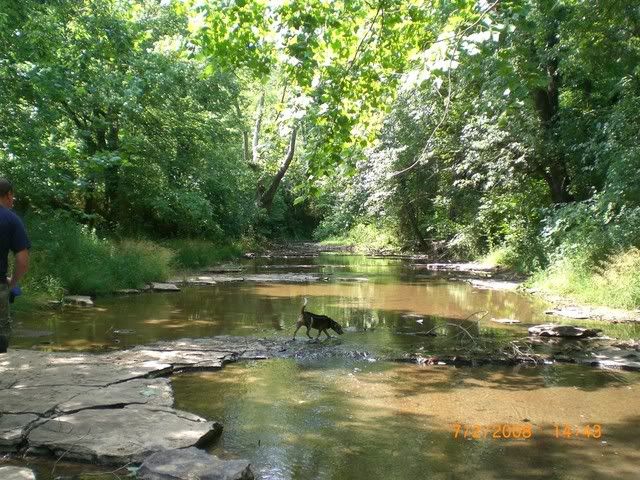
AprilsSummerVacation064.jpg


This is Shiloh and I wading a local creek.

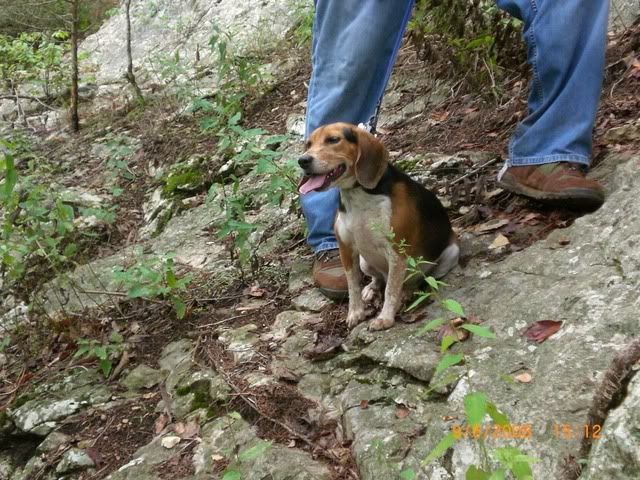
CheeksBendBluffSeptember2008022.jpg


Here we are after exploring a small cave and coming out on a cliffside overlooking a river. If you've never seen a beagle rock climbing, you don't know what you are missing :D

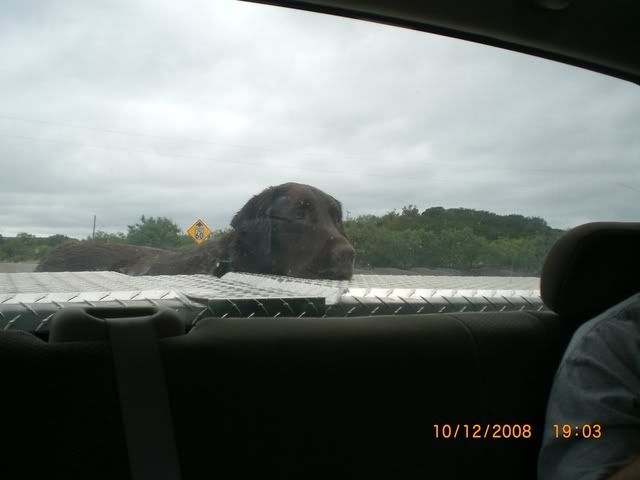
AbileneTripOctober2008236.jpg


This is one from a trip to Abilene, TX to see some family. It's my sister's dog in the back of my truck after a trip to the lake and hiking some trails with my new brother-in-law. We went to see their first baby (and my first niece!), so this trip has all kinds of sentimental attachments for me. It's one of my favorite pictures, even if it isn't my dog :D

Anyhow, I hope I didn't ramble too much. Thanks again for the opportunity to participate in the contest. There is such a sense of community in this forum, and I appreciate the opportunity to be a part of it! Take care all, and have fun doing what you do!
 
2. Post a wilderness story, adventure, or technique....

1. My winter wilderness thirst-quenching technique: don't eat the yellow snow.

2. A technique for winter fun, but be careful if there are children around... make a snowman. When you get to the body, stick one of those gallon jugs filled with red juice. Then keep building the snowman. When you get to the head, stick in a cow brain from the butcher. Finish the snowman. Get your guns out and make the snowman dance. Again, make sure there aren't kids around or they may never see winter as a fun time again.

In all seriousness, please don't eat the yellow snow.
 
Great idea for a contest Esav and thanks for setting this up!

My story is about my family vacation (sort of a travelogue). My wife and I found this little paradise of a place called Camp Anjigami and booked an accommodation for one of their fly-in fishing outposts. We started our vacation planning thinking that we would drive around to a bunch of provincial parks and camp a couple of nights at each. However, after figuring out camping costs and boat rentals the bill started adding up. My wife Becky found this place on the internet and based on the price it seemed crazy not to take advantage of the opportunity. I was always my dream to go on a fly-in fishing trip and when you get a chance to act out a fantasy, well its just best not to refuse.

The camp is located about 20 minutes outside the small city of Wawa which is situated in western Ontario about mid-way between Sault St. Marie and Thunderbay. The drive there is stunning, starting from Windsor, we crossed into Detroit and followed Hwy 75 through Michigan’s wonderful Upper Peninsula, crossing the Mackinaw Bridge and then back into Canada via Sault St. Marie. It takes us about 11 hours drive to get there. We do take our time, have some nice meals and make frequent rest stops.
Lots of wonderful water pictures similar to this on the way.

P8130077.jpg


On recommendation from a colleague of mine, we stayed the first night at a little hotel called Kinniwabi Pines located right at the edge of city of Wawa. The motel wasn’t all that great itself, but they had this great little restaurant that was recently bought out by this couple from India and the owner has a real fondness for Fusion cuisine. My wife and I gorged ourselves on a meal in the Fusion style, with French sauces mixed in with Indian curried side dishes all taken in with a couple bottles of wine. It was a wonderfully romantic dinner that followed a romantic night in the hot tub of the motel.
The next morning, we met at the float plane air station run by air-dale.

anjigamieairdaile.jpg

(Stock photo from Anjigami).

They weigh your bags and you are allowed a certain weight limit in travel items. They hold you to that too and of course we tipped the scales. The air guys are pretty used to this kind of thing however and gave us some time to sort out what we didn’t want to take. We took out a bunch of the canned goods, my axe (there was supposed to be one supplied their) and some spare clothing and made our limit.

The flight was about 30 minutes. You never get too high in the air, more like hugging hills and get a breathtaking view. As they approach your lake, they actually circle around it twice, showing you the different features and also pointing out the portage lakes that you can get to. Another stock photo from Anjigami, but this is the outpost cabin we stayed at. The lake is called Fulcher Lake. The outpost lake only has only the one cabin on it. There is also another lake, called lake Shasta which is about a 1.5 km hike to get to. The cabin has a couple of aluminum fishing boats, motors and enough fuel to last the week. The boat and fuel were all included in the price.

fulcherlake2.gif


fulchurlake.jpg


The cabin was great. Having a composting toilet indoors meant no secret trips in the night to an outhouse. The composting toilets have no smell to them. The only thing you have to do is throw in some peat moss when you are done and give the main compartment a flip via a lever once every couple of days. The cabin also has a propane fridge and stove that allowed us to cook some wonderful meals. We had many candle light dinners with wine and fish, wine and steak and our nightly single malt scotch night cap. Now you must realize we exercised some real priorities when we thinned out our bags at the take-off point.

Now the lake itself has absolutely fantastic fishing. This particular lake generates 1000’s of pike that mainly in the 2-3 Lbs range. Over the week, we caught and released well over 100 fish.

kenspride-1.jpg


Kenfreeingpike.jpg


We had a great time catching fish. Catching fish like I had never caught fish before! You would literally catch fish about once every 5 minutes if you set your mind to it. We had a number of times where both of us had a fish-on at the very same time. One of the best things that worked for us was a Mepps #3 spinner. I used my leatherman juice to cut the treble hook off. Replaced it with a split ring and fixed a worm hook. Then I would texas rig a plastic work on the work hook. Silver blades and pink worm was a killer!
The comic relief came with Becky, who loves the ‘catching’ part of fish but has less skill at the ‘release’ part. Mind you, she has earned a healthy respect for pike, which when let loose to their own devices on the boat are all teeth and gnashing.

becbravesfearoftouchingfish.jpg


So this is her more common method of releasing. I call this manoeuvre the ‘holy crap get this fish the hell away from me throw’

whosgettingthrownin.jpg


She did this a few times pretty much repeating the above performance. I’d turn my attention to making a cast and listen for the splash of the fish. This one time, I hear a really big splash, and my wife is no longer on the boat! Apparently, she forgot to let go of the pike. Fortunately she had her life jacket on, and her Tilley hat floats! She couldn’t quite get into the boat on her own however and I couldn’t quite lift her into it. To make matters worse, as I was trying to pull her in, wouldn’t you know it my rod starts sliding towards the other side. I caught a bloody fish!

I had to make a decision. Wife or fish...Wife or fish...Wife or fish... You probably guessed it. FISH....So wife is floating in the water looking at me as I catch and release another pike and then I finally towed her back to shore.
The next morning we went to Shasta Lake, the other lake that you can portage to. Shasta has walleye and pike in it and we wanted the walleye for eating. This was about 25 minutes of effort, mind you it was early in the morning and hit the right timing.

BecsWalleyes-2.jpg


Our one week at the outpost flew by quick as can be and we enjoyed every minute of it. I don’t have pictures of the stream we would skinny dip/bath in every morning, nor did I capture the black bear on film which was on the opposite shoreline and we managed to get about 100 feet away from it off shore by motor boat, nor the loud noise in the night of something really big entering the water from our beach (we thought it was a moose). I do have pictures of the grouse which were abound and the blueberries and raspberries which made their appearance. Better than a camera shot though, all of these things are firmly stamped into our memories.
The next year we returned to this same spot and this time brought along the kids. Bathing in the stream is much less fun when you have to where cloths. Still, the kids enjoyed it, but they are getting older now and don’t want to spend precious vacation time with the old folks. This might have been the last family vacation we had together for a long time...

P8090052.jpg


About Camp Anjigami. You can find the info about this place easily enough on the internet. The owner’s names are Craig and Linda and they are just some of the best people you can meet. They are both Americans and bought the camp about 10 years ago from a couple that were running it for several years and needed to pass it off to another younger couple. Craig has his own float plane that he services the outposts with but because of the nature of his license can’t fly out passengers. Oh yeah, did I forget to tell yeah that he came out on the 2nd day of our above trip and dropped off all the supplies that we had to leave behind at the main bush plane site for the weigh in? Linda makes some of the best blueberry pancakes that can be had. If I told you how cheap this place is to stay at, including the float plane costs, you wouldn’t believe me and then I’d lose all credibility for my story.

Anyhow sorry for so much text. There are great stories being generate don't on this thread and I look forward to sitting down for some fun reading. What a great idea!
 
G'day Esav

Thank you for the opportunity to participate in this generous competition.

My contribution for your consideration can be seen in the following posts:

The simple things
http://216.26.177.84/forums/showthread.php?t=605775

I love my GB mini
http://216.26.177.84/forums/showthread.php?t=605537

Bark: a versatile outdoor resource
http://216.26.177.84/forums/showthread.php?t=605533

Lazy way to trim firewood in the bush
http://216.26.177.84/forums/showthread.php?t=605535

Camp kitchen
http://216.26.177.84/forums/showthread.php?t=605545

Water
http://216.26.177.84/forums/showthread.php?t=605541


Once again thank you for this opportunity, and best of luck to all who are entering :thumbup:


Kind regards
Mick
 
Back
Top