WIP Gas Forge with Pics and Questions

Joined
Jan 15, 2014
Messages
66
I'm in the middle of building a gas forge: 7 gallon air tank with two burners, insulated with (2) one inch layers of ceramic fiber, coating of satanite, coating of ITC.

My question is about how far the stainless burner flares should protude into the forge body - I can imagine two ways to do this:

1) Keep the stainless flares as close to the metal enclosure as possible and make holes in the insulation layers so the flame can shoot into the chamber (this would mean coating the edges of the holes with satanite/ITC), or

2) Let the burner flares protrude about 2" into the chamber so that their tips are right at the edge of the insulation

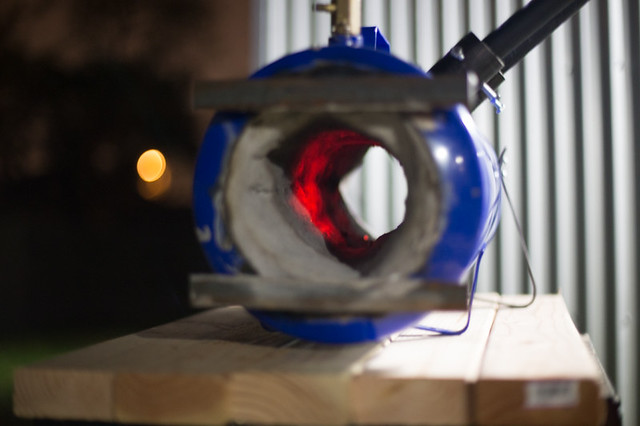
I'd appreciate your input. I am attaching a few pics of the forge in progress if that helps. In the last pic you can see the burner flares projecting into the forge body (upper right) - they are only held in place with set screws on the burner ports, so I can adjust them further in or out.


140218-RoughForge-3


140218-RoughForge-2


140218-RoughForge-1
 
The reason you use that adjustable mounting sleeve is so you can adjust the flares to be almost flush with the chamber walls. It is a good idea to coat the wool in the hole with satanite to keep it solid. The clearance between the flare and the wool should be sufficient for easy adjustment,....about an 1/8" clearance works well. More or less, just extend the rigid burner guide tube out to the chamber wall. I make the end of the hole flare out in a curved edge to make a smooth transition.

You want the burner flare not to project into the chamber any at all if possible. Projecting into the chamber will greatly shorten their life. When "tuning" the burners, move them in and out a tad to see where they run the smoothest. Do this after the forge chamber has heated up for about 5 minutes.
 
Okay - from the "Picture is worth a thousand words" department: I did this quick sketch - I think this is what you were describing, look right?


Scan
 
That's what I'm getting from what he said. I'll let him answer though.

Those are fabulous pictures btw. The forge looks awesome! What is the fitting at the top for? Is it possible to purge o2 with an inert gas in a propane forge?

Edit- duh... that's a fitting from the tanks former life I guess. :)
 
Thanks for the kind words.

The fitting in the top is leftover release valve from its former life as an air tank. I will probably take it out and close the opening with a steel plug rather than brass. The steel angles at one side will allow me to close off one end using a piece of rigid insulation that slides in between the angles.
 
That is more or less the setup.

The burner tube and flare will need to be run farther in than the sketch, though. Somewhere about the middle of the insulation layer works good. Play with it and you will find the sweet spot. You can usually hear when it is at the right spot.

Two sets of three clamping bolts are better than one. Place one set at the end of the guide tube and one set as close to the forge shell as is practical. This allows for better alignment and firmer clamping.
I like the corners where the burner hole meets the chamber sides a bit more smoothly rounded.


For the setup you drew, I would make the guide tube a close fit for the burner flare in size. The burner tube itself should be as large as the system allows, as restriction here will make for a lower BTU output. 3/4" is small, 1" or 1.25" are better. Blown is far better than venturi.

Flares are more important on venturi burners than on blown. The amount of flare needed is not really much. It is more of a curvature issue. Many folks just use Schedule 80 pipe and grind/file the last 1" of the inside of the end as a flare. The outside of the pipe is straight. This allows a closer fit to the guide tube. The purpose of the flare is to change the pressure and speed of the fluid stream by increasing the port diameter. A little flare will go a long way.

Another tip is to pack the sleeve with Insu-wool once the burner is in place. This stops heat loss as well as any venturi effect drawing air in along the sides.
 
In the past I've set my flares an inch back into 2" of wool from the heat chamber. They get some protection from the heat that way, and I just continued the flare out with satanite on the hand-formed kaowool edge. In 2007 I built a two burner sidearm venturi forge fairly similar to yours, using stainless flares from Larry Zoeller. It got hotter'n a cheap pistol but doing a lot of welding tended to burn the flare ends pretty well.
 
Salem has a good point. I didn't really go into it because it is hard to describe, but "shaping" the insulation and satanite into the flare and smoothly fairing it into the burner tube or flare is what makes it work best. Once the burners are adjusted and running right, doing this will only make it run better.

A he said, about half way out the insulation is the sweet spot.
 
Thanks for clarifying, guys!

Good tip on the second set of lock screws for the burner ports. I will see if I can make that happen with my hand drill.
 
BTW - I got my stainless pre-formed burner flares from HTT. They look very well made and durable. I'm going to start installing the insulation tonight!
 
Put on the first coat of satanite this morning. What I learned:

1) A milkshake consistency is better than a thicker pasty consistency. It might mean applying three coats instead of two, but I think it's a more efficient use of material and a smoother finish and easier application.

2) Get a small brush. The handle will get in your way even when it's tiny. A small sponge works well - and don't be afraid to use your hands (I wore latex gloves). It was much easier to do the areas around the burner inlets with fingers than with a brush or sponge.


140221-satanite-2


140221-satanite-1
 
I cooked a skillet of chicken and potatoes on top of my vertical forge once!

Forge looks good so far.
 
Dammit Bobby, how many times do I have to tell you never to joke about propane? It's a man's business!
- Hank Hill
 
I was thinking about that too. I can adjust the angle a bit with the set screws. I guess the next one I'll change the angle of the burner ports a bit if this one doesn't work the way I expect.
 
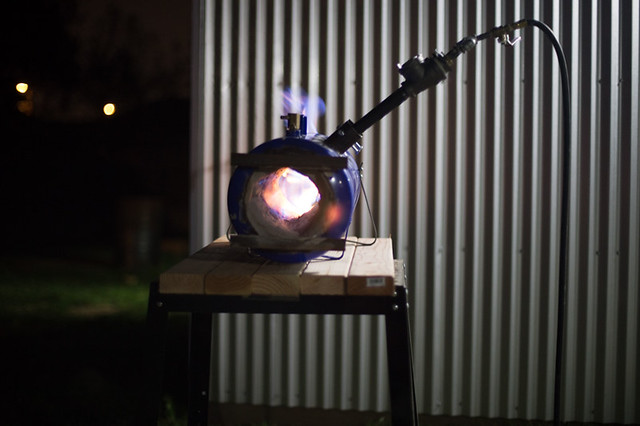
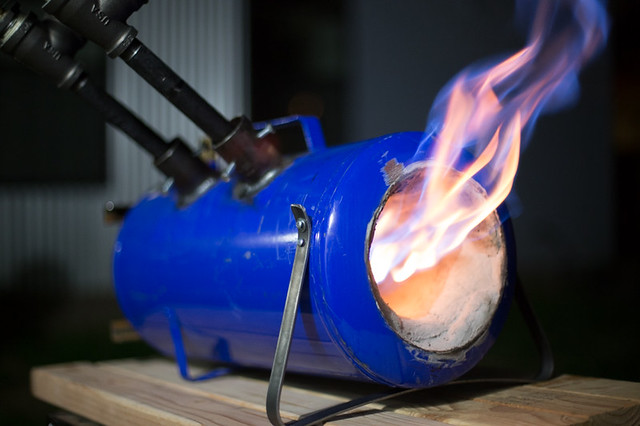
I fired it up briefly tonight to drive out the moisture from the satanite. A few pics. Need to figure out how to modulate the flame a bit - I was running 3 psi and played around with the choke plates I made a bit - it seems like even 3 psi was giving me lots of flame overflow.


140224-FIRE-3


140224-FIRE-4


140224-FIRE-5
 
Back
Top