
WIP Integral with a “Jumping Edge”

Tai Goo

BANNED
Joined
Apr 7, 2006
Messages
3,806
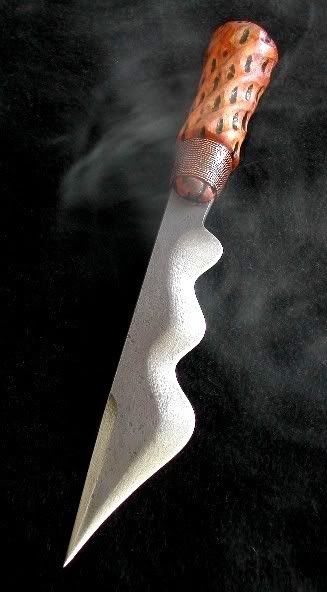
Chuck (AKA Wild Rose), and I have an order for another one something similar to this.
TheRipper1-3.jpg


http://www.taigooknives.com/Gallery...heaths/slides/WildGoo-007_Knife_Sheath_1.html

http://www.taigooknives.com/Gallery...heaths/slides/WildGoo-007_Knife_Sheath_2.html

The blade is forged integral from ¾ round 5160, with a “Jumping edge“. The handle is a piece of nice hard, dark, dense trunk stock from a local Staghorn Cholla.

… “Jumping cactus knife” for short.

Here’s what I have so far…

aaa022.jpg


aaa029.jpg


aaa030.jpg


aaa033.jpg
 
Ok no one else will ask, I must assume they all know something I do not. What would you use a Jumping Edge for?? Looks good
 
WHOA! thats neat!

what is staghorn cholla? im going to guess a member of the cacti family?
 
...and an integral, yet! Whoah.

History is replete with examples of the "jumping edge" (or wavy, or whatever). Look up the Southeast Asian keris (kris) and the European flamberge.
 
Neato, a Goo WIP! I look forward to seeing where this is going.
 
Very cool Tai. That blade is slick and that cholla makes a very interesting handle. How are you going about stabilizing it?
 
Staghorn cholla is a type of cholla cactus related to the "Jumping cactus". I use staghorn because it is the most solid kind.

This particular piece, I harvested green and seasoned myself. It's a piece of heartwood from the trunk stock, which is harder, denser and darker than the branch stock. I sealed it from the inside with epoxy paste. I'm not sure if I'm going to seal/fill the outside or leave it open and natural yet. It's such a nice solid piece, it doesn't really need to be filled from the outside for stability. It's about the color and density of walnut... a rare prime piece of cholla cactus skeleton... best I've seen or used so far.

If I do decide to fill it, (which I probably will), it will be more for "form and sanitation" than stability. I’m thinking a nice dark natural wood rosin like the first one, (pinon pine rosin), then a varnish with the same. The wood rosins I use for fillers work like hot glue (they get soft and liquid with heat and set up at room temp), but can also be dissolved in alcohol and used as a varnish. That’s probably what I’ll do.

It's going to be kind of tricky. We'll see? :)
 
Last edited:
John, I didn't get any pix of it but, I forged the bevels with a ball peen over the horn and a hardy with a rounded top. I had to counter bend it first and use my wooden schwocker a lot for adjusting the profile. The rest was fairly normal integral stuff.
 
I worked on an idea for the back end a little this morning. I wanted to try something reminiscent of a Staghorn cactus bud.

The actual flower buds are edible,… though I haven‘t quite figured out how to prepare them yet.

It’s just some quick cold punching (a bit of drilling, dreaming and reaming) on the end of a round copper bar with a round punch… might use it.

aaa037.jpg


aaa038.jpg


aaa043.jpg
 
I really like that, you should def use it... The copper petals just fit...
 
Tai,

I'm still trying to wrap my mind around how you put the edge on that bad boy ... ? :confused::confused::confused: AWSOME blade, Sir! :thumbup::thumbup::thumbup:

Larry
 
Very interesting design. I'd not heard of that cactus before and really like how it looks.

Are you tapping the steel tang to accept the threaded copper riveting end piece? That's a pretty neat idea, and makes me think about a project I have been at a dead end on for ages. I just might be able to adapt that idea and make something work. Maybe.

Can't wait to see how this turns out.
 
Larry, For the forging I had to use tight rounded surfaces (top and bottom), on the bevels to work along the edge, especially the indented areas. After I forged the bevels I did some filing (half round and round files) and sanding. There is no secondary bevel on the edge. It’s mostly sharpened by sanding the bevels to raise a burr, then it’s kissed with a hard Arkansas and stropped. For the sanding I wrapped sand paper around a 1 inch diameter wooden dowel. The stone and strop also had rounded surfaces.

VaughnT, The end of the tang has a “V” notch in it. The copper piece fits into the notch and is soldered with hard high temp silver solder. It's stronger than a straight butt seam.
 
Back
Top