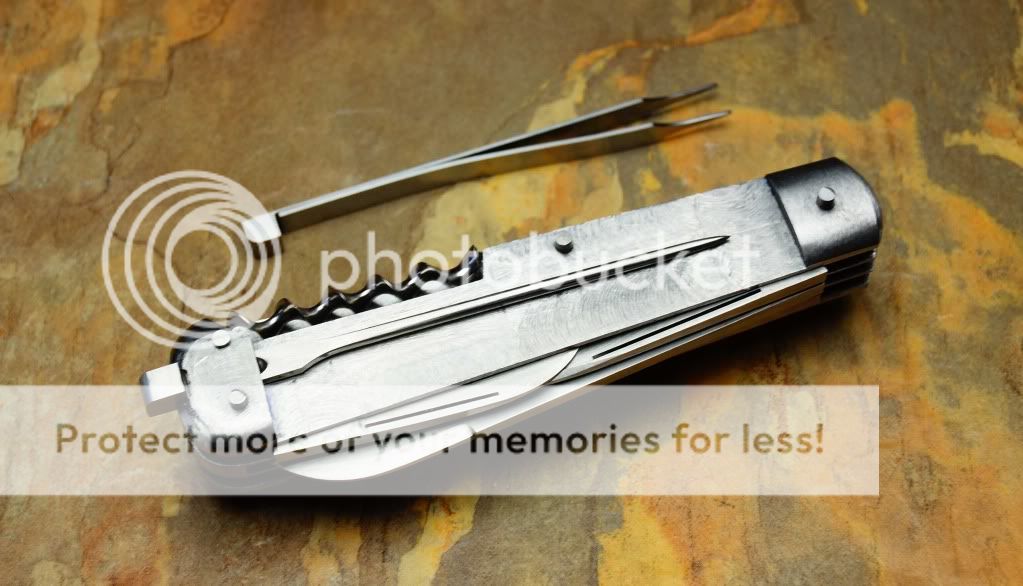
WIP of Sheffield inspired 3 thick Sportsman's knife - Ken Erickson

Incredible :thumbup:


I love the new tweezers design. Looks great at picking those pesky things out or placing a very small item perfectly. Your ingenuity shines through loud and clear in this thread Ken. I can never get enough of your builds. Thanks for sharing the process and taking the time to post all the pics, info and video. We all appreciate your effort and hard work.
 
Exquiste craftsmanship:thumbup: One day I hope to own one of your masterpiece's Ken:thumbup:
 
After seeing all the work that goes into one of your knives, I must admit I'm going to start saving for one now:D
 
Thanks for the all the kind comments guys. I really enjoy sharing this voyage. I can remember years ago looking at pictures of knives with tweezers, corkscrews etc and thinking , how do they do that? Learning and doing, for me, is the greatest reward.
 
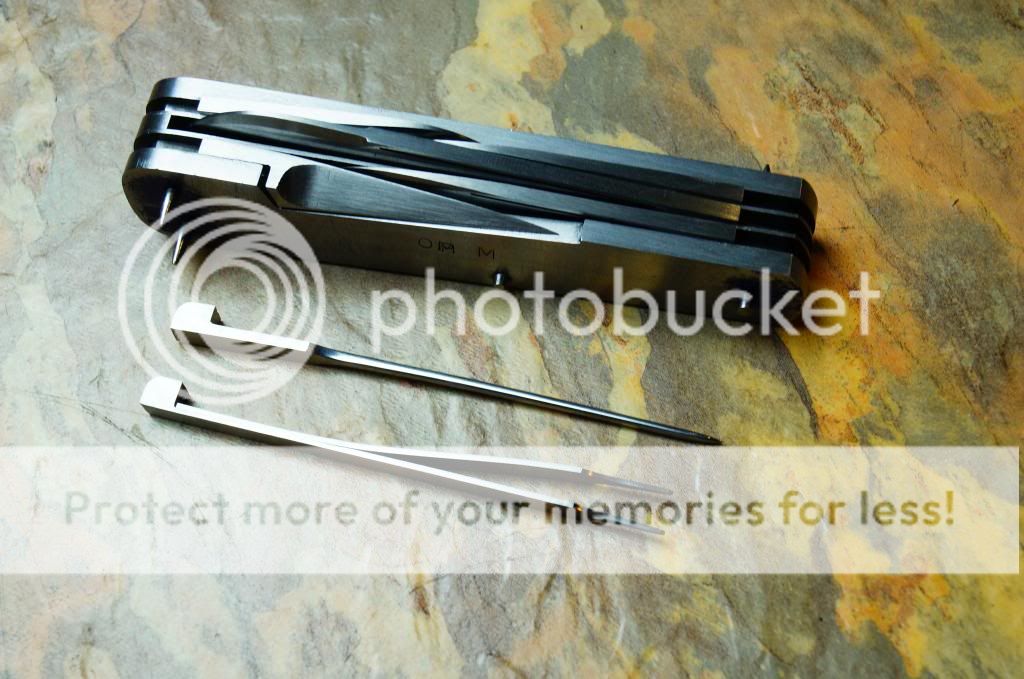
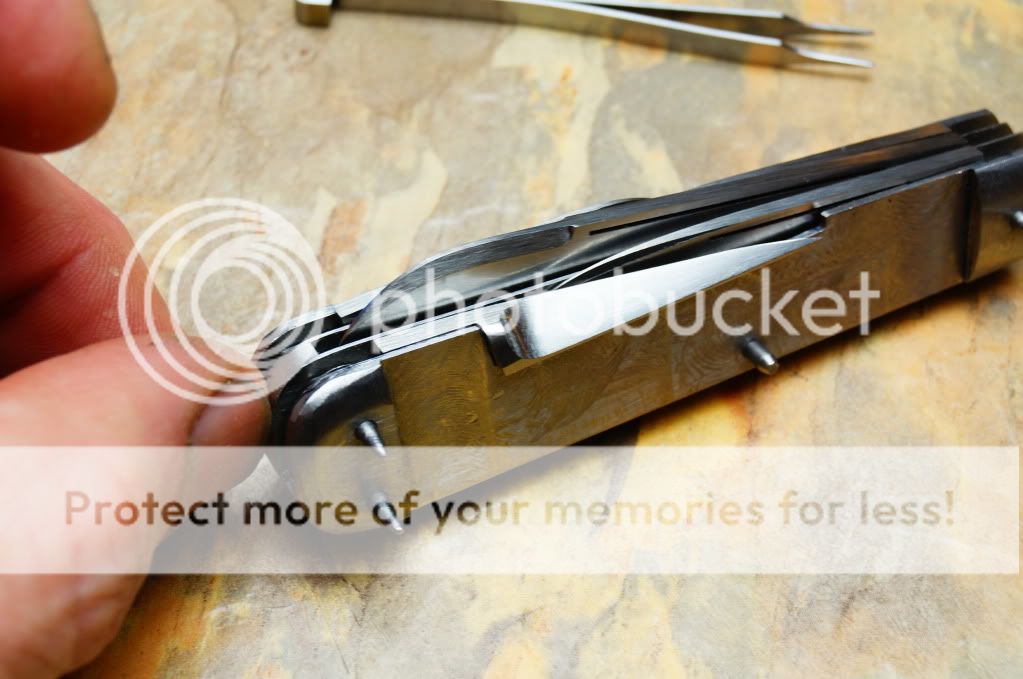
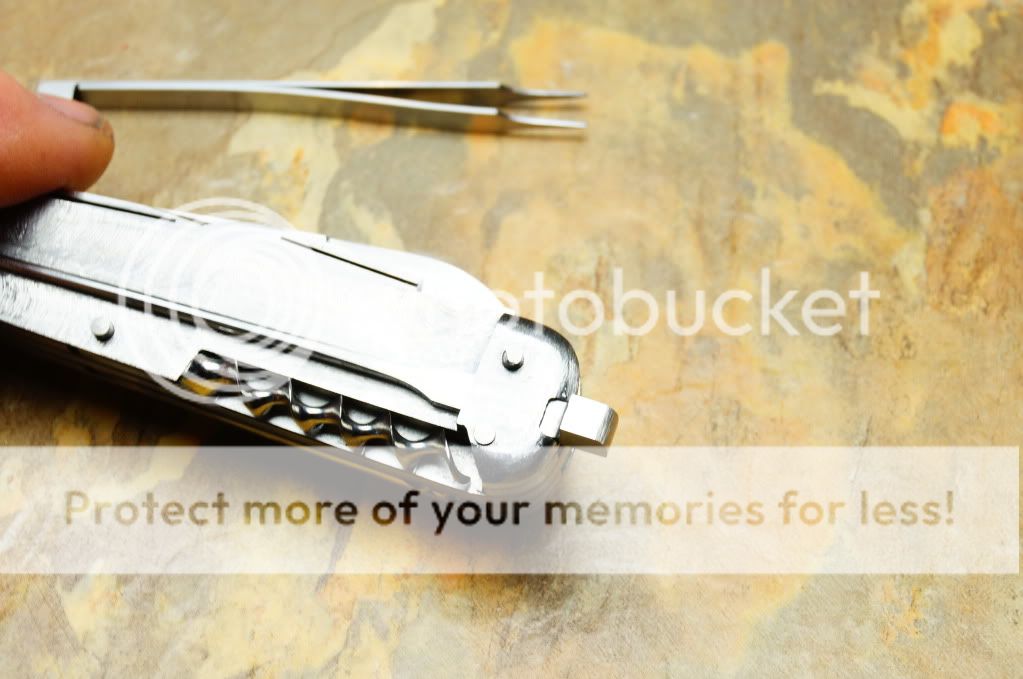
Made some progress on the knife. I was not happy with the mark side frame/bolster to leather punch fit. I had too large of gap toward the rear of the punch, so I re-made the side. I also milled the frame/bolsters for the covers. Elliott had asked were I was on weight. Before milling the frame/bolsters I was at 5 7/8oz, after 4 oz. I would imagine that with the covers I will come in around 4 1/2 to 4 3/4 oz total weight.

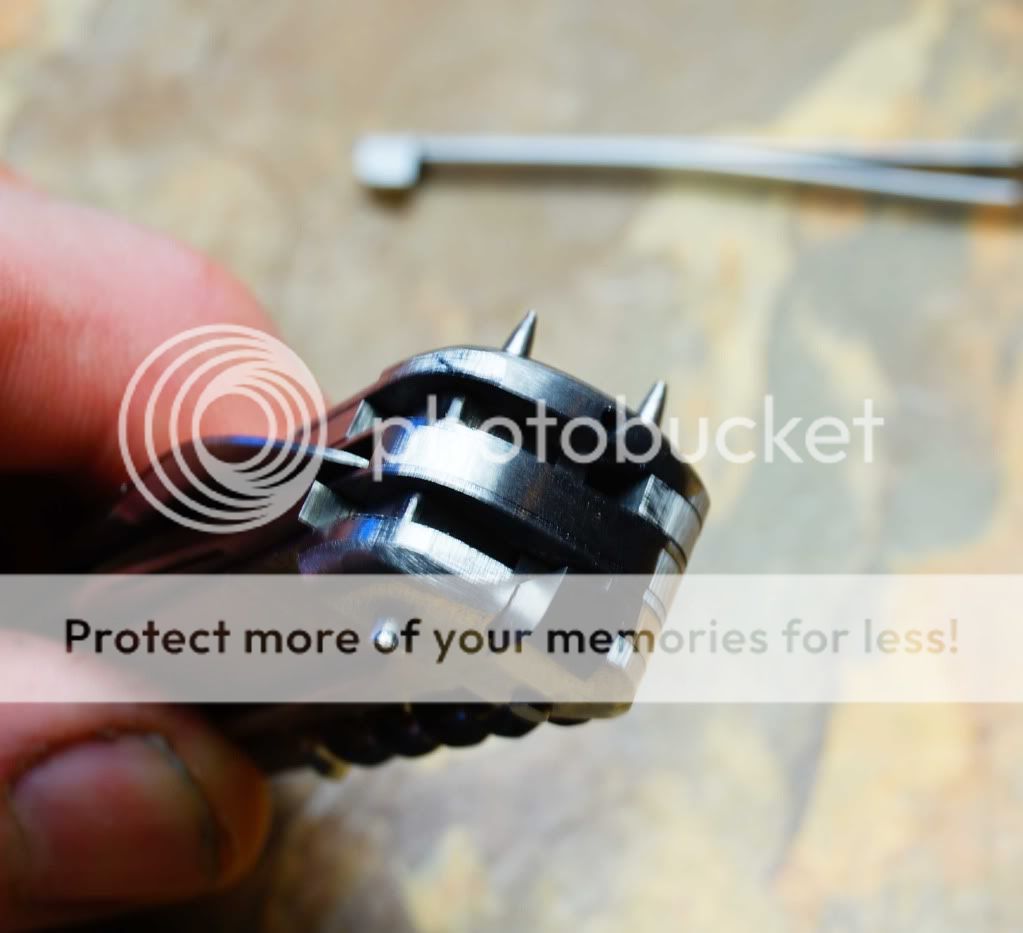
I also started to fit the one side for the lancet. I knew going in that this was going to be a time consuming operation as I still have a integral cap bolster. Had I planned on soldering on the bolster I could mill the back side first to form the trough that the slide-out implement needs. What I had to do was drill a 1/16 hole , then enlarge with a tiny dental burr and finish up with some needle files I ground for this job.

If you compare the gap at the rear of the punch in the two pictures I think you will agree that a new mark side bolster/frame was warranted.
DSC02305.jpg

DSC02324.jpg


DSC02323.jpg

DSC02322.jpg

DSC02317.jpg


My next steps will be to finish the other cap bolster for the slide-out and then start to refine the bolsters, blades and springs. I want to have things 80 to 90% completed before I install the covers. Milling the frame/bolsters really is a big step forward as far as feeling, looking like the finished knife will.
 
Ken,

What process are going to use to have the toothpick and tweezers nest into the bolster, appears to be a daunting task?

Fabulous build that makes you appreciate the final result even more!

Great job, Jeff
 

Ken,

You are amazing us along the way as usual! Another question for you is why is there a cut near the base of the tweezers? Sorry I don't know terminology. I remember reading you made the tweezers out of one piece as opposed to how Richard Rogers solders them together? I know everything is the way it is for good reason, but I wanted to understand for myself. Thanks, and sorry if this was already addressed.

Kevin
 
Ken,

What process are going to use to have the toothpick and tweezers nest into the bolster, appears to be a daunting task?
Jeff

Jeff,
I just about have the cut-outs finished on both bolsters now for the slide-outs. Keep in mind that there is extra material at the end of the slide-outs that will be ground away to match the height, length and radius of the bolsters. I should be able to follow up with a picture tomorrow that shows how they will nest with the bolsters.

Ken,

Another question for you is why is there a cut near the base of the tweezers? Sorry I don't know terminology. I remember reading you made the tweezers out of one piece as opposed to how Richard Rogers solders them together?
Kevin
Kevin,
This set of tweezers is the second that I have made. The first set was one piece. This set is two pieces pinned together. I still think I will be making a third set using Richard's method to decide which way I prefer.

Beautiful work, Ken. I'm enjoying the photos. That tweezer is great. The profile of the tweezer reminds me of Dumont No. 5 http://shopping.roboz.com/micro-sci...er-5-forceps/No-5-Dumont-Carbon-Steel-RS-5035
A very nice choice, in my opinion. All the tools/blades look exceptional!

Jake,

Good eye! Ed had requested a "number 5 medical" profile when discussing the tweezers. On the final version, which ever method I end up using, the tips will even be more needle like than what I have on this version, to closely match the number 5 profile.
 
Last edited:
Ken, No. 5 with "biologie tips" are probably one of the more common patterns. http://shopping.roboz.com/micro-sci...orceps/No-5-Dumont-Dumoxel-Tip-Size-05-X-01mm The .10 X .06mm tip size is very delicate. Students are good at bending them into interesting shapes. ;) A .34 X .14mm tip size like this No. 2 Dumont might be a good compromise. http://shopping.roboz.com/micro-sci...ttern-1-2/No-2-Dumont-Inox-Tip-Size-34-X-14mm


P.S. A set with a scalpel and scissors would be awesome.


Jake, thanks for your input (no sarcasm) but I spend quite a bit of money at Roboz and Fine Science Tools. I specifically requested a # 5 with specific dimensions.

Yes, a scalpel and other such tools might be nice, but Ken assures me the blades on this knife will be nice and sharp. Aside from that, I don't think that autoclaving any part of this knife is gonna happen. Nor will concentrated iodine (which will eat metal) nor will glutaraldehyde. And I won't hold any part of the knife in an open flame. As those are the best methods of sterilization that I know, I guess I'll have to leave the sugeries for my Roboz tools.
:D
 
shaldag, so you're the lucky dog. The scalpel/scissors/forcep wasn't for you. ;) I didn't intend to step on any toes. What specific dimensions did you request? My thought was that a more robust tip than a biologie tip would be better suited for a pocket knife, since the tweezers are not (easily) replaceable. Biologie tips would be cool though. ...I suppose you'll have to settle for 70% EtOH unless you want to ruin the temper or the metal... though I don't expect (or atleast hope) that you won't be using it for actual surgery. I haven't tried autoclaving my Erickson whittlers. :p
 
I find that the discussion and the making of the tweezers for me has been one of the most enjoyable and surprising part of this knife build. Jake, may I ask what 70% EtOH refers to?
 
Ken,
it's Ethanol in a 70% solution.
I have to be honest, even if I work surrounded by autoclaves, I never thought about sterilizing any of my knives :D
Again, the tweezers work is amazing and intriguing. Unfortunately, the toothpick isn't as interesting :rolleyes:

Fausto
:cool:
 
70% ethanol (EtOH) is sometimes uses as a weak method of sterilization, usually after washing with a very strong detergent... or sometimes just soap. That would be for basic use, not surgical. In a tissue culture environment, the tips of the forceps are dipped in 70% EtOH and lit by a Bunsen burner. That does ruin the temper but the temper of the steel is not especially important for this application. But probably the most common methods of sterilization would be heated sterilizers and autoclaves which use hot steam. I think it would be possible to use an autoclave on an all metal tool like the tweezers but it would depend on the type of steel and heat treat and the temperature used in the autoclave. It would probably destroy bone handles. For sanitary reasons, the old bone handle surgical tool knives were replaced with all metal knives and tools and eventually largely replaced with disposables.
 
Last edited:
Back
Top