Woodcraft Knife Scales

I've used their wood before and it's every bit as good as anyone else'. Know that some of the wood such as the Maples need stabilizing but woods such as the Desert Ironwood, Cocobolo and Snakewood do not need stabilizing. I'm not 100% sure, but I don't remember any of the scales I bought from them as being stabilized. But then, I generally buy scales from them that don't need stabilizing to begin with.
 
They tend to stabilize the woods that absolutely need it. The woods like Curly Maple, Black Palm, are perfectly ok to use unstabilised, but there will be a small degree of movement over time. (not so much if the handle was fitted under the same humidity and temperature as where it'll spend the majority of its days). Oily woods like anything from the Dalbergia species (most of the woods knifemakers love to use) don't need stabilisation and you'd find it difficult if not impossible to stabilise in the first place. You'd have to displace all the oils in the cellulose matrix and replace them with resin. Be careful with these woods as power tools tend to burn the oils leading to deep dark staining through the wood, losing all the interesting grain movement and different colour splashes/stripes in the wood. I use chisels, rasp and files followed by sandpaper to work them.
On that chart of woods, the only one I would be concerned about would be the spalted tamarind (which appears to not be stabilised). The others move a little bit but I think you'd have to be really OCD for it to be a concern.
 
I checked the link and see what you mean, some of the wood is listed as stabilized. I have no clue on the quality of their stabilizing.


African Blackwood and Ironwood are two they sell that don't need to be stabilized.

The Spalted Tamarind and Redwood really need to be stabilized and I noticed they were.

...Anything in between like Rosewood or Cocobolo should be fine but you could be taking a risk. The guys who sell lots of knives with wood scales will know more on this...
 
Last edited:
It mostly depends on the species and density. Ironwood, for example, is really stable and hard in its unfinished, unstabilized state. Its a bit oily too and will buff to a nice shine all on its own. Softer, more porous woods benefit the most from stabilization. A spalted maple or hackwood scale will often have slightly punky, soft zones that will become harder and virtually moisture proof when stabilized with a resin. A thread search on these forums for the wood you're using will turn up lots of hits. Some woods are hard but porous and need only danish oil or true oil to seal them up. When the structural longevity of the wood is in question I would say stabilization is in order. Burly woods can also check (crack) over time when the moisture content changes a lot so they probably need to be stabilized or at least sealed well for knife handles.
 
I would concur. Some of the wood that is heavy/resinous (Cocobolo, Rosewood, Ironwood) doesn't need to be stabilized. Others, like Purpleheart, maple, snakewood, really benefit from stabilizing. I prefer to use stabilized wood where available - It tends to be less frangible and splintery.

TedP
 
Good advice above. I'd recommend buying the 1.5 or 2" square stock and cutting scales yourself. I've bought African Blackwood, satinwood, cocobolo, bocote from them, and they sell others as well.
 
Look at this list of dalbergias, see how many are knife makers favourites?
Dalbergia bariensis Pierre – Burmese rosewood
Dalbergia baronii Baker – Madagascar Rosewood, Palisander Rosewood, Palissandre Voamboana
Dalbergia brownei (Jacq.) Schinz – Coin Vine
Dalbergia cearensis Ducke – Kingwood
Dalbergia cochinchinensis Laness. – Siamese Rosewood, Thailand Rosewood, Tracwood
Dalbergia decipularis Rizzini & Matt. – Tulipwood
Dalbergia ecastaphyllum (L.) Taub. – Coinvine
Dalbergia frutescens (Vell.) Britton (Syn. Dalbergia variabilis) – Brazilian Tulipwood, Jacarandá Rosa, Pau de Fuso, Pau Rosa, Pinkwood, Tulipwood
Dalbergia hupeana Hance
Dalbergia latifolia Roxb. – Bombay Blackwood, East Indian Rosewood, Indian Palisandre, Indian Rosewood,Irugudujava,Java Palisandre, Malabar, Sonokeling, Shisham, Sitsal, Satisal
Dalbergia louvelii R.Vig.
Dalbergia madagascariensis Vatke
Dalbergia mammosa Pierre
Dalbergia melanoxylon – African Blackwood, African Ebony, African Grenadilo, Banbanus, Ebene, Granadilla, Granadille d'Afrique, Mpingo, Pau Preto, Poyi, Zebrawood
Dalbergia monetaria L.f. – Moneybush
Dalbergia nigra (Vell.) Allemão ex Benth. – Bahia Rosewood, Brazilian Rosewood, Cabiuna, Caviuna, Jacarandá, Jacarandá De Brasil, Palisander, Palisandre da Brésil, Pianowood, Rio Rosewood, Rosewood, Obuina
Dalbergia obovata E.Mey. - Climbing Flat Bean
Dalbergia odorifera T.Chen. - Fragrant Rosewood
Dalbergia palescrito Rzed. – Palo Escrito
Dalbergia pinnata (Lour.) Prain
Dalbergia retusa Hemsl. – Caviuna, Cocobolo, Cocobolo Prieto, Funeram, Granadillo, Jacarandáholz, Nambar, Nicaraguan Rosewood, Palisander, Palissandro, Palo Negro, Pau Preto, Rosewood, Urauna
Dalbergia saxatilis Hook.f.
Dalbergia sissoo – Agara, Agaru, Errasissu, Gette, Hihu, Indian Rosewood,Irugudujava, Iruvil, Iti, Khujrap, Padimi, Safedar, Sheesham, Shinshapa, Shisham, Shishma, Shishom, Sinsupa, Sissoo, Sisu, Tali, Tenach, Tukreekung, Yette
Dalbergia stevensonii Standl. – Honduras Rosewood, Nogaed
Dalbergia tonkinensis Prain
Dalbergia tucurensis Donn.Sm. – Guatemalan Rosewood[2]

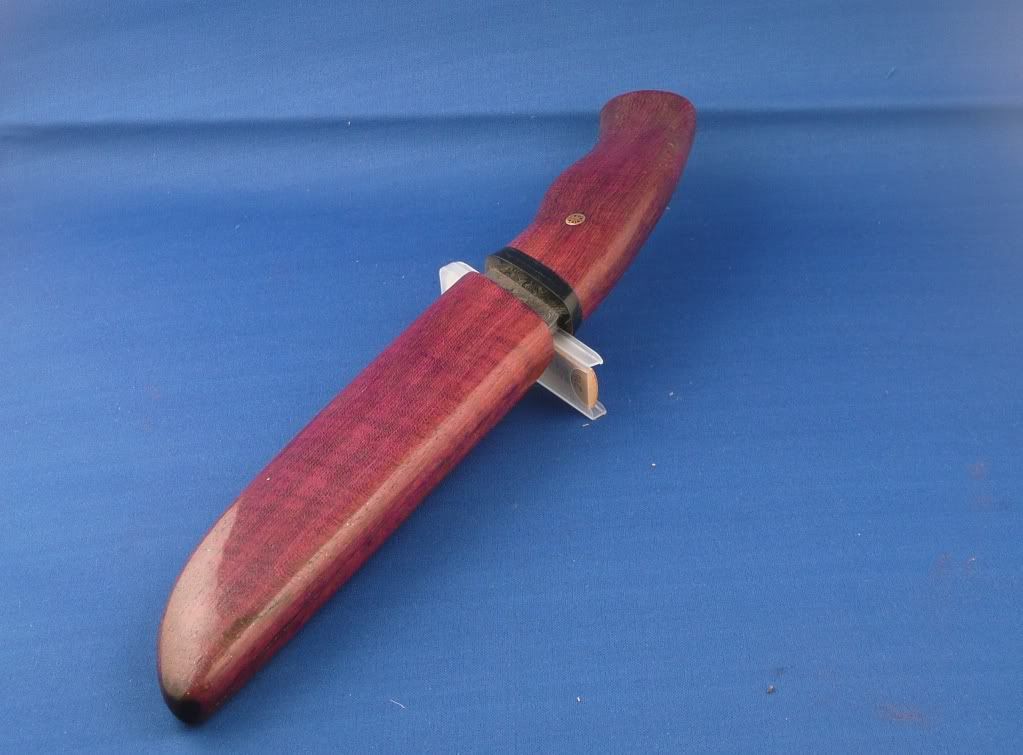
I would only disagree with Ted regarding Snakewood (leopardwood) and Purple heart. As I think you'd have difficulty finding someone to stabilise it properly as they're very oily. I don't know anyone in the UK who would stabilise those two woods. They can be splintery in one direction of the grain (and possibly reducing this tendency would be the only benefit from stabilising) , but I think wetting the wood down between grit changes of paper and keeping any edges rounded off stops that from happening anyway. I also suspect you would lose one of the best features of Purpleheart by stabilising it. The hue and intesity of the purple colouring comes from a reaction to UV. When the wood is first worked, it has a chocolatey tinge to it over time (and exposure to UV) this becomes more and more purple. Some of the peices I did about 5 years ago have the most intense purple colouring and the grain looks like it's been dipped in liquid glass. The grain and pores seem to about 3mm under the glassy surface of the wood. They weren't treated in any way except a wipe with a soft cloth after use to get rid of fingerprints. When I did the pieces I finished to 8000 grit on micromesh and then a rub with a beeswax/carnauba wax stick and a buff with a soft cloth. This was a commission, the pictures were taken the day after finishing and the knife spent the night under a flourescent "black light".(because I didn't want to ship it with brown patches) The contrast between the light and dark (tiger stripe) has since increased and the surface has become even glassier. The whole knife is now more purple than pink.
 
I've been buying exotics from Woodcraft for around 15 years. They have a good selection that seems dried slowly enough that I've never had the blanks split or warp. The one exception to my good experience with them was a bundle of pen blanks I bought on a rain check during a Black Friday sale. It was supposed to be a bundle of exotics, which may have been technically correct. I was expecting a bundle of Cocobolo and Purpleheart type material, but what I got was straight grained, light colored hardwoods that look like what they make imported kitchen chairs out of. I took it home, but it was barely worth the deeply discounted price.

- James B
 
I have used padauk, Brazilian tiger wood, and cocobolo without stabilizing. Zebrano, hard maple, and walnut are fine without stabilization.
 
The oils in wood can also cause epoxy not to stick to them unless the oil is removed, typically with acetone.

- Paul Meske
 
I ordered some pieces now!

I got:


Cocobolo 1-1/4" x 1-1/4" x 13"

Bocote 3/8" x 1.5" x 5" Knife Scale 2pc

Maple, Birds Eye 1.5" x 1.5" x 5"

Olivewood 1.5" x 1.5" x 6"

How would I cut the blocks into scales with a table saw?
 
Yep, a table saw with a good quality, thin kerf, carbide tipped blade .....ALWAYS USE PUSH STICKS.
 
Table saw. I divide the width of the board by 4, then set the fence to roughly that thickness. If I do the math right and account for the kerf of the blade, I can get four strips out of a 1.5 square.
 
Listen to Stacy. Use push sticks. Make sure the scales are long enough to pass through the saw safely.

Ric
 
I got my wood! I have one question, the blocks are coated in wax, I should remove this before sawing right? How should I remove it?

Here's what I got:

54C97EFA-1A85-4C49-A09D-B0CE82E3D364-795-000000AD1F6D553F_zpsb8151e67.jpg


Cocobolo, birdseye maple, olive, and bocote.

I noticed the cocobolo block had this in it, so I contacted the nice people at Woodcraft and they offered me another block of it. I figured that most of the block was usable, so I opted for some rosewood scales.

AAD31BFC-D9CF-4507-A661-49005D454F0B-795-000000AD2D384B94_zps56323c5d.jpg
 
I guess this question got lost in my post...


I have one question, the blocks are coated in wax, I should remove this before sawing them into scales right? How should I remove the wax?

(Was this an okay way to get my question answered instead of bumping Stacey?)
 
Back
Top
