Wool blankets

QOUTE WIKIPEDIA:

"Characteristics

. . .Wool's scaling and crimp make it easier to spin the fleece. They help the individual fibers attach to each other so that they stay together. Because of the crimp, wool fabrics have a greater bulk than other textiles and retain air, which causes the product to retain heat. . . .
"Boiled" wool is like felt = less bulk but much better wind-resistance.

The big plus as someone already mentioned is that you won't flare up like a barrel of maya dust if a spark from the campfire lands on you.
Pitdog, polyester and nylon burn, but not partuclularly well. Unless you hold the material in a open flame, you get holes melted in nylon outers and fused spots on fleece (which look brown to me). Wool is much better. Cotton is much worse. Hold onta' your Maya Dust (CR).
 
Last edited:
There's an episode of Survivorman where Les wears something very similar to this (can't remember if it was wool or fur/hide) while "camping" in the wreckage of a simulated small plane crash. It had shorter sleeves like yours, which would be great for keeping snow off them and for putting big winter gloves off and on, I imagine. It also had a long "tail" in the back which was useful to sit down on in the snow when there wasn't anyplace else off the ground (I assume it had to be somewhat water resistant). All in all, looks like a pretty sweet big, bulky, warm "over-shirt" for cold wintery weather.

We have the same mentor as well as many friends in common.... the group kinda levitates toward the same equipment.... lol.
 
Where I live it is -28 Celsius right now and will get quite a bit colder during the night so I know cold weather. Natural materials like wool ,fur and and my current fave alpaca are much better than synthetics. I like a silk or merino wool under layer ,then wool or alpaca
and a synthetic hard shell for the top layer although I am going to replace that hard shell with a wolf fur hoodie once I shoot some more wolves now that they are getting their nice coats. The one real advantage of synthetics other than price is they are lighter weight.

I saw a great science show where they tested some Viking era natural materials cold wet weather gear and some modern top of the line synthetic gear and sat 2 guys who weighed the same and had similar metabolisms in the cold wet weather and monitored their body temps. The natural gear went down a fair bit slower in temp than the modern gear but was also a bit bulkier and heavier. The point was to find out how the Vikings managed to traverse the north Atlantic in open boats without freezing to death.

Alpaca is amazing and wool is the only material that keeps you warm when it is wet ,everyone knows that.
 
Alpaca is amazing and wool is the only material that keeps you warm when it is wet ,everyone knows that.

First, I guess it depends on what "wet" means. I think of wet as capable of having liquid water squeezed out, and I think I know that nothing insulates worth a #@$!^ when it's "wet" in that sense. That is why we emphasize keeping dry, as do the First Nations folk. As in, "Work slow; stay dry; stay alive."

Again, all the folks equipping Artic and Antarctic expreditions that I can find in hours and hours of research don't use wool except for socks.

The Swedes dropped wool in favor of man-mades.
The Germans ditto.
I own what they sold off. Nice stuff. Love it.

Canada?
http://www.army.forces.gc.ca/LF/ENGLISH/2_display.asp?product=110
http://www.peerless.mb.ca/xtreme_parka.htm
Wool hood liner. Otherwise plastic.

U.S. Government testing reportedly involved putting tanks of water hooked to thermometers inside garments and measuring the temperature fall. Then they tested the gear on the entire 10 Mountain Div. in 'Stan. No wool. All "plastic."

They could all be wrong. I didn't witness the tests. But your "everyone" is a tiny minority.

Keep the faith.
 
Excellent post, Pitdog..... that's using yer noodle.

For those who asked here is are a couple methods I used during my cold training...

I should add that extreme cold temperatures require a different sleep routine. You sleep when you can during the day and work all night. During the day, I would tie my poncho between saplings... tight like a trampoline with my blanket on top... When I was tired, I would lay in it and the whole thing would dip and hug me like my mother used to... lol. This was great on sunny days.

The other technique was to make a "cocoon" using debris covered and contained by my poncho. Don't use this one more than a couple times as condensation will begin to build up. It would be easier to draw a pic of this one...
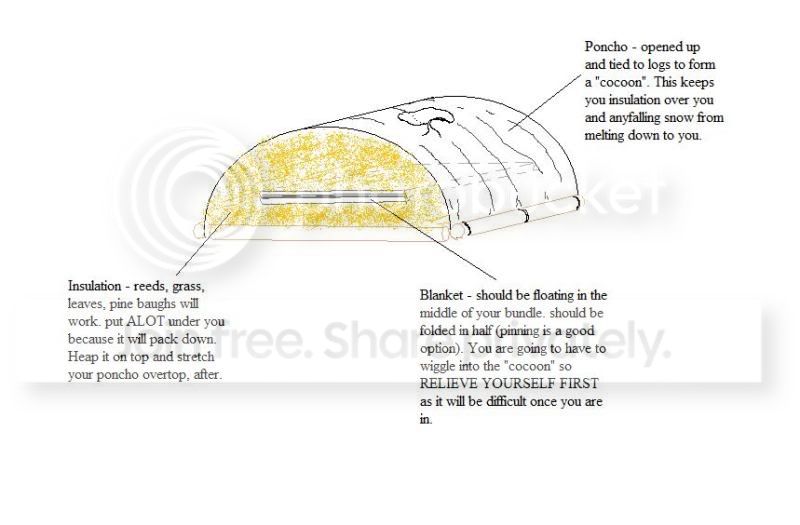
Cocoon.jpg


There are many other options... I hope this helps.

Rick

PS..... NEVER CLIMB INTO A PONCHO LIKE YOU WOULD A SLEEPING BAG OR A BIVY... THE CONDENSATION CREATED INSIDE IS VERY DANGEROUS!!


:thumbup:

Okay, THAT makes sense! So the insulation is not really wool per se, but the debris.

I was picturing this being done without anything but the blanket and the poncho and couldn't figure it out for the life of me!
 
They could all be wrong. I didn't witness the tests. But your "everyone" is a tiny minority.

Keep the faith.


I can say from first hand experience, fleece does retain a lot of body heat when saturated. Practicing ice rescue is still not fun.

Water also drains out of fleece by gravity alone and will dry out with body temp alone. Not so with wool. Pros and cons for sure but modern synthetics are here to stay for good reason.

Skam
 
Okay, THAT makes sense! So the insulation is not really wool per se, but the debris.

I was picturing this being done without anything but the blanket and the poncho and couldn't figure it out for the life of me!

thats all i use is a wool blanket and poncho (or tarp). Never had an issue.


I challenge anyone to go spend a day out on the east coast of canada, or up in the crab waters of the Northern waters, in a fishing scow during the winter rains., in your fleece. If you survive the first few hours at all i urge you to try the same experience with a wool fishermans sweater. You will be damp, possibly even wet, but you WILL be warm. Centuries of coastal fisherman and lobstermen have proved that wool keeps you warm when wet.
 
Last edited:
Okay, THAT makes sense! So the insulation is not really wool per se, but the debris.

I was picturing this being done without anything but the blanket and the poncho and couldn't figure it out for the life of me!

That was just one of the techniques we used... I warmed up by the fire mostly. Like I said... in extreme cold survival situations it is not wise to sleep at night... you gotta keep feeding that fire... putting hot liquids and food into your sytem.... especially if you are foraging in 4ft of snow. Easier to sleep during the day. I've slept using just the blanket, too. In those kinds of temperatures there is not much moisture in the air so sunlight actually warms you if the wind is blocked.
 
Wool certainly does have airspace - until it doesn't . While it does, it is probably still capable of absorbing water and keeping it off you. It feels "dry." It may even still be generating heat. That's why wool was once THE standard for cold-weather wear. When it doesn't, it cannot absorb any more water, feels wet, and does not insulate.

Trapped water does not insulate as well as traped air. Higher specific heat, but not insulation. If it did, thermo windows would be filled with water. If it did you wouldn't be advised to wear a dry suit, not a wet suit, when water temps are below 60F.

If you have some source for the insight that trapped water insulates as well as trapped air, please share. New knowledge comes along all the time.


I did not claim that trapped water insulates as well as trapped air. That is why dual pane windows have air spaces rather than water spaces. But trapped water does have some insulating capability (again, the wetsuit comparison). It's just not as good as trapped air, which is why dry suits are used in cold water.

Don't get me wrong, I am not saying wool is superior to modern synthetics. I have and use both, and both have their place. I was just trying to correct the misconception that wet wool has zero insulation value.
 
thats all i use is a wool blanket and poncho (or tarp). Never had an issue.


I challenge anyone to go spend a day out on the east coast of canada, or up in the crab waters of the Northern waters, in a fishing scow during the winter rains., in your fleece. If you survive the first few hours at all i urge you to try the same experience with a wool fishermans sweater. You will be damp, possibly even wet, but you WILL be warm. Centuries of coastal fisherman and lobstermen have proved that wool keeps you warm when wet.

Did they spend the same amount of time trying out the synthetics to see which was better?

I have spent enough of my life working in the cold - both dry cold in northern ontario and quebec and wet cold on the BC coast - to know that most guys have switched to fleece. It's cheaper, easier to get, and it doesn't weigh a ton when it gets wet. Wool is warm when it's wet, no doubt about it. So is fleece, so no problem there. Do you know any commercial fisherman out here or on BC's North Coast, or in the Charlottes? The uniform is always the same...fleece under hellys. I have not seen anything else in years, except the odd guy who wears about half a dozen cotton hooded sweatshirts...there's always one. But I haven't seen much wool in a long time.

Pile driving - that's my day job most of the time - is done on the water for the most part. We spend all our days outside in whatever weather the coasts throw at us, generally 12-16 hours a day. I know all about dealing with cold and wet! Not only do I seem to keep surviving the first few hours, I seem to survive the middle hours, and the last hours, week after week, month after month, year after year!

If you are finding that you are able to sleep comfortably in 35 below with just a wool blanket and a tarp I would be interested to hear your technique!


Magnussen your explanations make a lot of sense...dry cold is definitely not so hard to deal with but even so getting warmed by a fire is a good approach IMO!

Of course if you have a fire going...does it still count as using a blanket in -35? after all you've probably warmed up the immediate area to +5! ;)

Sleeping during the day is a very good idea...the snow can probably act as a bit of a reflector oven in your poncho-hammock-burrito system, probably good for a few extra degrees!
 
Magnussen your explanations make a lot of sense...dry cold is definitely not so hard to deal with but even so getting warmed by a fire is a good approach IMO!

Of course if you have a fire going...does it still count as using a blanket in -35? after all you've probably warmed up the immediate area to +5! ;)

Sleeping during the day is a very good idea...the snow can probably act as a bit of a reflector oven in your poncho-hammock-burrito system, probably good for a few extra degrees!

I would rather be at -40F in Northern Ontario than -10F in Southern Ontario.... that's for sure......... My wilderness survival stomping grounds are limited to Ontario (Northern and Southern)... I can't vouch for wool's effectiveness on the rainy, cold coasts.

I thinks fleece is a wonderful fabric and has many advantages over wool.... I use microfleece as a base layer.
 
Gotta say, I don't know of anywhere else that one could find a 4 page, heated discussion about wool vs synthetics. :D

(Sorry for the 'heated' pun, couldn't resist)
 
... I can't vouch for wool's effectiveness on the rainy, cold coasts...

I can vouch for wool in the cold wet climate of the British hills where you will be walking in freezing rains.
You get wet no matter what rain gear you wear.
Woolen clothing kept me warm when it was wet.
 
I just hate having the wool pulled over my eyes.


Yup.... you got fleeced on that one! :jerkit:


And that ain't just a sheepshot....


..... oooh, that last one was pushin' it...... :o


Okay enough spinnin' yarns, already!!


Rick
 
Back
Top
