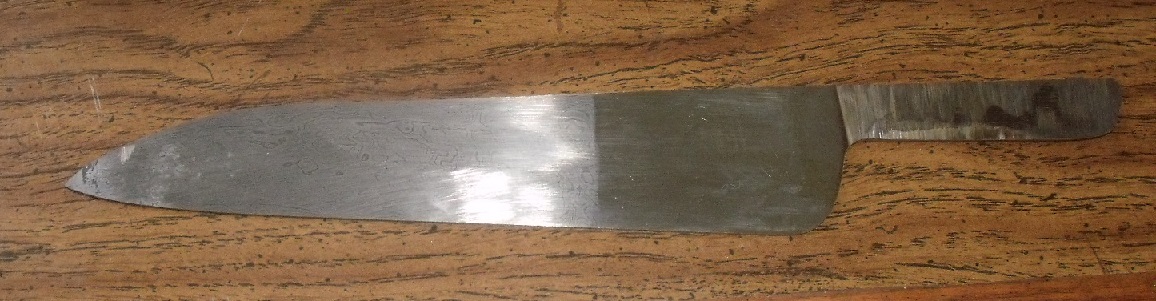
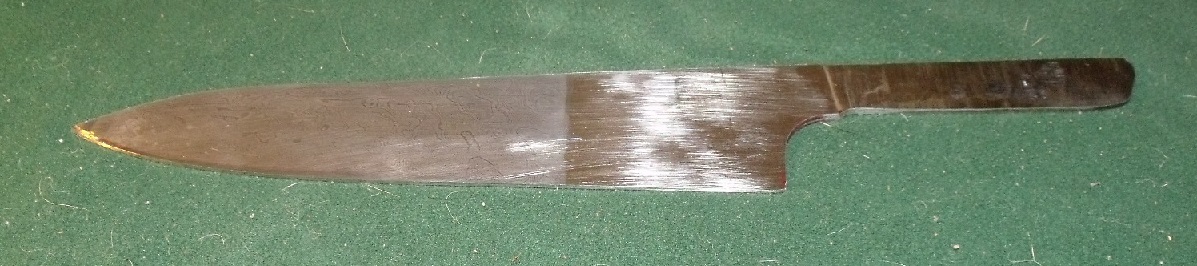
Working on 2nd kitchen knife...advice wanted (Final Pics)

weo

Joined
Sep 21, 2014
Messages
3,116
Hello all.
Spent the day at the forge today and forged out another kitchen knife. Seeing as my anvil doesn't have a flat face, I'm planning on having my friend flatten it under his 250lb Chambersburg or 50 ton press. Billet started at ~1 3/8" x 1/2 " and was 240 layers of 1084/15N20 that I ground random waves in before forging.
The blades forged dimensions are: 9 3/4" long; Spine is 0.240" at the heel, 0.145" at the tip; edge is ~0.100 from heel to tip. Height at heel is ~2.095"
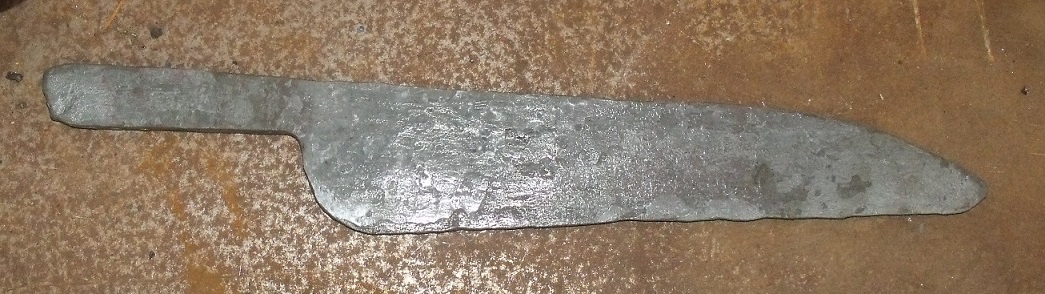
zgI32iV.jpg


Any suggestions on shape changes?
What dimensions should I be shooting for when forging?
What thickness should I tell him to shoot for?
Anyone ever do a random curves pattern?
and lastly: What's a good size for starting billet size when grinding a ladder pattern or drilling shallow holes? To be honest, I'm beat after forging this into a blade and another piece into a ladder pattern blank today...:yawn:

Thanks in advance for the answers/advice.
 
Last edited:
With forged damascus, leave plenty of metal to grind away in the shaping. The dips and ridges are often deeper than they seem, as well as layers of decarb and scale to be removed. I leave about 25% to 50% in thickness to be ground away after forging.

Your blade looks about right to take to the grinder. Just flatten it as well as you can on a board or flat piece of metal plate and then grind and adjust as needed in the finishing.
 
Thanks Stacy. Is this a decent shape? (I really need to get a poster in the shop to give me a target to shoot for:rolleyes:....)
 
Shape looks pretty good to me but could use a little belly. I leave the first 1/3 of the cutting edge flat to help finish cuts and then slightly raise the edge as I go towards the tip.
 
A knife shape is one of those things that's hard to judge without knowing its exact use. But I think you have a good start and that shape should make a nice slicer when ground thin. It's simaler in shape the the knife I made for my wife a little while ago. Hers has some belly to it because that's what she likes, loves this knife for chopping lettuce as she uses a rocking motion.

Photo%20Oct%2013%2C%204%2020%2044%20PM.jpg
 
Thanks for the links Stacy.
Here it is after rough grinding. Spine thickness at the heel now is 0.160", 0.100 at the tip. Wondering if I should go thinner?

2mkktnz.jpg


Looks like I ended up with a Bocho style, so I may just add a little more belly. In the link above, it mentions that the Bunka Fuayuki Bocho has a single bevel. Any specific reasons for single versus double bevel? Any other suggestions?
Thanks again.
~billyO
 
I would go thinner and also put a bit of curve in the blade edge from about mid blade up to the tip.

I like them a bit lighter and thinner, but others like more heft. Either way. .16 is pretty thick for a kitchen blade that will be used in slicing.
 
Thanks for the replies/advice, I have added a bit more curve toward the tip and do want to go thinner, the last pic was just after getting the scale off. I forged out 2 more blades today and just finished the rough grind. One santoku-like and another basic chef's knife.

F9wIz9z.jpg


This Damascus thing is addicting...:D Makes being on medical leave from work and not being able to drive not too bad...
Any suggestions on how thin should I shoot for on these?

Again, thank you for taking the time to help.
~billyO
 
Last edited:
Most of the manufactured kitchen knives I have at home are about 0.070" at the spine and 0.010" behind the edge. The thinner it is, the better it should slice. I would definitely get that edge WAY thinner than 0.100".
 
Shape is much improved. I like a spine at .125 and the edge at .030 on a damascus blade pre-HT. You will grind a bit more off after HT on damascus than on plain steel. Final spine is usually .100 or a bit less, distal taper to about .050-.060 ", and the edge around .010-.050 prior to sharpening.
 
Thanks again! I'll post pics after when finished...if not after etching.
 
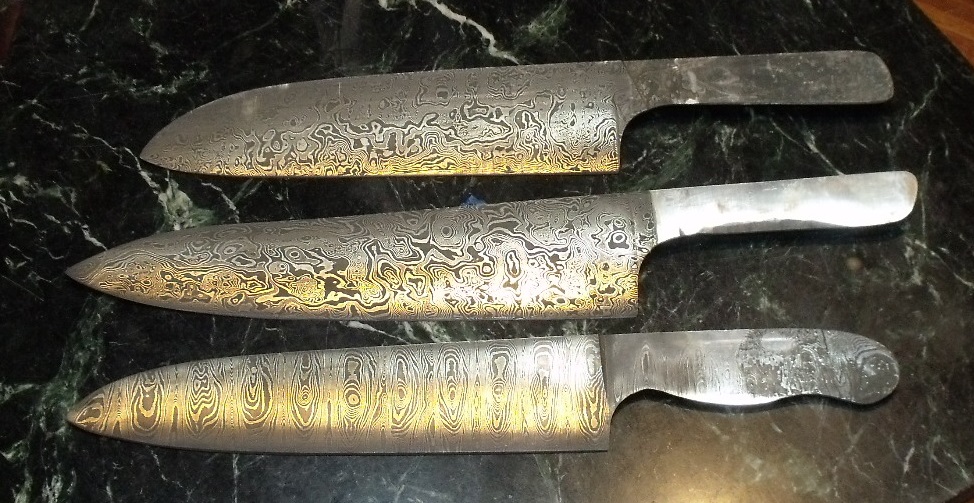
Well, I never was as patient as I'd like, so here it is after post HT grinding and a quick 2 minute etch (with 2 others I'm working on too....)
mZQW9ih.jpg

~billyO
 
Looks very nice, the ladder pattern came out good looking. What did you end up with for edge thickness after grinding. I find at least for the knives I make for my wife that I finish grind till it's just about sharp then give it a secondary and she slices like a champ.
 
Thanks for the compliments, Stacy, Shane and JT. Coming from folks like you means a lot to a newbie like me.

JT- I'm thinking I need to go a little thinner, but due to my (in)experience, I stopped a bit short to avoid going too deep.
The blade that started this thread is: spine .090 at the heel down to .020 at the tip and behind the edge; the ladder pattern: spine .100 at the heel down to .030 at the tip and behind the edge; the Santoku-like: spine .110 down to .030 at the tip and behind the edge. All prior to sharpening.
Thanks again and keep the suggestions coming as you feel appropriate. I value the advice (so much so that I plan on upgrading my membership when I start getting income again...:o).
~billyO
 
Hope everyone had a wonderful Thanksgiving.

I'm almost finished, have the knife etched, scales cut and sanded to 1000g and pins cut and ready to epoxy together, but....I'd like to keep the etching throughout the tang and am wondering how y'all finish sand the handle scales without sanding/polishing off the etching on the tang. Do you sand and polish the scales before epoxying them on? or are you just really careful not to sand on the tang when finishing the handle? (and is that what makes you guys Master smiths and me just a wannabe?:o)
Thanks
~billyO
 
Just finish it all like normal and then come back and etch the tang again. Tape off the scales and use a q-tip to apply your etchant.
 
Back
Top