
Stacy E. Apelt - Bladesmith
ilmarinen - MODERATOR
Moderator
Knifemaker / Craftsman / Service Provider
- Joined
- Aug 20, 2004
- Messages
- 38,577
I generally don't leave the etch on the spine or tang rim. The pattern on the bevels is the main factor.

The BladeForums.com 2024 Traditional Knife is available! Price is $250 ea (shipped within CONUS).
Order here: https://www.bladeforums.com/help/2024-traditional/

Hope everyone had a wonderful Thanksgiving.
I'm almost finished, have the knife etched, scales cut and sanded to 1000g and pins cut and ready to epoxy together, but....I'd like to keep the etching throughout the tang and am wondering how y'all finish sand the handle scales without sanding/polishing off the etching on the tang. Do you sand and polish the scales before epoxying them on? or are you just really careful not to sand on the tang when finishing the handle? (and is that what makes you guys Master smiths and me just a wannabe?)
Thanks
~billyO

Thanks Stacy, that's what I've done on all my other knives so far, but thought I'd try to keep the pattern on the spine this time.I generally don't leave the etch on the spine or tang rim. The pattern on the bevels is the main factor.
Thanks Warren. I did that on my first Damascus knife and last kitchen knife, and will probably continue with this route in the future. Although full tang handles are a bit easier/less work than hidden tangsGo with a hidden tang design in future. Problem solved.
 ....
....

Thanks Matt, that's a good idea.
Thanks Stacy, that's what I've done on all my other knives so far, but thought I'd try to keep the pattern on the spine this time.
Thanks Warren. I did that on my first Damascus knife and last kitchen knife, and will probably continue with this route in the future. Although full tang handles are a bit easier/less work than hidden tangs

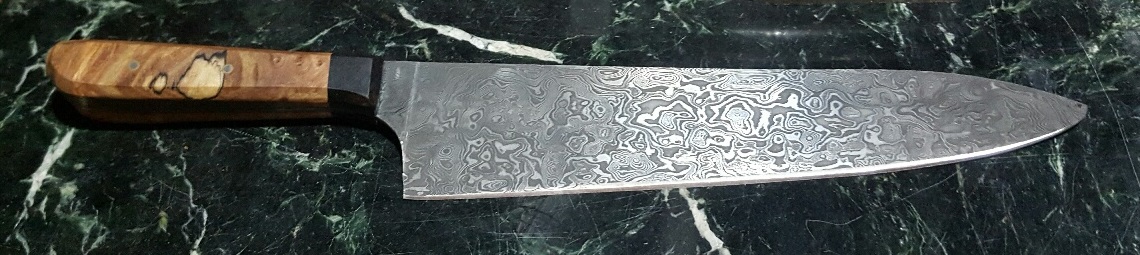
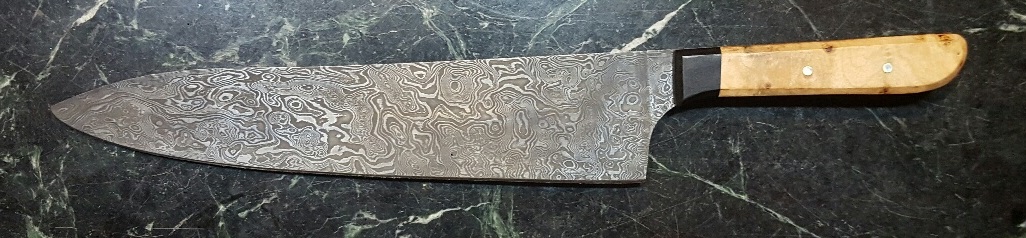
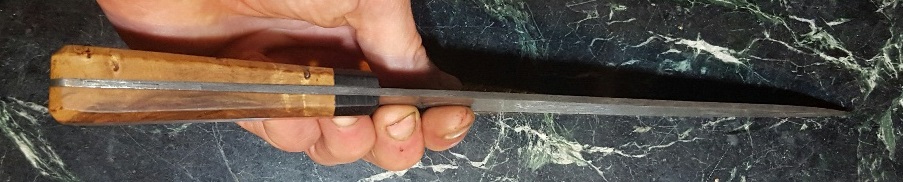
Hope everyone had a wonderful Thanksgiving.
I'm almost finished, have the knife etched, scales cut and sanded to 1000g and pins cut and ready to epoxy together, but....I'd like to keep the etching throughout the tang and am wondering how y'all finish sand the handle scales without sanding/polishing off the etching on the tang. Do you sand and polish the scales before epoxying them on? or are you just really careful not to sand on the tang when finishing the handle? (and is that what makes you guys Master smiths and me just a wannabe?
Thanks
~billyO

