WSK/Tracker Design Help/WIP

Joined
Oct 21, 2014
Messages
168
I was asked to do a Tracker/WSK for a friend's brother, and as I've never done anything outside of EDC and kitchen knives, and I'm not much of an outdoorsman myself, I wanted to run my design by you guys who are both more experienced woodsmen and knifemakers than me ;)

I was asked to make something with a 5" blade and 9.5" OAL, so this would be something similar to the TOPS Tracker #2.

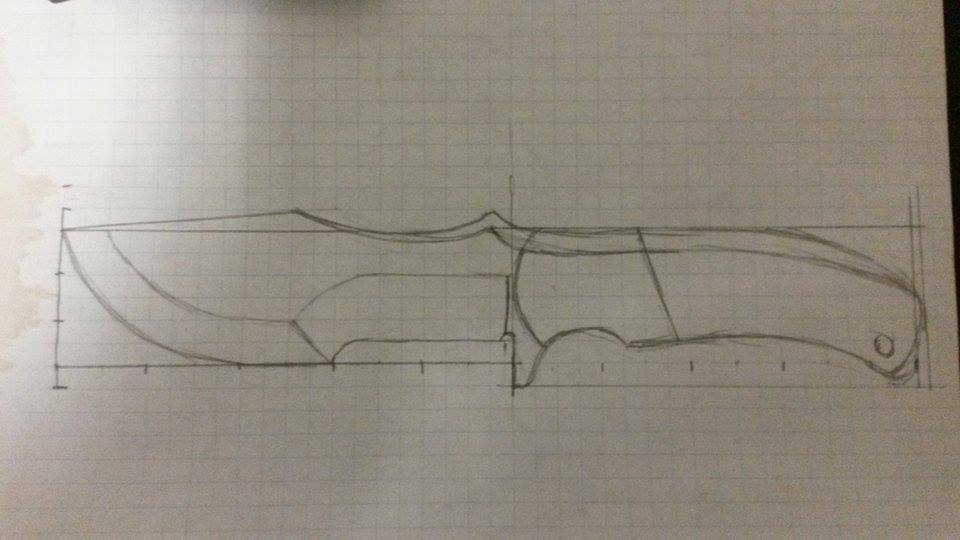
Knowing that the Tracker is a hybrid of a hatchet and a carving knife, I tried to balance it to make it as front heavy as possible. I have access to waterjet, but I'm not confident enough to do a tapered tang, so I tried to lighten the tang as much as possible.
L74prp7.jpg


I started with some back and forth in CAD and cardboard, and settled on a shape on graph paper that I was happy with, which I then transfered into CAD again.

2ifedO3.png


I don't have a 2x72, so I'm going with making a file guide that can accommodation the blade's width. I'm thinking of doing the quarter rounder with a half round file.

My main questions are what do you guys think about the guard (I feel more comfortable with it than without, but I know it's kind of a no-no on bushcraft knives) and what about the swedge (which I hear messes with batonning).

Oh yeah, it's gonna be 5/32" O1 and dovetailed stainless steel bolsters (I'm thinking 303), white liners, and lightning strike carbon fiber for the handles :D
 
Last edited:
Say NO to the swedge. It is dreadful for battening, and does nothing for you, performance-wise on a knife like this. In fact, I would cut the spine at the line you have the swedge finishing, so that the spine is more horizontal. That or make it convex so that when you do batton out toward the tip, the batton is less inclined to slip towards the tip.

I think that you could also do with a bit more of a dropped hook or swell at the butt so that you can drop your hand back for a three fingered chopping grip with more security. This is one option....

esee-WSK2.png


Halving the length of the guard won't compromise your safety much, but will make it more useable.

Not sure the bolsters are a good idea or not. They'll look good, and add weight, but I am not sure if the weight is going to be helpful, or just extra baggage to pack on the trail. If your CAD is 3D, you can get an estimate of the CoG by modelling up rectangular blocks from which you could cut the handle and bolster, and place them on the tang. My experience has been that there is about as much material in one of my pre-profiling handle slabs as there is in a pair of my fully shaped and contoured scales. Crude, but can be helpful.

Looks good otherwise! :)
Chris
 
If he doesn't reply to this thread, try to watch his videos and read his threads, and contact AverageIowaGuy

He has a lot of experience and opinions with that tracker style
 
You could leave some guard there but not a lot. Just enough to hold back sliding up the edge. That long of a guard might limit your use of the "drawknife" section of the blade. Leave the swedge. Shaping the hook area is very tricky. Hand files and patience might just be the thing though. Nice work.
 
My experience with the WSK design is very limited, but I'll add my 2 cents.
  • No Swedge, as I can't see an advantage on anything other than a fighting knife. This is only a fighting design in a movie. As stated, it'll kill a baton.
  • That guard is way too long. Again, it's like a knife fighting feature. A big guard is only needed for thrusting and I can't think of any woods work requiring that.
  • I think your stock is too thin. 5/32" would put you about half-way between 1/8" and 3/16". That's a carver and slicer, not WSK.
  • I'd forget about bolsters. They look nice, but I can't imagine them serving a purpose other than looks, and they'd get beat up.
  • I would want the saw back. Some don't like it and it can also tear up a baton, but it is useful for notching, some cutting, and makes a great scraper for shredding wood for tinder.
  • Add length to the handle. That long Tracker handle allows multiple grips, the rear-most being useful for chopping.
My take, and please don't take this the wrong way, is that you are trying to make a fighter and a slicer, and shape it like a WSK. The thin stock can't possibly give you any momentum for chopping, no matter how the balance is set up. Even the Tops TB 2 isn't any sort of chopper. I'm thinking your design would result in a sort of Nessmuk, with a 1/4 round and giant guard. Which may not be bad, but I think it will miss the utility of the WSK concept. I would handle a Tracker of some sort and watch some of the BETTER videos available. That'll help you understand the "why" of the features. Good luck and keep us posted.
 
I have made them 1/8" thick and they chop very deep like a machette. They don't batton oak very well at that thickness. 3/16" seems to fit the needs of a batoning WSK pretty good.
 
I have made them 1/8" thick and they chop very deep like a machette. They don't batton oak very well at that thickness. 3/16" seems to fit the needs of a batoning WSK pretty good.

That's interesting about the chopping at that thickness. I wouldn't think there'd be enough mass at only 10" OAL, but I've been wrong before:D I would think 3/16" would be a nice trade-off on this one for added abuse-handling and batonning. Either way, I'm curious to see how it turns out:thumbup:
 
One more thing, I would round the two "peaks" on the top. One of the secrets of the design is to hold the blade, not the handle, for many tasks. Those peaks look like they would interfere. Good luck.
 
Wow! :eek: Thanks for all of the replies guys!

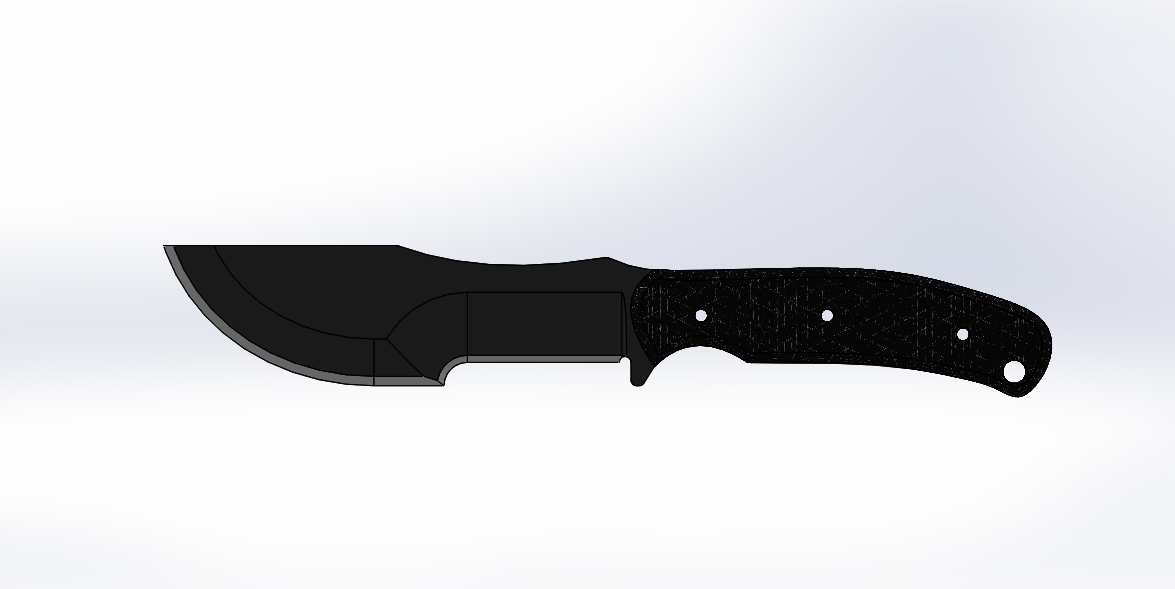
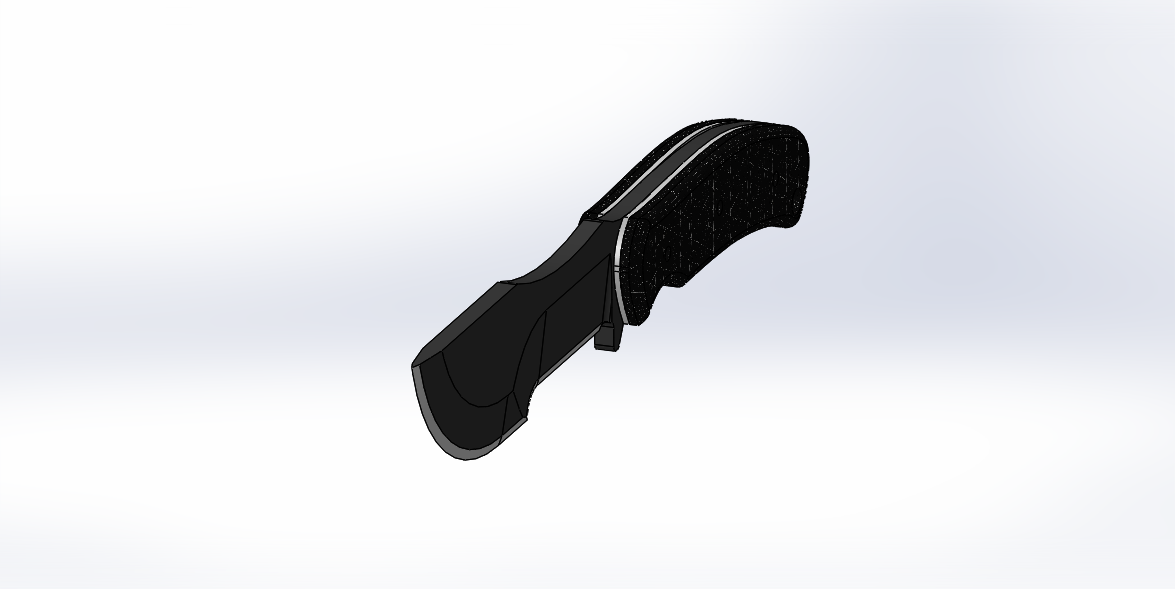
It seems that the general consensus seems to be no to the swedge and to halve the guard length, so that's what I did. I've also upped the stock thickness to 3/16 to make it more axe-like chopper. I also wanted to make the handle longer, but I'm already at my OAL length limit, and from what I can tell with my cardboard mockup, doing more butt droop interferes with the 3 finger grip.

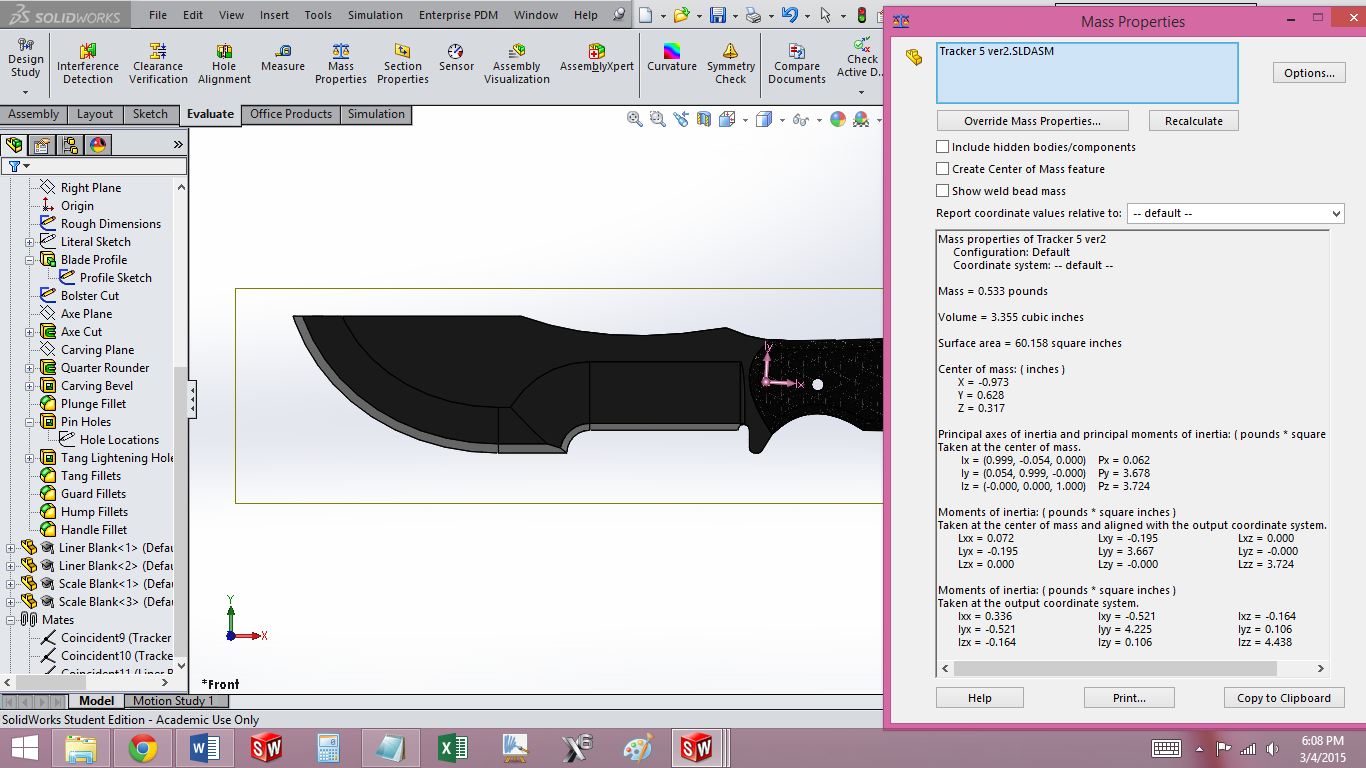
SolidWorks has a function to tell you what the mass and CG is! Without the scales, it's actually about a third up and from the right inside the carving portion of the grind.
CDW6vti.png


Should I shorten the guard anymore? Do the corby hole spacings look alright? Mass is currently at a little over half a pound, and I know the TOPS TBT #2 is at 10oz so I'm more or less below par right now, probably gonna be there once I add the lanyard hole tube and the corbys.

p7LxWe7.png


uPeObAP.png
 
I would probably cut the guard in half again myself. I just don't see it adding anything, but it can interfere with carving near the handle. But, that's just me. You could post in the Great Outdoors section as you'd get more opinions there. There probably aren't too many WSK users here in this section. The Beck WSK seems a favorite. I'd try to duplicate it's features. Good luck.
 
BNKBDG9.png


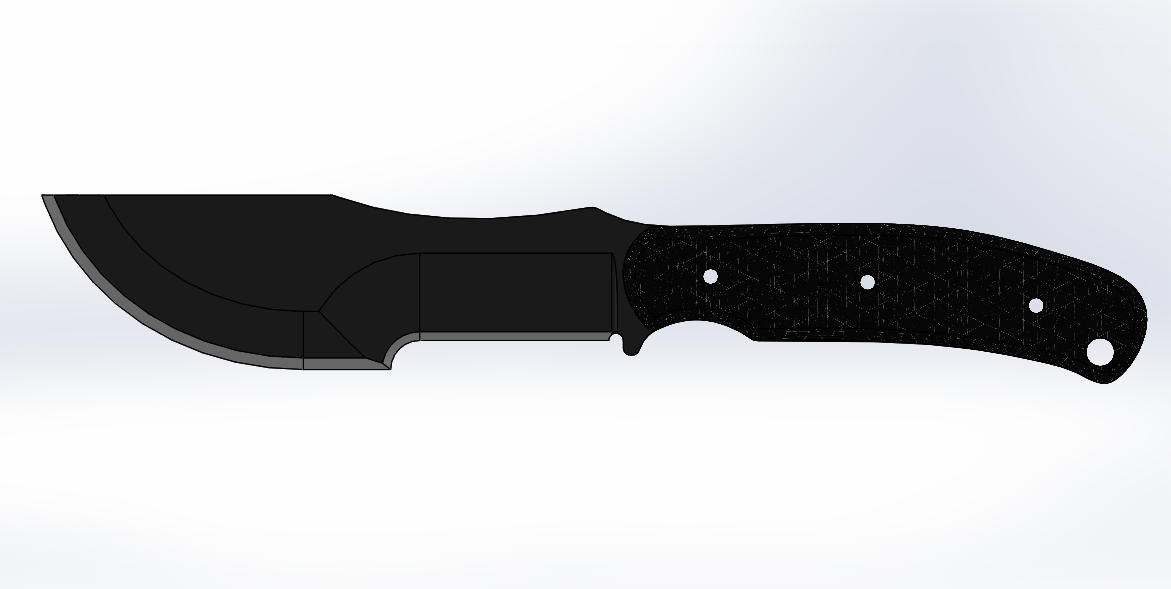
Halved the guard again and made some tweaks to the finger choil and thumb ramp after playing around with a printout. Speaking of, does anyone know of a good way to do jimping on the ramp? I'm thinking either square or round file and some patience and steely nerves, or get a small end mill and mill them out.

Additionally, is there an easy way to do the saw on the back? I'm not optimistic, but I figure I might as well ask. I know on James Terrio's WIP he was asked to do serrations instead of a saw, but I agree with jdk1 that the saw would be useful.
 
You can hand file them in with a triangle file or cut them in with a bandsaw or mill. Some have opted for the chainsaw tooth style. They really chew up a baton pretty good. I have had a few people ask me to remove them from their WSK/Tracker knives. The easiest of the choices would be to add the triangle teeth design into your profile and sharpen every other one in towards the opposite side.
 
Thanks for the info. I did a bit of research on saw cutting, and it seems like the proper cross cut profile would do horrible things to a baton and I don't feel particularly confident in doing it, so I guess for now I'll leave them off unless the customer insists on the saw.
 
That looks great! I think the saw is useful, but again, it's for notching and making sawdust/scrapings really. The Tops version looks as though it would saw a car in half, but it's marginally effective on actually sawing wood. I wonder how a shallow, almost file-like section would work instead of the big saw blocks most WSK's use? Almost just a rough area for scraping and such. I would think it would still get some good dust and cut/clean up a small notch. Or, you could just tell the guy to buy a SAK Farmer for his pocket:D I can't wait to see the finished product.:thumbup:

ETA: If you want to learn about the different grinds, definitely check out this thread: http://www.bladeforums.com/forums/showthread.php/1197515-Problems-encountered-regrinding-a-TOPS-Tracker
 
Last edited:
Thanks for all of the feedback and support, jdk1. The file scraper idea sounds interesting to me, since it could probably scrape and notch okay, and doesn't chew up a baton or weaken the blade the way a proper saw or swedge would. I've definitely never heard of a file-back knife before, but I know that the Leatherman file is often used for notching.
 
Thanks for all of the feedback and support, jdk1. The file scraper idea sounds interesting to me, since it could probably scrape and notch okay, and doesn't chew up a baton or weaken the blade the way a proper saw or swedge would. I've definitely never heard of a file-back knife before, but I know that the Leatherman file is often used for notching.

Those little files also work great as ferro rod scrapers. I added a link to a great thread to my previous post. Good luck and thanks for sharing your project.

PS.Also, I'd be cautious about cutting too many holes in the handle. This is meant to be a hard use knife.
 
Interesting link! I've skimmed it before, and some of how I modelled the knife in SolidWorks was affected by what I saw in that link. I'm thinking of filing basically a stout flat grind on the chopper portion, then convexing it on my 1x30 without the platten, then doing a high flat on the carving portion, and using a half round file for the quarter rounder.

I'm definitely leaning heavily towards making the spine nice and flat, just to avoid tacking on more tools/features that I'm not experienced in making. This already is a very difficult grind, and I've never made a knife with quite this mass either.

I'm also curious about the handle thing. I agree that it should be strong, so I left it at a quarter of an inch thick at the thinnest portions. I originally wanted a hammer or glass breaker on my previous iterations, but took it out due to length constraints. I figure since this doesn't have a hammer or glass breaker on the butt, any hammering done with the butt of the knife will be relatively light duty and the handle hole cutouts would be okay.
 
Interesting link! I've skimmed it before, and some of how I modelled the knife in SolidWorks was affected by what I saw in that link. I'm thinking of filing basically a stout flat grind on the chopper portion, then convexing it on my 1x30 without the platten, then doing a high flat on the carving portion, and using a half round file for the quarter rounder.

I'm definitely leaning heavily towards making the spine nice and flat, just to avoid tacking on more tools/features that I'm not experienced in making. This already is a very difficult grind, and I've never made a knife with quite this mass either.

I'm also curious about the handle thing. I agree that it should be strong, so I left it at a quarter of an inch thick at the thinnest portions. I originally wanted a hammer or glass breaker on my previous iterations, but took it out due to length constraints. I figure since this doesn't have a hammer or glass breaker on the butt, any hammering done with the butt of the knife will be relatively light duty and the handle hole cutouts would be okay.

I'm not thinking about hammering on the butt, but thinking of rough batonning. I've seen more than a few knives around here which snapped at the handle around grip holes or cutouts. I didn't realize you were planning a having it 1/4" under the slabs. That would be strong. I would've maybe opted for 3/16" the whole way, and left out the cutouts. But, I've never made a knife, so I'm just guessing.
 
Sorry, I was unclear. I will be using 3/16 stock for the whole thing, it's just that the cut outs are all at least 1/4" away from the nearest edge or hole.
 
Ah, gotcha. That makes sense. I still don't like that front cutout. It looks weak at the bottom. Again, I'm not an expert or even close, but I'd personally at least drop that front cut. I've seen too many knives break there during batonning. Not a ton, but when it happens, that seems to be the spot.

I think it's great you're putting so much thought in to it. I can't wait for the final result. Take care.
 
Back
Top