

james terrio
Sharpest Knife in the Light Socket
Recently a fellow came to BladeForums looking for someone to make him a WSK/Tracker style knife and sheath, with some of his own design features and preferred materials. My pal Richard J saw the thread and was kind enough to point the gentleman in my direction. He checked out my website, liked what he saw, and after a couple emails, we agreed on all the details. This knife is quite different from anything I've made before, and I'm really looking forward to the challenges it presents.
Quite naturally, the client is eager to see what progress is being made, so I thought this would be a good time to do my first WIP thread. This way, I can keep him informed of how it's going, and hopefully get some tips from y'all to improve my processes.
It's extremely helpful when a client provides you with a clear, detailed drawing to work from:
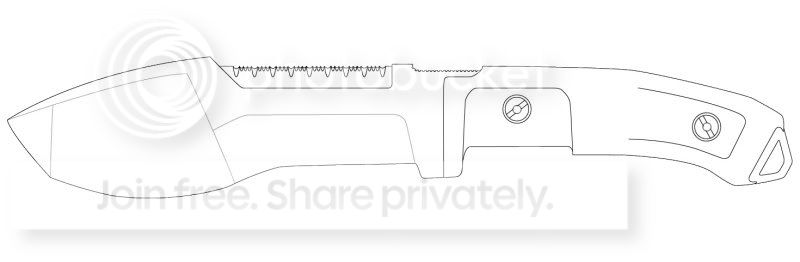
He wanted a corrosion-resistant steel with high toughness and good edge-holding, so we decided to use Elmax. I have heard excellent reports about this steel from other makers, and I'm excited about working with it for the first time. I ordered a bar from one of my favorite suppliers, Tracy Mickley at USAKnifemaker.com. As always, it arrived exactly as described, in a timely manner. :thumbup:

My first step is to chop off a suitable length of steel, draw the basic profile on it and commence drilling holes. I like to leave a strong 1/16" around the final dimensions to allow for goofs and tweaking later. I wear safety glasses and a respirator whenever I use power tools or do any work involving impact, and do my best to work safely. Danger never sleeps!

Not having a good metal-cutting bandsaw, I generally drill, grind a thin notch between each hole with a rotary tool, then finish the cutting with a cold chisel. This profile is so complex that I couldn't do it all with a bandsaw, anyway:

My main bench is quite heavy and rigid, but I still like to use a piece of 1/4" mild steel as an anvil of sorts whenever I use a punch, rivet-setter or cold chisel. The idea is to make sure all your energy goes into the work, not into rattling the bench around. Pay attention to the direction of force, cutting this way can send waste pieces flying!


Mill scale is very hard, and tough to grind off. I buy precision-ground steel whenever possible to avoid this, but sadly that option wasn't available for this project. So I pickled the roughly-cut blank in weak acetic acid (common white vinegar). It really does help:

I forgot to take a picture, but at the same time I put the blank in the vinegar, I took one of the small scrap pieces and ground one side to a clean 160-grit, and the other to a clean 400-grit finish. Then I plopped it into a small glass jar and filled the jar part-way with salt-water. Half the sample piece is submerged, half isn't.
I used a ratio of 4 Tablespoons of normal, iodized table salt to one quart tap water; I believe this approximates seawater, but don't quote me on that.
The idea was to test the corrosion-resistance of annealed Elmax. My limited understanding of metallurgy tells me that annealed steel of any type is at it's least corrosion-resistant state. I'm trying to establish a baseline and compare it to a fully hardened and tempered sample later.
The upshot is that my annealed sample still shows ZERO signs of corrosion after 72 hours in my salt-water bath.
Anyhow, I've cleaned up the blank and have begun to bring the profile to final dimension on the belt grinder.

I'm fresh out of 2x42 belts, so I'm kind of stuck now. The good news is, I have the materials I need to convert my 2x42 to use 2x72 belts! Luckily, both the Raiders and Packers have a bye this week, so I have time to work on that today
Quite naturally, the client is eager to see what progress is being made, so I thought this would be a good time to do my first WIP thread. This way, I can keep him informed of how it's going, and hopefully get some tips from y'all to improve my processes.
It's extremely helpful when a client provides you with a clear, detailed drawing to work from:
He wanted a corrosion-resistant steel with high toughness and good edge-holding, so we decided to use Elmax. I have heard excellent reports about this steel from other makers, and I'm excited about working with it for the first time. I ordered a bar from one of my favorite suppliers, Tracy Mickley at USAKnifemaker.com. As always, it arrived exactly as described, in a timely manner. :thumbup:
My first step is to chop off a suitable length of steel, draw the basic profile on it and commence drilling holes. I like to leave a strong 1/16" around the final dimensions to allow for goofs and tweaking later. I wear safety glasses and a respirator whenever I use power tools or do any work involving impact, and do my best to work safely. Danger never sleeps!
Not having a good metal-cutting bandsaw, I generally drill, grind a thin notch between each hole with a rotary tool, then finish the cutting with a cold chisel. This profile is so complex that I couldn't do it all with a bandsaw, anyway:
My main bench is quite heavy and rigid, but I still like to use a piece of 1/4" mild steel as an anvil of sorts whenever I use a punch, rivet-setter or cold chisel. The idea is to make sure all your energy goes into the work, not into rattling the bench around. Pay attention to the direction of force, cutting this way can send waste pieces flying!
Mill scale is very hard, and tough to grind off. I buy precision-ground steel whenever possible to avoid this, but sadly that option wasn't available for this project. So I pickled the roughly-cut blank in weak acetic acid (common white vinegar). It really does help:
I forgot to take a picture, but at the same time I put the blank in the vinegar, I took one of the small scrap pieces and ground one side to a clean 160-grit, and the other to a clean 400-grit finish. Then I plopped it into a small glass jar and filled the jar part-way with salt-water. Half the sample piece is submerged, half isn't.
I used a ratio of 4 Tablespoons of normal, iodized table salt to one quart tap water; I believe this approximates seawater, but don't quote me on that.
The idea was to test the corrosion-resistance of annealed Elmax. My limited understanding of metallurgy tells me that annealed steel of any type is at it's least corrosion-resistant state. I'm trying to establish a baseline and compare it to a fully hardened and tempered sample later.
The upshot is that my annealed sample still shows ZERO signs of corrosion after 72 hours in my salt-water bath.
Anyhow, I've cleaned up the blank and have begun to bring the profile to final dimension on the belt grinder.
I'm fresh out of 2x42 belts, so I'm kind of stuck now. The good news is, I have the materials I need to convert my 2x42 to use 2x72 belts! Luckily, both the Raiders and Packers have a bye this week, so I have time to work on that today
Last edited:


