Your customers: Thin Blades or prybars?


making feather sticks from fence posts was he?:D

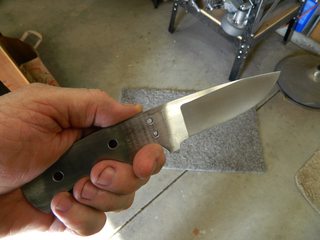
This is the knife rough fit together. I've got the blade final sanded now, and am assembling today. This was a challenging build for me as I normally make organic flowing knives.

29697886604_19da4e3c83_z.jpg
[/url]IMG_0403 by Wjkrywko, on Flickr[/IMG]

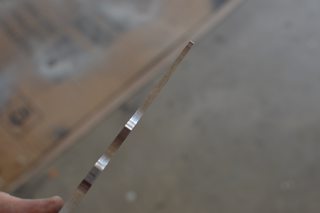
Its 3v on top of it. Rc60, 416 hardened stainless guard. It's blocky like this on purpose, customer's vision. I redid the scales as I drilled one of the holes out by 1/8".

3v is no fun to hand finish. :grumpy:
 
This is the knife rough fit together. I've got the blade final sanded now, and am assembling today. This was a challenging build for me as I normally make organic flowing knives.

29697886604_19da4e3c83_z.jpg
[/url]IMG_0403 by Wjkrywko, on Flickr[/IMG]

Its 3v on top of it. Rc60, 416 hardened stainless guard. It's blocky like this on purpose, customer's vision. I redid the scales as I drilled one of the holes out by 1/8".

3v is no fun to hand finish. :grumpy:

Zombies are not to picky as to the blade that pokes them in the brain.

That'll work ;)
 
Zombies are not to picky as to the blade that pokes them in the brain.

That'll work ;)

I think the guy wants to show off the biggest, baddest bushcraft knife to his buddies. He is aware of the limitations of this design. It's a user, not a show piece though. It'll cut down a tree like an axe, I think. It weighs 2lbs, 11oz. :eek:
 
I think the guy wants to show off the biggest, baddest bushcraft knife to his buddies. He is aware of the limitations of this design. It's a user, not a show piece though. It'll cut down a tree like an axe, I think. It weighs 2lbs, 11oz. :eek:

I like your guy's style :D
 
I make knives in a wide variety of geometries. I normally grind bush knives to near full flat. By that, I mean a VERY shallow convex. The main bevels are brought to a zero degree edge(with burr) before a final cutting edge is put on with either stones or belts. I have been running the finished edge across a slotted paper wheel to polish.... LOVE IT.
 
My bad. it would-be more like .015 or so. But yes, even with that, don't change the bevel angle much at all. The hollow is also VERY shallow and done lightly with a 72 inch "diameter" platen. Once blend,you really can't see the transitions except for eh convexed edge.
Just trying to understand what you're describing, 1mm is .040" so are you saying on your second flat facet you barely change the angle of the first full bevel? If so what is the purpose of the initial bevel? Just to make visualizing and hitting your desired final profile easier? Like a rough pass and finish pass with only slight tuning to the edge side of the grind?
 
expensive piece of 3V right there:eek:


There's a matching 6" knife with a sabre grind. $425.00 worth of 3v, after duty, tax, and conversion to Canadian. I suggested 80crv2, to save money, and the geometry is so thick, that 3v is overkill. Nope, 3v it was. :thumbup:
 
I hope you charged him a couple of hundred buck for pain and suffering........yours!!!!!:D
 
I like your guy's style :D

It's been a fun and frustrating build. Customer has been very understanding with the delays. Great guy. He's getting a hell of a knife for what I charged. I'm pretty sure I'm losing money on this one, but I stick to my quote. My underestimates are my fault.
 
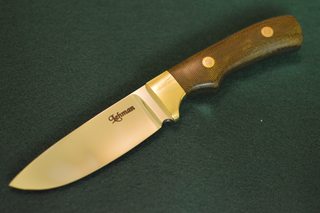
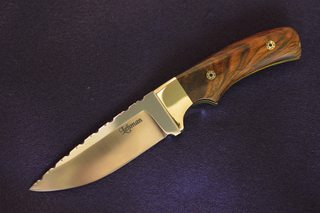
I like thick stainless steel for camp knives usually listed as 3/16" but actually about .200 inch before surface grinding. I will do a full hollow grind and taper the tang and only the forward spine is thick at the top and rounded slightly when finishing. This makes a knife that is sturdy but with a fine cutting edge and that does not weigh a ton when finished. The hollow grind removes a lot of stock and leaves an edge that can be easily sharpened. Larry

q0o6QNxm.jpg
7h3Sicnm.jpg

UCSi3IGm.jpg
2k4BUQbm.jpg
5ZSKajom.jpg
KStRZ9gm.jpg
hR86eO5m.jpg
 
I have been doing all .090 to .125 thick with full distal tapers. These have been mostly kitchen knives though. I have also been sending kiridashi types into the wild at .050 thick, 3V. I do have a couple projects coming up, one is for an EDC I plan to use .26 thick 5160 full distal taper and tapered tang. I just love the thicker stock with the dramatic taper, first time I handled a large Loveless big bear i was blown away by the lightness and agility.

So for kitchen knives: .005 behind the edge with a shallow 36" radius or a full flat grind to about .015 behind the edge and then convex dang near to zero behind the edge. Also very important, is the distal taper, I apply it towards the end of the process to get real slicey tips, It ends up looking like a michael price like false edge on the spine. I am currently trying to get a more crisp finish showing it, but its hard for me....
For EDC's I did grind a couple 22ish deg buschrafters but have not gotten much feedback on those, most of my EDC are full flat grind to .015 to .010 behind the edge. I also leave the tip more like .020 behind the edge.
 
Last edited:
I use mainly 3/16 to .200" steel for most everything I make. May be way more than enough steel but, I can still get the edge nice and fine with a good hollow grind, and still has a thick enough spine to keep it tough.
 
My finished thicknesses vary from 3/32" to roughly 3/8" depending on what is expected of the blade. Some of my blades see prying, batonning, chopping, digging, hammering, etc... they are made for that purpose. Some blades are for slicing, skinning, etc... they are designed for that. Same goes for whittling, kitchen work, carpentry, etc...

My "Bush" philosophy is minimal tooling, maximum versatility. If i can afford to take the right tool for every task, I do... but mostly, I grab for the one tool that can get me past anything. With enough experience the shape/size of that ONE tool is not as important.

A long time ago, during some training with a new group, I was ribbed about the "sharpened prybar" I brought. They informed me that I was at a disadvantage lugging a 1/4" thick, 9" long blade around. Part of the training was making an expedient shelter and enough firewood for 2days. We were only allowed our knives. I thought it was ironic that as the week progressed, the criticism changed to pointing out that I had an unfair advantage with my "hand axe". I will mention that there were times I felt a smaller, thinner blade was more appropriate, obviously. That is only one example to defend the prybar. There are valid arguments against it as well. My point is that you need to ditch the dogmas from both sides of the fence and go FREEBLADE.... cuz there ain't no fence!

 
Just think how much better it would have been if the rules were you could only bring a machete' :D
 
A 9" 1/4 thick full flat ground knife is not a pry bar in my opinion unless the blade is only 1 inch wide. .
My finished thicknesses vary from 3/32" to roughly 3/8" depending on what is expected of the blade. Some of my blades see prying, batonning, chopping, digging, hammering, etc... they are made for that purpose. Some blades are for slicing, skinning, etc... they are designed for that. Same goes for whittling, kitchen work, carpentry, etc...

My "Bush" philosophy is minimal tooling, maximum versatility. If i can afford to take the right tool for every task, I do... but mostly, I grab for the one tool that can get me past anything. With enough experience the shape/size of that ONE tool is not as important.

A long time ago, during some training with a new group, I was ribbed about the "sharpened prybar" I brought. They informed me that I was at a disadvantage lugging a 1/4" thick, 9" long blade around. Part of the training was making an expedient shelter and enough firewood for 2days. We were only allowed our knives. I thought it was ironic that as the week progressed, the criticism changed to pointing out that I had an unfair advantage with my "hand axe". I will mention that there were times I felt a smaller, thinner blade was more appropriate, obviously. That is only one example to defend the prybar. There are valid arguments against it as well. My point is that you need to ditch the dogmas from both sides of the fence and go FREEBLADE.... cuz there ain't no fence!
 
The vast majority of knives I make are around .125. Some kitchen knives and fillets of course would be thinner, but virtually all my hunters and general carry knives are in that range. The odd camp knife or larger chopper gets thicker but those are few and far between. Like many guys, I started out using thick stock in the 3/16 or 1/4 range, and found that the knives just didn't cut as good as the thinner knives I was starting to make. Also after some destructive testing, I realized how much abuse the thinner knives can actually take and don't see a need for overly thick blades now.
 
Back
Top