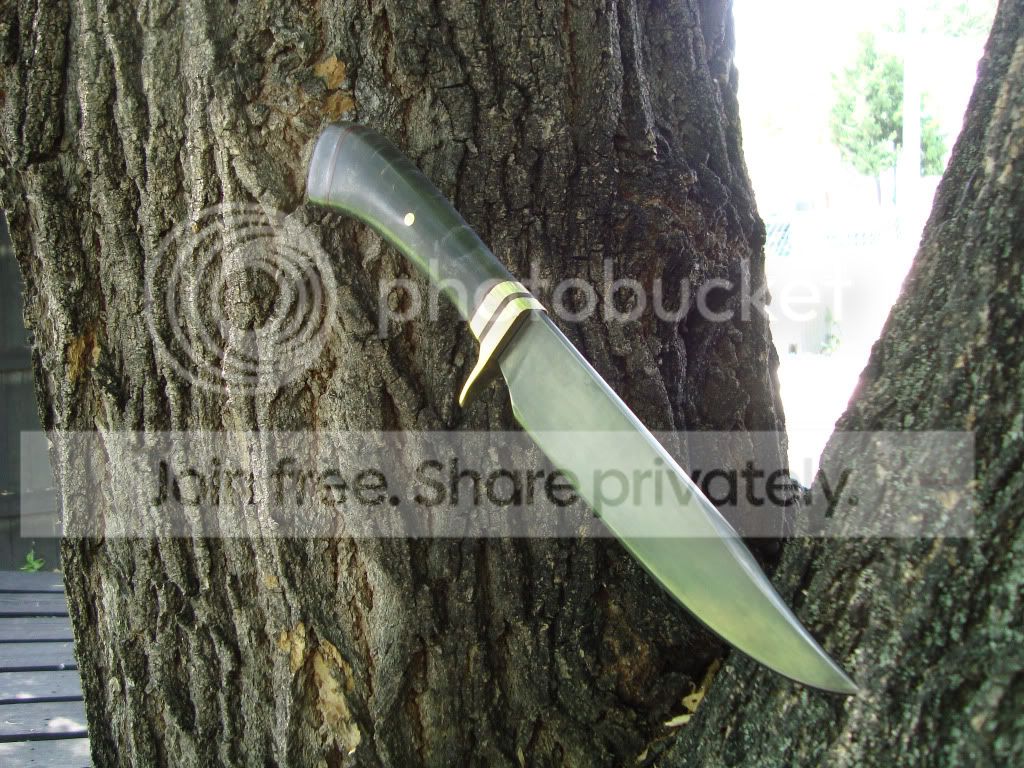
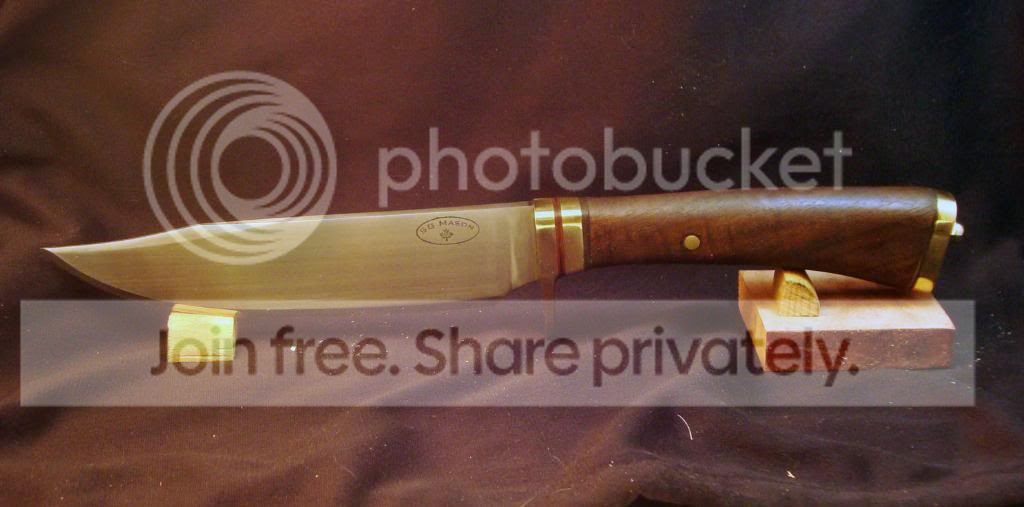
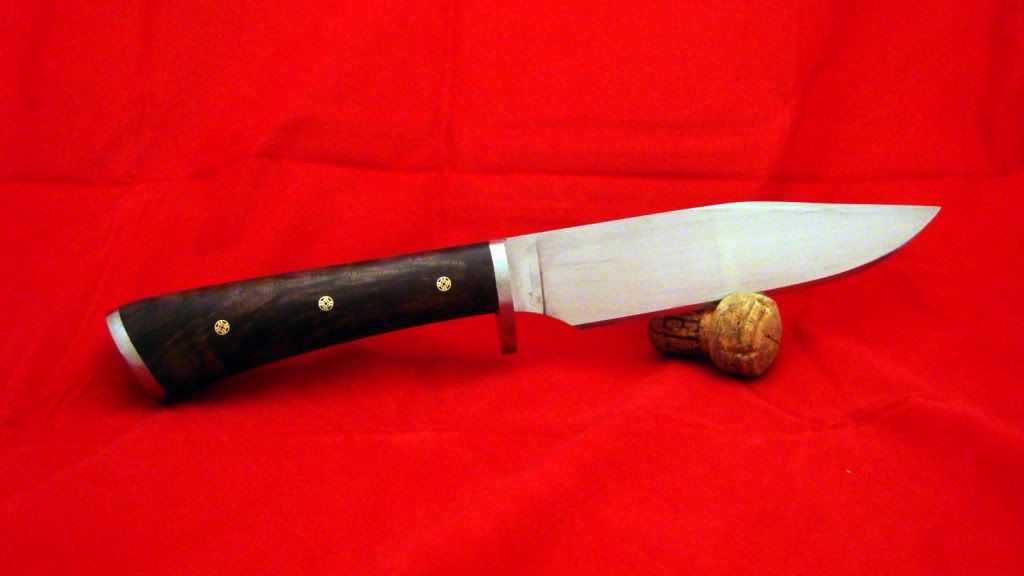
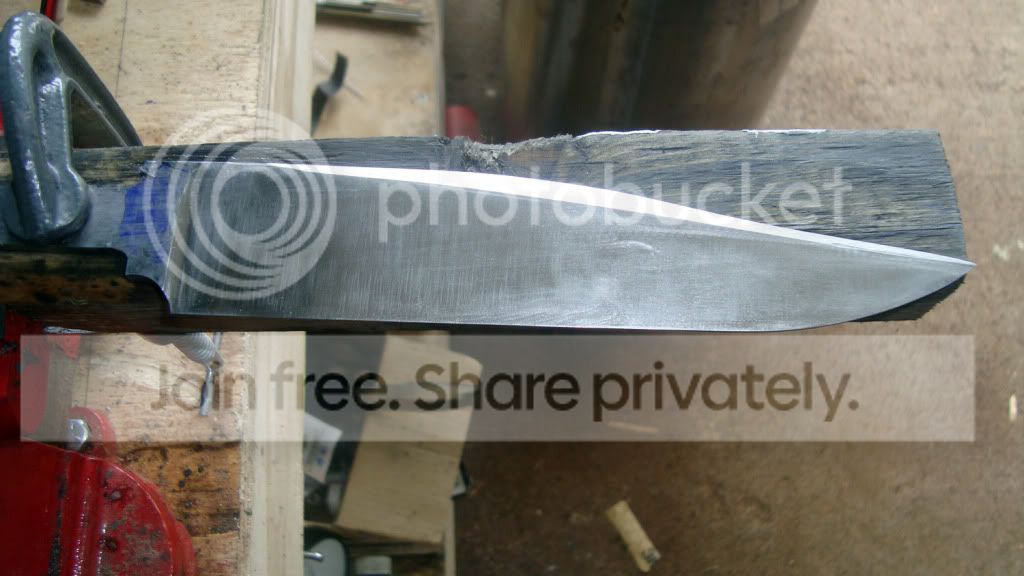
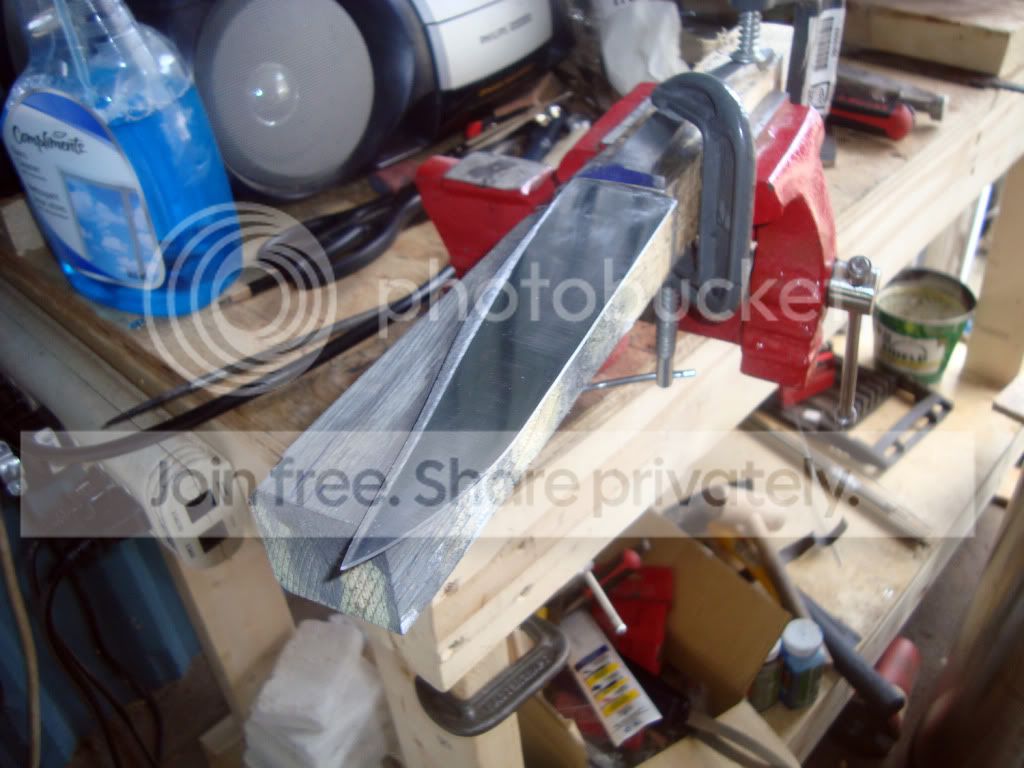
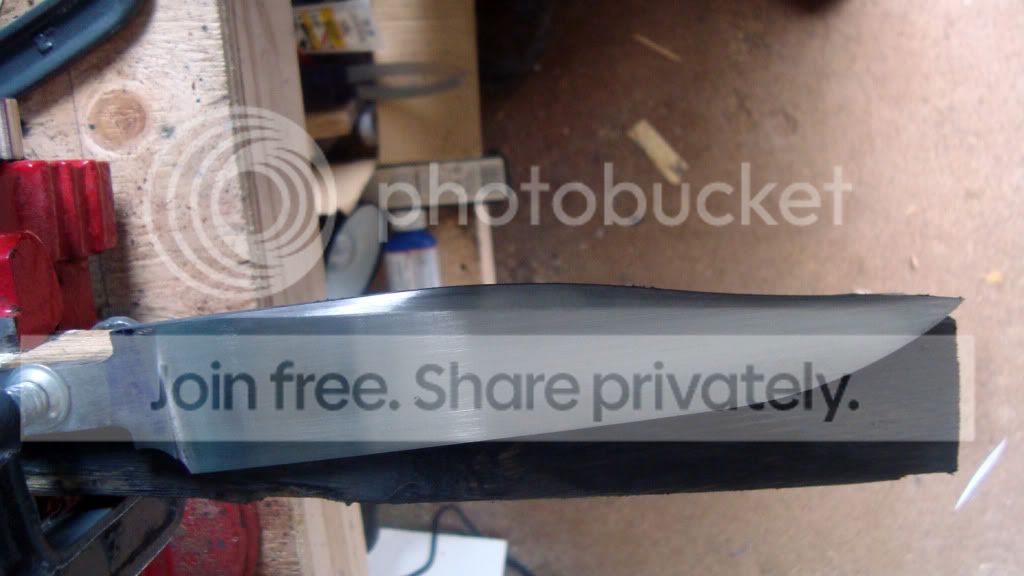
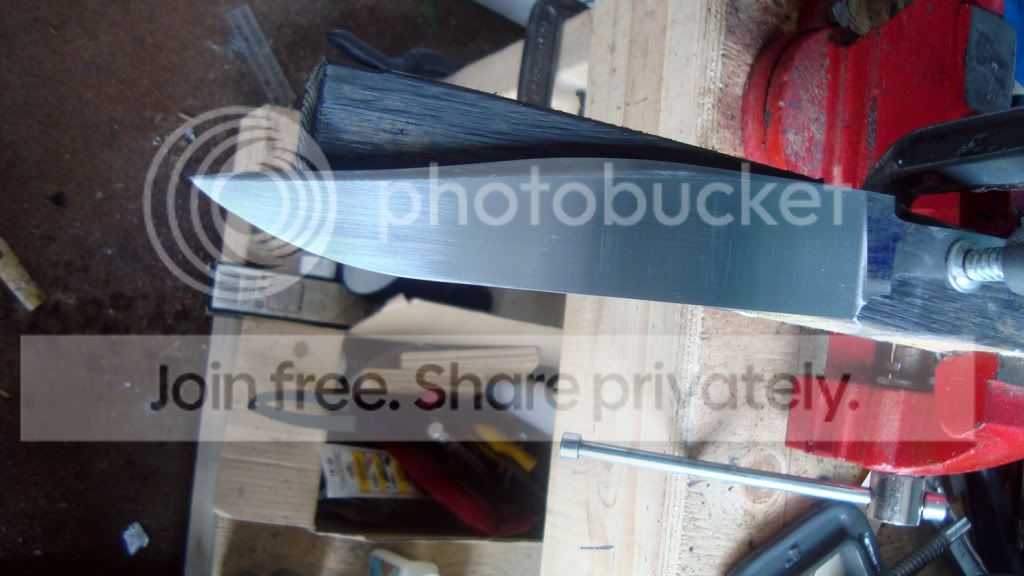
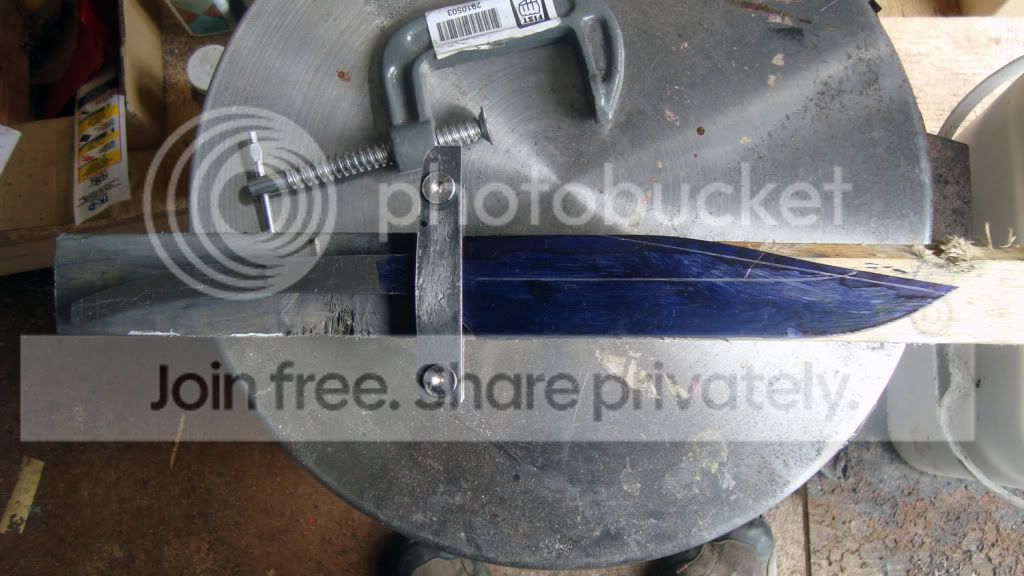
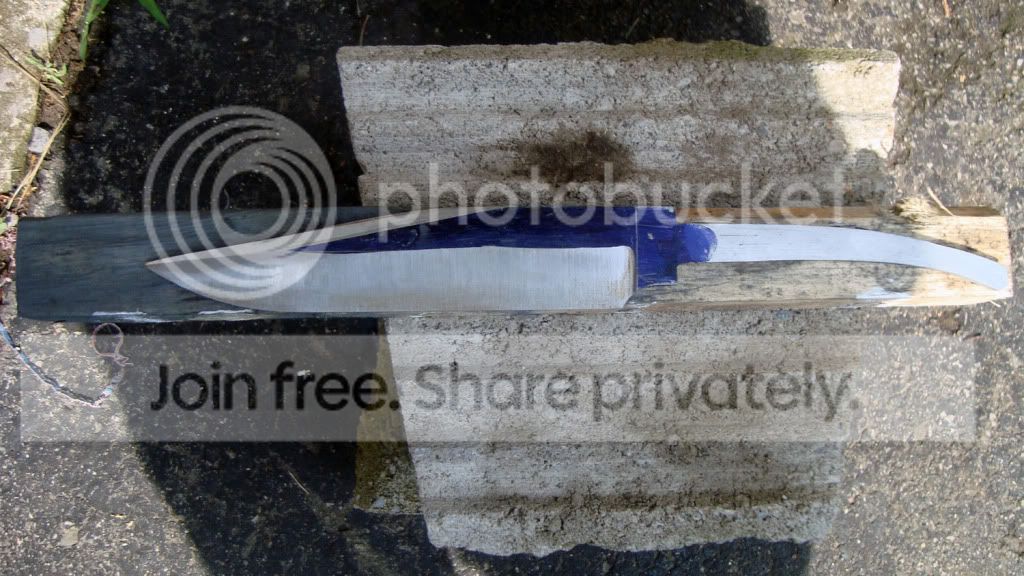
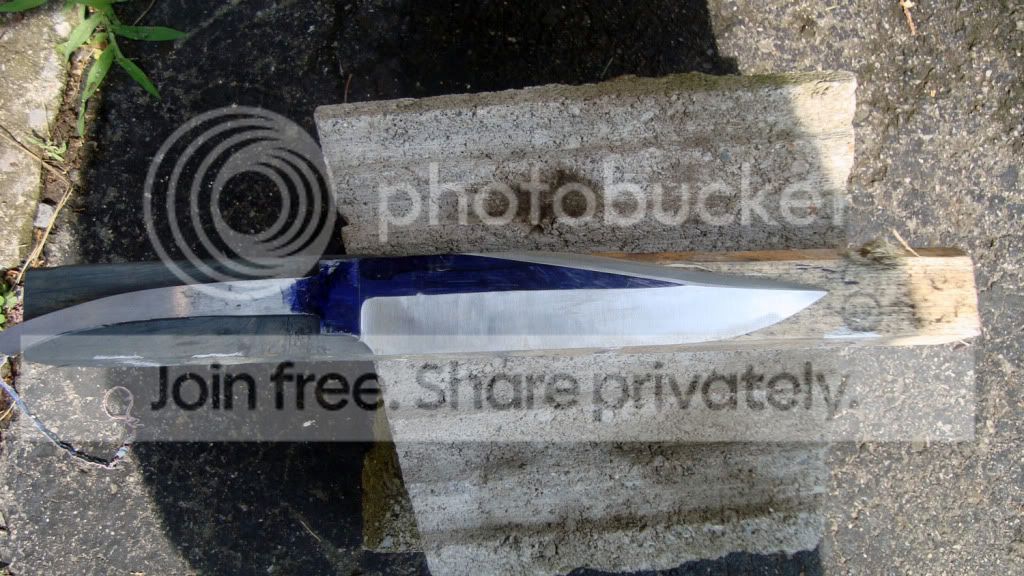
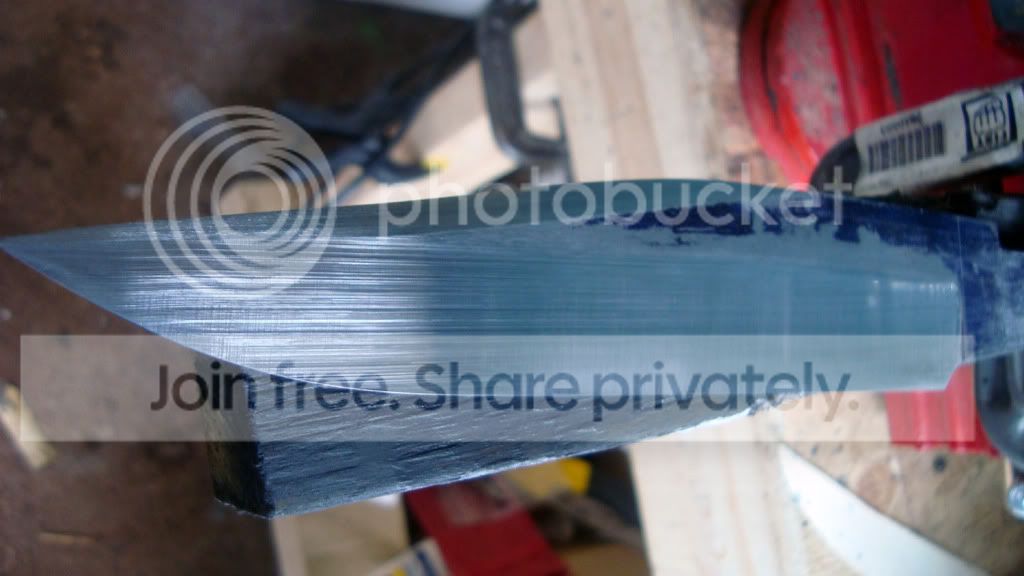
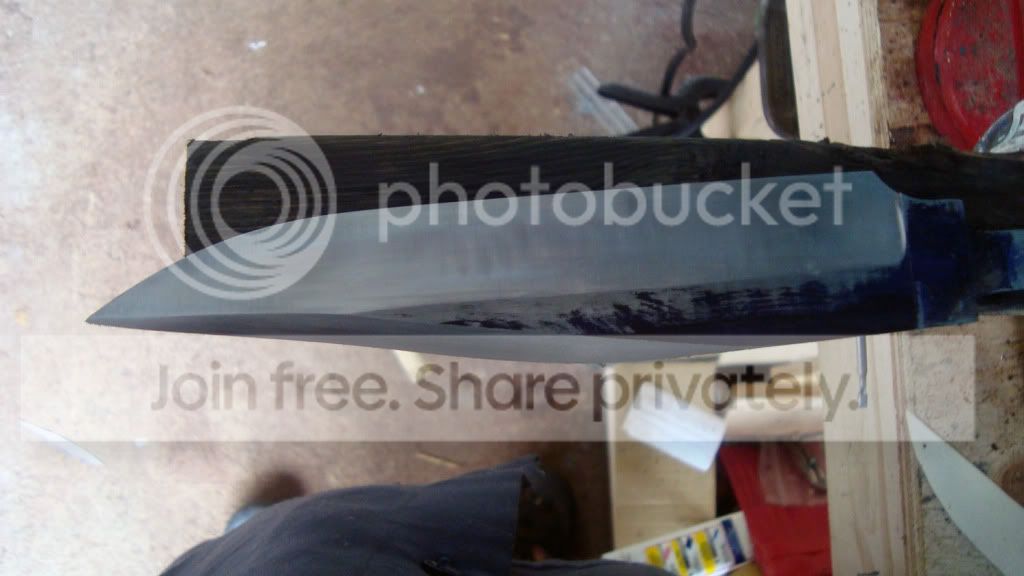
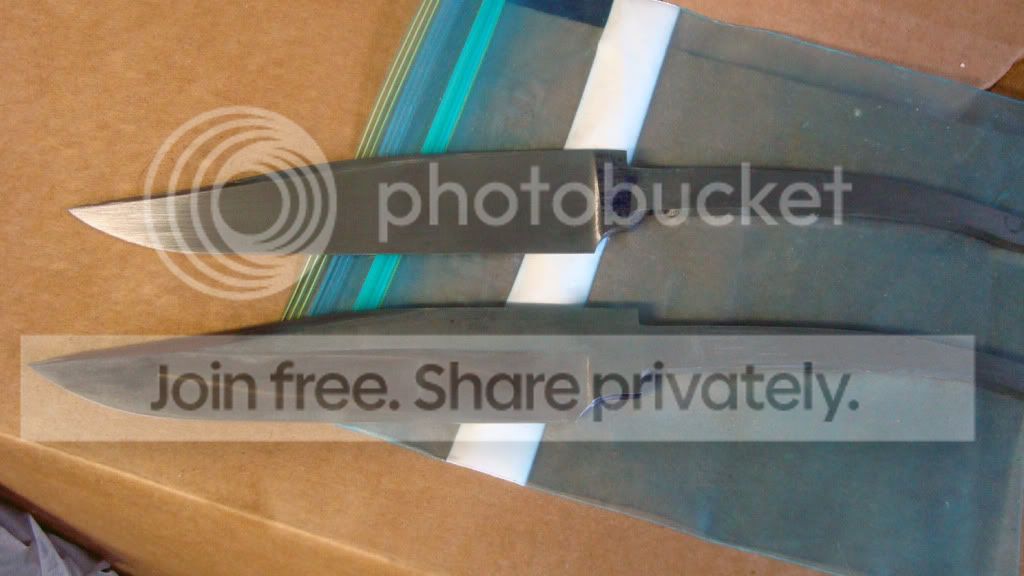
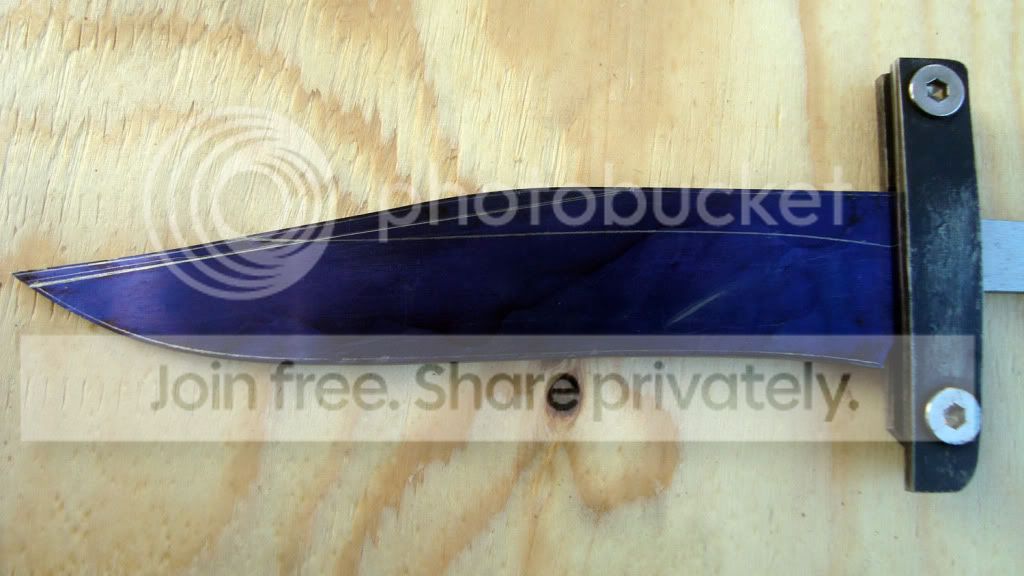
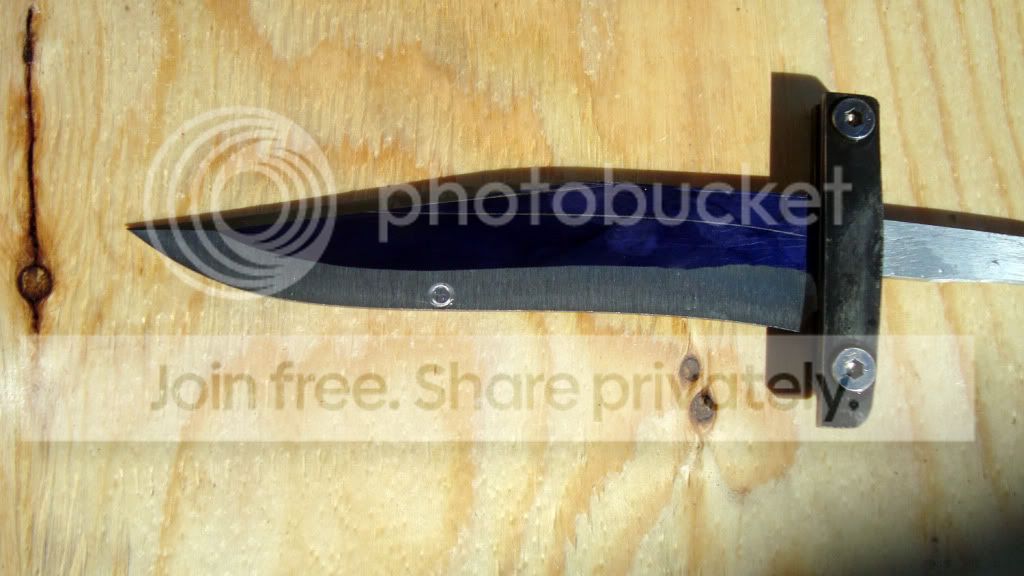
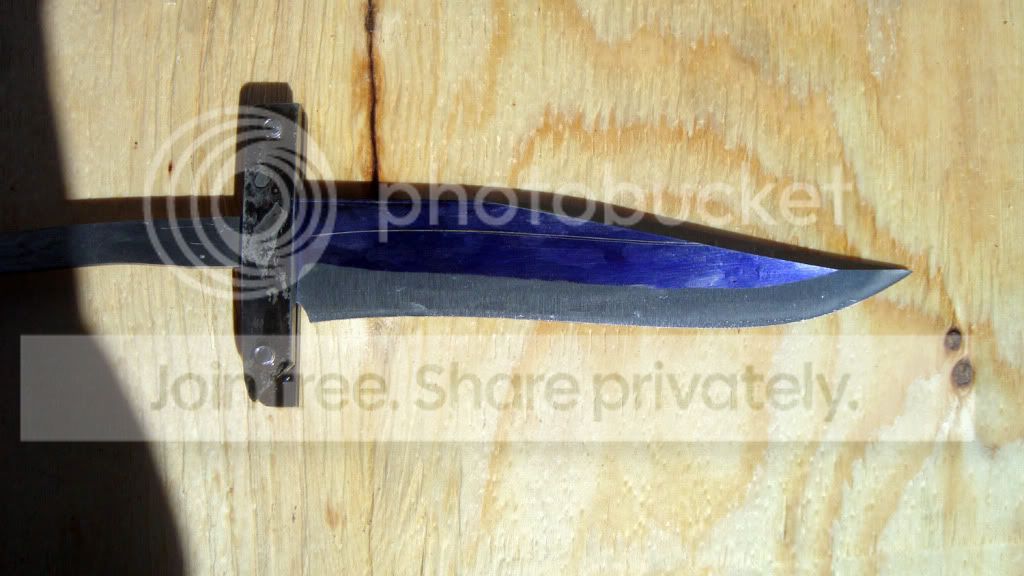
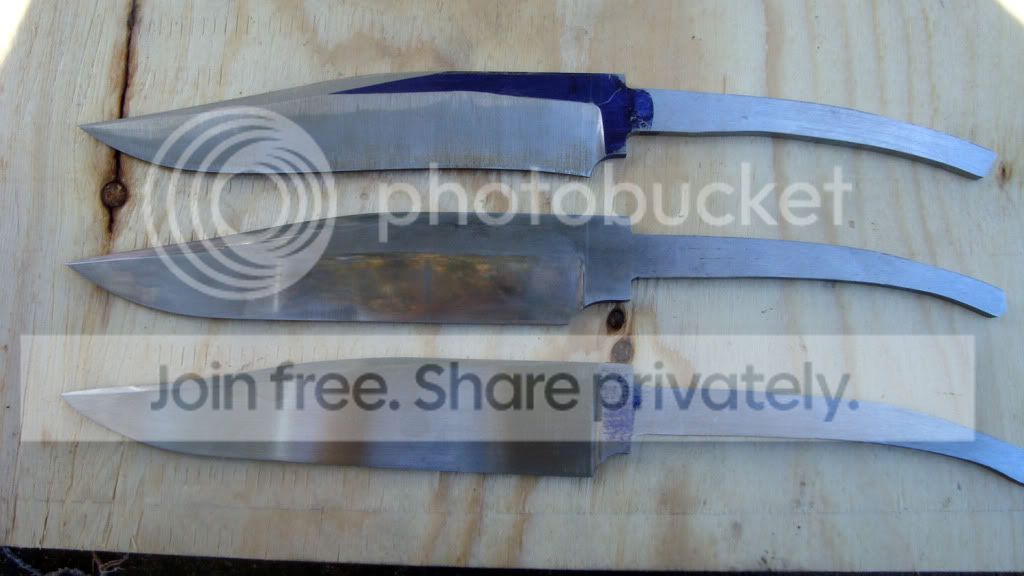
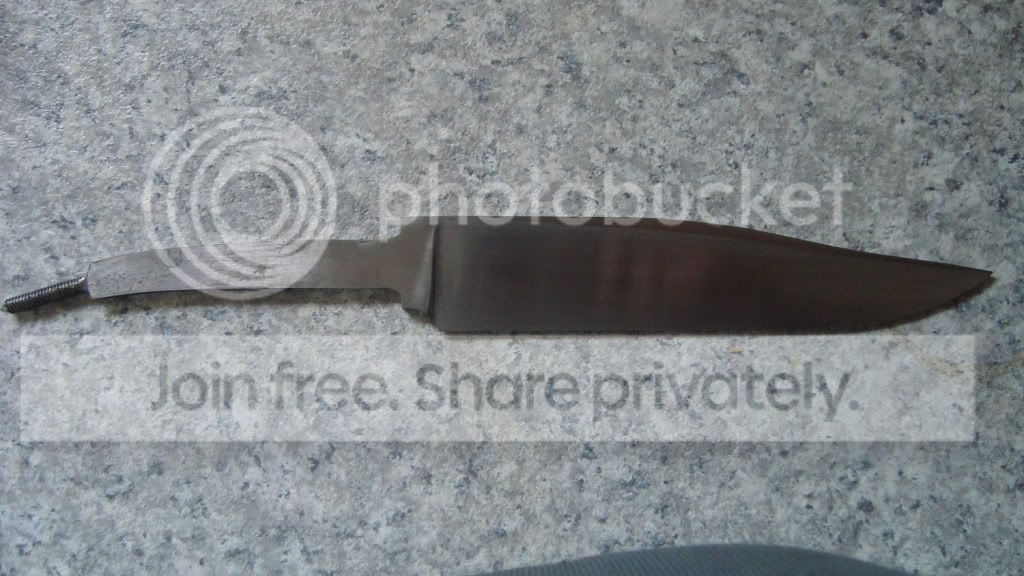
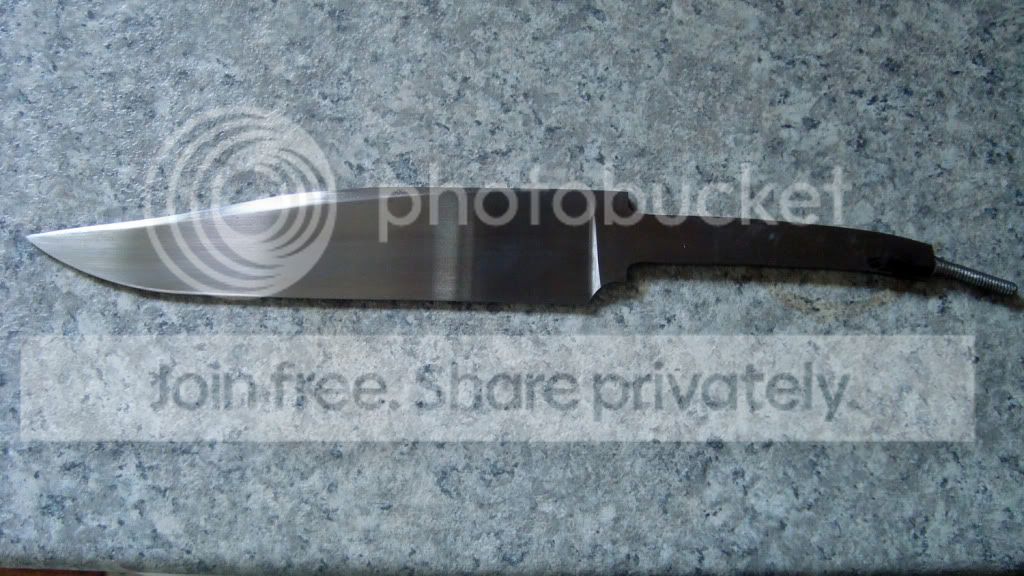
3 similar blades WIP ***Now including KITH updates***

Joined
Aug 28, 2009
Messages
7,951
So the first knife I made I did a WIP on it and made it using files and hand tools. This time I have my GIB and power tools so I figured I would do another WIP for my first knife in the new digs.

This time I am making a batch of 3 Bowies, all are based off of the same drawing, but there will be variations in them as I go. I don't even know what I am going to use for handles yet or just how long it will take me to finish these up, but I wont drop out in the middle of the WIP, it just may take some time to finish them all:o

This is the drawing that all of them are based off of

bowie.jpg


The blade in the drawing is 7.25" long from tip to shoulder and I am using 3/16" O-1 steel. I am not going to show layout, and cutting because I am sure most of us know how to do that and don't need to see pictures of how I do it.

After my first couple of attempts at a through/hidden tang knife, I realized that I needed a bit of guidance for squaring up the shoulders. First thought I had was this.
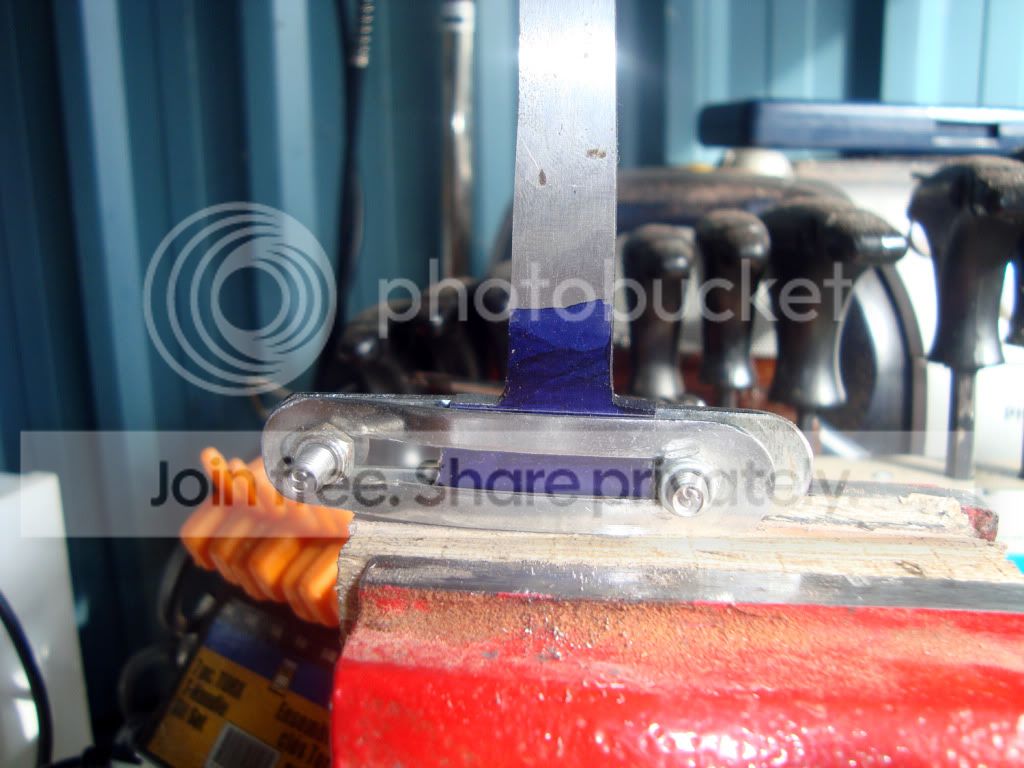
oldfilestop.jpg


Just a couple pieces of strapping, but I quickly realized that they were neither strong enough or straight enough to do the job. After sitting for a bit and thinking about what else to use, I spied a couple of cut offs from my PG O-1 that had the factory edges intact and that were long enough. I knew that I could get the O-1 hard enough in my coffee can forge so I lined up the factory edges, drilled and tapped them to make this.
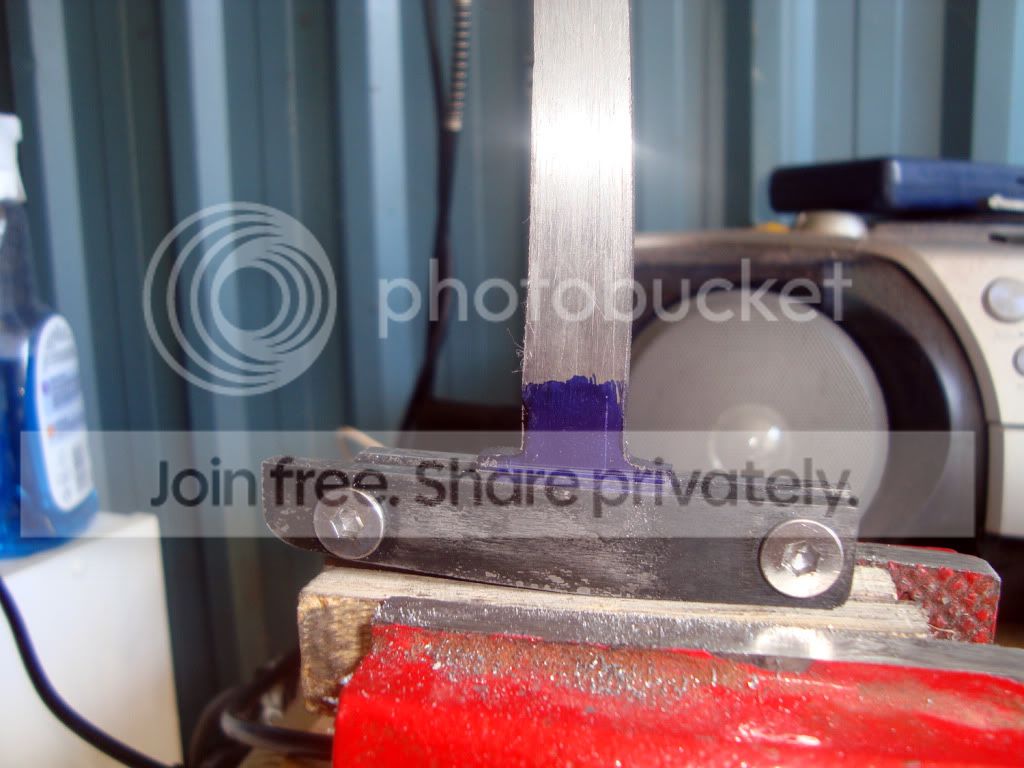
newfilestop.jpg


It is crude looking but it gives me a square strong edge to file to, and the file does not cut into it. So there is the first knife making tool I made on my own:p next I think I will make a brooch for fitting the tangs into the handles.

After a bit of filing the first blank looked like this
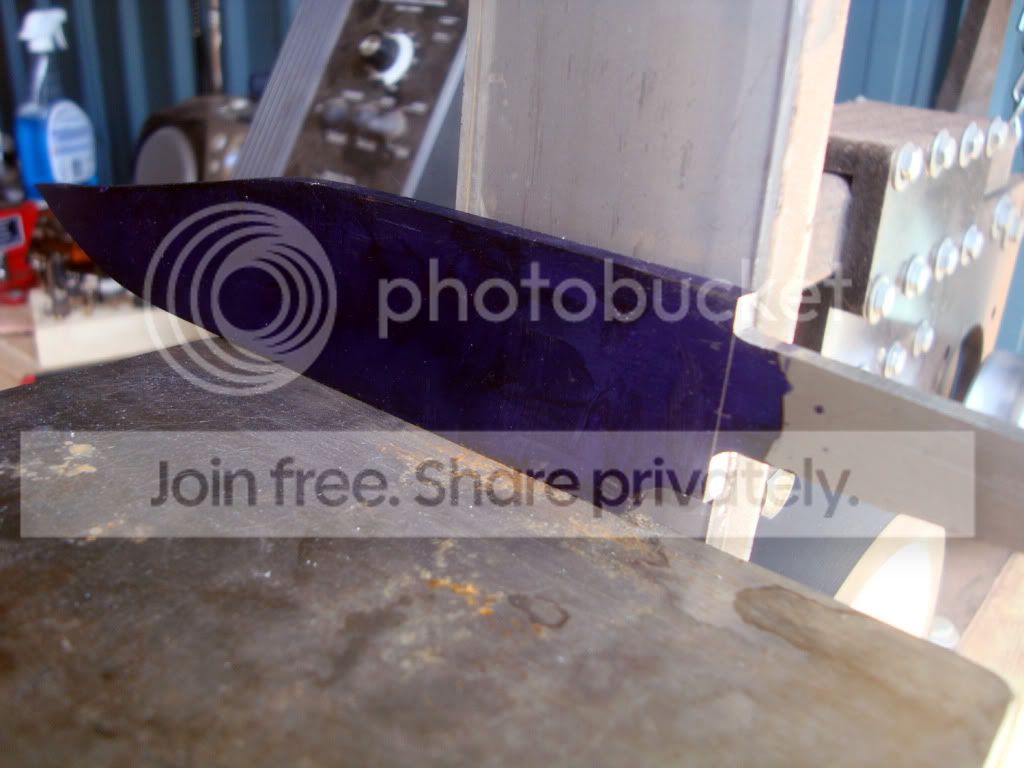
shoulderssquared.jpg


Perfectly square as far as I can tell with the cutting edge of the blank. I wont know for sure though until I mock up a guard out of some scrap.

Finally I started grinding in the bevels. I work alone so there is no one to take pictures of me grinding, but here it is after a 60g rough in.
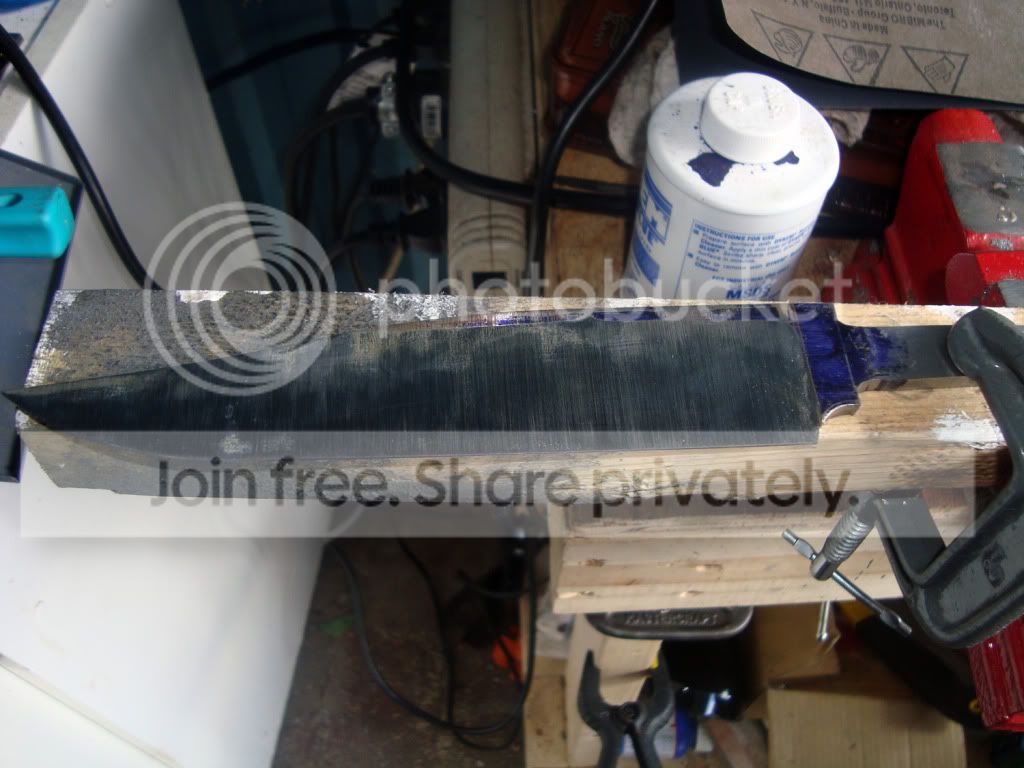
roughground60g.jpg


The cutting edge is still about 1.5mm thick, but I am aiming for dime thickness (1mm) by the time I get the grind up to the spine. Today I am starting with a 120g belt and finishing with a 220g belt. Then I switch over to hand sanding to make sure that the bevels are flat and true.

Hopefully I get more done today on the first one, and get started on the other two. There should be more pictures later tonight or early tomorrow.

Keep in mind I still consider myself a noob at this so don't take anything I say or do as the way to do it properly, its just the way I do it.

George
 
Last edited:
Nice! :thumbup: I have enjoyed your WIP's. Thanks for sharing! :D

That' a nice looking knife. I look forward to seeing what your variations are.
 
Looking good! I don't make my shoulders perfectly square, rather angle them forward just a bit, maybe a couple degrees. (so the top of guard will be slightly closer to the tip than the bottom is). I don't really understand why but when you make them square and complete the guard, it seems to look like it's leaning back... some kind of optical illusion :confused:

I swear I'm not making this up, experienced makers have commented on it too.
 
Looking good! I don't make my shoulders perfectly square, rather angle them forward just a bit, maybe a couple degrees. (so the top of guard will be slightly closer to the tip than the bottom is). I don't really understand why but when you make them square and complete the guard, it seems to look like it's leaning back... some kind of optical illusion :confused:

I swear I'm not making this up, experienced makers have commented on it too.

Odd I have made 3 bowies now and all I have squared the guard up with the spine and edge and haven't gotten the optical illusion of that lean:confused:

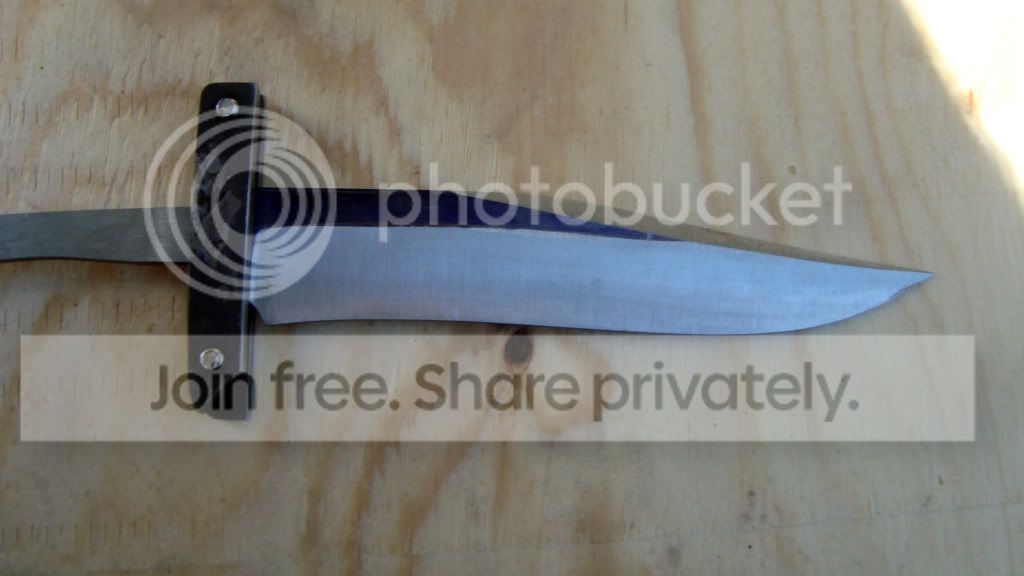
the first
bowieC.jpg


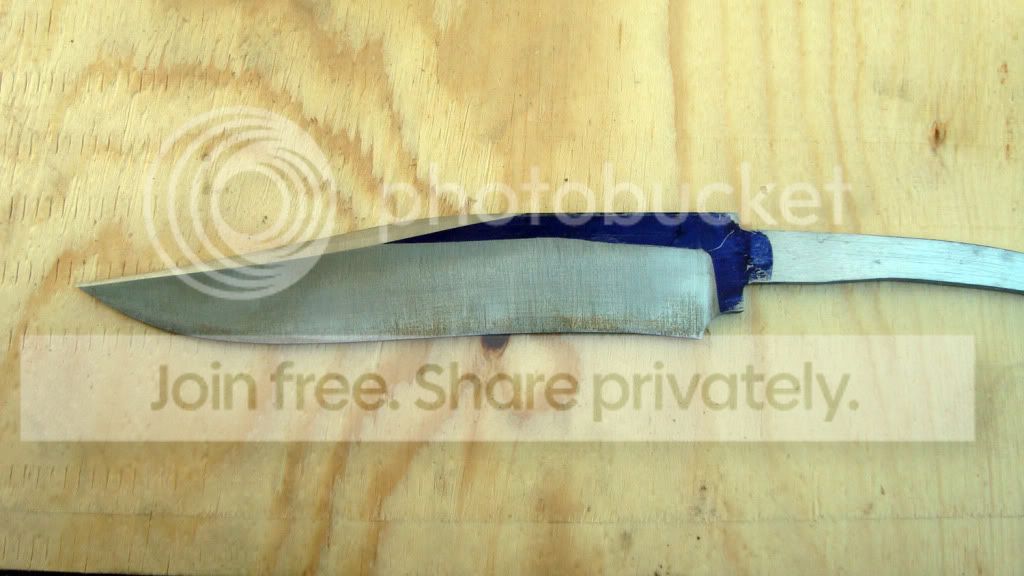
The Second

DSC02219.jpg


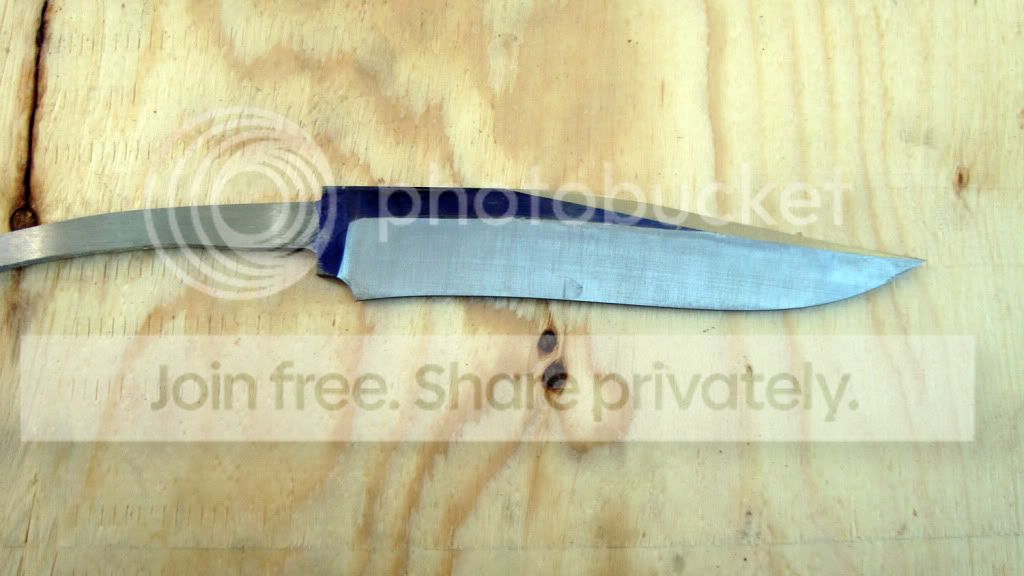
and the third

DSC02364.jpg


All are squared up and look so to my eye do they look off to you? I really want to know, I am not often fooled by optical illusions so if they look off to others I may have to change my strategy.
 
So I got my grind up to the spine and my edge thickness is right on target. I should hit my HT thickness perfectly once I rub all the scratches out. After I hit the spine I laid out the lines for my swedge, flipped the blade over and free handed them in on a 120g belt at low speed ( about 35%, yeah VFD:p). I always start on my weak side and match the results with my strong side. Once I had the swedge ground in and matched as good as I could, I clamped the blade to my handy dandy sanding jig, AKA a chunk of 2"X2", and loaded a piece of 600 grit in to my palm sander. I pulled the foam off of the sander so I would have a solid surface to mount some mycarta to, but the base of the sander was already flat and had no funky ridges to cause problems. I will add that piece of mycarta at some time though.

The reason I use the palm sander and 600 grit paper is to show any high or low spots, not to actually sand the blade. I did find one spot where the belt dug in a bit but its nothing I can't clean up during the hand sanding. Then I started sanding things out to my HT finish. I normally go to 600g, I don't know why I do it to that grit but it works for me so I don't feel the need to change that yet. Well enough of the typing time for some pictures.

Grinding done, hit with the palm sander to expose any defects in my grinding
DSC02486.jpg


Other side same thing, this is the side with the gouge.
DSC02481.jpg


After a bit of dirty sanding at 320g
DSC02492.jpg


and the other side, now you can see the gouge, but it gets lighter with every stroke of the sanding stick.
DSC02493.jpg


Thats it for today, because my mother broke her foot last week and I am doing all the household chores for her till she gets back on her feet. Tomorrow I will go back and forth between the second blade and hand sanding on the first. I have the grind lines all marked out on the second, but the picture will have to wait till tomorrow.
 
All are squared up and look so to my eye do they look off to you? I really want to know, I am not often fooled by optical illusions so if they look off to others I may have to change my strategy.

The last one looks a little off, but it could very well be the angle of the photo. In any case, all three flow very nicely from the spine/ricasso into the handle, and the butts angle back to continue that flowing look. Really nice work! :thumbup:
 
Patrice Lemée;9772376 said:
No optical illusion for me either.
Looking good Unky. :thumbup: Take downs are fun! :D

Guess I am kind of rude because I epoxy them solid so they cant be taken apart once they leave me:D

The last one looks a little off, but it could very well be the angle of the photo. In any case, all three flow very nicely from the spine/ricasso into the handle, and the butts angle back to continue that flowing look. Really nice work! :thumbup:

Thanks for the compliment, but I got a lot of guidance from so very respectable makers while doing the first three. this set I am am trying to meld the best parts of the first ones and test my skills with a grinder. The first two are all ground out and in different stages of hand sanding before HT and all look good to me. The third one will get ground tomorrow then its time to start hunting down handle material to match each one.
 
No need to apologize, its not like you said something offensive. I don't feel I have the precision skills to do a take down knife:o

So, on to today's progress. Today I started grinding the second blade. You saw the first version, and here is the second, scribed and ready to hit the grinder.

DSC02503.jpg


I know it has a 3 on the tang, but that is just for the mock up guards I am making to check the shoulders. There are three holes in one piece of scrap and the third hole is for this, the second knife.

This time I ground the swedge in first, and the bevels in after that.

Weak side.

DSC02507.jpg


Strong side

DSC02506.jpg


Both are ground out to 220. I know the weak side looks a little wobbly in these pictures, but it is just a bit of the layout dye had flaked off. It's not perfect, but passable with a bit of sanding to square up the grind lines.

Next I hit it with the palm sander and 600g paper to find any flaws in my grinding. This time I found a nice gouge on the weak side. I can sand it out, but it is going to take a little effort for this one.

Weak side, the gouge is about 2" out from the plunge. I think when I am coming into the belt I am leading a bit to the tip end. I will have to see if I can fix that on the 3rd blank, because I don't like hand sanding out scratches:grumpy::p
DSC02511.jpg


Strong side no major problems on this side:thumbup:

DSC02508.jpg


And finally the two that have been ground and lightly sanded side by side

DSC02515.jpg


I still have to figure out what exactly I am going to do on the third one, I may just copy the grind from one of the other two and do something different in the finishing to set it apart.

As for now its time to ice the elbows in hopes that they will be good enough to get some sanding done tonight. Look for more grinding and pictures tomorrow.

George
 
Weak side, the gouge is about 2" out from the plunge. I think when I am coming into the belt I am leading a bit to the tip end.

Ah, the dreaded 2-inch disease. You can cure it by switching to a 1" belt, then you will have the dreaded 1-inch disease :p

(wait... that sounds really wrong out of context... nothing personal intended!)
 
Last night I spent a few hours looking at pictures trying to find inspiration for what to do with the third blank. I found it in my BM710 and set out to do a re-curve. It maybe a little outside of my skill set, but you don't learn from not trying so I laid it out on the steel and ground the re-curve into the cutting edge last night so I wouldn't have a chance to change my mind. Once I had a curve that I liked I set about laying down my grind lines for this morning.

At 8:30 this morning, this is what I was looking at

DSC02518.jpg


I have decided that I like to grind the swedge in first with a 120g belt, so I did that, then I broke the corners of the cutting edge with a 60g belt, and started to grind in my bevels.

Bevels started
DSC02519.jpg


DSC02521.jpg


I stuck with the 60g belt till I had almost hit my grind lines and them switched to a 120g belt to bring everything up to the edge of the lines. Keeping the grinds even while following the curve of the edge was hard, but I think I did a decent job for my first try.

DSC02522.jpg


DSC02524.jpg


Then I switched out to my 220g belt and tried to fine to the grind and get rid of all the 120g marks. In the end my grind lines aren't perfect, but they aren't that far off that I feel I totally failed at my first attempt at a re-curve.

DSC02523.jpg


DSC02524.jpg


So all of the major grinding is done and it is time to start hand sanding to my pre HT finish. Some where along the line I need to grind the end section of the tangs round and cut the threads. I also need to decide on handle materials and hardware for them. For the next week I will be sanding away so there wont be much to see, but I will post before they head out for HT.

This is the three of them as they sit right now

DSC02526.jpg


Cutting edges are from 6.5" to 6.75" with an overall blade length of 7.25"-7.5" If you have any handle material or hardware suggestion feel free to speak up.

George
 
I've only done one recurve (a 9" bowie) and I had to do a fair amount of draw-filing to smooth out the top of my grind lines. It worked, though. I too just started another big bowie and tried grinding the swedge first; I found it much easier to keep it even that way.

Lookin good, George!
 
I don't feel I have the precision skills to do a take down knife:o

George, from the looks of things so far, you do. If it is not of interest to you that's fine but if you don't try them just because of that, you should. I am sure your first epoxied one wasn't perfect so this one doesn't have to be. (believe me mine wasn't). And what better way to work on precision skills. In fact I find it easier in a way, as you can work on parts separately.
 
I've only done one recurve (a 9" bowie) and I had to do a fair amount of draw-filing to smooth out the top of my grind lines. It worked, though. I too just started another big bowie and tried grinding the swedge first; I found it much easier to keep it even that way.


Lookin good, George!

I just came in from running the file over the bevels, didn't take much time, and made a huge improvement. Thanks for the tip:thumbup:

Patrice Lemée;9776068 said:
George, from the looks of things so far, you do. If it is not of interest to you that's fine but if you don't try them just because of that, you should. I am sure your first epoxied one wasn't perfect so this one doesn't have to be. (believe me mine wasn't). And what better way to work on precision skills. In fact I find it easier in a way, as you can work on parts separately.

I will attempt one sooner or later, but a lot of the lack of precision I have is my tools. My drill press is a little wobbly for starters, and I really need to get into Ottawa to pick up some reamers so I can drill far enough under sized to be able to ream to the proper size. I should be able to get to Ottawa in 4 weeks when I take my mother into the hospital for her broken foot check up. I would have done it today but funds were a little tight this week. By the time I get these finished I may have updated some of my tools and make one of these a take down knife.

George, your grinding is fast becoming samsational, my friend.

With these only being my 3rd,4th, and 5th knives using the grinder (I don't count the little 1.5" bladed knife) I will take that as a complement. I do have to say that I have gotten years worth of advice from reading here in the knifemakers forum.
 
I just came in from running the file over the bevels, didn't take much time, and made a huge improvement. Thanks for the tip:thumbup:

I kinda felt like I was cheating, since I couldn't get the recurve bevels nice and even on my grinder... but if draw-filing to clean 'em up worked for you too, more power to us ;) Whatever works, man!
 
I don't think it is cheating at all, it is doing what ever it takes to get the best possible product you can make. Mind you it would be much nicer to be able to just grind them in perfectly to start:p
 
It has been a few days since the last update, and you would think I would be further along than I am, but I had a little set back called rust:grumpy: The humidity is much higher than I am use to and I left the first blade out where it could get some condensation on it, and when I woke up the next day I had a nice rust spot on it that pitted the blade. After 2 days of sanding to get rid of the pitting and trying to keep the edge even, I managed to get it done.

DSC02548.jpg


DSC02547.jpg


600 Grit pre HT finish, no pits, no scratches on the first blade. It kind of sucks because this is exactly where I was 2 days ago. Even now I am noticing little spots of surface rust forming on the blade, so I think I may have to give it a light coat of oil before putting it away while it waits for the others to be finished and I can send them all out for HT. I realize I will have to wash them down to get the oil off of them before HT, but its better than having to sand out pitting again.

For you guys that live in more humid areas, how do you combat this rusting problem while you are working on a blade? It seems to me that once the steel is hardened in is much more resistant to rusting, but that could just be a figment of my imagination and the reason I don't see rust on hardened blades is because of the oil use to quench.

Now I am off to do a little draw filing on the second one to get rid of a deep grind line, then tomorrow is back to sanding. Hopefully I wont have the same problem I did this time.
 
It has been a few days since the last update, and you would think I would be further along than I am, but I had a little set back called rust:grumpy: The humidity is much higher than I am use to and I left the first blade out where it could get some condensation on it, and when I woke up the next day I had a nice rust spot on it that pitted the blade. After 2 days of sanding to get rid of the pitting and trying to keep the edge even, I managed to get it done.

DSC02548.jpg


DSC02547.jpg


600 Grit pre HT finish, no pits, no scratches on the first blade. It kind of sucks because this is exactly where I was 2 days ago. Even now I am noticing little spots of surface rust forming on the blade, so I think I may have to give it a light coat of oil before putting it away while it waits for the others to be finished and I can send them all out for HT. I realize I will have to wash them down to get the oil off of them before HT, but its better than having to sand out pitting again.

For you guys that live in more humid areas, how do you combat this rusting problem while you are working on a blade? It seems to me that once the steel is hardened in is much more resistant to rusting, but that could just be a figment of my imagination and the reason I don't see rust on hardened blades is because of the oil use to quench.

Now I am off to do a little draw filing on the second one to get rid of a deep grind line, then tomorrow is back to sanding. Hopefully I wont have the same problem I did this time.

George, I think this thread http://www.bladeforums.com/forums/s...-_-Dip-Bucket-Blues?highlight=dip+bucket+rust relates to your problems with rust and how to address them. I think this thread came along when you were on your Blackberry still from the move. Hope the advice here helps. Are you wet sanding with water, or Mobile 1? Seems like the flash rust is common unless you use the Borax in your water....

Btw, I really appreciate all of your WIP's and willingness to ask questions. It's been of great help to me as I learn myself.
 
Back
Top