3 similar blades WIP ***Now including KITH updates***

What you don't think my first knife was perfect? I am so crushed:(:D

So I went to see the specialist this morning and it looks like I start me platelet therapy on the 19th and I will probably be down and out for a couple of weeks:( the good thing is that couple of weeks lines up with the time that I will be sending the last one out for HT so I don't lose and of my planned time on these knives.

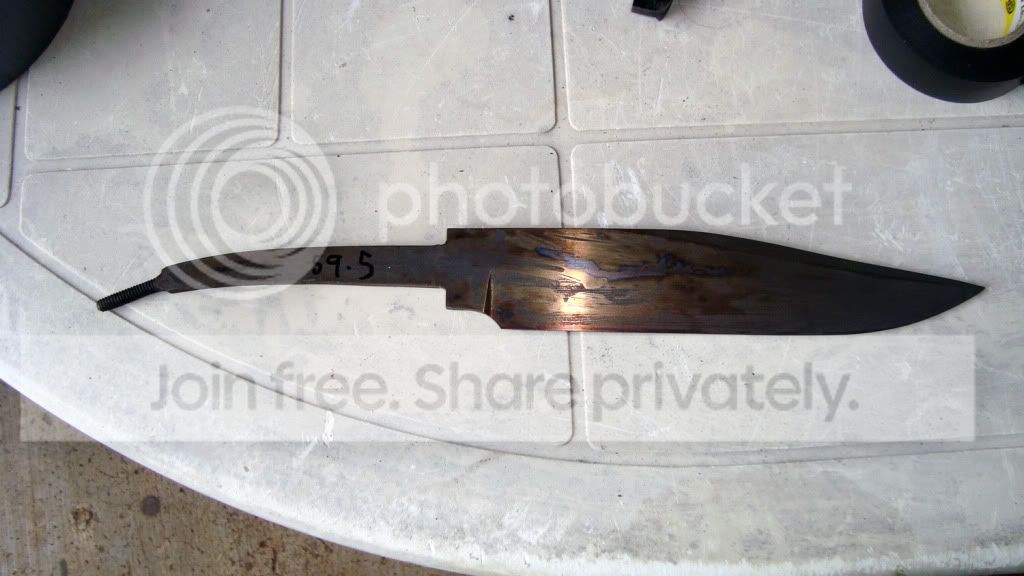
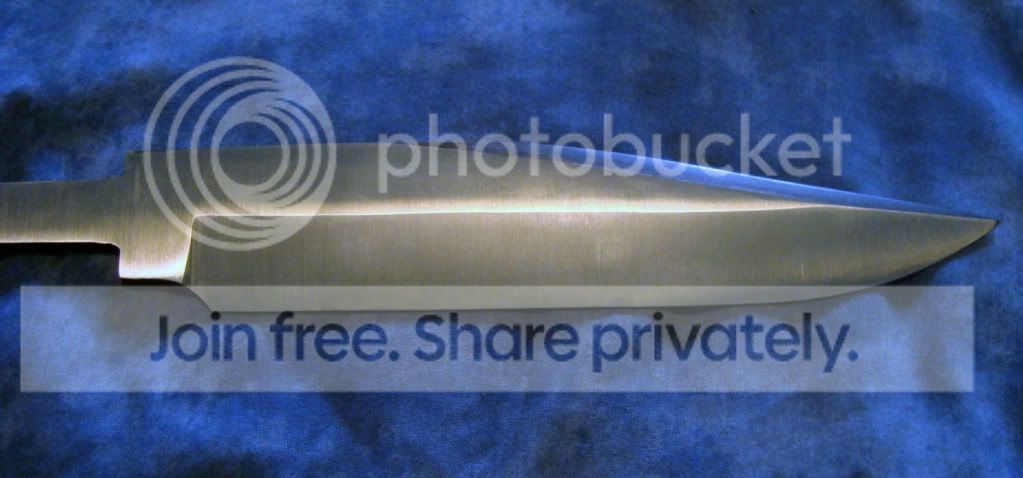
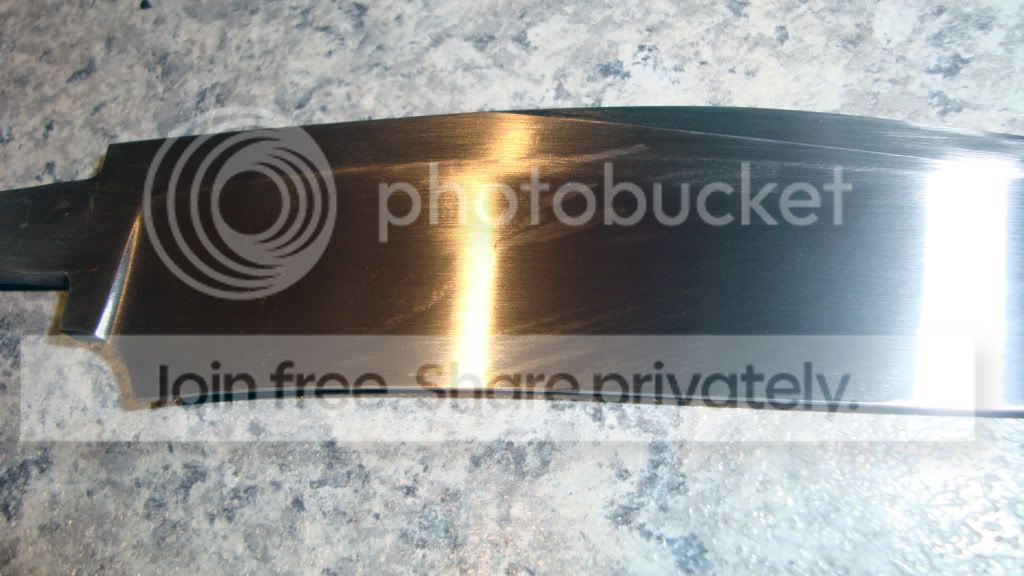
Now onto what I did after getting back home. The first thing I did was work on getting the shoulders right, I am closer but still have a bit of tweaking to get it just right, then I started sanding. After the first couple of swipes I knew I had a problem. I am not sure what is going on here but the knives left here smooth and scratch free, but under the decarb I found this
DSC02667.jpg


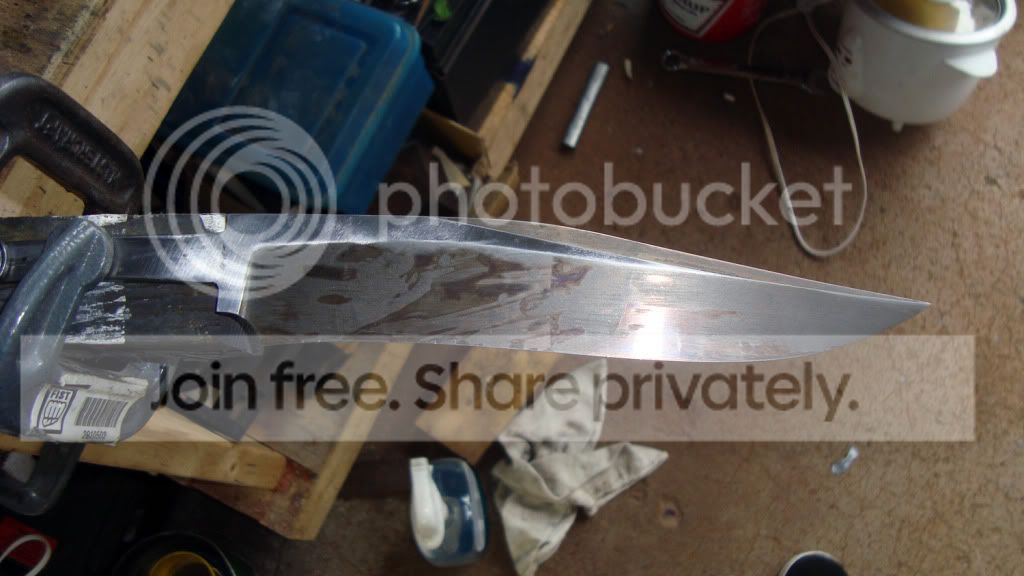
While it sort of looks like smudges it isn't and it doesn't really change depth to much. It is sort of like a stain in the steel. If you look at the next picture you can see exactly where these marks are before I even started sanding.
DSC02660.jpg


I would really like to know what caused these marks so I can avoid them in the future. Is it from me not cleaning them well enough, did I sand to to high a grit before HT (600), is it a problem with the steel itself?

As you can see it looks like I am going to have the same problem with the next one too:(

DSC02662.jpg


The marks are sanding out but it is taking a long time. I am guessing that at the current rate I will be sanding this one till the end of the weekend. Luckily the second one I will be able to do on the grinder because my new belts should be in by then and I ordered some high grit finishing belts to try and shorten the time I spend hand sanding. That and it was suggested that if I want sharp crisp grind lines I needed to go to a higher grit than I was.
 
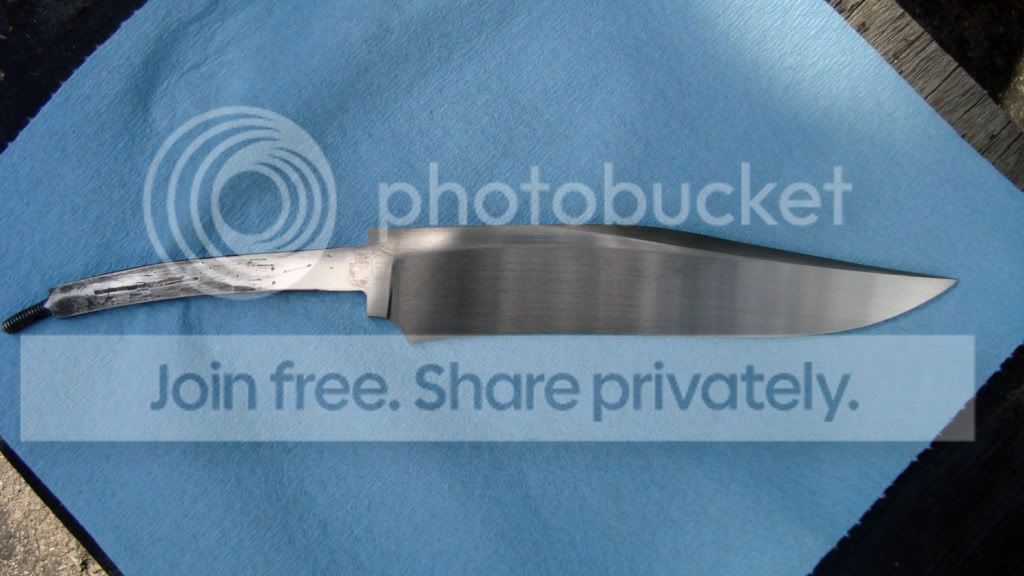
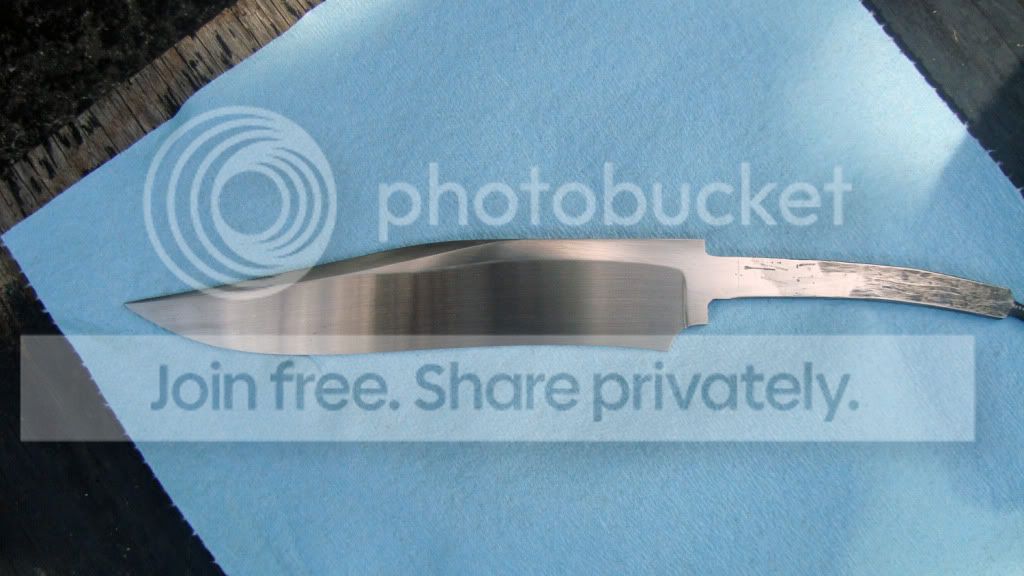
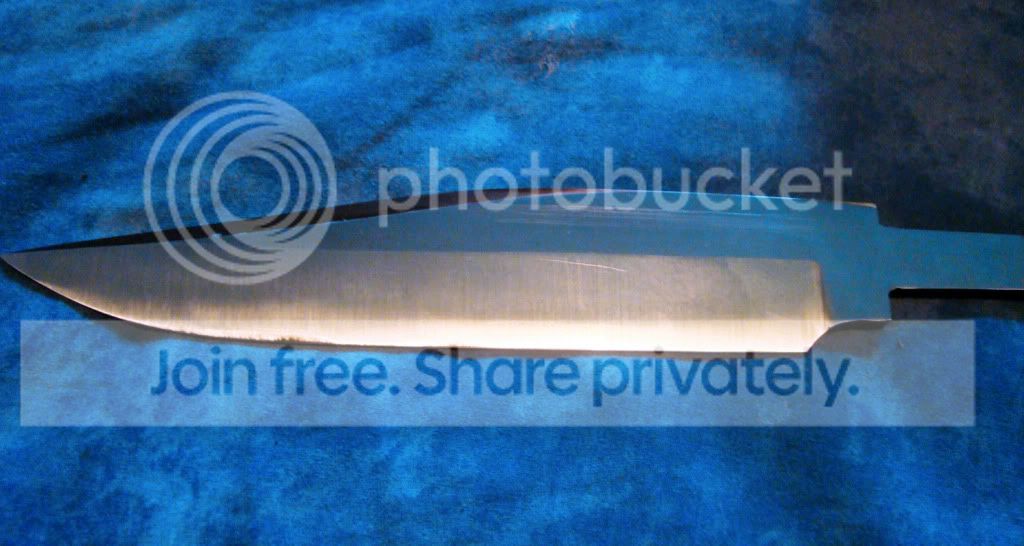
Well disappointment time has arived:( While I got the funky marks out of the blade at 400g, as soon as I went to 600g they popped up again. I spent the day going up and down between the two grits, making sure that there was nothing visible at 400, then going to 600 only to have them pop up again and again. They aren't scratches, or bumps, just what seem like discolorations or slight hazy spots. I had wanted to go to a full polish on this one, but now it looks like I will be doing a hand rubbed satin finish. I did a little test and the haze pretty much goes away at 600 when the scratch pattern is ricoso to tip, but shows again at 800 in the same direction. SO that was 10 hours of sanding to only advance 2 grits:grumpy: I haven't had this problem with O-1 before so I am thinking the problem might be the steel. I will post some pictures tomorrow once I get he satin done.
 
OK I pretty much have the first one wrapped up, well the knife side of it. I still need to get the shoulders fitting flush, and do a little fine tuning on the handle, pommel, guard blending. Then it just a thing of cleaning up the wood and sealing it so it doesn't pick up as much dirt. I will also have to put my makers mark on the blade and epoxy everything up.

So here are the pictures of today's work. I spent much of yesterday and this morning trying to sand through the marks that were on the blade, I manage to get them almost invisible at 800g, but at 1000g they were just too strong to continue to go for that mirror finish I wanted to do on this one.

at 600g, no that isn't poor sanding its a bit of oil still on the blade:o
DSC02674.jpg


DSC02673.jpg


I tried to get a picture of the marks at 1000g but they just wouldn't show up.
DSC02683.jpg


After a few more tries I finally gave in and went to a 600g satin finish. There are a few little imperfections in the finish along the grind line, but I will need to do some clean up on the blade after I do my makers mark, so that is when I plan on fixing that. You can't see them in the pictures but they are there, trust me I wouldn't lie to you.

DSC02688.jpg


DSC02687.jpg


DSC02689.jpg


DSC02690.jpg


I didn't document what I did for my hand sanding, but it is fairly basic. I start at one grit below what I did pre HT and work my way up through the grits rotating my direction 90* each grit. On this one if everything had gone as planned I would gone in this progression 400, 600, 800, 1000, 1200, 1500, 2000, 2500. Because of the marks in the steel on this one I brought it up to 1000g then dropped back to 600g using WD40 as a lube to get my satin. I have learned to hate WD40 as a bike mechanic, it is not meant for lubricating anything:mad: yet people would use it on their bike chains and wonder why their drive trains would wear out. I didn't have any Mobil 1 kicking around or any other oil for that fact other than a old can of WD40, well to my surprise it worked quite well:eek:

Tomorrow I am going to do those touch ups and maybe my mark on the blade. I still need to decide on whether or not to cold blue the fittings, but that wont happen till just before gluing everything up. If that all goes well I will get to work on the sheath tomorrow evening, the next knife wont be started till my belts get in some time next week, and the gluing will happen when both are ready.
 
Thing is it still doesn't do well as a lubricant:p I actually knew someone that thought they could use WD40 as a prelude on a small engine rebuild. They came into work complaining that they spent all that time rebuilding the engine only to have it seize almost as soon as they got it running. When I ask what they used to build the engine and they told me WD40 I almost pee'd my pants laughing
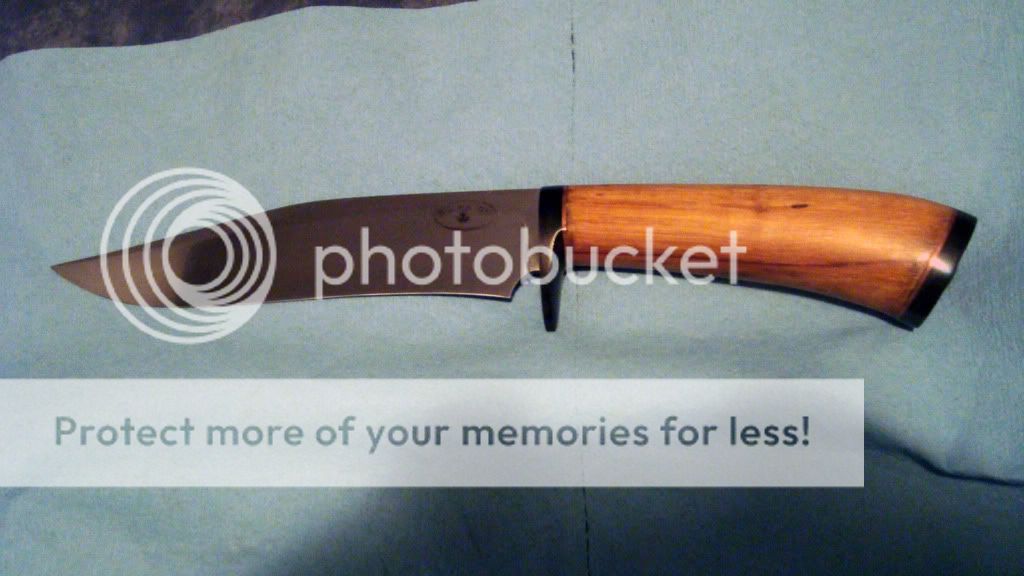
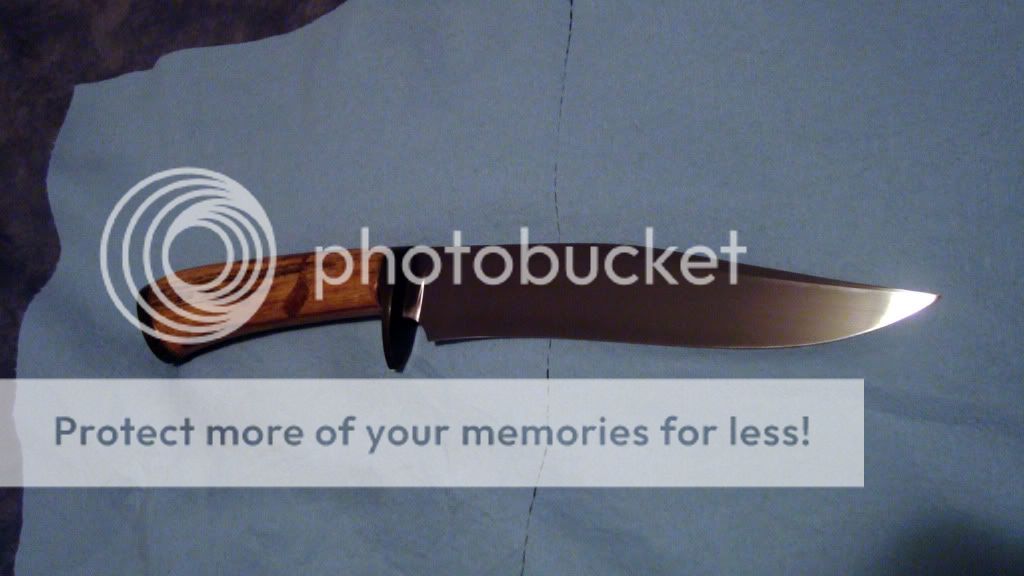
 
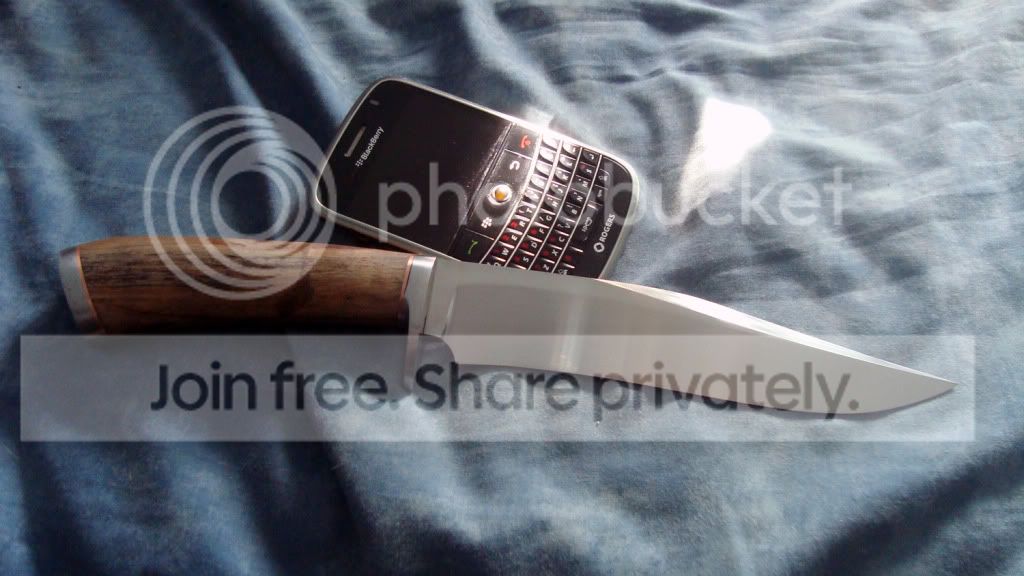
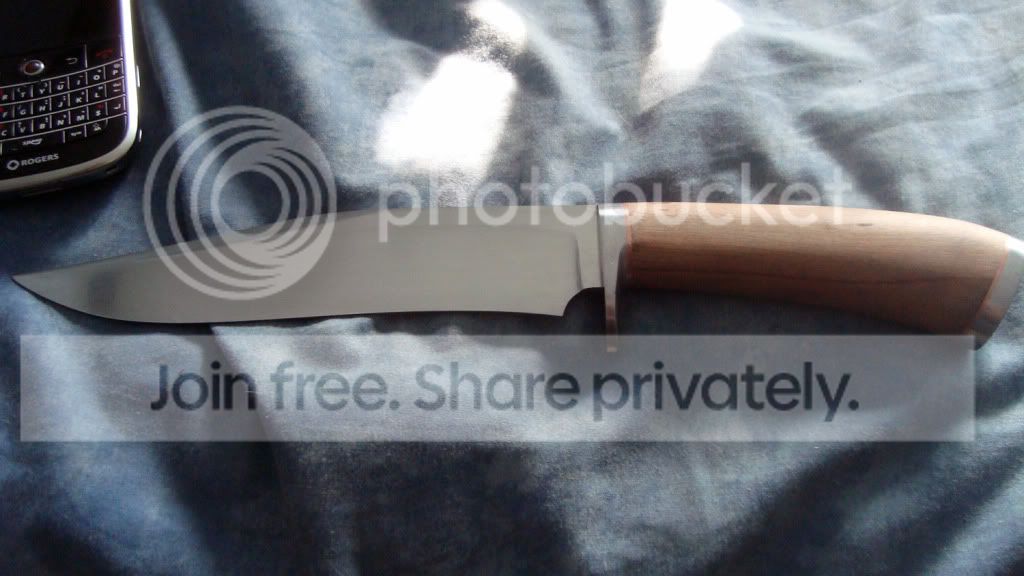
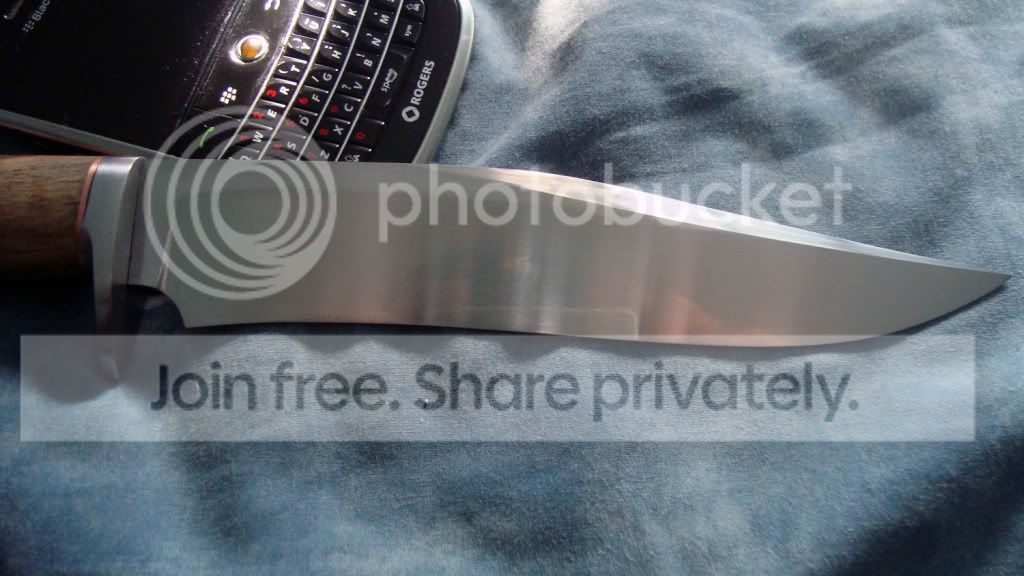
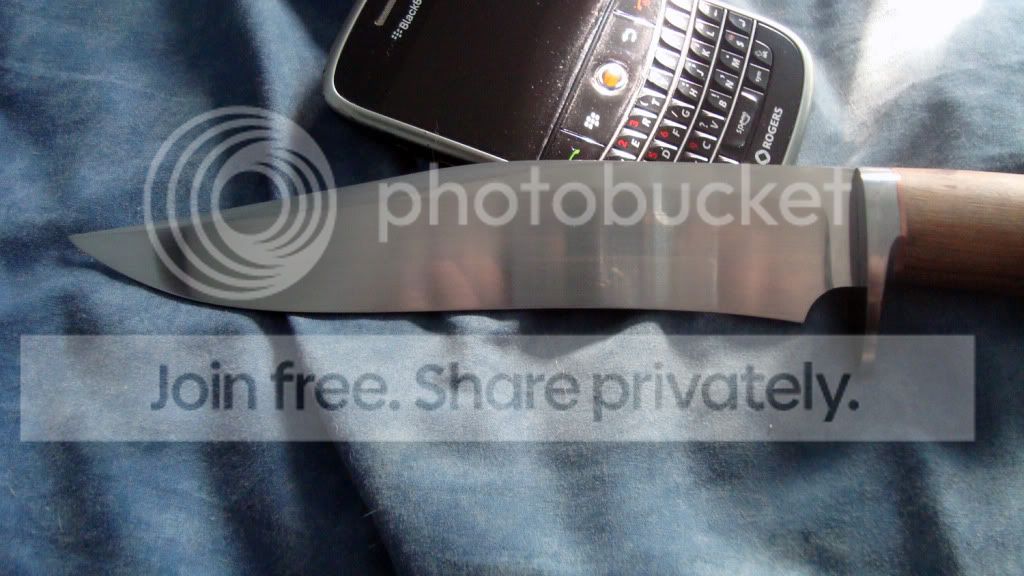
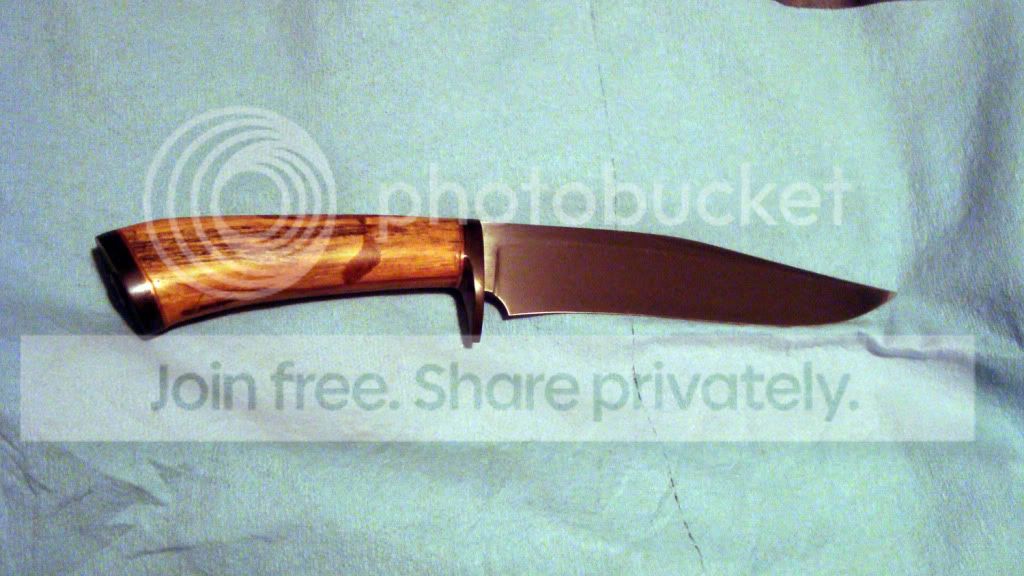
I'm back! This time with a more or less finished knife. All that is left to do to it is glue it up, make a sheath, and sharpen it. Not necessarily in that order, but sharpening it is definitely the last thing I will do to it. I do have a bit of a hard time sharpening recurves, but all the recurves I have ever sharpened were only 4" or less folders. I will give it a try on my own first, but if I am not happy with it I will send it off to Richard J and let him do it with his paper wheels. It also gives me a chance to put one of my knives in another makers hands and get some fed back on it. I know whats wrong with it and what I would do different on this one, I just want to see if I am just nit picking or missing other things. Keep in mind these are not the finished product beauty shots, just a couple of quickies on my bed:eek:

DSC02695.jpg


DSC02698.jpg


DSC02697.jpg


I had the ISO on the camera set to auto and it went a little high making things look a bit grainy, and my brother borrowed my tripod so I was freehand on this one. trust me the makers mark is crisp and clean, a little thick on the bottom, but still looks good.

Tomorrow morning I am going to finally get to the second one and see if I have the same alloy banding I had with this one. If I do its off to the grinder to see if I can get rid of it any easier than I did with this one. I didn't want to take the recurve to the grinder and mess it up:o
 
That is one sick looking recurve bowie man, you really pulled it off! That handle material is very nice... I think it fits the blade well :thumbup:
 
So on to the second of the two I got HT'd already. I cleaned it off this morning with some 400g paper and even though it didn't look as bad as the first one before cleaning, it was worst underneath:( Good thing is this one isn't a recurve so I could take Stacy's and many others advice confidently and I took it to the grinder with a 220g belt. Working slowly with the grinder running at 20% of full out and using a light touch I started working on getting rid of the banding, dipping with every pass.
Right now I have about 95% of the marks gone unless you get the light on the blade just right. I may go for a bit longer on the 220 belt, but I have some new belts on the way and they should arrive in the next day or two so I just may wait for them to show up. In that belt order are some 220 ceramics, and some Norax U264 X45 (aprox 320g) and some Norax U264 X22 (aprox 750g) so I can work my way to a finer finish before going to hand sanding.

Right now here is what the second one looks like.

DSC02701.jpg


Notice the line in the ricasso right near the shoulder? That is the only mark that is visible without rotating the knife in the light. I am still undecided if that is one of the banding marks or a little flaw in my grinding, but it doesn't seem to change with more grinding and doesn't look or feel to dip in.

DSC02700.jpg


In this picture those are not scratches, it is from me running my fingernail across the knife trying to feel the marks i can see from the right angles. I did how ever twist the blade ever so slightly while doing the clean up and you can see that on the ricasso:o I am not to worried about it though because by the time I get rid of the marks it will be flat again. About the only thing I am worried about is that by the time I grind through the marks or get them small enough that I will accept them and do a satin finish, is that the knife will already be sharp and I will still have a crap load of work to do to it:eek: Just how many times will I have to back off the edge before I am ready to make it sharp for good:confused: place your bets now on the number of times I cut myself, dull the knife, and the number of stitches I should have gotten by the time I finish this one:p
The last one I didn't back off the edge once, didn't require any stitches, and only drew blood in any amount once ( I poked myself in the palm because the paper boy came up behind me while I wasn't paying attention) Mind you I haven't sharpened it either so that kind of stacks the deck in my favor:p
 
Geez I am beginning to think I wont get my belts this week after all, here it is Thursday and no updates on the tracking. Normally it has made it to at least Mississauga by now. Last one made it here in 7 days, with a long weekend included. I am really beginning to think that the Canada Post workers are slacking off. Because of the no belts yet there is not progress to report.
 
Geez I am beginning to think I wont get my belts this week after all, here it is Thursday and no updates on the tracking. Normally it has made it to at least Mississauga by now. Last one made it here in 7 days, with a long weekend included. I am really beginning to think that the Canada Post workers are slacking off. Because of the no belts yet there is not progress to report.


I was tracking a package about a week ago & there were some comments in the tracking about a labour disruption.

Apparently there is or was a strike by workers in a sorting plant.
 
Count, I didn't find anything about a strike interruption, but I did see that they are going to court about being wrongly forced back to work.

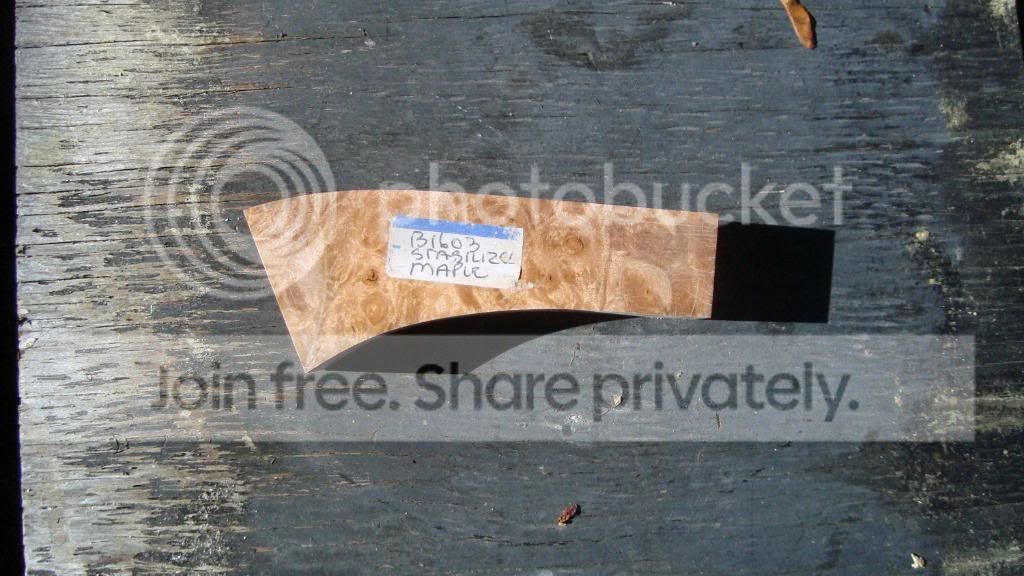
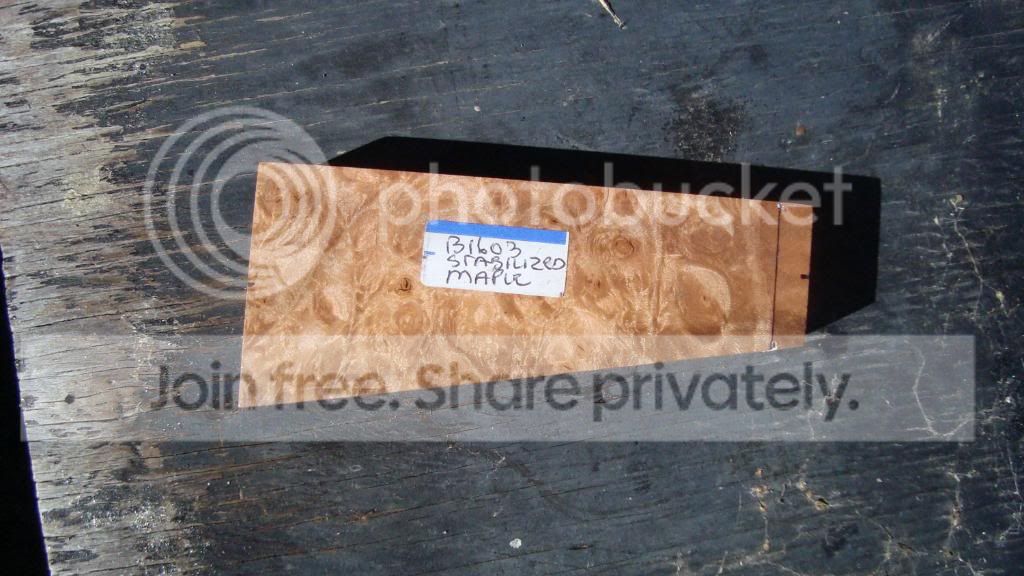
Well even though none of the stuff I ordered came in today I did manage to find something to work on. I was going to keep the last handle a surprise, but then I thought it had been lost in the mail. Five days after Mark sent out a replacement piece the original showed up. It was shipped out August 8th and arrived on the 12th or 13th of this month, I can't remember which:o. I felt really bad about Mark sending out a new block just because our postal service is working so slow that it took 35 days for a package to get to me, but he and I have worked something out. There is no way I would let him pay for the post offices slow delivery, I would even feel bad if it had been lost and he replaced it.

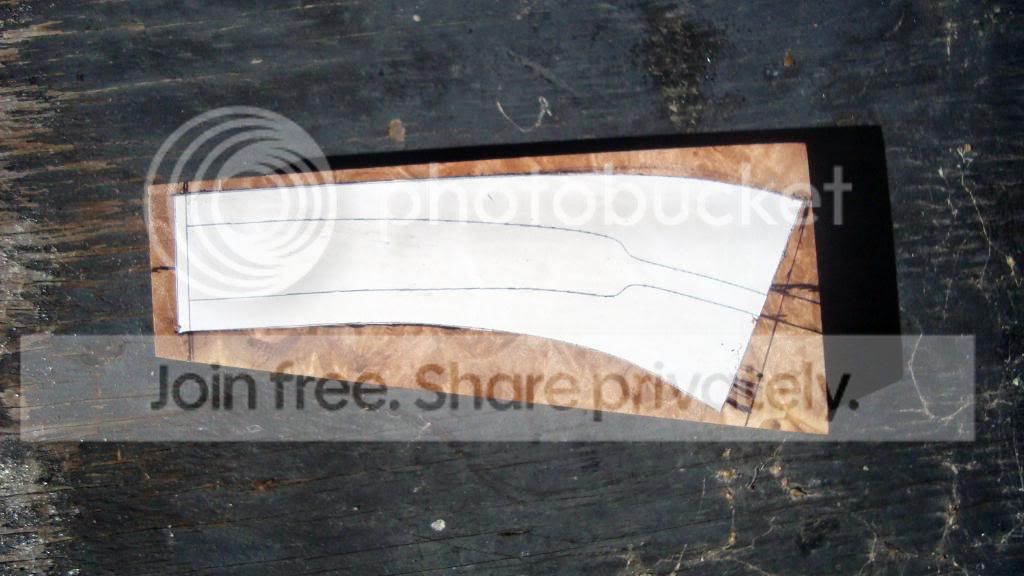
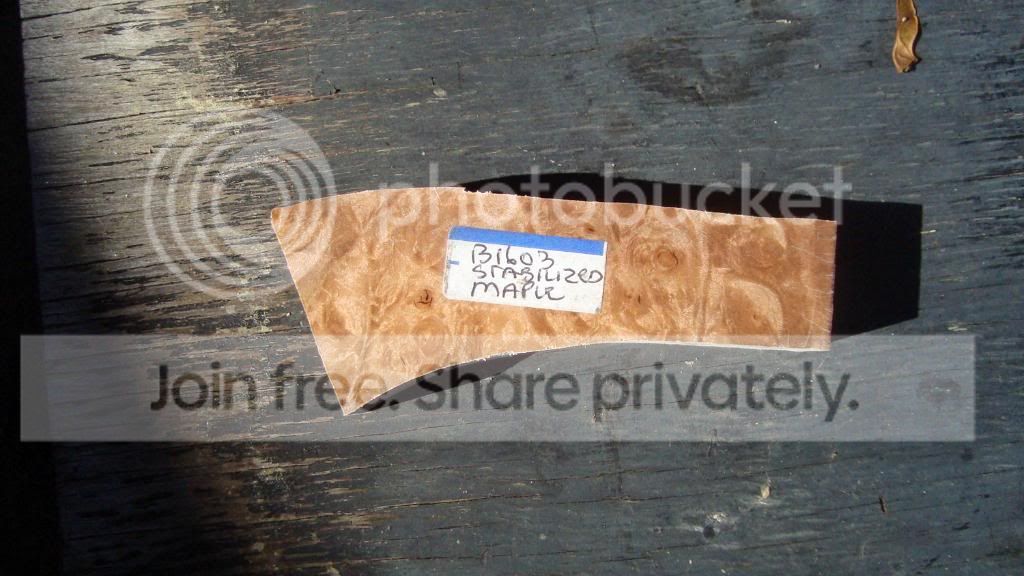
So with no new belts to grind with, I went to work on the handle for the third knife. the slow moving block in question is a beautiful piece of premium grade maple burl.

DSC02702.jpg


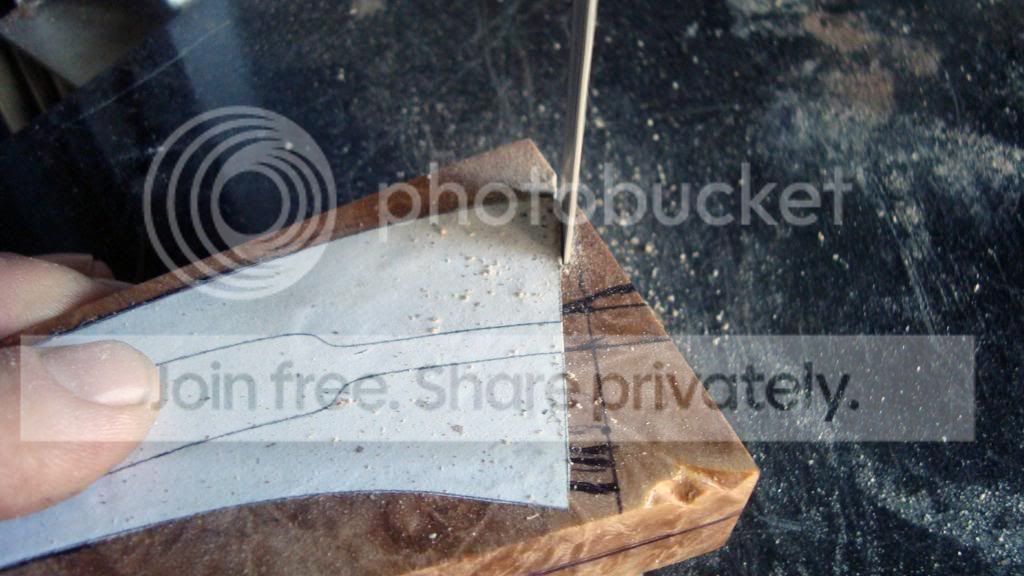
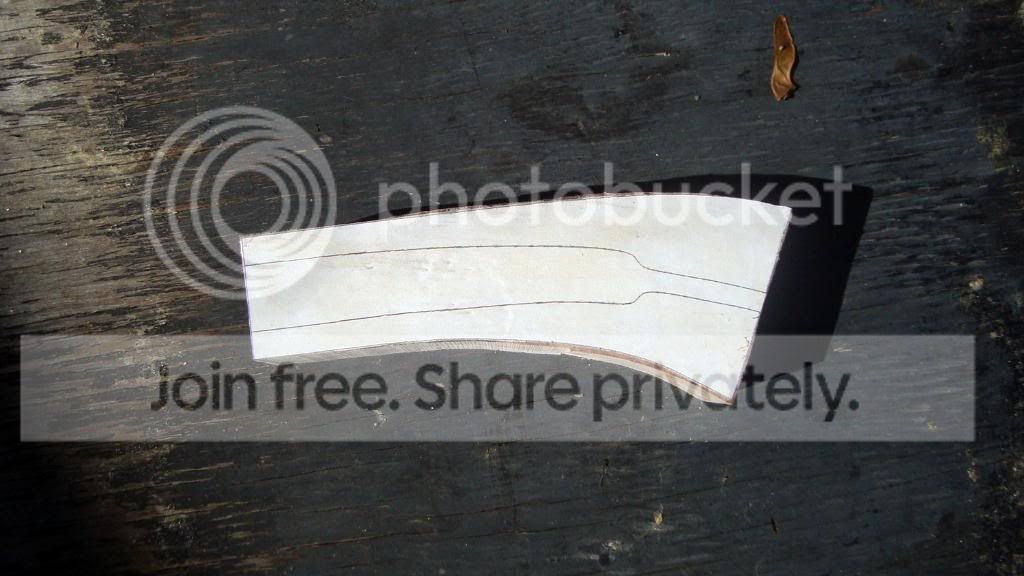
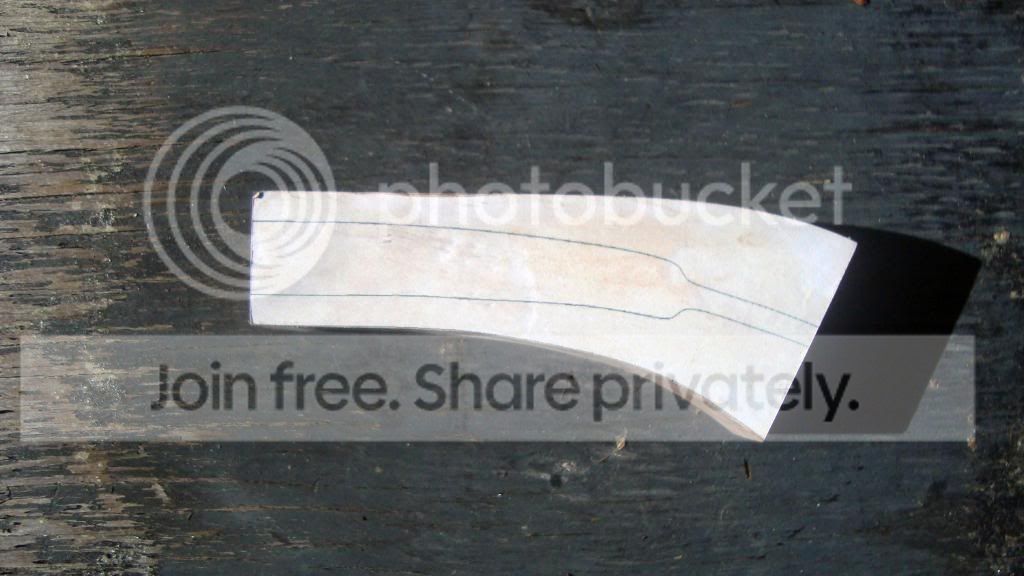
It did have a small crack in it right in front of the line I drew. It most likely would have been fine and not caused any problem, but I didn't want to risk it so I eliminated that section from the equation. The next thing I did was take my original handle design for this knife and made sure it fit the block, and then modified it to suit the pattern in the wood. Once I was happy with that I drew in the tang, and printed everything up. With a little contact cement I glued it to the block, using the line I had drawn to avoid the crack.

DSC02703.jpg


Then it was off to the band saw and time for some slow cutting. I treat stabilized wood as if it was steel for my cutting and drilling speeds and use a very slow feed. I do this to try my best to avoid heating the piece up and causing the block to fracture. I had it happen once when I didn't have a drill press and I let someone else drill a handle out for me. Apparently the acrylic that is often use for stabilizing will expand when heated, and in a burl it can cause fractures that weaken the piece. Believe me it really blows when you are doing that final hand buffing on a handle and it falls apart for no reason:frown:

DSC02704.jpg


No I am not actually cutting in that picture and the saw isn't running, I do pause often and check for heat build up. I wasn't there to see how much heat was built up in the piece that failed on me, but my goal is zero heat and my gauge are my finger tips. I am smart enough not to touch a running saw. I found my perfect feed speed and just how long i was able to go before having to let things cool and finished up the rough cutting of the block

DSC02705.jpg


DSC02706.jpg


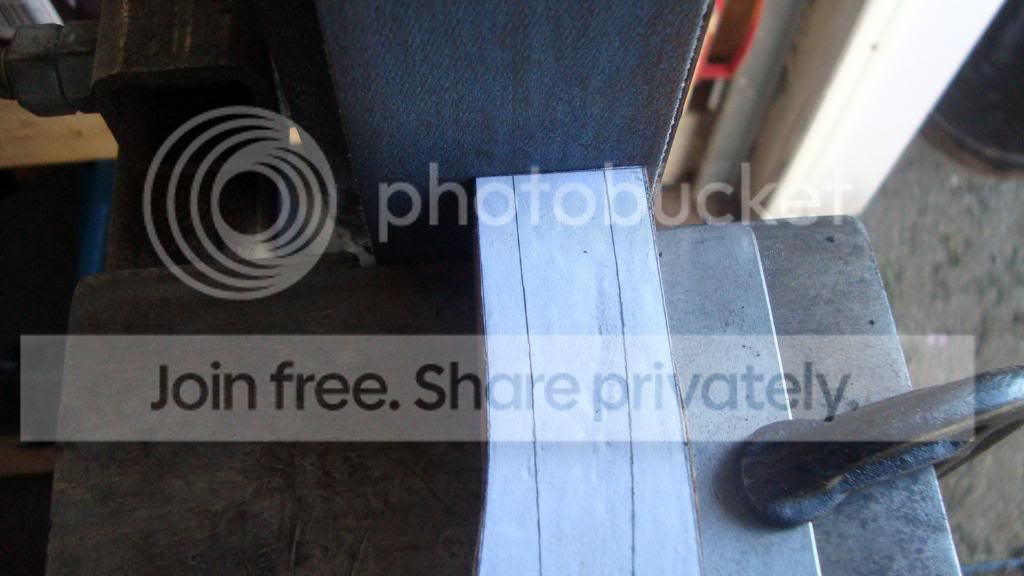
My next goal was to get a square flat face on the front of the handle. I do this on the grinder with a 120 grit zirc belt. Knowing that my print out was square I was able to use that to get the face square with the belt and set up a guide that would keep me from wondering off.

DSC02707.jpg


DSC02708.jpg


Once again no machinery running in any of the pictures, running grinder, running saw, running drill press, all good things to keep my fingers away from.

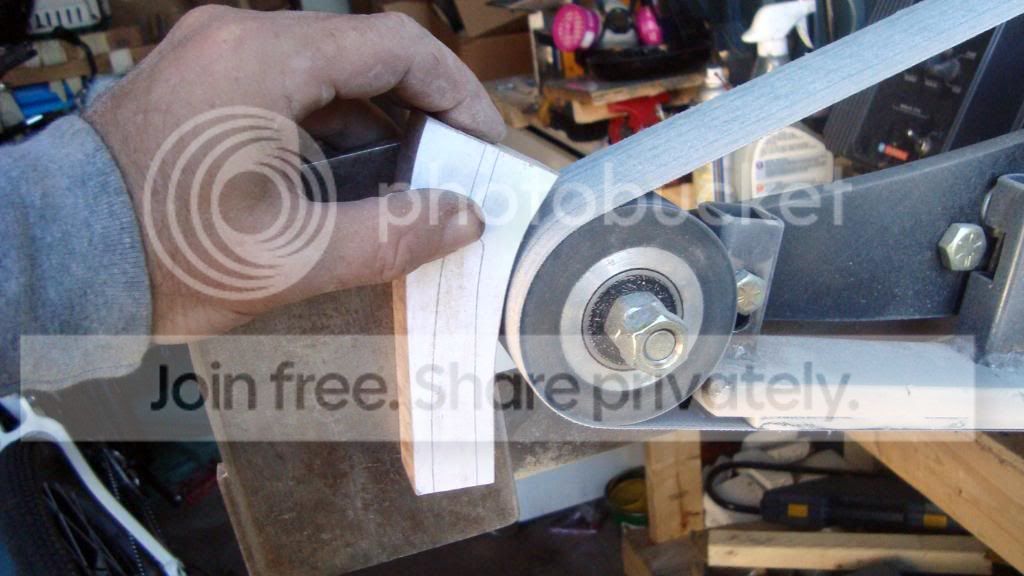
With the face square with my printout I simply started grinding to it with confidence. The inside curve of the handle was done one the 3" wheel on my multi platen. I just spun the platen then flipped the tool rest so everything stays square

DSC02709.jpg


DSC02710.jpg


DSC02711.jpg


I know it looks like there are lumps and bumps, but there isn't. I wouldn't have let them go if there was. Next it was time to lay out for the tang hole. It is pretty simple, measure the width of the block, subtract the thickness of the tang, divide by two. Then with the tang location on the template just use a square and draw the top and bottom lines down. Measure to double check and if everything works out, its time to drill.

Unfortunately For some reason even though I had everything laid out perfectly to the 1000th of an inch and center punched the holes, I still missed my marks by a bit:o Its OK though because this part is hidden and the epoxy I use will fill the gaps.

DSC02716.jpg


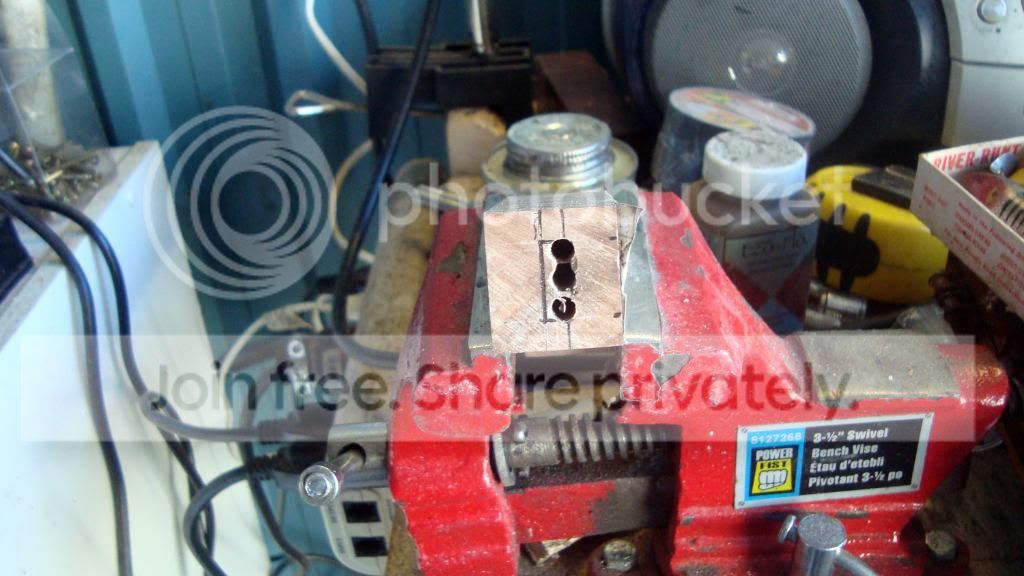
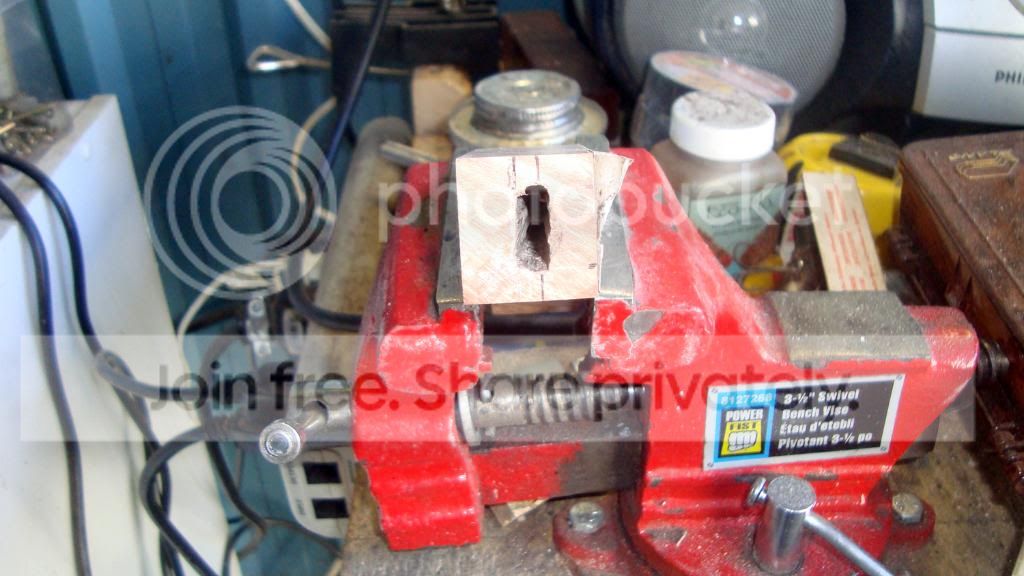
Some how I managed to slip to the side about 3/32nds. With that mistake out of the way and not a huge problem I started cleaning it up with my homemade broach.

DSC02717.jpg


I am just going to make the hole over sized equally on both sides then pop the hole through the back side. My arms started to hurt so I left the handle as it is for now and started on the sheath for the first knife.

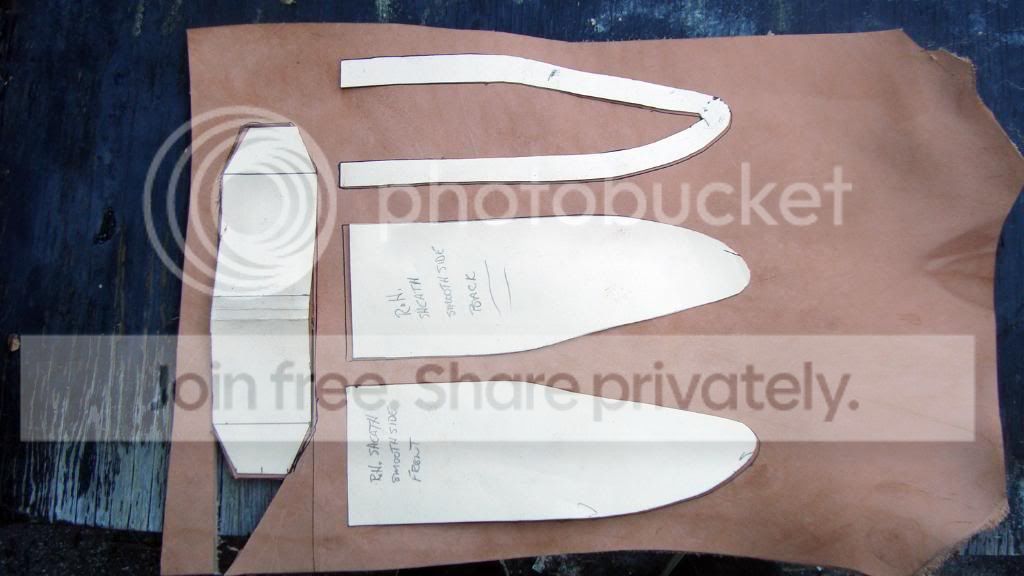
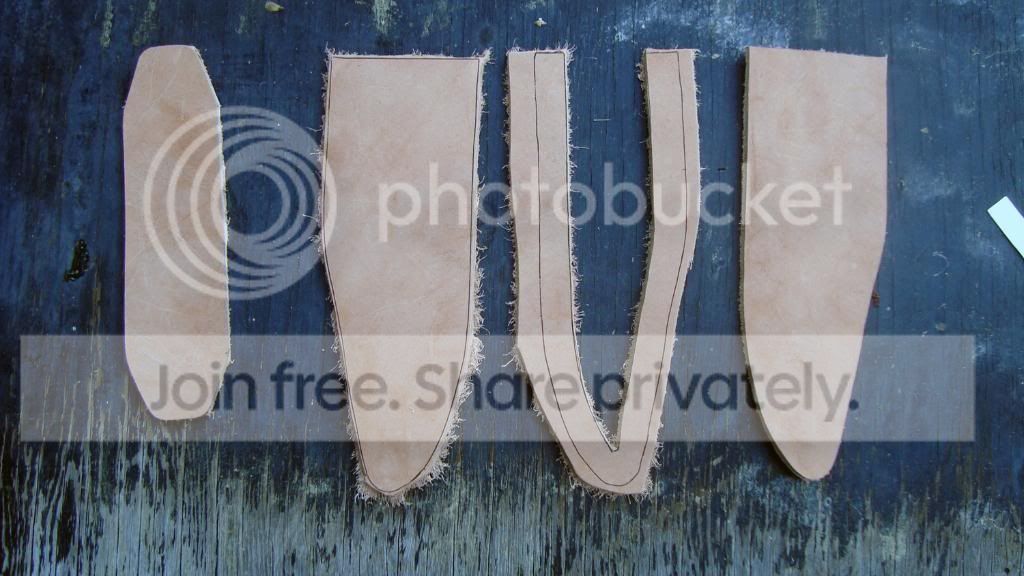
The first thing I do is trace out the blade of the knife onto a file folder. With this one being a recurve I connect the high spots on the cutting edge with a straight line. If I followed the blades curve one of two things would happen, the knife wouldn't go into the sheath when done, or it would end up cutting its way into the sheath and possibly the stitching. With my pattern drawn and cut out I lay it out on the leather. I am using 8-9oz leather, simply becasue that is what I was told I should use back when I started.

DSC02719.jpg


I label my pattern pieces so I don't mix things up and once I have them traced onto the leather I label the back sides of the leather to keep everything the way it should be. Even though I am a lefty I am making the sheath right handed. I am not sure if I will be selling these or giving them away or who will even get them if I do. The fact that there are more right handed people, just dictates that the chances of a right handed person getting the knife are considerably higher. Besides all three knives are based of the same template so they will all fit into each others sheath. the next one will be a left handed sheath and the third will be right handed again.

DSC02720.jpg


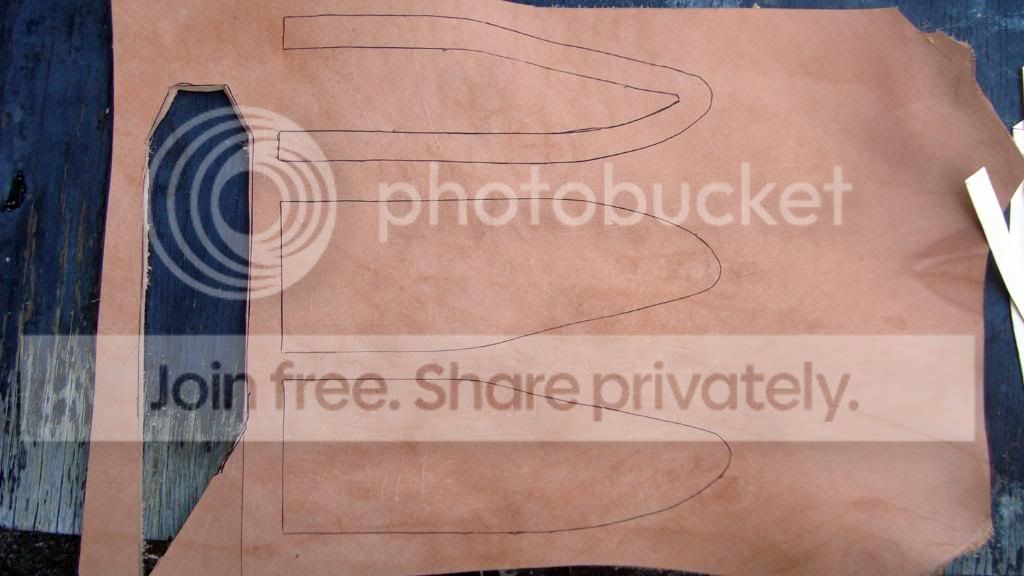
I had tried to cut out the leather with a cheap exacto knife but the handle broke and the blades were too flimsy, so I took it to the band saw. I cut the front piece as close as possible without going over the lines, the welt and back piece I leave oversized so I can match them to the front after any tooling I may do. For those that don't know, leather stretches when tooled. Yes another lesson I learned the hard way:eek: I then bring the front piece down to its proper size on the grinder

DSC02721.jpg


Once i have take the front piece down so that the pen marks are all gone and it is all nice and even, I do the same thing to the belt loop and round the edges on it. With that done I case the belt loop and front piece and stick them in the fridge for a few hours, clean up and make supper. Then it is on to the computer to resize pictures and make this post:p The next step on the sheath is to cut my stitching grooves and to decide just what I want to do on the sheath. That will most likely be tomorrows work right after my morning shower so my hands are spotless to work on the damp leather.
 
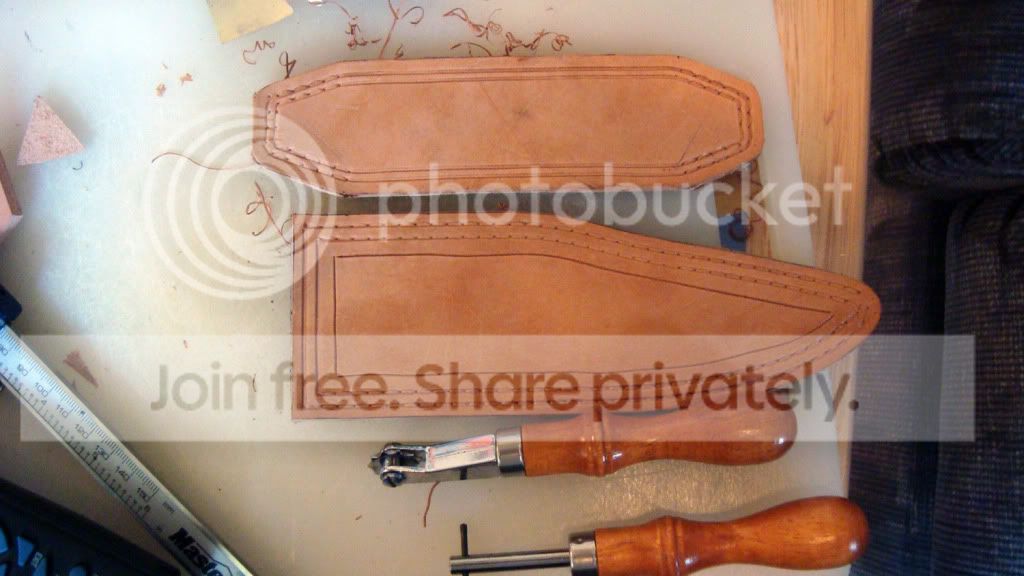
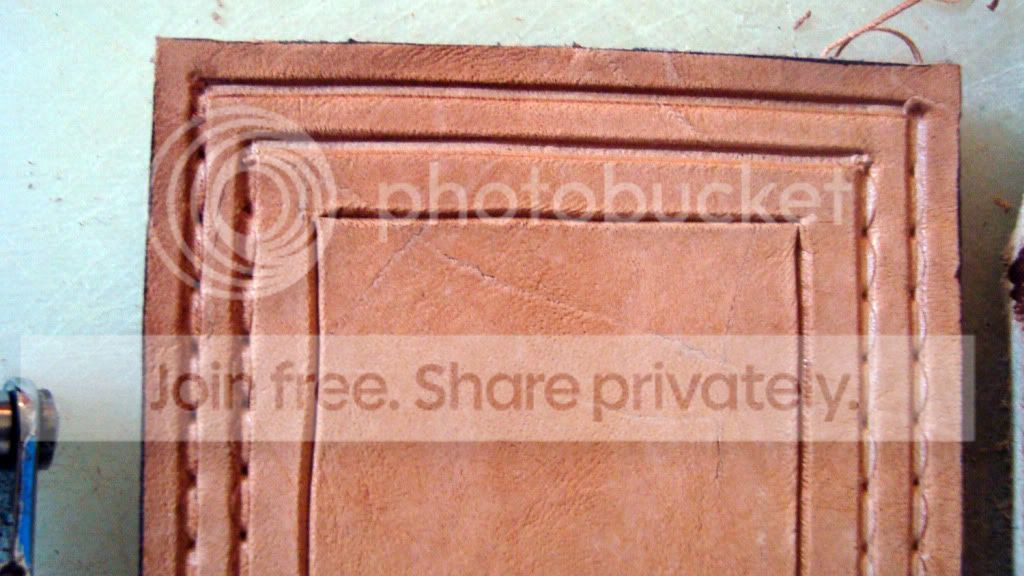
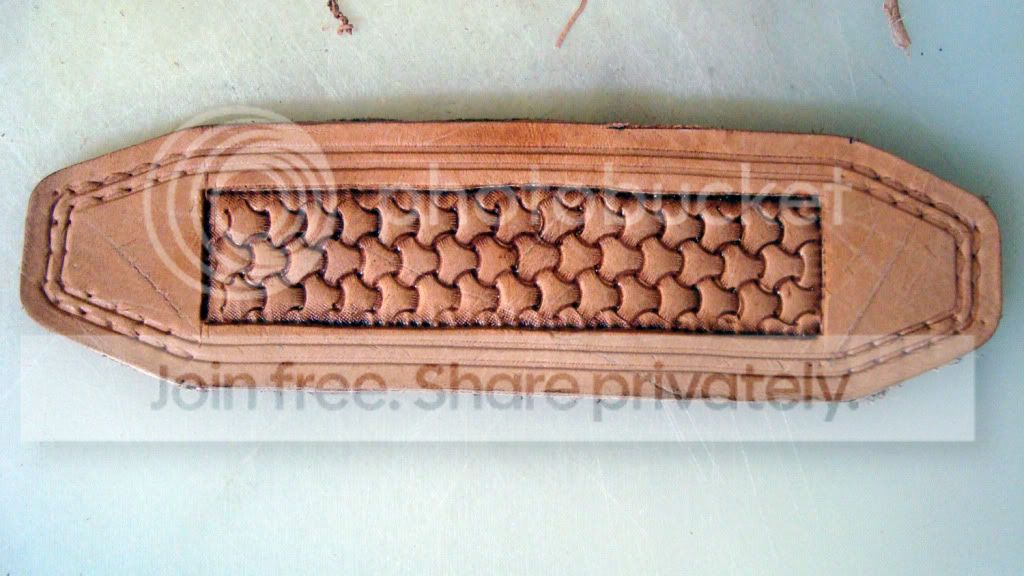
No handle work today, but I did go further on the sheath. The first thing I did was make the stitching grooves. I like the look of a double row of stitching so thats what I did. I measure the width of the welt and lay out my groove from that. My welt for this sheath is 12mm wide so the first groove is 4mm in from the edge, and the second is 8mm in from the edge.

DSC02724.jpg


Once I have the grooves as deep as I want them I use my stitch marker to mark out where my stitches pass through the leather.

DSC02726.jpg


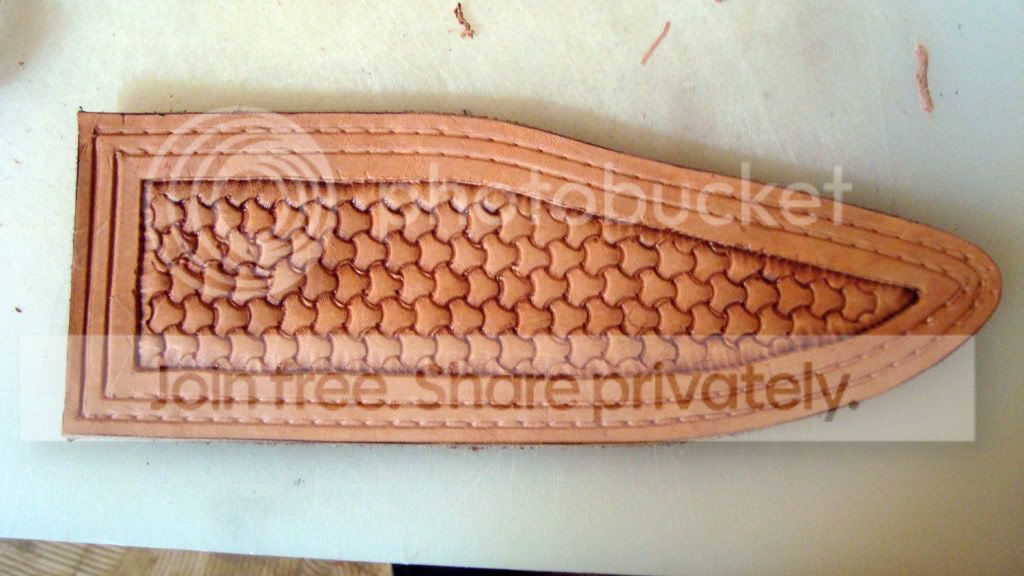
I once the stitches are marked out I decide just what I want to do, if anything, for tooling and carving. For this one it is just tooling, no real carving. I use my swivel knife to cut where the pattern will end and find the center of that space. I try to always start in the middle and work my way out from there, it sort of balances the pattern. I used what I call a tri-weave tool for this one. The only other tooling I did for this sheath is the belt loop, I did it to match the front.

DSC02728.jpg


DSC02727.jpg


Next I will slick the edges of the belt loop and dye it to its finished color. Then I will position it on the back side of the sheath mark the stitching holes and punch them through.

Thats about it for today, I am just not having a good day with my arms and they are throbbing like crazy:( What I will be doing to the sheath over the next couple of days, is punching the stitching holes through the front and welt together and then the back using the welt and front as a guide. When the holes are all in I will dye the inside of the sheath and slick down the flesh side a bit. once the dye has dried I will glue the sheath up and start stitching everything together. When done that I will clean up the over hang on the welt and back so they match the dimensions of the front and slick the edges. Once everything dries up I test fit the knife to the sheath to make sure I did everything right and if it passes I hit the sheath with a finish of some sort.

You will notice that I haven't mentioned any sort of knife retention yet, that is because I am still trying to decide on a snap or a post, but I am leaning towards a snap to cover up the little bit of messy tooling on the sheath:o

Advil and ice time.
 
Well I finished the sheath, but didn't finish taking pictures:o I just got too involved with what I was doing and forgot till it was all done. I haven't done any more work to the maple handle either. After yesterdays painfest at the hands of the doctor, my arm is just too sore to be pulling out the excess wood from the tang hole. I am still waiting for Canada Post to get off their butts and get my belts delivered, so that means I can't continue to try and grind out the alloy bands in the second knife. So what am I going to do with this unwanted down time? I am going to do some practice grinding on a paint stick.

I decided that I may as well kill two birds with one stone and try my first dagger and hollow grind all at once. A little ambitious? Yes probably, but its only a piece of free wood so all I ma loosing is a bit of time and right now I have too much of that

template.jpg


Working within the confines of the stir stick it is going to be 10 1/2" overall with a width of 1 1/16". I am unsure of the choil but what the heck, its a way to put some down time to good use.
 
Well that didn't take as long as I thought it would:( I did find out that doing a hollow grind in wood is fairly simple. Yes I have a bit (a lot) to work on, but once you have the grind established it is easy to stay in the groove and walk the grind line up. I do think this is going to feel completely different in steel. The only real problem I had was at the tip. I think that I got it figured out at the end, but the stir stick was just a little too flexible and would just bow under enough pressure for my worn 120g belt to cut.

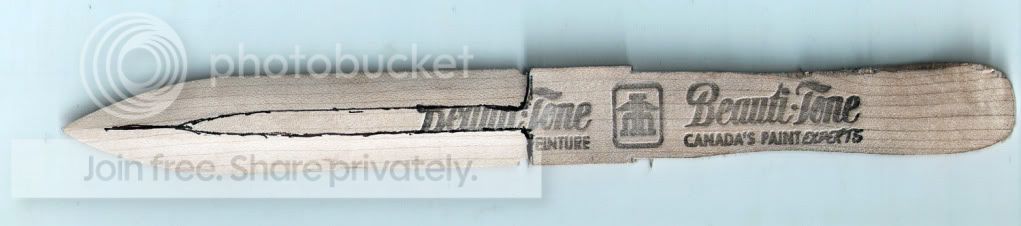
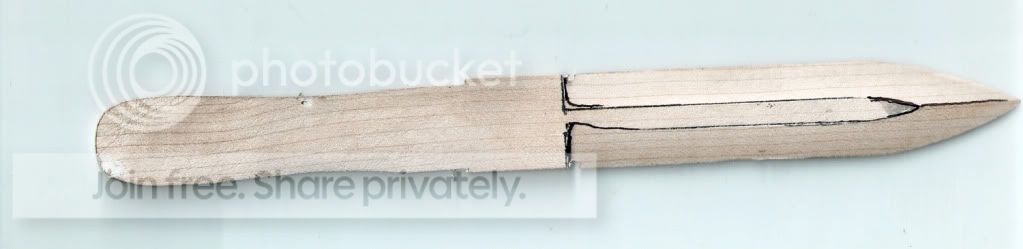
This is what I managed to do in the few minutes I was working on it.

scan0058.jpg


scan0057.jpg


Since the grind lines are hard to see I drew them in with a fine tip sharpie. In the top picture you can see that the bottom grind line is pretty good and stops as near center as could be expected for a first try. The top line on the other hand I leaned in a bit too much at the ricasso. I think if I was working with steel it wouldn't have been so bad and I could have corrected it before it gouged in too far. Now for the tip, you can see that my drawn in line doesn't go all the way to the end. Well that is because the line washes out at the end of the line. Also I loose the hollow grind in that area. I noticed that as I was coming to the tip the piece of wood would flex a fair amount and I think that could be the main culprit for the wash out and loss of hollow. Then again it could be the 8" wheel was just too big for the grind, its less than 1/2".

Side 2, The rocked grind line at the ricasso same as the first same side for me to grind on. I know this is completely my fault and why it happens, I have read all the tips I can find on it and am doing my best to correct it. Thing is it never looks this bad in steel. This is my strong side, and I think part of the blame can be put on my elbow and the injections I got yesterday, I just don't have full range of motion back in it yet and it hurts like the dickens. Practicing in wood really amplifies your mistakes, and I like that. It lets me know what I have to work on. Top grind line is darn near perfect to my marks, other than I didn't push all the way back to the plunge line. The tip stayed stronger and crisp on this side and and makes it almost all the way to the tip. I think that is because this was the side that got the ground first on the lower side. and third for the top side. Therefore it had more material, keeping it from flexing as much.

So there you have it, my first attempt at a hollow grind. I think I know what I have to do to correct my mistakes, and I have this little wooden thing to remind me when I try it in steel. I think that if my belt/steel order ever gets delivered I will try a hollow ground EDC so I only have to getting two grinds the same and not four. Well I am off to check the mail, with fingers crossed that there is something good there waiting for me. If not then I have to do the dishes and will sit around and do some more design work.
 
Thanks for sharing your progress! I forged a fighter a couple weeks ago, but every time I look at your WIP I get inspired to hammer out a big bowie...
 
I haven't forged anything yet thanks to my bad elbows:o I am going through Platelet Rich Plasma injection therapy right now to try and cure my chronic tennis elbow. If this doesn't work its a second surgery, and possible removal of the tendon altogether as I understand it. It would also mean a long road and lots of physio to recovery so that I could use my first two fingers independently again after the surgery. I could be wrong but as I understood what the doctor said is that they cut out the tendon and attach the muscle to the muscle next to it.

I should get my belt/steel order today and be able to get back to working on the second knife, and Canada Post "said" they are going to refund my shipping cost because they are so late in delivering. This will be my first run with ceramic belts and anything over 220g. I am also changing the handle material one the second knife from the bloodwood to black dyed redwood burl. I got a nice piec3e from Mark (aka Burlsource) at Its a Burl:thumbup: I will stick it in the sheath for the first knife and remake that sheath. I dyed the first sheath completely black thinking it would compliment the light handle, but the contrast was a bit much. Since all three knives are based of of the same blade the sheaths will be interchangeable:thumbup: and using a tip I got on finishing stabilized wood I really think polished black handle and shinny black sheath are going to be the better combination.

I have plans for the blood wood that involve the steel I have coming in today, fingers crossed. I rarely let things go to waste and if I can find a use for it it gets used. I am still wanting to do a folder or two, but I am also trying to find my style of knife making. Something that just flows out of me is usable and original all at the same time. I think I am getting there with the bowies, the long sweeping swedges and the rounded out clips speak to me, and has since I did my first knife with that profile.

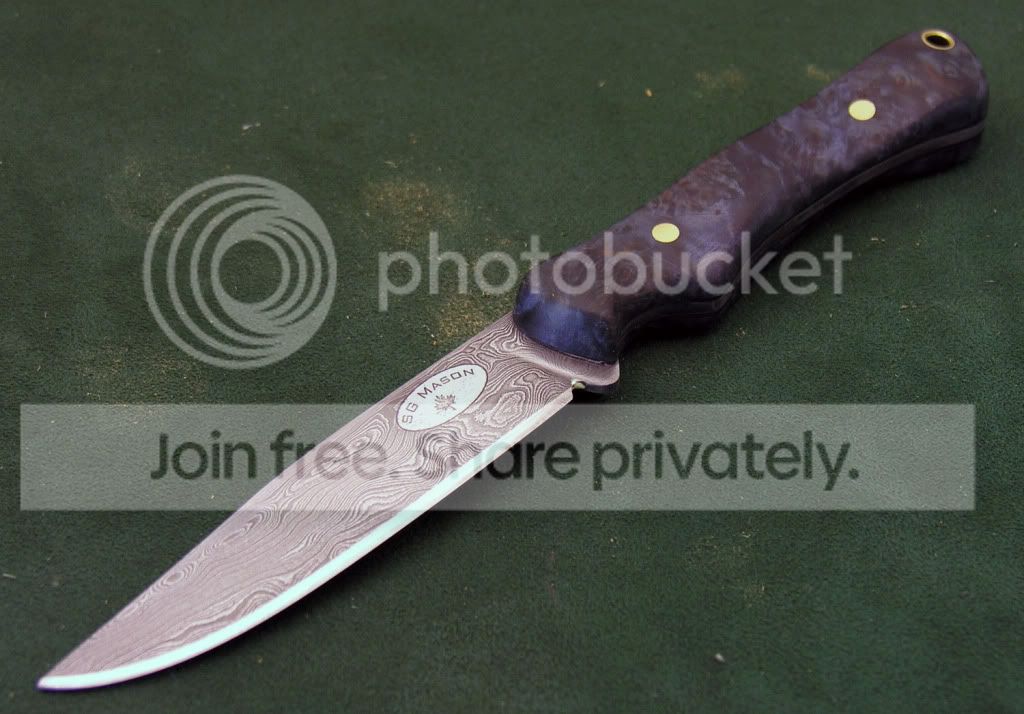
This was the first rounded clip knife I did

DSCN3502.jpg
 
Back
Top