440c Problem child or just misunderstood

.... If you read the link, you would see that the conclusion they expect the reader to come to is that fine grained steels are the optimal choice for most knives.

Yes...and that is because, as you yourself say, "...Most of their [Sandvik] knife steels appear to be what they call "fine-grained steel"."

So...a manufacturer claims their product is the best. I'm sold!

And they recommend against other manufacturers' product. Even more convincing!
 
440c is misunderstood, and/or under appreciated.

it's a better than most people will admit. as said already, it was the super steel at one time. that said i think all 440 steels have been given a bad rep across the board regardless of brand, etc. , due to chinese steels which weren't 440 anything, being called 440 and with poor heat treats and such in the past, and some still today. i think 440a if properly heat treated isn't all that bad. sure it's not for most folks on these boards, but for a regular person who wants something that cuts and takes an edge and sharpens easily, and resists rusting and staining. it's an okay choice. not the best, but not the worst. as usual ymmv......
 
440C is a GREAT steel. Funny that some people think lowly of it... that just means they've never tried it, I guess. It holds a very serviceable edge, is quite corrosion resistant, isn't that expensive, and is pretty easy to sharpen. It's along the lines of ATS-34 and 154CM in my experience.
In the mid 1990s, it was indeed considered a "super steel."
 
Yes...and that is because, as you yourself say, "...Most of their [Sandvik] knife steels appear to be what they call "fine-grained steel"."

So...a manufacturer claims their product is the best. I'm sold!

And they recommend against other manufacturers' product. Even more convincing!

Circumstantial ad hominem. You appear to be arguing that their claims are suspect because they want to sell products. However, ALL companies want to promote their products. This doesn't disprove their claims.
 
Circumstantial ad hominem. You appear to be arguing that their claims are suspect because they want to sell products. However, ALL companies want to promote their products. This doesn't disprove their claims.

Yes...I am arguing that. I never claimed to disprove their claims. I just don't take them on faith as fact, as you appear to. To each is own, I guess.
 
I don't recall 440C ever being considered a super steel. It's use goes back long before the term was coined. By the 90's it wasn't used all that often except by some custom makers, having been used then discarded by companies like Buck, and Gerber for one reason or another.

It has good wear resistance. Not great, but good. It has excellent corrosion resistance. It does not have good edge stability. You will find that out if you lower the angles and use it hard. It does not, and will never hold up like the smaller carbide steels when it comes to this.

It's an ok steel. Nothing super, or lousy about it with the exception of it's very good corrosion resistance. Other, newer steels do it better now. I prefer other steels to it but still have quite a few in 440C.

The new CTS-40CP powder steel 440C should help with the overly large grain structure and provide a modern, clean version of 440C. If 440C comes close to being a "super steel", it will likely be this version which should solve 440C's very real weaknesses.
 
Typically if a knife is stamped 440, then it is 440A. 440A is true high carbon martensitic stainless, if it comes from a reputable source. 440C is just a higher carbon version that costs more to work with. The higher costs stem from the fact that 440A can be stamped or blanked whereas 440C usually needs to be laser or waterjet cut. (Some companies have successfully blanked or stamped 440C in thin sections.) Our customers mark "440C" on their blades to make sure the end user knows what they are getting.
 
Yes...I am arguing that. I never claimed to disprove their claims. I just don't take them on faith as fact, as you appear to. To each is own, I guess.
The OP asked why 440C isn't used by custom makers much these days. I responded with a cite from Sandvik that says that coarse carbide steels excel at resisting wear but have generally have worse performance in other properties that are desirable in knife blades than other steels. Custom knife makers seem to prefer powder steels and according to Sandvik's comparison of the different types of steel, powder steels dominate coarse carbide steels. You took issue with this claim, saying, in effect, that Sandvik's claims about coarse carbide steels cannot be trusted as they are motivated by profits over the truth. Setting aside the fact that it is an ad hominem fallacy, I do not understand why this needed to be pointed out, even if it was not a fallacy. Sandvik does not make powder steels and, in fact, also makes their own coarse carbide steel. If they were truly motivated by profit, they probably would have excluded their fairly positive evaluation of powder steels from their comparison.

I do not think that I am believing their claims on faith. Although I have no formal education in metallurgy, their explanations appear to be reasonable. I would be very much interested if an expert could point out flaws in Sandvik's claims.
 
Some of my favorite knives have 440C blades in them. A lot of the cheap foreign imports would put 440 on their blades or 400 series trying to make people think it was the same as 440C. However 440 comes in more variety than 440C with the older versions being 440 a, b, or c if I remember correctly. I know there's more version's of 440 offered today. If I remember correctly 440c also used to be called "surgical grade steel" since they made a lot of surgical tools and scalpels from it. The 440C was considered the most durable of the three mentioned earlier, I think it's a great blade steel but 440 a or b to me is just not that great.
 
You took issue with this claim, saying, in effect, that Sandvik's claims about coarse carbide steels cannot be trusted as they are motivated by profits over the truth.

Bingo. You seem to like Latin...here's some more for you. Caveat emptor.
 
Lion Steel uses it too...in the daghetta at least. I got an itch to try that one out...
 
Those that think 440c is cheap, would probably never know the difference if they had S35VN stamped on their 440c blade... Heck, I'd bet most of us would never know the wiser.
 
Those that think 440c is cheap, would probably never know the difference if they had S35VN stamped on their 440c blade... Heck, I'd bet most of us would never know the wiser.
Depends on the heat treatment to be honest. Benchmade 440C might stick out like a sore thumb next to a Sebenza. Lionsteel and CRK might be closer. Custom heat treated 440C might perform even better. However, given that original S30V has even higher corrosion resistance than 440C, I could probably find out in a day by wiping my sweat on the blade.
 
1) Does Sanvik make 440C or steels that compete with 440C?
2) "Sharpness" has nothing to do with types of steel.
3) "..do not have poor performance in any relevant factors"? Any? Please. Sounds like pure marketing hype. Best steel ever!

Regarding the Sandvik claims, Verhoeven has drawn up nearly identical conclusions in many of his papers. I believe Roman Landes has as well. If anything, 13c26 or AEB-L is the plain boring timeless steel. It is the steel formulation that was used in Gillete blades about a century ago.
 
Lots of custom makers still use 440c. Thousands of older Bucks that have it are still out there doing what they always did! Even the newer Bucks with 420C will serve the hard user with satisfaction. I like feeling like I have the latest and greatest blade steel, But truth is, The properly heat treated 440C is tough to beat for ease of sharpening and holding an edge. I like a variety of steels. It depends on the end use of the blade.
 
Depends on the heat treatment to be honest. Benchmade 440C might stick out like a sore thumb next to a Sebenza. Lionsteel and CRK might be closer. Custom heat treated 440C might perform even better. However, given that original S30V has even higher corrosion resistance than 440C, I could probably find out in a day by wiping my sweat on the blade.

Ok, sure, I agree the heat treatment and tempering is key but is true for most steels. My Randall Mod #25 is 440c and has displayed excellent corrosion resistance and Ive lived near tbe ocean for a long time. I really dont agree tbat a little sweat wiped on properly heat treated 440c would create corrosion in one day.
 
I'm not a custom knife maker, but as a consumer, I equate 440C with cheap, low quality mass production knives from the likes of Pakistan. It may not always or even mostly true, but when I hear "440C," that's the voice in my head that you have to overcome. Say S30V, D2 or even 1095 and I hear other voices.

Much of the cr*p steel wasn't even 440C, it was stamped 440 implying it was 440C.
Nothing wrong with 440C and currently some bargains to be had thanks to peoples perceptions.

Most knife buyers, even those who consider themselves collectors, fail to differentiate between 440A, 440B, and 440C. They see "440" and think "oh it's 440C". The properties are significantly different.

According to Sandvik, coarse carbide steels like 440C have little to recommend them over other stainless steels due to comparatively poor sharpness, edge stability, and toughness. Powder steels may be more expensive, but do not have poor performance in any relevant factors, along with excellent wear resistance.

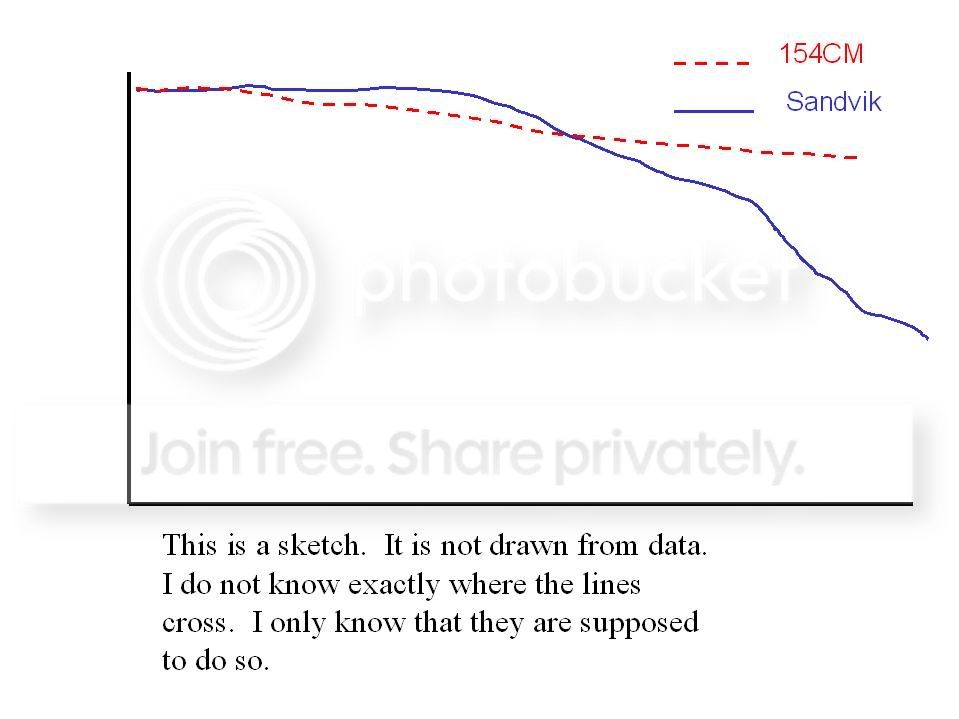
That depends on your paradigm. Some folks like an absolute razor edge and for that Sandvik's alloys are superb. The lack of carbides gives allows them to take an hold a razor edge exceedingly well.

Some others prefer longer edge retention and are willing to give a little in absolute sharpness to get it. For that 440C and PM steels excel far beyond what most of Sandvik's alloys will do. The carbides in 440C and PM steels give superior edge retention, though they do not hold an absolute razor edge as long.

Here is an illustration of my point. Hand drawn, not from specific data, but rather as an illustration my experiences with the various alloys:

Sandvikvs154sketch.jpg


Personally, because of the experiences I have had cutting various substrates with various alloys over a number of years, I prefer alloys with carbides. I find I don't need the razor edge as much as I need a blade that keeps on cutting. But that is my way of doing things. Others have other ways, which is to say, YMMV.
 
i read a lot of the positive and negative comments (some of which contradict each other... but I'm going to leave it there) that being the case, I've used 440c for quite a number of years now and I picked it over ats-34 and 154-cm because I read it has better corrosion resistence and less tendancy for the edge to chip out at harder RCs. I have found it to be an amazing steel when put through its paces... and I've used it hard! I'm not sure if maybe it's just that my guy does an amazing heat treat, my outstanding geometry (not likely) or the steel itself, however, I've managed to make some pretty phenominal combat/utility blades over the years. comparing apples to apples as it were, just using tests i've seen in magazines or on forums, I've managed to hammer my blades (and I mean hammer... sledge hammer in fact) through 4 -1/8 inch pieces of aluminum checker plate, batonned (with a 4' pry bar) through 8 inch curly maple logs and hacked all the way through a whitetail deer antler (it took a lot of hits) with no visible edge damage. i'm not sure what else I can throw at 440c, but I bet you would grit your teeth trying those "tests" with almost any other steel you were carring.
 
Back
Top