440c Problem child or just misunderstood

Regarding the Sandvik claims, Verhoeven has drawn up nearly identical conclusions in many of his papers. I believe Roman Landes has as well. If anything, 13c26 or AEB-L is the plain boring timeless steel. It is the steel formulation that was used in Gillete blades about a century ago.

Gillette razor blades were not stainless until Wilkinson introduced stainless blades in 1965. So Gillette blades rusted just fine, thank you, from 1901-1965.

440C was used extensively for surgical blades used by by cosmetic ("plastic") surgeons at Cleveland Clinic for many years. That calls for a finer edge than most of us will ever need. I guess Sandvik hadn't "educated" them yet that the scalpels they were using would not take a fine edge.

440C was also used for disposable razor blades and surgical scissors.

As to whether any steel is wonderful in a knife, that, of course, depends on heat treatment.
 
Last edited:
I made a mistake. Uddeholm supplied Gillette with steel from 1905, but only made AEB-L in 1928. Still, it is plenty old, and plenty plain and conventional. You could say it was a household steel for 40 years. That might be better than what you could say about 440c, maybe not.

Scalpels are used once before being disposed or resharpened. It literally only has to maintain sharpness for a few cuts at most. Scissors on the other hand are not subject to fine-edge wear. Find the nearest pair of shears and measure the angle on them. I can't speak for the sharpness of scalpels, but I know when it comes to importing steel, the compositional standards books apply all sorts of weird conversions to steel. The primary purpose of the designation surgical is that it can be easily sanitized, not that it is sharp enough to be a scalpel. 316 is a surgical steel. Also, 440C has often been used simply because of the ability to attain high hardness with normal heat treating, which is important to attaining a sharp scalpel-like edge. As far as I know, it is much harder to find 0.65c/13cr steel domestically in the US, or coming out of China than it is to find 440 grades.

The primary point of interest is that respected scientists in the field have drawn similar conclusions. Not whether or not company X made steel Y for company Z in whatever year. The only point of that was to show that 13c26 and AEB-L are indeed boring and time tested steels like 440c is being made out to be and your chronology doesn't disprove that.

The heat treatment can only be as good as the steel used. It is a fallacy to say a good knife only relies on good steel just as much as it is to say it relies on only a good heat treatment. That is to say, heat treatment is imporrtant, but one should not simply shrug off the differences in steel with the argument of heat treatment. The literature is not the same kind of hyping used on supersteels and CPMs.

 
Last edited:
I like 440C - and it is pretty close in formulation to a lot of better repped steels. I have a few Boker folders that I really like - the Exskelibur, for instance and the big broad blade Classic in green bone

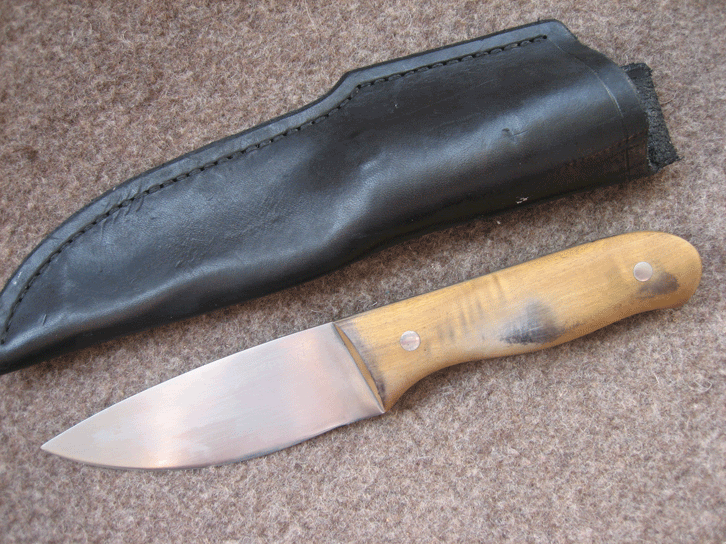
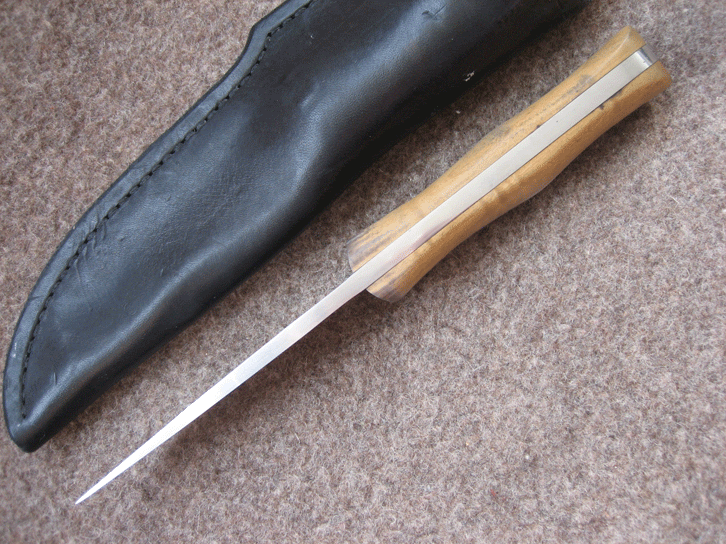
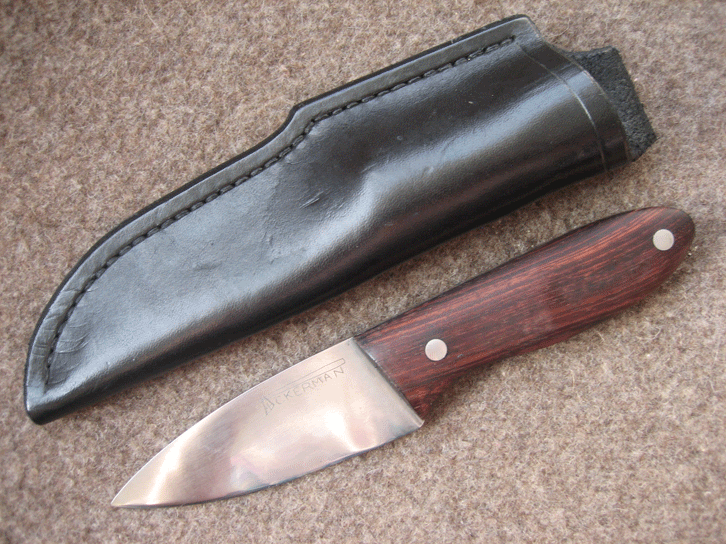
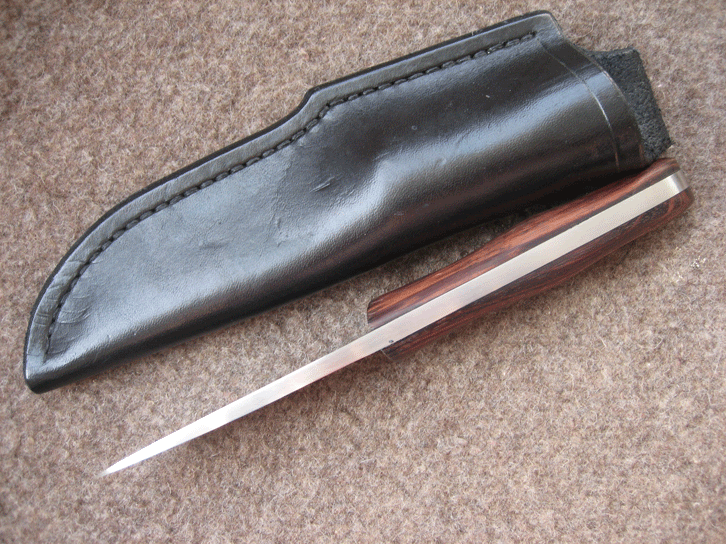
But here are two customs from Stuart Ackerman (NZ/SA) in investment cast 440C.

As you can see they are used quite a bit - and they are a bit special. The one with the sneezewood (blond) handle is about 4 1/2" in the blade. The one with the red (kingwood) handle has a 3 1/2" blade. The casts make billets of approximately 6mm when ground back

Thesehave lost their original etch in use - but it was really something to see. The crystal patterns are just amazing

Serrata-Large-Sneezewood-1.gif
Serrata-Large-Sneezewood-2.gif


Serrata-1.gif
Serrata-2.gif
 
This is true.440C is a true super steel.At least equal to 154cm or ats 34 imo.Of course it must be profiled and heat treated correctly.
Much of the cr*p steel wasn't even 440C, it was stamped 440 implying it was 440C.
Nothing wrong with 440C and currently some bargains to be had thanks to peoples perceptions.
 
I like 440C. I've got production stuff in it (mostly Benchmade) and at least one custom that gets regular usage (Hartsook Talon Lite).
 
There was a time (early 70's) when the only way knife makers could get 440 C was in round bars. I am told that Gill Hibben started out forging it and made some good knives.
 
Ok, sure, I agree the heat treatment and tempering is key but is true for most steels. My Randall Mod #25 is 440c and has displayed excellent corrosion resistance and Ive lived near tbe ocean for a long time. I really dont agree tbat a little sweat wiped on properly heat treated 440c would create corrosion in one day.
Of course, proper heat treatment and finish(very important) can affect corrosion resistance. However, for me it comes down to the potential of the steel. Professionally heat treated M390 will outperform professionally heat treated 440C. This is an inescapable physical fact. The potential of the steel means that while a good HT 440C can outperform S30V with a less than optimum HT, the steel with better potential will be a tier higher if both are given optimum heat treatment(relative to the task at hand).

That is why I would not opt to have a custom maker use 440C given alternatives. And yet, I feel equally as confident that a Randall can cut every bit as well as my CRK Umnumzaan, and would even expect it to be better all things considered. Yet all bets are off if we're going to consider the Randall against a Phil Wilson custom in S35VN.
 
Why settle for 440C today, when better performer alloy are readily available. On its own 440C might've been top notch 20-30 years ago, but not anymore.
 
Why settle for 440C today, when better performer alloy are readily available. On its own 440C might've been top notch 20-30 years ago, but not anymore.

Why pay more for a "better alloy" when for 99% of uses, 440C will do the exact same thing?
 
Why pay more for a "better alloy" when for 99% of uses, 440C will do the exact same thing?

Why pay for a car that has 150 horse powers, AC, assisted steering, and a cd player when this Indian low budget car can perform the same thing for 99% of users?

Because of comfort, style, enjoyment and just because you can.
 
Why pay more for a "better alloy" when for 99% of uses, 440C will do the exact same thing?

I don't understand this thought process. Are you being serious or joking?

Joe
 
The answer to the OP's question was already mentioned: 440C is out of fashion because of its pre-PM status. 440C itself offers different capabilities that not all modern powdersteels possess. What about rust resistance for example? The 440 steel family excels in this category. If you look for decent edge retention with rust resistance, relatively good machinability (compared to some PM steels) and a drawcut purpose for the blade, 440C is not a bad choice. A lot of tasks can be performed by this steel and in most cases it will not be outperformed by a PM steel in a way that reflects the price difference. Let's always remember that steel is only one component of a good blade, you also need the right geometry and heat treatment, which is a lot more difficult for high alloy PM steels. If you're looking for superior edge retention 440C is out of the question, of course, but 'better' is always relative, it depends on what you want or what you need.
 
Randall uses 440B,or used to,in their stainless blades.440C with a good heat treat works just fine for me.
 
I don't understand this thought process. Are you being serious or joking?

Joe

Why couldn't I be serious about it? Not everyone wants to spend massive amounts of money on knives and 440C is an excellent steel, a known quantity and quite capable in it's own right.
 
my car has 300hp and i still think 440c is a hell of a blade steel. i even asked a thread on this not that long ago, looking for a better "all round" stainless for a "hard use" knife and there were very few guys that would put their name on a steel to preform better in the field as a stainless under diffecult conditions than good old 440c.
 
Why pay more for a "better alloy" when for 99% of uses, 440C will do the exact same thing?
No it will not, 100% of the time(or uses) it is behind more modern, better performing alloys and the price difference is not that big actually. I guess it depends what do you mean under "use". If you refer to an ability to make a cut, then the same applies to 420, bronze, copper, flintstone and teeth too. No reason to spend money on 440C when the rest is available even cheaper.
Otherwise, in terms of efficiency(ability to hold thin edge) and edge holding it isn't gonna hold up.
 
I get the feeling that most custom knives are never actually used, so the edge holding performance of the steel is probably irrelevant. I was under the impression that many custom makes took a very favorable view of 440C because it took such an exceptional polish. 440C can certainly make a pretty, shiny blade that resists corrosion well.
 
Why couldn't I be serious about it? Not everyone wants to spend massive amounts of money on knives and 440C is an excellent steel, a known quantity and quite capable in it's own right.

For an experienced knife user that knows his knives and needs like you that's fine. The search for the next, higher performing "super steel" drives the industry and has been responsible for a lot of great knives and steels. Steels that aren't even cutlery steels but used for the plastics industry, industrial tooling, commercial cutlery needs, etc.

I lived through the cutlery industry's lethargic days of the 60's and 70's and I sure prefer the current, though admittedly unnecessary constant search for better we see now. The industry has changed for the better in many ways, and is much more dynamic. Still, for you who knows what they want and is satisfied with it there is nothing wrong with 440C. Me? Give me Elmax, M390, BG42, or a couple of dozen other stainless alloys anyday. They have much better performance in any of the 3 major categories and take better edges to top it off. Then there are my favorites, the non stainless cold work, and high speed steels.

By the way, 440C is a bearing steel for some applications where high temps and high pressures and wear aren't involved. When made cleanly and heated well it's a good steel for cutlery. It's just not in my top 20 list for stainless alloys.

Joe
 
Randall uses 440B,or used to,in their stainless blades.440C with a good heat treat works just fine for me.

Actually, Randall told me that they use both B&C, depending on what stock is available at the time but they are both treated the same. This is why they simply say ”stainless steel” and dont really specify in their advertising.

I am not claiming that 440 b/c is better or worse than a modern super steel such as s35vn or any others, just that it is a good steel when treated correctly and if purchased from a quality company like Benchmade or others, it is just fine and not inferior. To the OP, I would say - Just misunderstood.
 
Back
Top